Save the Cheerleader, Save the World: Girls, media and leadership in the 21st century

Fellow sci-fi fans may remember the TV series Heroes, in which ordinary people develop superpowers. Their mission centres on one character, Claire Bennet, a high-school cheerleader with the power to regenerate herself. The superheroes’ mantra is, ‘Save the cheerleader, save the world’.

Claire’s precise role in world-saving I can’t explain, because I stopped watching (along with most of the rest of the audience) before the seasons played out, but the mantra stayed with me. Claire Bennet came to mind as I began to think about my latest research exploring girls and leadership, because she embodies so many of the qualities of the successful girl discourse – a discourse that, like her, is proving remarkably resilient.

Saving the world (market)

In similar fashion to the ways girls are seen as the key to advancing progress in developing countries, girls in the global North are an increasing focus of attention as the solution to gendered inequalities in decision-making roles. Pre-loaded with girl-power and post-feminist narratives of women’s success in making change, the ‘can-do’ girl of the affluent West is tasked with the mission of saving the world through taking charge of it.  At the same time as The European Commission and The World Economic Forum are raising concerns about the slow progress toward gender equity in power, calls are being made, post global economic crash, for more ethical, careful and connected forms of leadership to avert future disasters of a similar nature. These forms of leadership are popularly gendered as female, as for example in the Lehman Sisters hypothesis. Both political and corporate discourses are thus coalescing around girls as the potential leaders who can deliver a more equal and therefore more secure future. In short, to avert disaster the free market looks to the fearless girl rather than to regulation.

Saving the cheerleader

A quick search of Twitter throws up programmes, websites, and motivational speakers galore all promising to empower girls and develop their capacity for leadership. Among the most prominent is Ban Bossy, which extends Sheryl Sandberg’s Lean In corporate feminism to address girls through mobilising celebrities and providing advice and resources to encourage leadership aspirations. The model of leadership it offers reproduces and revivifies some of the central tenets of neoliberal postfeminisms with its emphasis on self-regulation, its focus on individual and capitalist solutions to gender inequalities, and its privileging of entrepreneurship. ‘Change the world!’ the Ban Bossy Leadership Tips for Girls brochure advises, because ‘running a campaign gives you amazing practice for speaking and marketing yourself as a leader’.

While under neoliberal governmentality female citizenship is redefined and redirected away from political participation and towards self-actualisation through consumer citizenship, girls’ leadership campaigns do focus on addressing gendered inequalities through developing a public role; however, the inequalities are represented as barriers to personal ambition rather than as social ills in themselves. As such they are surmountable through the development of skills in self-sufficiency, networking and public speaking. The kind of agency girls’ leadership campaigns promise is not equally accessible to all; like many aspirational discourses aimed at young women, it exhorts girls to believe in themselves and to work hard, offering the promise that they can achieve their goals with sufficient commitment and by creating an attractively branded self. As well as a glossing over of structural barriers, there is a lacuna in popular girls’ leadership promotions where strategies for fostering solidarity, collectivism and activism should appear in order to address them. The girl leader fit for salvation here is Grainne McMahon’s good ambassador, not her shadow twin, the angry activist.

I’m with her

Power, as Mary Beard has noted, is “an elite thing, coupled to public prestige, to the individual charisma of so-called ‘leadership’, and often, though not always, to a degree of celebrity”. It is this relationship with visibility and celebrity that is foregrounded in interventions around girls and leadership. Hillary Clinton framed her 2016 presidential campaign as an exercise in girl-empowerment; Beyoncé, Alicia Keys and Michelle Obama are pledging to Ban Bossy, while here in the UK, Edwina Dunn’s The Female Lead project has produced a glossy book of 60 ‘amazing women from around the world’ pitched at schools. It could be argued that projects like Dunn’s and Sandberg’s are long overdue – a recent study for the World Association of Girls Guides and Girl Scouts (WAGGGS) suggests that girls struggle to name female leaders they admire, and that they are far more likely to identify men as successful leaders.  Access to role models is popularly held to be the key to the development of girls’ leadership aspirations. However, the holding up of celebrities and highly visible role models as the answer to overcoming barriers to leadership for girls is problematic. Young people are consistently instructed that they should not base their aspirations around celebrities. Even when celebrity role models are offered to them, the ways in which girls are expected to admire such models is heavily policed within celebrity discourse itself.

Celebrity aside, the incentives to developing a visible role/public voice in terms of leadership for girls are scant – we are witnessing a rise in public misogyny particularly directed at women politicians and campaigners, especially BME women, on social media.

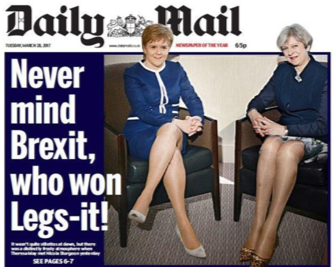
At the same time, traditional media sources continue represent women leaders in demeaning, diminishing and stereotyped ways – by coincidence, as I start to write this blog with BBC Radio 4’s flagship Today news programme on in the background, the (male) presenter describes the (female) prime minister’s Brexit negotiating tactics as ‘showing a bit of leg’. The (male) politician being interviewed responds without raising objection.

The research

In this project, together with my colleague Hannah Yelin, I seek to gain understanding of l the gendered nature of popular discourses of leadership, to explore girls’ engagements with highly visible women leaders in global media texts, and to gain insight into how these relate to their own ideas, identities, experiences, and imagined futures.  I am undertaking the first phase this autumn, with the support of the GEA. This involves conducting a series of group interview/workshops in schools across England with girls aged 14-15. Participants will discuss ideas about leadership, and then go on to create digital social media collages in dedicated closed groups. These collages will form a visual archive for later comparison in wider European settings.

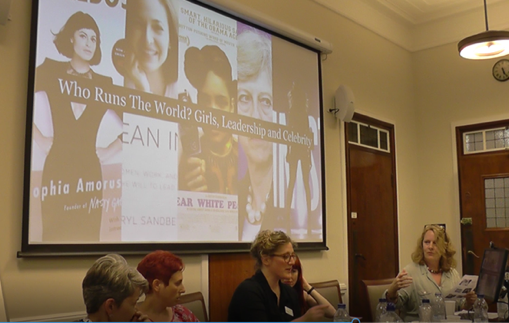
We launched the project with an event this summer: Who Runs the World? Girls, Celebrity and Leadership, where we had brilliant papers from Heather Mendick,  Janet Batsleer & Grainne McMahon, and Anita Biressi followed by a lively roundtable. As well as sharing some initial findings on the GEA site, we will be holding a public engagement event in 2018 exploring some of the implications. To find out more about the project contact Michele Paule.

Thoughtful Gatherings: Guest Post by Emily F. Henderson and James Burford

Thoughtful gatherings: gendering conferences as spaces of learning, knowledge production and community

Guest Editors

Emily F. Henderson, Warwick University

James Burford, Thammasat University

While conferences are a ubiquitous feature of academic work and represent a billion-dollar global industry, they rarely take centre stage in their own right as objects of educational inquiry. This is despite the fact that conferences, understood as spaces where learning can/should happen, can be subject to pedagogical analysis. This absence is consistent across explicitly feminist conferences, which is surprising given the decades of debate about feminist and gender pedagogy. Many questions remain about how delegates learn at conferences, the kinds of environments that support conference learning, and the pedagogical intentions of conference organisers and presenters.

Conferences are also important sites for knowledge dissemination and creation; ideas are developed and theoretical trends are set. Conferences are sites of embodied knowledge production, and as such academic hierarchies play out in full view. Furthermore, these questions are inflected by debates about situated knowledge production, and inequalities in global academia. Conferences often aim to be international in scope, but the travel that they require is exclusionary for a number of reasons—including border politics and boycotts, economic disparity, precarity, and caring responsibilities.

At conferences, collaborative relationships and friendships—and rivalries—develop. Yet analyses of the social, familial and sometimes erotic dimensions of conferences remains limited. Of particular relevance to the role of conferences in the development of feminist and gender research is the blurring of academic-activist boundaries. Yet where there is community, there are also issues of belonging, membership and exclusion. For example, how do conference spaces establish codes of in/appropriate gender presentation? How do conference spaces, particularly those held in the knowledge production ‘centre’ of the Global North, promote the inclusion of academic participants from the Global South?

The special issue explores the intersection between conferences, education and gender in relation to three key themes: (i) learning, (ii) knowledge and (iii) community, and is anticipated to appear in print in mid-2019. We hope the special issue is an exhortation to scholars in the field of gender and education and beyond to ‘gather their thoughts’ about conferences.

Please see the full Call for Papers here.

Abstracts are due by 5 February 2018. Please send abstracts and inquiries to Emily F. Henderson (e.henderson@warwick.ac.uk) and James Burford (jburford@tu.ac.th). Please note that selected authors will be invited, on the strength of their abstract, to submit a full-length manuscript by 2 April 2018. The guest editors are happy to discuss ideas prior to the deadline. We anticipate that the special issue will appear in print in mid-2019.

Call for Papers for a Special Issue of Gender and Education: Thoughtful Gatherings

Thoughtful gatherings: gendering conferences as spaces of learning, knowledge production and community

Special Issue Guest Editors: Emily F. Henderson & James Burford

Conferences are an important but neglected research area. While they are a ubiquitous feature of academic work and represent a billion-dollar global industry, conferences rarely take centre stage in their own right as objects of inquiry (Henderson, 2015). There is a clear dearth of academic analysis of conferences in general, and gender, feminist and queer analysis in particular. Arguably this lacuna is due to widespread ambivalence about the value of conferences, a sentiment which is shared across formal and informal academic spaces alike. This special issue, anticipated to appear in print in mid-2019, is an exhortation to scholars in the field of gender and education and beyond to ‘gather their thoughts’ about conferences. The special issue explores the intersection between conferences, education and gender in relation to three key themes: (i) learning, (ii) knowledge and (iii) community. Contributions to the special issue should address the key themes in accordance with Gender and Education’s focus on international scholarship, which is especially pertinent given the role of conferences in uniting—and perpetuating the exclusion of—international scholarly communities.

Themes

(i) Learning

Conferences, understood as educational spaces where learning can/should happen, are rarely subjected to analyses of their pedagogical practice. This absence is consistent across explicitly feminist conferences (exceptions include Bell, 1987; Saul, 1992; Stanley, 1995), which is surprising given the decades of debate about feminist and gender pedagogy. Many questions remain about how delegates learn at conferences, the kinds of environments that support conference learning, and the pedagogical intentions of conference organisers and presenters.

Potential topics for this theme:

  • Analyses of conferences as educational spaces, including posters, virtual conferences and social media use, which draw upon gender/queer/feminist theories.
  • Analyses of the teaching and learning at explicitly gender/feminist-oriented conferences, including alternative conference pedagogies, trigger-warnings and no-platforming.
  • Ways in which conference pedagogies contribute to in/accessibility for reasons of geopolitics or caring responsibilities, for example, and how conference pedagogy mediates the experiences of those who face exclusions/discrimination.
  • Critical engagement with the pedagogy of informal conference spaces, including organised socials and entertainment, and the social/(un)professional learning which plays out at conferences.

(ii) Knowledge production

Conferences are important sites for knowledge dissemination and creation; ideas are developed and theoretical trends are set. Conferences are sites of embodied knowledge production, and as such academic hierarchies play out in full view (Lewis, 2013; Jones et al., 2014). Furthermore, these questions are inflected by debates about situated knowledge production, and inequalities in global academia. Conferences often aim to be international in scope, but the travel that they require is exclusionary for a number of reasons—including border politics and boycotts, economic disparity, precarity, and caring responsibilities. This theme addresses the production of knowledge about gender at conferences, and the gendered construct of knowledge producer.

Potential topics for this theme:

  • Analyses of conference knowledge production, using gender, feminist and queer theoretical tools.
  • Analyses of the reception of gender knowledge at conferences, including STEM conferences and conferences not designated as ‘gender’ conferences, and including historical accounts.
  • Feminist-postcolonial and decolonial analyses of conferences, including questions of language, funding, boycotts and border politics, and ‘peripheral’ knowledge projects.
  • Intersectional analyses of gendered knowledge producers/conference participants.
  • Sexism, misogyny, sexual harassment and microaggressions at conferences (Shen, 2012).

(iii) Community

Historically, conferences have been important spaces for building feminist solidarity, friendship and careers. At conferences, collaborative relationships and friendships—and rivalries—develop; this theme invites analyses of the social, familial and sometimes erotic dimensions of conferences. Of particular relevance to the role of conferences in the development of feminist and gender research is the blurring of academic-activist boundaries. Yet where there is community, there are also issues of belonging, membership and exclusion (Hodge, 2014). This theme therefore also addresses the underside of conference communities. For example, how do conference spaces, and their use by delegates, establish codes of in/appropriate gender presentation? How do conference spaces, particularly those held in the knowledge production ‘centre’ of the Global North, promote the inclusion of academic participants from the Global South?

Potential topics for this theme:

  • The role of conference communities in the development of the gender research field/s.
  • The presence of activism, advocacy, and NGOs at gender and feminist academic conferences, and the role of gender academics in activist and civil society conferences.
  • Conferences as spaces of collegiality, solidarity, community, friendship or kinship, including intergenerational considerations.
  • The relationship between community and conference learning and knowledge production.
  • Issues of belonging and membership—and exclusion, such as geographical location, precarity, and the experiences of doctoral, adjunct and early career researchers within conference communities.
  • Inclusive conferencing practice and hospitality in relation to intersectionality and care.

Information for contributors

The special issue seeks a mixture of conceptual/theoretical and/or empirical papers. Papers which engage with methodological debates and challenges will be welcomed, as will uses of creative research strategies. We invite authors from across the globe to submit abstracts, and especially welcome proposals for contributions from underrepresented and marginalised groups.

All submission proposals should: demonstrate a focus on conferences; clearly address at least one of the three key themes; use theories/conceptual tools relating to gender, feminism and/or queer studies; appeal to an international audience; take an inclusive perspective in terms of intersectionality.

Proposals should be for original works not previously published (including in conference proceedings) that are not currently under consideration for another journal or edited collection. Formats for proposals include full-length papers (5000-8000 words) or ‘Viewpoint’ pieces (3000-5000 words). See the journal’s full Instructions for Authors here for further information.

Proposals should include:

  • the article title
  • an abstract of 350 words maximum (not including references)
  • author name/s, affiliation/s and a contact email address.

Abstracts are due by 5 February 2018. Please send abstracts and inquiries to Emily F. Henderson (e.henderson@warwick.ac.uk) and James Burford (jburford@tu.ac.th). Please note that selected authors will be invited, on the strength of their abstract, to submit a full-length manuscript by 2 April 2018. The guest editors are happy to discuss ideas prior to the deadline. We anticipate that the special issue will appear in print in mid-2019.

References

Ahmed, S. (2012). On being included: Racism and diversity in institutional life. Durham: Duke University Press.

Bell, L. (1987). Hearing all our voices: Applications of feminist pedagogy to conferences, speeches and panel presentations. Women’s Studies Quarterly, 15(3-4), 74-80.

Henderson, E. F. (2015). Academic conferences: Representative and resistant sites for higher education research. Higher Education Research & Development, 34(5), 914-925.

Hodge, N. (2014). Unruly bodies at conference, Disability & Society, 29(4), 655-658.

Jones, T. M., Fanson, K. V., Lanfear, R., Symonds, M. R. E. and Higgie, M. (2014). ‘Gender differences in conference presentations: a consequence of self-selection?’. PeerJ, 1-15.

Lewis, G. (2013). ‘Unsafe Travel: Experiencing Intersectionality and Feminist Displacements’. Signs, 38 (4), 869-892.

Saul, J. (1992). Planning a women’s studies conference. Feminist Teacher, 7(1), 22-25.

Shen, H. (2012). Scientific groups revisit sexual harassment policies. Nature. doi:10.1038/nature.2015.18790

Stanley, J. (1995). ‘Pain(t) for healing: the academic conference and the classed/embodied self’. In V. Walsh and L. Morley (Eds), Feminist academics : creative agents for change (pp. 169-182). London: Taylor & Francis.

#MeToo

When I was 13, I took a train to Birmingham with a friend. The train conductor came to inspect our tickets, before handing them back he lifted up our t-shirts and stamped our belly buttons. He returned to the driver’s cabin, laughing.

This and many other memories of bodily intrusions have been on my mind this week as the words ‘me too’ reverberated across social media.

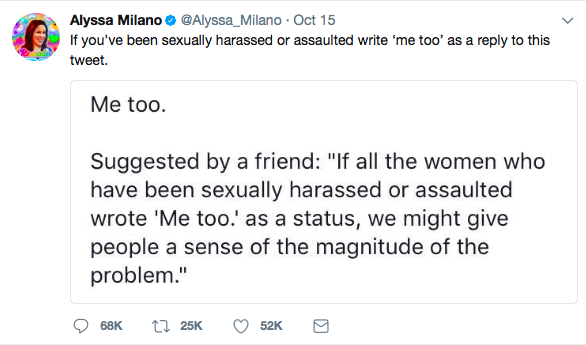
In response to growing reports of Harvey Weinstein’s sexual predation, actress Alyssa Milano tweeted, “Suggested by a friend: If all the women who have been sexually harassed or assaulted wrote ‘Me too’ as a status, we might give people a sense of the magnitude of the problem.” Since Sunday friends, family, colleagues and acquaintances (mostly women and non-binary people) have been sharing their stories of being groped, grabbed, leered at, cornered, flashed, stalked, violated, raped.

Me too. These words have a history.

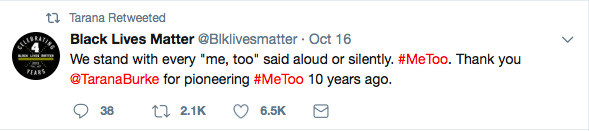
In 2006 Tarana Burke founded the ‘me too’ movement to aid survivors, particularly young women of colour, in communities where sexual assault services were under-resourced or non-existent. In a statement about ‘me too’ Burke told Ebony Magazine, “it was a catchphrase to be used from survivor to survivor to let folks know that they were not alone and that a movement for radical healing was happening and possible.”

In the aftermath of renewed discussions about sexual assault in Hollywood, the words have picked up pace as a feminist hashtag. #MeToo has sparked conversations and connections, opened up wounds, been left unspoken but nevertheless felt and incited anger and frustration.

A growing body of literature documents how feminist hashtags can provide ‘comforting solidarities and connections between strangers’, as well as entry points to wider feminist communities (Keller, Mendes and Ringrose 2016, p. 12; Williams 2015). However, they can also draw upon, and rearticulate, long-standing inequalities within feminist activism (Khoja-Moolji 2015). For example, the initial credit given to Milano rather than Burke for #MeToo perpetuated the diminishment of black women’s experiences and work within feminism (Hill 2017).

Like others (see here, here, here), I questioned what the hashtag was doing and who it was for. I wondered why the onus was on women to reveal their pain and worried about friends who had shared raw experiences. At times it felt blasé to me – ‘of course we’ve all been sexually harassed and/or assaulted, who is this news to?!’ At others I felt angry as close male friends fumbled their attempts to acknowledge the problem – ‘How do you still not get it?!’

Before I had the words to describe how sexism shaped my world, I had many ‘me too’ moments with girl friends. Conversations that, as Sara Ahmed notes, can act as a ‘drip, drip’ and eventually a flood as you connect your experience with the experience of others (Ahmed 2017, p. 30). I have epic friendships built on this ‘releasing of the pressure valve’ (Ahmed 2017, p. 30). Most notably my best friend Tari with whom a friendship began 13 years ago over shared experiences of ‘coming out’: for her as a mixed race woman, for me as a lesbian.

Of course, ‘women may have common situations and experiences, but they are not, in anyway way, the same’ (Braidotti 2011, p. 156).

This week Tari’s #MeToo post drew attention to the fact that the world has never really respected and understood her body as her own. Her rights to bodily autonomy have been impeded not only by the men who’ve assaulted her, but the women and men who have touched her hair without permission or shouted ‘afro!’ at her in the street.

In my #MeToo post I nodded to the fact that my most recent experiences of sexual harassment have been from men on the gay scene (Tari has also experienced this). Men who tickled my crotch as they walked past me or squeezed my boob, acts that both intimidated and made me feel unwelcome in a space that was supposed to be safe.

The phrase ‘Me Too’ works as a refrain, to draw on Deleuze and Guattari’s (1987) concept, a scoring over of the world’s repetitions, that marks and expresses territories (Youngblood Jackson 2016). Its recurrence weaves together communities of solidarity and simultaneously maps the persistence over time of the sexual violence that elicits it. Each utterance is different from the other, branching off and connecting territories; what we call ‘patriarchy’, ‘misogyny’, ‘heteronormativity’, ‘racism’ or ‘white privilege’. These deeply entrenched territories are marked out by repeating forces of domination and control.

Me Too. These two little words channel the enduring felt force of subjugating systems, the ways they minimize and diminish us. Yet, they also exceed these systems. Me Too.

With each repetition, the ‘refrain becomes more and more mobile, going somewhere – destination unknown’ (Youngblood Jackson 2016, p. 20). Bertelson and Murphie (2010, p.145) remind us that refrains are ‘not just closures but openings to possible change’. With this in mind, I want to end by considering how the intensified situation of a feminist hashtag might be put to work in schools. How might we harness the energy of #MeToo in a way that enables young people to safely and creatively challenge gender inequalities and oppressive gender norms?

——————–

Gender Equality Leadership in Schools (GELS)

Hosted by the Gender and Education Association, GELS helps educators and young people raise awareness of and address gender inequalities. One way in which this work is being taken up in schools is through student-led feminist clubs. Hanna Retallack, an intersectional feminist teacher and researcher, notes that these collectives provide vital space for young people to ‘discuss the issues denied to them by the curriculum’, including the ‘intersectional inequalities that lie at the root of sexual violence and harassment, as well as the structural injustices affecting them both personally and politically’ (Retallack 2016, para 7).

AGENDA: A Young People’s Guide to Making Positive Relationships Matter

Calling out sexual and gender inequalities is not without risk. Utilising the powerful potential of creative methods, such as the visual arts, poetry & theatre, can enable young people to make the personal political without revealing too much of themselves. The interactive Welsh tool-kit AGENDA is packed full of inspiring art-activisms that can help young people engage with all too frequently silenced issues. Developed by Professor Emma Renold and young people in Wales, the toolkit has equality, diversity, children’s rights and social justice at its heart.

Do you have thoughts about the pedagogical potential of hashtag feminism in educational institutions? Consider writing us a blog, we’d love to keep this discussion going.

References

Ahmed, S. 2017. Living a Feminist Life. Durham: Duke University Press.

Bertelson, L. and Murphie, A. 2010. An ethics of everyday infinities and powers: Felix Guattari on Affect and the Refrain. In: Gregg, M. and Seigworth, G. (eds). 2010. The Affect Theory Reader. Durham: Duke University Press.

Braidotti, R. 2011. Nomadic Subjects: Embodiment and Sexual Difference in Contemporary Feminist Theory. New Yor: Columbia University Press.

Deleuze, G. and Guattari, F. 1987. A Thousand Plateaus: Capitalism and Schizophrenia. London: Bloomsbury Academic.

Keller, J., Mendes, K., and Ringrose, J. 2016. Speaking ‘unspeakable things’: documenting digital feminist responses to rape culture. Journal of Gender Studies [Online]. Available at: http://dx.doi.org/10.1080/09589236.2016.1211511 [Accessed 20 August 2016].

Khoja-Moolji, S. 2015. Becoming an “Intimate Publics”: Exploring the Affective Intensities of Hashtag Feminism. Feminist Media Studies 15(2), pp. 347 – 350.

Williams, S. 2015. Digital Defense: Black feminists resist violence with hashtag activism. Feminist Media Studies 15(2), pp. 341 – 344.

Youngblood Jackson, A. 2016. Potentializing a Deleuzian Refrain. Departures in Critical Qualitative Research 5(4), pp. 20 – 23.

#FEAS Cite Club: Decolonizing ‘place’ in early childhood studies

Cite Club: Decolonizing ‘place’ in early childhood studies

Feminist Educators Against Sexism (#FEAS) are an Australian-based, international feminist collective committed to developing interventions into sexism in the academy and other educational spaces. One of their most recent interventions is Cite Club, an e-mail group where #FEAS send their works to one another and cite one another where possible. As part of our ongoing collaboration with #FEAS, each month GEA profiles a Cite Club publication on this blog. August’s Cite Club features a paper by Dr Fikile Nxumalo and Dr Stacia Cedillo at The University of Texas, USA. It is one of three publications co-authored or authored by Dr Nxumalo in this months Cite Club.

Decolonizing ‘place’ in early childhood studies: Thinking with Indigenous onto-epistemologies and Black feminist geographies

To cite this article:

Nxumalo, F. & Cedillo, S. (2017). Decolonizing ‘place’ in early childhood studies: Thinking with Indigenous onto-epistemologies and Black feminist geographies. Global Studies of Childhood, 7(2), 99-112.  https://doi.org/10.1177/2043610617703831

Outdoor education programmes, such as forest schools, are attracting growing interest in North America. Whilst the reasons for these programmes are varied, Nxumalo and Cedillo note a shared investment in idealised and romanticised notions of nature and childhood (p. 100). Seeking to unsettle EuroWestern perspectives that position children and nature as separate but belonging together as sites of innocence, the authors bring much needed politicized attention to place in early year’s environmental education. Specifically, they center Indigenous onto-epistemologies and Black feminist geographies in considerations of place, environment, and ‘nature’ in childhood studies.

The authors begin by outlining dominant approaches to knowledge-making in place-based and environmental education with young children. They demonstrate how modernist, colonial perspectives on nature as ‘mute, pure and separate’ persist through such education programmes, which often side-step the ‘colonial, raced, and gendered politics impacting accessibility and affordability of outdoor education’ (p. 101).

Nxumalo and Cedillo consider the need to pay attention to Indigenous relational presences, Indigenous onto-epistemologies, and past–present land histories when conceptualizing place within ongoing settler colonial contexts. Specifically, they address how childhood studies might ‘engage with specific places as storied Indigenous land, foregrounding specific Indigenous knowledges and place relations where both human and more-than-human actors participate in the storying of places’ (p. 100). In doing so, they remain mindful of superficial engagements with Indigenous knowledge: noting the diversity of Indigenous relationships to land. They also explore the challenges of ‘conceptualizing pedagogies of place that trouble ongoing settler colonialisms through histories and stories without appropriating or “museumifying” Indigenous knowledges’ (p. 104). Staying with these tensions, the authors nevertheless argue for the potential of Indigenous place stories to unsettle settler colonial relations to place in early childhood research and pedagogical contexts.

The authors also attend to the potentialities of Black feminist geographies for enacting anti-colonial and anti-racist place-based childhood research and practice. Challenging dominant deficit depictions of Black land stories and relations, Nxumalo and Cedillo draw on a range of Black feminist geographies to demonstrate that experiences of Black geography cannot be ‘contained within stories of damaged place relations, surveillance, and absenting’ (p. 106). Black feminist geographies ‘bring important complexity to understandings of North American Black relations to place’ without erasing the enduring violences of past-present planation histories (pp. 105 – 106).

Bringing Black feminist geographies into conversation with environmental early childhood studies, the authors consider: ‘what kinds of pedagogies might trouble “Black narratives of un-belonging” (McKittrick, 2002, p. 28) and erasures in certain places?’ (p. 106); ‘What might emerge from seeking out immigrant and Black land stories with children?’ (p. 106); and how might creative interventions offer ‘another form of (re)storying places in ways that disrupt Black placelessness’ (p. 106). With each question they offer examples of current practices, such as the Black/Land Project, from which educators may draw inspiration.

In the final section of the paper Nxumalo and Cedillo consider how Indigenous onto-epistemologies and Black feminist geographies might “walk alongside” (Sundberg, 2014) considerations of human/non-human and nature/culture entanglements in post-human geographies (p. 100). Whilst the troubling of nature/culture dualisms in posthuman geographies resonates with the aforementioned perspectives, post-humanisms have been critiqued for their ‘presumptive universalization of the human/non-human or nature/culture divide and consequent erasure of relational Indigenous onto-epistemologies’ (pp. 107 – 108). Furthermore, it has been argued that these theories are taken up in ways that ‘inadvertently reinstate transcendentalist Eurocentrism’ by leaving the ‘racialized ordering within the normative “human”’ largely unexamined (pp. 107 – 108).

Acknowledging the fractures between Indigenous onto-epistemologies, Black feminist geographies and posthuman geographies, Nxumalo and Cedillo nonetheless argue that together these perspectives help subvert ‘taken-for-granted anthropocentric narratives of “knowing” a place’ (p. 108). They conclude that these subversions offer necessary movement towards explicit engagement with ‘racialized environmental (in)justice, human/more-than-human relationalities, as well as past–present settler colonial histories of place’ in young children’s place encounters (p. 108). Overall, this article works to disrupt dominant notions about what counts as ‘nature’ and who is seen as belonging and ‘out of place’ in nature.

References

Black/Land Project (2017) Searching and researching. Black/land project. Available at: http://www.black- landproject.org/stories/2016/9/12/searching-and-researching

McKittrick K (2002) Their blood is there, and they can’t throw it out: Honouring Black Canadian geographies. TOPIA: Canadian Journal of Cultural Studies 7(2002): 27–37.

Sundberg J (2014) Decolonizing posthumanist geographies. Cultural Geographies 21(1): 33–47.

Resistance, identities, and reducing pressure: Reflections on GEA Conference 2017

Resistance, identities, and reducing pressure: Reflections on GEA Conference 2017
by  Nicole Johnson, PhD Student, Open University of Catalonia

After enjoying the keynotes, sessions, and conversations at the 2017 GEA Conference, I found myself reflecting over the past month on the themes that emerged and impacted me. I’ve been sitting on this blog post, pondering, as I try to find the right words to describe the way this conference has shaped me as an academic.

Through deep discussions on privilege, identity, resistance, and feminism in all its forms, I was reminded of the importance of creating space for diversity and the importance of actively listening to the wide range of perspectives and experiences from around the globe as we seek to address inequity and injustice worldwide. I met people with similar life experiences to mine and I met people whose experiences were very different. We laughed together, we debated pressing issues, we helped one another see our potential blind spots, we discovered commonalities amidst our diversity, and we heard one another.

While I thoroughly enjoyed the keynote presentations, I found the most value in the parallel sessions, discovering the vast scope of research that is being undertaken in the field of gender and education. Furthermore, the discussions resulting from those sessions were powerful, insightful, and encouraging.

My key takeaway: When we surround ourselves with diversity, we are better able to understand our own biases and blindspots.

My key takeaway: When we surround ourselves with diversity, we are better able to understand our own biases and blindspots. In other words, when we open ourselves to hearing the experiences of others, we see our own experiences in a new light and the lens through which we design studies and analyze data is reshaped. We also begin to see the unique and ever-evolving shape of our personal lens more objectively, as well as our personal distortions due to this shape of our lens . As other voices, that tell of experiences very different from our own, penetrate our understanding of concepts and events, we begin to understand how privilege (whether it be due to gender, race, or class) has given some of us a pre-shaped lens. We can then, hopefully more willingly, create space for those with different experiences to correct our distortions so we see our world more accurately.

For more about the GEA Conference 2017, check out the #GEAConf2017 Storify curated by Kate Marston, GEA Social Media intern. Do you have reflections to share about your experience at GEA Conference 2017? Let us know!

We look forward to seeing you at GEA Conference 2018 at the University of Newcastle Australia!

Featured photo by Ileana Jiménez‏ of a performance by Kranti Mumbai girls at GEA Conference 2017


Picturing Care: Guest Post by Wendy Luttrell and Victoria Restler

Picturing Care: Reframing Gender, Race and Educational Justice

Wendy Luttrell, Graduate Center City University of New York

Victoria Restler, Rhode Island College

Everyone knows that schools cannot function and children cannot learn without care.  And yet, this topic is marginalized, if not absent from debates about how contemporary educational policies fuel racial and economic inequality.  Public discussions and debates about why schools are “failing” do not explicitly address all the care dimensions of life that support young people’s growth, well being and schooling.  The intensification of neoliberal, market-logic educational policies are squeezing out investments in the care aspects of education so that the work of care is increasingly a private matter rather than a public good.  Still, parents, children and teachers persevere through care, which goes unseen. This Special Issue seeks to re-orient a vision of educational care.

We believe that insights drawn from visual and arts-based methodologies that have burgeoned across several disciplines (including anthropology, education, public health, psychology, and sociology to name a few) will enable such a re-visioning. In the context of high stakes school accountability and an ever-narrowing quantitative angle of vision on teaching and learning, multimodal and arts-based educational scholarship can provide tools for reframing educational discourses about how care works, what it looks like, how it is unequally distributed, what it means to those who do it, and the policies and cultural politics that shape all this.

This special issue explores the intersections of visual and arts based research with scholarship on educational care in/justice that intentionally broadens, if not takes issue with dominant white, Western, feminist frames. We hope that Picturing Care, will both challenge neoliberal frames for viewing and valuing educational practice and also offer new ways to image and imagine school life, work, care and creative resistance.


The GEA Fund 2017/18: APPLICATIONS OPEN

We are excited to announce that the GEA Fund is entering its second year in 2017/18.  The Fund aims to support our membership to develop networks and undertake small research projects.

The focus of the 2017/18 Fund is to support pilot work (transcription, travel costs, workshops to bring potential collaborators together) that can feed into the development of a larger research bid.

To find out more and apply please visit our funding page


Young people light up the AGENDA for a better sex and relationships education 

Guest post by Victoria Edwards

Generating more energy than the  blazing July sun, over 70 young people (age 13-18) streamed in to the Educating Agenda conference, in Cardiff University last week. They came to participate, share, reflect and build the event into a powerful and inspiring call to arms. Joining them in the building, and in purpose, were some of the teachers and heads of department who continue to give their time and support to  young people speaking out in their schools and communities. Representatives from a range of charities and statutory organisations profiled the services they are able to offer young people across an array of colourful and engaging stalls, contributing to the carnival-esque feel of the event. This was not a typical conference, more of  a celebration of the many achievements of all involved. It was also about bringing together these young people who are working tirelessly and bravely to show that, far from alone, they are part of a bigger movement with a shared collective aim: improving the provision of sex and relationships education for everyone. And so, it was also a strategic meeting, looking to the future, building onwards, with Agenda.

Professor Emma Renold opened the conference, welcoming back the young people and practitioners who co-produced the Agenda resource and attended its launch in Cardiff bay last year.

Reflecting on this amazing journey so far, which clearly inspired many of the performances we were to enjoy that day, Emma highlighted the many directions Agenda has moved in. Taking the resource across Wales, physically, digitally and emotionally. From the Welsh Assembly, to police and teacher training, and the Welsh Baccalaureate conference, across schools town and cities, it was clear much has been achieved.  We saw how Agenda has become a living archive in motion, amplifying the creations and messages of all the young people involved in its creation, many of whom were gathered in the room. We saw Agenda gaining momentum through its appropriation and adaptation in each new encounter and forging onwards as a powerful vehicle for change, as we were about to see.

‘Children’s champion for Wales’, commissioner Sally Holland drew our attention to Agenda’s value as a human rights based approach, commending the work of everyone involved. The children’s commissioner applauded Wales’ brilliant young people who, using Agenda as a launch pad, are demanding, better sex and relationships education in powerful and creative ways. Cabinet secretary for Education Kirsty Williams echoed these sentiments describing Agenda as a platform for discussing complex issues, helping teachers to provide the sex and relationships education young people deserve.

Classrooms, the cabinet minister said, have to be free of intolerance and, she added, sex and relationships education must be inclusive, comprehensive and delivered by trained experts. The talk concluded with messages from primary school pupils, sent to Kirsty Williams via a fantastic Pride-inspired, rainbow piñata, calling for gender neutral toilets in schools, more teacher training, awareness raising and protests.


Two outstanding performances followed featuring pupils from Ysgol Gyfun Plasmawr and Mountain Ash comprehensive schools. Siriol Burford introduced these Agenda ambassadors, firstly Plasmawr performing a new drama production ‘Hidden’ that highlights the potentially unseen harm of homophobic bullying. A powerful representation of the insidious effects of ‘harmless banter’, exploring the impact of phrases such as ‘that’s so gay’ from the perspective of a non-heterosexual pupil, overhearing them. #WAM (We Are More) maintained the high standard delivering their own dramatization of the kinds of everyday sexism they experience. Their rallying call ‘WAM: We Are More’ was the response to derogatory marks about skirt length, make up and body shaming. Mountain Ash students also shared a video of their activism and its path through their school and beyond, out in to communities in Cardiff, at the International Women’s day event and onwards to Paris for the European Children’s Rights summit!

Rhian Bowen-Davies, National Adviser for Violence against Women, other forms of Gender-Based Violence, Domestic Abuse and Sexual Violence emphasized the need to listen to young people in designing and delivering the necessary preventative work to advance gender equity and address all forms of gender-related and sexual violence via a whole school approach.

Young people from Tonypandy community college’s ‘Outlook’ group performed their drama exploring, among other things, sexting. Introducing them, their teacher emphasized that these young people had created the characters and the script themselves, without assistance.  All of the powerful messages were their own and they made a strong case for the importance of inclusive and student-led sex and relationships education.


Tonyrefail comprehensive school students brought a musical flavour to close this first section of the day. Firstly, with backing from Mountain Ash Comprehensive school’s male voice choir, Charlie (age 13) performed her own song ‘Face to Face’, inspired by Agenda. It’s a beautiful song about respect, ambivalence and the challenges of growing up. With barely a moment to dab our moistening eyes Tonyrefail introduced the GCSE art project of one of their most talented students, Lauren. Set to the Macklemore track ‘Same Love’ a short film chronicled the impact of contemporary society on understandings of LGBTQI identities, from media representations to the uncertainty of the current political climate. Punctuated by the removal of rainbow coloured tissue paper from a skull inscribed with all of the intersecting identities that can sometimes become lost when we think of people only in terms of their sexualities. It was both sobering and uplifting to be invited to view these issues from this young person’s perspective, seeing what they see in the world around them. For real emotional impact when delivering your message, think creatively.

After a short break young people from Ysgol Gyfun Plasmawr led students from all of the schools through the Agenda starter activities (‘the runway of change’, ‘stop/start plates’ and ‘what jars you’), using them as a kicking off point for

developing a pledge of the top five key things that need to change in their schools.

These pledges were videoed, filtered through a ‘glitch app’ which distorts images to obscure participants identities. And these pledges were made to be gifted back to the schools the students originated from, glitch-activism in action. This industriousness filled the hall with conversations between schools about the strengths and weaknesses of their own current provision. Aptly, while this was going on, teachers and professionals were enjoying presentations in another part of the building. Emma shared details from the AGENDA case studies and accompanying Welsh Baccaluerate resources on Feminist Activism, Healthy Relationships; LGBT Rights; Selfie Culture; Digital Gaming and more. Inspiring feminist teacher Hanna Retallack made the journey from London to share about her experiences as a feminist teacher and facilitator of feminist groups, sharing ideas and strategies with professionals in Wales. The Spectrum Hafan Project also helped to outline positive moves and whole school approaches that all schools could make to get conversations started.

During the lunch break most of us migrated to the grounds to sit in the sun, continue conversations and share thoughts and reflections on the day so far. With sun soaked backs lulling us all gently towards inertia we made our way back indoors. The glitch pledges were screened at the front of the hall and the main themes of better staff training and listening to student voice came across clearly from all groups.

Minutes after, Jên Angharad  (Voices in Art) was re-energising everyone and waking us all up, working with some of the thoughts and feelings of the day to create a series of  movements. Capturing the spirit of the day Jen took her cues from the young people, moving with their feelings. For me, this was what the conference was about, it really was their day. A day that united the representatives from national charities, Government, academia, educators, county councils and youth groups, through the awe-inspiring enthusiasm, determination and creativity of the young people whom their work affects.


The talent, passion, commitment and strength of all the young people who came together on July 5th outshone the ferocity of the midsummer sun, they are our brightest stars. Captured in image, movement and song, here are some of the day’s best bits: https://vimeo.com/224546331