Young people light up the AGENDA for a better sex and relationships education 

Guest post by Victoria Edwards

Generating more energy than the  blazing July sun, over 70 young people (age 13-18) streamed in to the Educating Agenda conference, in Cardiff University last week. They came to participate, share, reflect and build the event into a powerful and inspiring call to arms. Joining them in the building, and in purpose, were some of the teachers and heads of department who continue to give their time and support to  young people speaking out in their schools and communities. Representatives from a range of charities and statutory organisations profiled the services they are able to offer young people across an array of colourful and engaging stalls, contributing to the carnival-esque feel of the event. This was not a typical conference, more of  a celebration of the many achievements of all involved. It was also about bringing together these young people who are working tirelessly and bravely to show that, far from alone, they are part of a bigger movement with a shared collective aim: improving the provision of sex and relationships education for everyone. And so, it was also a strategic meeting, looking to the future, building onwards, with Agenda.

Professor Emma Renold opened the conference, welcoming back the young people and practitioners who co-produced the Agenda resource and attended its launch in Cardiff bay last year.

Reflecting on this amazing journey so far, which clearly inspired many of the performances we were to enjoy that day, Emma highlighted the many directions Agenda has moved in. Taking the resource across Wales, physically, digitally and emotionally. From the Welsh Assembly, to police and teacher training, and the Welsh Baccalaureate conference, across schools town and cities, it was clear much has been achieved.  We saw how Agenda has become a living archive in motion, amplifying the creations and messages of all the young people involved in its creation, many of whom were gathered in the room. We saw Agenda gaining momentum through its appropriation and adaptation in each new encounter and forging onwards as a powerful vehicle for change, as we were about to see.

‘Children’s champion for Wales’, commissioner Sally Holland drew our attention to Agenda’s value as a human rights based approach, commending the work of everyone involved. The children’s commissioner applauded Wales’ brilliant young people who, using Agenda as a launch pad, are demanding, better sex and relationships education in powerful and creative ways. Cabinet secretary for Education Kirsty Williams echoed these sentiments describing Agenda as a platform for discussing complex issues, helping teachers to provide the sex and relationships education young people deserve.
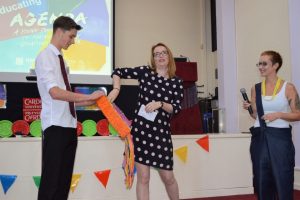
Classrooms, the cabinet minister said, have to be free of intolerance and, she added, sex and relationships education must be inclusive, comprehensive and delivered by trained experts. The talk concluded with messages from primary school pupils, sent to Kirsty Williams via a fantastic Pride-inspired, rainbow piñata, calling for gender neutral toilets in schools, more teacher training, awareness raising and protests.


Two outstanding performances followed featuring pupils from Ysgol Gyfun Plasmawr and Mountain Ash comprehensive schools. Siriol Burford introduced these Agenda ambassadors, firstly Plasmawr performing a new drama production ‘Hidden’ that highlights the potentially unseen harm of homophobic bullying. A powerful representation of the insidious effects of ‘harmless banter’, exploring the impact of phrases such as ‘that’s so gay’ from the perspective of a non-heterosexual pupil, overhearing them. #WAM (We Are More) maintained the high standard delivering their own dramatization of the kinds of everyday sexism they experience. Their rallying call ‘WAM: We Are More’ was the response to derogatory marks about skirt length, make up and body shaming. Mountain Ash students also shared a video of their activism and its path through their school and beyond, out in to communities in Cardiff, at the International Women’s day event and onwards to Paris for the European Children’s Rights summit!

Rhian Bowen-Davies, National Adviser for Violence against Women, other forms of Gender-Based Violence, Domestic Abuse and Sexual Violence emphasized the need to listen to young people in designing and delivering the necessary preventative work to advance gender equity and address all forms of gender-related and sexual violence via a whole school approach.
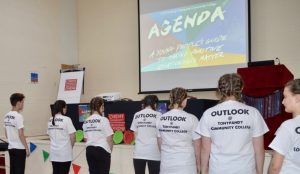
Young people from Tonypandy community college’s ‘Outlook’ group performed their drama exploring, among other things, sexting. Introducing them, their teacher emphasized that these young people had created the characters and the script themselves, without assistance.  All of the powerful messages were their own and they made a strong case for the importance of inclusive and student-led sex and relationships education.


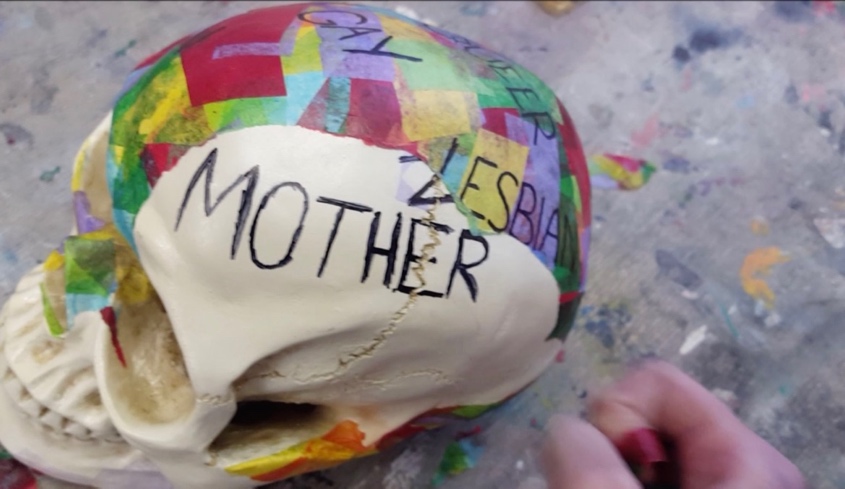
Tonyrefail comprehensive school students brought a musical flavour to close this first section of the day. Firstly, with backing from Mountain Ash Comprehensive school’s male voice choir, Charlie (age 13) performed her own song ‘Face to Face’, inspired by Agenda. It’s a beautiful song about respect, ambivalence and the challenges of growing up. With barely a moment to dab our moistening eyes Tonyrefail introduced the GCSE art project of one of their most talented students, Lauren. Set to the Macklemore track ‘Same Love’ a short film chronicled the impact of contemporary society on understandings of LGBTQI identities, from media representations to the uncertainty of the current political climate. Punctuated by the removal of rainbow coloured tissue paper from a skull inscribed with all of the intersecting identities that can sometimes become lost when we think of people only in terms of their sexualities. It was both sobering and uplifting to be invited to view these issues from this young person’s perspective, seeing what they see in the world around them. For real emotional impact when delivering your message, think creatively.
After a short break young people from Ysgol Gyfun Plasmawr led students from all of the schools through the Agenda starter activities (‘the runway of change’, ‘stop/start plates’ and ‘what jars you’), using them as a kicking off point for

developing a pledge of the top five key things that need to change in their schools.

These pledges were videoed, filtered through a ‘glitch app’ which distorts images to obscure participants identities. And these pledges were made to be gifted back to the schools the students originated from, glitch-activism in action. This industriousness filled the hall with conversations between schools about the strengths and weaknesses of their own current provision. Aptly, while this was going on, teachers and professionals were enjoying presentations in another part of the building. Emma shared details from the AGENDA case studies and accompanying Welsh Baccaluerate resources on Feminist Activism, Healthy Relationships; LGBT Rights; Selfie Culture; Digital Gaming and more. Inspiring feminist teacher Hanna Retallack made the journey from London to share about her experiences as a feminist teacher and facilitator of feminist groups, sharing ideas and strategies with professionals in Wales. The Spectrum Hafan Project also helped to outline positive moves and whole school approaches that all schools could make to get conversations started.

During the lunch break most of us migrated to the grounds to sit in the sun, continue conversations and share thoughts and reflections on the day so far. With sun soaked backs lulling us all gently towards inertia we made our way back indoors. The glitch pledges were screened at the front of the hall and the main themes of better staff training and listening to student voice came across clearly from all groups.
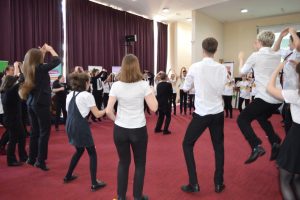
Minutes after, Jên Angharad  (Voices in Art) was re-energising everyone and waking us all up, working with some of the thoughts and feelings of the day to create a series of  movements. Capturing the spirit of the day Jen took her cues from the young people, moving with their feelings. For me, this was what the conference was about, it really was their day. A day that united the representatives from national charities, Government, academia, educators, county councils and youth groups, through the awe-inspiring enthusiasm, determination and creativity of the young people whom their work affects.


The talent, passion, commitment and strength of all the young people who came together on July 5th outshone the ferocity of the midsummer sun, they are our brightest stars. Captured in image, movement and song, here are some of the day’s best bits: https://vimeo.com/224546331


Padam… Padam… GEA Conference 2017: Dr Zoe Charalambous

By Dr. Zoe Charalambous, Anatolia College

“Cet air qui m’obsède jour et nuit
Cet air n’est pas né d’aujourd’hui
Il vient d’aussi loin que je viens
Traîné par cent mille musiciens
Un jour cet air me rendra folle
Cent fois j’ai voulu dire pourquoi
Mais il m’a coupé la parole
Il parle toujours avant moi
Et sa voix couvre ma voix”

Written by Henri Contet and Norbert Glanzberg, sang by Edit Piaf

Padam… Padam… the sound keeps being repeated in my head as my past returns.

“Not having a voice means you become empty from inside, you become dead,” I had mentioned consciously and unconsciously during the panel discussion titled:  “Teaching Intersectional Resistance: Global Feminist Teachers in Conversation.” I had said that actually not having a voice as a feminist may be symbolic of being a Greek feminist. I am still unsure of what feminist I am; I have to tell you the truth here before you read. We (myself and my students at Anatolia College) created Genderisms, a club exploring gender relations in high-school doing “amateur or not” research, reading Butler and Lacan, and playing with ideas on how to bring awareness of sexism going on – we created ‘AC Genderisms’ too on Facebook. Musings on Gender; we called it in Greek:  ‘ Φυλο-λογισμοί» (unsuited quotes here intended).

I have not read much Feminist theory, though I love Irigaray’s wave-like writing and Bracha Ettinger’s echoes of the primitive womb of all connections for that which we all seek. I am also in love with fantasies and their stories of prohibition, and the uncontrollable madness of the symbolic muting the Real – Padam- Padam- Lacan…so bear with me, with the fruit I shall bear. We always begin with a disclaimer in this capitalist society, don’t we?

When you are given a voice, how does the chimera of all that you have concealed come out unlike a tsunami?

I am thinking of a conference as a vessel packed with voices speaking their directions in the wind; then letting go of their articulated creations into the crowds of understanding to become something: what? Where do we go from here?

What happens after a conference? It is not just about the knowledge shared. It is about the solidarity and the generation of connections. Thank GEA we are not alone. Even the most minimal of discussions which happen between strangers about their work and passions produce threads of connections- interlacing us all back into realizing that we do can have an actual impact.

The 2017 Gender Education Association Conference at Middlesex University contained oceans of both visible and invisible questions about what it means to explore gender in education and what it means to be a feminist, (for me).

As I start this blog very abstractedly I wonder can the personal take on a communal meaning?

I begin with my story returning to London for this conference after unexpectedly returning to Greece, due to personal circumstances. From being an academic at university I became a teacher at a high-school : quite a violent return to my old school and being a metaphorical teenager myself.  And now, a re-turn to the future I was building here in my you-topian home London. The place where I found my own language, English, to write my dreams. I walked down a cemented pathway after leaving the Middlesex campus on day 1 of the conference and I thought of “circles- cycles” of generations.  We are generating new–reconfiguring material “discursive apparatuses” (someone and everyone) quoted from the conference) as we engage deep in and on the space (De Certeau, The Practice of Everyday Life, 1984 ). Documenting a walk of thought.  How can documenting our walks of thought in the past and in the present help us better understand how we are shaping our future as feminists?

For me this question becomes very important having to teach girls and boys at school, touching their minds with theory that may mean something or nothing or anything to them. How do we manage to make them aware of their own desire, their agenda, their human rights without imposing our own convoluted projections for what never came to be for us, or for what has become for us? I touch upon this concern as this is the key question in my own teaching/research – how do we teach without indoctrinating? How do we liberate without imprisoning?

This conference was a concave mirror for the practices and transformation currently going on within and beyond the academic landscape about ways of understanding gender and feminism. Here is a generalization. I will become more specific.

What I heard in this conference became separated in my mind in these four categories, themes touched on:

a) The safety in learning and education linked with community connections and boundaries.                                   

Leading and relating to…

b) Reflections: is it about us? Teachers? Academics?

Producing wondering experiments/discussions/presentations on the question of…

c) How do we do this? via projects/workshops/bodies/art discussing bags, music, dirt .

Moving to Metaphors in order to view these issues and understand them….

d) Theory about and conceptualizations of situations linked with gender and feminism.

All of these moves/categories happening at the same time and not in a linear sequential order.

All of these articulations (for me) somehow encompassed by the echo of Ahmed’s title: “Leading a Feminist Academic Life”

It is impossible to touch upon all the presentations and material covered in the conference. So, I will briefly mention the presentations/ideas that most relate to teaching English at my school.

Jessica Ringrose, Hanna Retallack and Ileana Jimenez have been significant in my coming to this conference. They have been my supporters and believers. Thus, attending “Nasty Feminist Teachers” took on a special meaning for me at the conference.  During this session, Hanna and Ileana spoke about their ongoing collaboration to create a feminism syllabus to teach their classes and Hanna’s visit to Ileana’s school in New York. Ileana touched upon the unsaid incidents happening within her school having to do with sexual harassment and how this course actually managed to push for an actual change in the school’s policy. Activism and education hand-in-hand.   It was most inspiring to listen to Briony O’Keefe’s efforts to create a campaign with her students, creating posters against sexism, her funded writing of teaching resource material and the open manner she conducts her classes.  I loved that her students call her by first name. She highlighted that she always tries to be at one level with them, not playing the “monopoly” of the teacher, as I understood this.  Briony really helped me understand how far we, as teachers, can take a multi-modal project we do with human rights into having an effect on the community.

“Bag experiments: Working the borders of gender fluidity” by Constance Elmenhorst, Nikki Fairchild, Carol Taylor, Mikra Koro-Ljunberg, Angelo Benozzo and Neil Carey was especially poignant in that in the doing and undoing and writing about and for bags we were just creating and breaking down borders in our minds with our bodies.  In many ways, embodying the social borders of gender and the fluidity of gender is not an easy reality to mouth! Thus, I found great inspiration in doing and undoing bags, and the idea of what is inside, what is an extension. This is  an activity high-school students could use to wonder – along perhaps with a small excerpt from “Gender Trouble” or “ On giving an account of oneself.”

Other useful ideas were:  using music projects to communicate (“troubled”) masculinities. Elly Scrine’s project of using Drake’s song and re-making it with two students in order to help them work through anger was also an inspiration. At the same time, via the presentations of Anne-Sofie Nystrom, Minna Salminen Karlsson and Carolyn Jackson the importance of exploring the “masculine” anxiety reared its beautiful head.

Dr Iris van der Tuin’s key note lecture on “The Generative Curriculum: On the Past, Present and Future of Feminist Teaching and Learning” was hugely intriguing in the sense that as I listened to the melodies of theories and wondrous abstractions – going against the grain in terms of simple and accessible key note lectures – I recognized many of the Middle Years Practices (in IB Schools) which we attempt to work with at our high-school – allowing students to find their own questions – their topics – the Personal Project, which colleagues of mine have been working on and have really been watching wonders happening in the minds and passionate pursuits of the students. That is the beauty of when theory and practice actually meet and recognize each other as always having been each other’s fate.

In many ways, this is an ongoing question at schools – a question I had encountered when I was teaching a module for the B. Ed at the Institute of Education UCL – and one that I am now also faced with as a teacher- “Oh Zoe, this is theory – practice is what is important.” The dismissal of other ways in which we can see our life –practice-profession – the dismissal of our imagination is one of the biggest disappointments; yet it is not anymore.  One must waddle through the water one chooses to waddle in. I wonder whether the acceptance of the struggle is the first step towards grounding our fears of subjection to a system that requires us to be “practical” and not “theoretical” ;but we must view (theorize ) what we do (praxis).

Research too is significant: to listen to the very detailed results of the session titled: “Examining family and educational experiences of gender diverse and transgender children and young people: methodologies, policies and practices” chaired by Rachel Skinner and presentations by Ulman, J, Davis C., and Robinson, K. was precious evidence pinpointing the significance of realizing that concealing hurts ;  the percentages of self-harm and suicide rates of kids who are not allowed a voice to speak what they are exploring- the lack of sexuality education – looking through the internet to find a label for what you are going through- the harm we cause because we are afraid of the Other. This reminded me of Zizek’s “Neighbours and Other Monsters”(2005). We are afraid to look at our neighbour’s mangled/hurt arm because it is something we contain inside of us – the shame of containing that which you cannot talk about.

This takes me to the very interesting following sessions about “Affective Relationality as Response-ability” with presentations by Gowlett C, Hook G, Mayers, E and Wolfe, M. What really stayed with me was the “resistance” discussed by Genine Hook in her undergraduate teaching and the attacks she underwent for having a feminist syllabus.  I wonder aren’t we teachers for those who attack us? What is the limit? Lacan argues that when we perceive resistance from others it is always our own. (Charalambous, 2014, p. 126) – Someone at the conference told me “You are very generous Zoe” when I had said that we must listen and ask questions when someone disagrees with us, instead of going on the attack or defense.  Here comes the mirror – do we look into the other’s mirror and become one with them or do we mirror back to them – what we create with our stance? Do we surprise others with our generosity? Can this generate a new generation of feminists? Of genderists….? Of human beings?

I absolutely was touched and troubled by all the dance performances and through the work of “Moving with the not-yet: choreographing with young people in space and time.” Something came out of my body with this embodied experience:  tears and sweat.  Fluids. It was really hot in that theatre. It is vital to become uncomfortable and comfortable with our bodies contacting us with the truth of our practices and theories. I somehow gazed into the abyss of so much emotion contained in the research by Renold, Ivinson and Anhgharad. This was too much/the unspoken excess needed to exit via a generous transmission of bodies.

Generosity and Viscous Porosity= the workshop by Carol Taylor and Nikki Fairchild played with our limits with “DIRT” – After the “theory” – the presenters presented us with bags and boxes containing dirt (teeth, hair, nails, etc.) and we engaged in a free-associative discussion about our reactions to these. I absolutely was fed with thought [–as the conversation somehow spiraled into “breastfeeding” and the role of the mother – whether it is natural or not – criticisms about discourses created- ] by what was said by the presenters : “Dirt is always with us” linked with what Marx has said (it was said) “the Poor are always with us”  and I must add “the Other is always with us.”

“Being Porous,” it was added, “is a good thing, skin is the boundary.”  A final entertainment of boundaries was discussed using Haraway’s concept of the cyborg (1984) – a little girl from Fairchild’s research working with a rice-tray that was one with her – as she was moving and going away and being with it at kindergarten school.

Playing. Punctuating, playing with punctuating. Playing with our bodies- with the bodies – with the body of this conference – in a manner that recognizes the validity of Other’s desires.  This text.

Somehow I have tried. In an incomplete manner and yet as complementary as I could and with EXCESS I had to process [one week I am unsure is enough to write into this].

I will finish off with a reference to our panel discussion on Day 2 – when Ileana, Hanna, Robin, Briony, and myself were put in discussion facilitated by Professor Miriam David. It was a joy to connect with all of the teachers/academics and to realize the many ways in which we are connected!  A true embodiment of “intimacies of solidarity” – which I have now experienced – and felt – not just thought about. This takes US back into the beginning of the cycle I have been writing into – : ultimately what we are seeking is a connection as human beings, as feminine<masculine<transgender<whatever the signifier. GEA conference 2017 absolutely and yet openly communicated this need to allow for connections rather than dismemberment and cut offs in both education and in our communities at large.  The matrixial borderspace of Ettinger (2006) comes to mind and something mentioned by Dr. Iris van der Tuin:

The phrase “You can’t challenge what remains unsaid,” which I heard in one of the sessions, made me curious.  What does it mean to “challenge”?

Can we challenge with the aim to return to each other rather than move away from?

Thank you all for openly connecting with me and disconnecting too.  Let me break the narrative of this blog post with my own “moral panic” –(using Jessica Ringrose’s phrase here, though not being unable to quote the paper) through the words of another:

“What is the agency of the one who registers the imprints from the other? This is not the agency of the ego, and neither is it the agency of one who is presumed to know. It is a registering and a transmutation that takes places in a largely, though not fully, preverball sphere, an autistic relay of loss and desire received from elsewhere, and only and always ambiguously made one’s own.” (Ettinger, 2006, p. xi)

References

Charalambous, Z. (2014). PhD Thesis. “A Lacanian Study of the Effects of Creative Writing Exercises: Writing Fantasies and the Constitution of Writer Subjectivity.” Institute of Education, University of London.

Ettinger, B. (2006).  The Matrixial Borderspace. Minneapolis, London: University of Minnesota Press.

Žižek, S.( 2005). Neighbors and Other Monsters. In : S. Žižek, E. Santner and K. Reinhard (eds) The Neighbor: Three Inquiries in Political Theology.  Chicago and London: University of Chicago Press, pp. 134-190.

GEA Editors Workshop for Early Career Researchers

Carol Taylor and Susanne Gannon led the editorial team from the Gender and Education journal on a pre-conference workshop for Early Career Researchers on “The secret life of journal articles: selecting, writing, reviewing, revising”. Over 15 participants from England, the Netherlands, Australia, and the United States attended. The editors discussed criteria for evaluating manuscripts, the reasons for rejection, and choosing a suitable journal. Background information on Gender and Education journal logistics such as who owns the journal, number of issues per year, impact factor, quartile ranking, readership and authorship were discussed – and reasons why authors might want to take these factors into account were explored. Participants were introduced to the Author Services provided by the publisher.

The criteria and selection of choosing reviewers, the timing and timeline for reviewing and also how to interpret reviewers’ ratings of a manuscript were discussed. The editors provided an overview of the characteristics of a ‘good reviewer’, and explained that timely response to an invitation to review or decline to review is much appreciated in order to ensure a timely review process.

Carol provided participants with an extract from an article she had submitted to Gender and Education along with the reviews the initial submission had received She talked through how she changed the article in response to the reviews and the resubmission process through to eventual publication. There was a broader discussion on how an author responds to reviewer and editor’s comments, the process for re-writing manuscripts and the expectations for re-submission.

ECR’s commented that the workshop helpful and informative.  They also appreciated having the opportunity and time to share their experiences in submitting manuscripts for review and raise questions about the process.  The workshop created a collaborative space to share insights on research approaches, reviewing practices, publishing strategies and impact narratives for gender/feminist scholars doing qualitative and quantitative research.

If you are an ECR or doctoral student and you are interested in reviewing for Gender and Education please contact Helen Rowlands, our Editorial Manager.

Email: genderandeducation@outlook.com

Carol Taylor, Susanne Gannon, Jayne Osgood, Kathryn Scantlebury

http://www.tandfonline.com/toc/cgee20/current

Reporting Feminist Potential at ‘The Rebirth of Feminism’ conference (Middlesex University, 30th October 2013 #mdxfeminism)

By Yvette Taylor, GEA Member

I was excited to be invited to speak at ‘The Rebirth of Feminism’ conference, with the title posing potential… and, perhaps, problems or even pain. A ‘rebirth’ is loaded with prospects and (re)production, as enduring feminist labour. This is messy and, while something (and someone) ‘arrives’, the potential, problems and pain arguably carries on (see ‘feminist failures’).

Intrigued, I wondered what (and who) was being re-birthed, pondering on the newness implied, and the feminist lines and lives continued, renewed or rejected.  Feminism(s) have long articulated and circulated the language of ‘family’, of ‘sisterhood’, and generational ‘waves’, suggestive of a generational inheritance and ‘passing on’; these notions can veer between a ‘never had it so good’ to a ‘failing the future’ sentiment. As the recent Gender and Education Association 2013 conference variously considered, I wondered ‘who gets to inherit and what is accumulated and lost in renewing feminism?’

I considered these questions as I searched for an object’ to bring to the conference, as instructed by the organisers. The chosen object was intended to foster discussion, deliberately deviating from a stand-and-speak format of knowing-feminist speaker versus feminist-in-training audience. Conscious of these knowledge exchanges, often bound up with generational positions, I chose to speak about my own retrieved school report cards, marking my own educational trajectory. Which I wouldn’t easily describe – or feel – as an ‘arrival’ (see here).

Report cards are something we’ve all likely experienced (arguably continued and self-audited as our own academic CVs). We’ve all been evaluated, and as educators, we all evaluate, celebrating potential and lamenting failure. When the question of our own academic biographies intersects with questions of women’s entry into the world of employment and education more generally, questions of potential can quickly become problematic – even recast as feminist failure.  As Angela McRobbie highlights in the Aftermath of Feminism, women’s entry into the workforce, as beneficiaries of and achievers in education, has become a sign of ‘arrival’, that she has found her place in a (post)feminist world. But she can also go ‘too far’ and (some) women’s achievement has also been seen as a cause and symptom of a male-underachievement and ‘crisis of masculinity’ (even with his pay differential).

In presenting, I hoped to remind everyone of this story beyond me, even as I placed my report cards on the floor, in the group circle; as we report on feminist potential (and failure) we must, of course, move beyond our own stories. But here is mine: I rediscovered my school report cards, held as valued and treasured objects, even though what they conveyed on the pages was frequently a ‘failure’ rather than a ‘success’. In reading these educational (mis)representations of me, my initial curiosity moved to an anger and even dismay as I realized the emotional (and material) pull these stories still had for me as an adult.

I am deeply skeptical of the story of meritocratic promise, of working really hard (and, romantically, ‘against all the odds’) and so I certainly didn’t want to convey a problematic beginning, transformed by an educational ‘becoming’. Instead, I wanted to query these official stories, which seem profoundly marked by classed and gendered terms and anticipated trajectories. My own reports are littered with ‘lapses into idle chatter’, of being ‘easily distracted’ and rather ‘slap dash’ in approach: the phrase ‘continual underachievement’ is, for one subject, underlined and in my physical education report a rather harsh judgment is made that I have, in fact, ‘not mastered the basic skills’ (of badminton).

So, when the ‘girl with potential’ becomes celebrated, anticipated and lamented, as a sign of feminist future/failure, we need to be attentive to the re-birthing and recirculation of enduring inequalities, so as to report feminist potential for everyone.

A report from from the BSA’s Young Masculinities one-day seminar

On Friday the 2nd of November, in an event entitled Young Masculinities: Challenges, Changes and Transitions the British Sociological Association’s Youth Study Group turned their attention to masculinities, an area receiving ever increasing academic attention in light of both the concerns of ‘the problem with boys’ as well as shifts within contemporary theories of masculinity. These shifting theories of masculinity have been usefully brought together in relation to education in particular in a recent article in Gender and Education by Chris Haywood and Máirtín Mac an Ghaill (October 2012), who suggest that “studies of masculinity in education are reconsidering how masculinity is being constituted” (2012: 580). Thus, while researchers within the field of gender and education have had masculinity as a central site of analysis for some time, in the case of the BSA’s Youth Study Group, masculinity has been noticeably absent as Steve Roberts, the group’s co-organiser remarked when opening the seminar. Although education acted as an investigatory location for some of the papers (Cann, Ingram, Kehler, Schalet), education as a specific avenue of investigation for young masculinities was interestingly not at the forefront of the papers being given. Forms of education could nonetheless be observed in the papers offered, with young men learning about acceptable forms of cultural consumption, learning about codes of conduct within particular subcultural contexts, learning to regulate themselves, and applying what it means to be a ‘man’ in transition(s) to the work place. The relationship between education and young men was therefore located, in most of the papers, at the level of social and cultural practice rather than at a formal or institutional level. Continue reading “A report from from the BSA’s Young Masculinities one-day seminar”

Promoting Equality: UK Feminista

GEA Policy Report Autumn 2012

UK Feminista is a relatively new organization of ‘ordinary women and men campaigning for gender equality’. Founded just over 2 years ago, it has wide and international aims, namely a ‘vision of a world where women enjoy all the rights enshrined in CEDAW – the Convention on the Elimination of All Forms of Discrimination against Women – otherwise known as the ‘women’s bill of rights’. Continue reading “Promoting Equality: UK Feminista”

‘Keeping it Real’: teenage girls and everyday feminism

It is an overcast Friday in mid-October as the Cardiff University contingent (that’s us!) pull up outside a rated-but-dated business hotel in Newport; we are attending the #KeepingItReal conference for teenage girls, run by the South Wales charity Full Circle, who seek to support aspiration in young people, and as we find our way into the conference suite the atmosphere of excitement and enthusiasm is already building. A large room is decked out as if an awards ceremony is about to take place, with over a dozen huge round tables, bedecked with linen and festive balloons, arranged in front of a stage where a sound check is underway. The walls are lined with exhibitors from local charities promoting sexual health, domestic violence services, and education opportunities, and what we thought to be a big purple bouncy castle in the corner turns out to be an inflatable ‘Big Brother Diary Room’ for the teenage attendees to record their thoughts about their lives and the conference away from adult eyes. No bouncing for us then, we sigh, and set up our stall nearby.  Filling the table with pamphlets and adverts for our gender and sexualities research group, we also lay out our GEA leaflets and journal copies, later eagerly seized by both teachers and charity representatives alike. Continue reading “‘Keeping it Real’: teenage girls and everyday feminism”

Ester McGeeney on ‘Collisions, Coalitions and Riotous Subjects: The Riots One Year On’

A Conference Report for GEA

At the end of last month I started my week with a colleague from Sussex University, a few of our new masters students and a trip to the CLF theatre in Peckham Rye. We were there to watch The Girls – a play based on the lives of the four young people who performed in the play. The play was set at a group counselling session in South London. Four young people turned up and waited for the counsellor who never arrived. And as they waited, London started rioting and as the news of the looting and violence poured in via their mobile phones, the on-stage drama followed each young person’s story – the mistakes they had made, the anger and pain they had experienced and the hopeless, stuck position in which they found themselves. This was a harrowing welcome to child hood and youth studies for the new students. As a youth practitioner and researcher I think I am pretty hardened to harrowing tales of young peoples’ sexual exploitation, domestic violence, neglect, hunger, gang violence, anger, loss and pain, but the raw emotion and hopelessness of this play still hit me hard.

Continue reading “Ester McGeeney on ‘Collisions, Coalitions and Riotous Subjects: The Riots One Year On’”

Abby Hardgrove on ‘Collisions, Coalitions and Riotous Subjects: The Riots One Year On’

A Conference Report for GEA

I work as a post-graduate research associate on a research initiative focused on young men’s experiences of unemployment in the UK during a time of austerity: ‘Diaspora geographies and generations: spaces of civil engagement’. This is a collaborative research endeavour directed by Professor Linda McDowell and in collaboration with Dr. Esther Rootham. This research has particular relevance to gender and education as we look at gendered experiences of unemployed young men in the UK with specific interest in how their formal education and skills training map onto their structured experiences of precarious work and unemployment. Continue reading “Abby Hardgrove on ‘Collisions, Coalitions and Riotous Subjects: The Riots One Year On’”