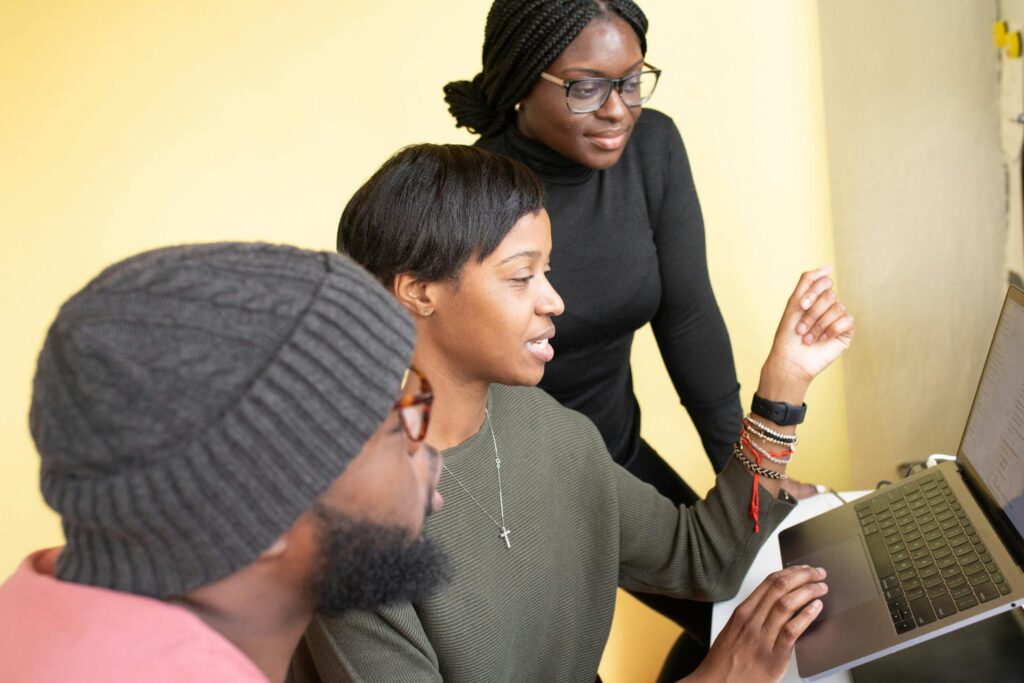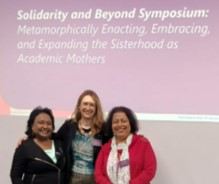
Three women smile at a camera with the text Solidarity and Beyond Symposium

Solidarity, Sisterhood, and the Emotional Labour in Academia

by Reshmi Lahiri-Roy, Rachel Daniel & Kelly Hart

Some stories need sharing. And sometimes we must be our sisters’ keepers. As three women working in the same regional Australian university, our sisterhood and solidarity grew as we shared the vicissitudes of our lives, conversing in corridors, online, and occasionally, sharing meals. These interactions, interwoven with our passions, interests, and emotions offered an unusual academic freedom. We shared on parenting, life events, cultural responsibilities, and the emotional labour of being mothers in academia.
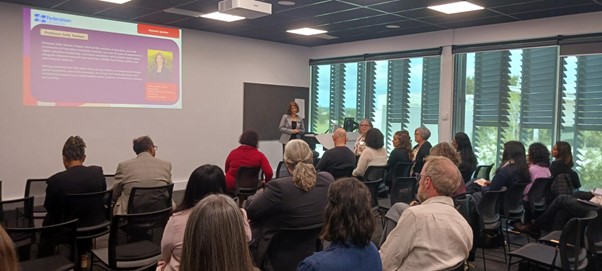
a person speaks at the front of a seminar room that is full of people looking at the speaker

Working as collaborative autoethnographers, our conversations became a journal paper. Encouraged by reviewer responses to our now accepted paper and a faculty conference grant, we hosted a symposium based on solidarity, sisterhood, and allyship around academic motherhood. It was gratifying to be joined by enthusiastic scholars, on-campus and online, who proactively queried “what happens when we stop pretending these experiences sit outside academia and instead recognise them as central to it”? Instead of a single narrative of “academic motherhood,” all voices asserted that gender, care, and education are deeply entangled. And to be meaningful, solidarity must extend beyond tokenistic celebrations of diversity, perfunctory policy changes, or advocacy of endurance.

From the symposium’s presentations and collaborative discussions, strong themes emerged:

Stories beyond “work–life balance”
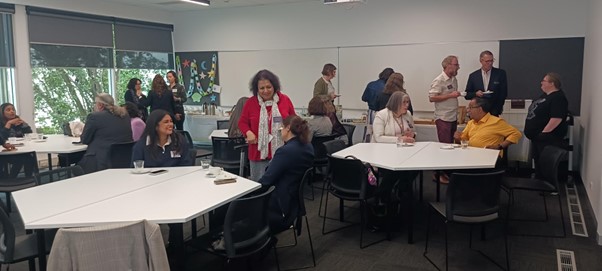
a classroom of people interacting with each other, some are seated at tables, others are standing

Women academics are conditioned that balancing academic work and care responsibilities is a personal responsibility. Our presenters (of all genders) resisted this idea, contending that the issue is not women, mothers, carers, or marginalised academics failing to manage competing demands. It stems from neoliberal academia’s fossilised academic stereotype of the heterosexual male, preferably single, or supported by the ubiquitous wife, ready to meet academic demands (Anderson et al., 2020). Overlooked narratives ranged from academics based in regional universities, struggling with travel, to the penalties paid by others who cannot relocate or attend conferences; illuminating that care responsibilities are not incidental. Given the institutional preference for rewarding staff visibility, research productivity, and traditionally linear careers, those encumbered with care responsibilities remain behind.

Whose motherhood counts?

Running like a silken ripple through the symposium was the refusal to treat academic motherhood as a single, universal experience. Indigenous, migrant, working class, adoptive motherhood, and first in family academics convivially intertwined different realities.

For Australian First Nations scholars, caregiving is interwoven with kinship, community, and Country (Minthorn et. al 2018). Motherhood is imbricated in their lives as a knowledge source rooted in accountability, not viewed as a distraction from intellectual life. Institutional systems mostly devalue these ways of being and knowing, designating care as an individual rather than a collective responsibility.

For migrant academics, motherhood comes layered with stresses of visa insecurity, fractured professional networks, and the task of caring across borders based on cultural expectations. Some navigate “third space” roles, straddling academic and professional spaces, as a flexible compromise, which raises questions around academic legitimacy, recognition, and authenticity. We heard from those struggling to achieve parenthood, for whom conversations centred on motherhood become exclusionary. Reflections on topics usually avoided in academia, including infertility and miscarriage were shared, highlighting the profound impact on wellbeing, identity, and participation. Solidarity based on preconceptions that everyone’s reproductive journey is similar risks silencing many.

Invisible labour and audible bias
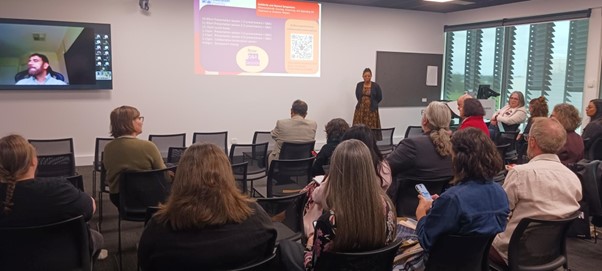
A person speaks in front of a lecture room of people seated and watching. On a screen we see an online speaker and community also joining.

With a smattering of international scholars, an emergent global theme was the lack of recognition and reward for that which academics deem as essential work (Reid 2021), encompassing emotional and individual labour including mentoring students, fostering collegiality, organising workloads, defusing conflicts, and professional and domestic care work, essentially ‘women’s work’, often racialised and ignored. Workplace microaggressions (Blithe & Elliott, 2020) were mentioned: being interrupted, spoken over, dubbed unproductive and excluded from decision-making spaces post motherhood.

The exhaustion from this marginalisation through motherhood was a palpable presence. The need to constantly prove credibility, mask grief, fatigue, or vulnerability to be perceived as professional, and the painful knowledge that stepping back, even briefly, has long-term consequences remains omnipresent.

We learned that:

Solidarity needs expanding beyond support in stressful times to be designated as genuine sisterhood; capturing elements of resistance, advocacy, and collective action. Several contributors argued for solidarity as a clearly developed collective practice. This includes challenging visible bias, advancing transparent workload models, planning meetings and events acknowledging care responsibilities, refuting longstanding narratives of inevitable, and recognising diverse allyship outside gender groups. A core feature of solidarity is listening, especially to those traditionally suppressed in universities, the ‘invisibles’, ranging from BIPOC scholars to those with disabilities.

Why gender and education matter right now!

We rethought Epictetus’s assertion that only the educated are truly free. Positioned as a pathway to equality, education systems can reproduce inequality if we don’t interrogate embedded intersectional inequalities and question whose knowledge counts. Universities are under pressure, leading to normalising burnout and stress. But gendered and intersecting inequalities are exacerbated by austerity. As redundancies become commonplace, losing experienced women, carers, and marginalised scholars narrows knowledge production, students support, and ultimately, creative futures.

Progressing Together

While no perfect solutions crystallised at the symposium, hope emerged that naming these realities together is a form of change (Sum et al. 2025). Connecting across institutions, disciplines, and borders transforms isolation into collective understanding. The presenters asserted that gender equity is intertwined with access, participation, knowledge, and care. These conversations reiterated that academia needs more institutional responsibility not individual resilience. We recognised that solidarity is not about struggling alone but about imagining, insisting upon, and progressing to something better, together.

References

Anderson, L., Gatwiri, K., & Townsend-Cross, M. (2020). Battling the “headwinds”: the experiences of minoritised academics in the neoliberal Australian university. International Journal of Qualitative Studies in Education33(9), 939–953. https://doi.org/10.1080/09518398.2019.1693068  

Blithe, S. J., & Elliott, M. (2020). Gender inequality in the academy: microaggressions, work-life conflict, and academic rank. Journal of Gender Studies29(7), 751–764. https://doi.org/10.1080/09589236.2019.1657004

Minthorn, R. Z., Nelson, C. A., Shotton, H. J., Lee, T. S., Tsinnajinnie-Paquin, L., Faircloth, S., Reyes, N., Chow-Garcia, N., Johnson-Jennings, M., & Johnson-Jennings, A. (2022). Indigenous Motherhood in the Academy. Rutgers University Press. https://books.google.com.au/books?id=fLx9EQAAQBAJ  

Reid, R. A. (2021). Retaining Women Faculty: The Problem of Invisible Labor. PS: Political Science & Politics54(3), 504–506. doi:10.1017/S1049096521000056

Lahiri-Roy, R., Daniel, R., & Hart, K. (2026, accepted, in press). Arduously reconciling the ‘good mother’ with the ‘academic worker’: A collaborative autoethnography on academic motherhood and sisterhood in Australian higher education. Journal of Women and Gender in Higher Education.

Sum, N., Lahiri-Roy, R., & Belford, N. (2025). Hope theory as resistance: narratives of South Asian scholars in Australian academia. Equality, Diversity and Inclusion: An International Journal, 44(1), 26–40. https://doi.org/10.1108/EDI-03-2023-0085  

All images are author’s own
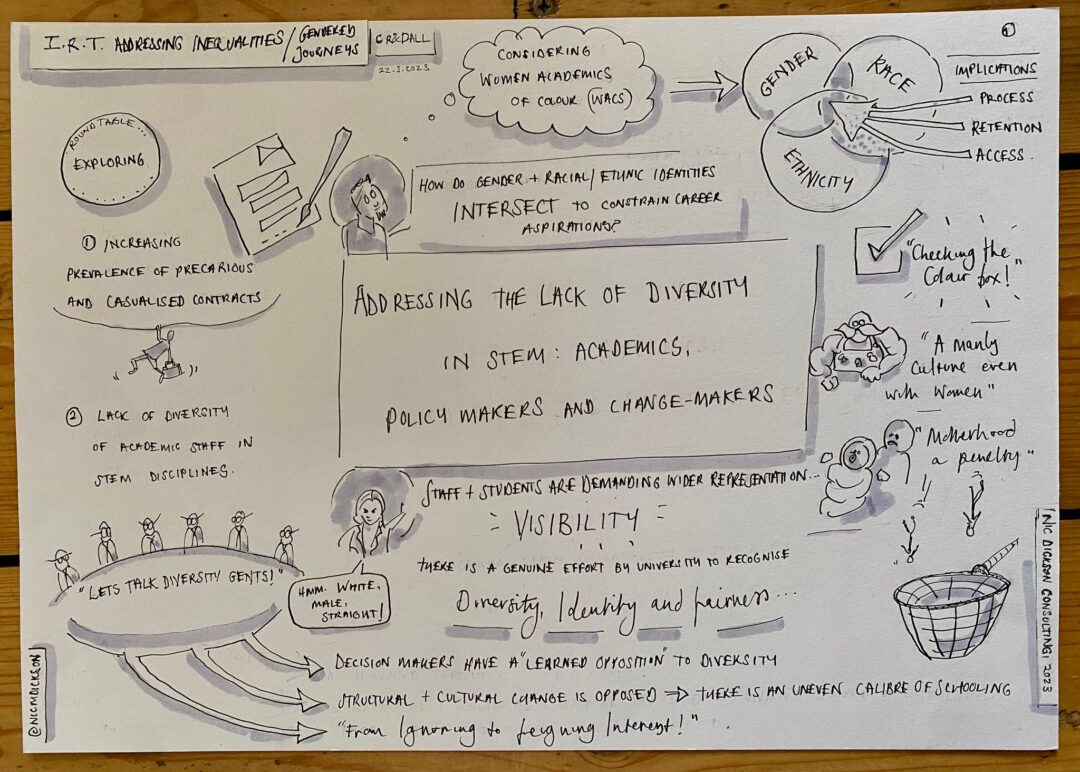
The image shows a sketch 'addressing the lack of diversity in STEM: Academics, policy makers and change makers' which was created by a colleague, Dr Nic Dickson, to visually capture discussions from a STEM roundtable

Are We Moving the Needle? Women Academics of Colour and the Politics of Representation in STEM 

Dr Abimbola Abodunrin, Post-doc Researcher in Education. University of Glasgow.

Walk into many STEM faculties across the UK, and you might notice something right away: the posters/decor speak of diversity, the strategies promise inclusion, and the websites proudly showcase progress or perhaps more accurately, incremental progress. Yet, look a little closer at who is leading labs, shaping research agendas, and influencing decision-making, and a different story often emerges. As a male academic of colour researching within STEM education spaces, I often find myself asking a simple but ‘uncomfortable’ question: Are we really moving the needle? And perhaps more importantly, who is still being left behind? The experiences of women academics of colour continue to reveal a persistent gap between representational gains and promising agendas to pursue equ(al)ity. Their stories speak not just about numbers, but about belonging, voice, and power. They also echo wider concerns raised in Danny Clegg’s WonkHE blog, where he suggests that universities are often better at documenting inequalities than preventing or addressing them. These reflections challenge all of us, including men and men of colour such as myself, to think more introspectively about what it means to actively contribute to decolonising STEM and academia more broadly. 

Vibrant test tubes filled with liquids in a modern lab setting, showcasing scientific exploration.

For many institutions, progress is measured through the politics of enumeration, even when agendas are well-intentioned: how many women are recruited, how many minoritised academics are appointed, how many diversity initiatives are launched. These numbers matter, of course. But numbers alone do not tell the whole story. Being the only one in the room or, worse still, being present to ‘authenticate’ spaces and projects without necessarily shaping them remains a familiar trope of experience for many women academics of colour. Alongside this is the invisible and often unremunerated labour of mentoring students seeking role models, sitting on diversity committees, and balancing expectations both at home and in the workplace that weighs on her body and career. Do I also speak of the tensions of performing particular forms of scientific legitimacy – marked by her ability to speak science, do science, and embody science in ways that mirror dominant cultural practices?  

A Black woman scientist in a lab coat using a microscope in a modern laboratory setting

I have witnessed, and through my research, had the privilege to listen to, brilliant women academics of colour whose ideas (re)shape conversations, yet whose contributions are sometimes framed as “niche” rather than central to STEM innovation. These experiences speak to representational politics, signalling symbolic inclusion and progress without disrupting the epistemic centre. As  Kalwant Bhopal’s article discusses, even equ(al)ity and diversity staff within universities often find themselves constrained; able to “talk the talk” but not always permitted to “walk the walk” when it comes to implementing equitable changes. Representation, in this sense, becomes visible but precarious; present, yet positioned at the margins of institutional power, even when occupying a leadership position. 

As a male academic of colour, I am also conscious of the spaces I occupy and the privileges I may hold, even within marginalised identities. Decolonising STEM is not simply about increasing diversity; it is more about questioning whose knowledge counts, whose voices are heard, and whose experiences shape institutional change. This means listening more carefully to women academics of colour, amplifying their contributions, and reflecting on how we, as colleagues, mentors, and collaborators, can challenge systems that continue to (re)produce inequ(al)ities. It also means recognising that decolonisation is neither a metaphor, as Tuck and Yang, put it, nor a destination but an ongoing practice. Sometimes this work involves small but subversive everyday actions: citing their work, recommending them for leadership roles, or challenging assumptions about their credibility and expertise in meetings. These may seem like small steps, but they contribute to shifting cultures and redistributing voice and influence. 

Three colleagues working together on a project, focusing on a laptop screen.

Encouragingly, there are growing conversations and initiatives seeking to address these issues. From mentorship networks and collaborative research communities to institutional commitments around equity and inclusion, there are signs of movement in the right direction. Yet, the question remains: are these efforts reshaping structures, or simply reshaping appearances? The stories of women academics of colour offer a powerful reminder that equitable and lasting changes require more than good intentions. It requires sustained commitment, uncomfortable conversations, and shared responsibility. As we continue to trouble the question of whether we are moving the needle, perhaps the most important step is to keep listening, keep reflecting, and keep working together toward a STEM academy where representation is not only visible but fundamentally equitable. 

Dr Abimbola Abodunrin 
Post-doc Researcher in Education 
University of Glasgow 
a.abodunrin.1@research.gla.ac.uk 

https://www.linkedin.com/in/abimbola-abodunrin

Images:
Featured image: Photo of a live sketch by Dr Nic Dickson, Visual  Inquiry (2023)
Photo by Artem Podrez: https://www.pexels.com/photo/vials-with-liquids-in-holder-8533087/
Photo by nappy: https://www.pexels.com/photo/people-looking-at-laptop-3514805/
Photo by Gustavo Fring: https://www.pexels.com/photo/woman-wearing-a-white-lab-coat-looking-through-a-microscope-8770727/

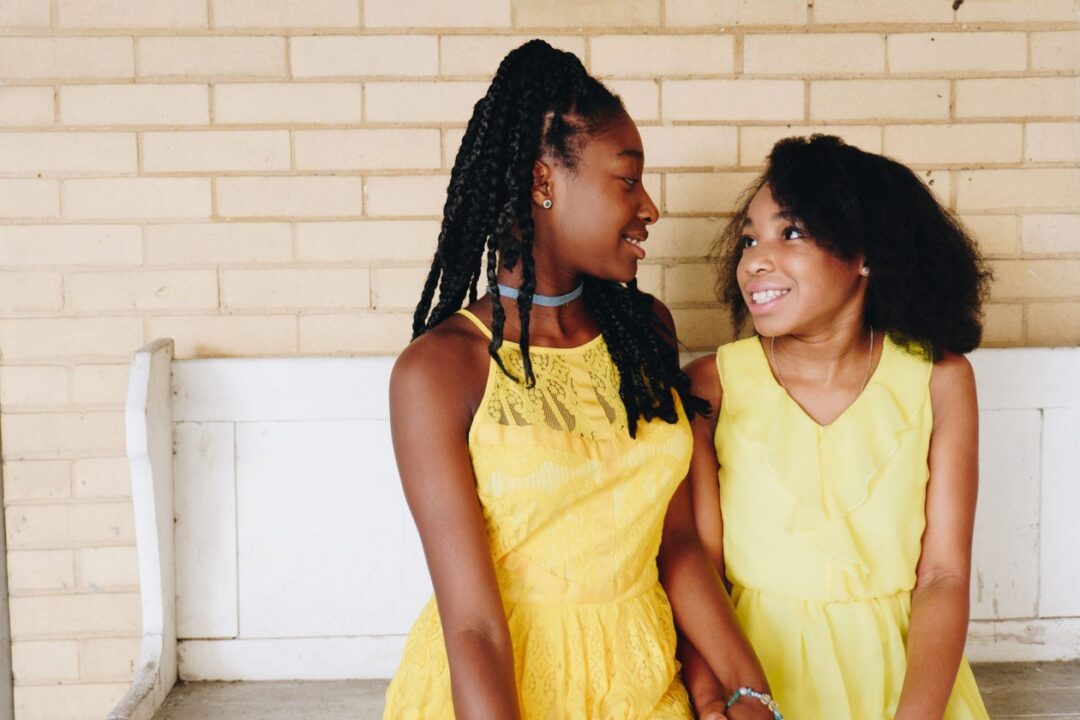
two smiling young Black girls smiling at each other

Black Girlhood in Europe Symposium 2026 – Are you Down? 

By Dr Silhouette Bushay

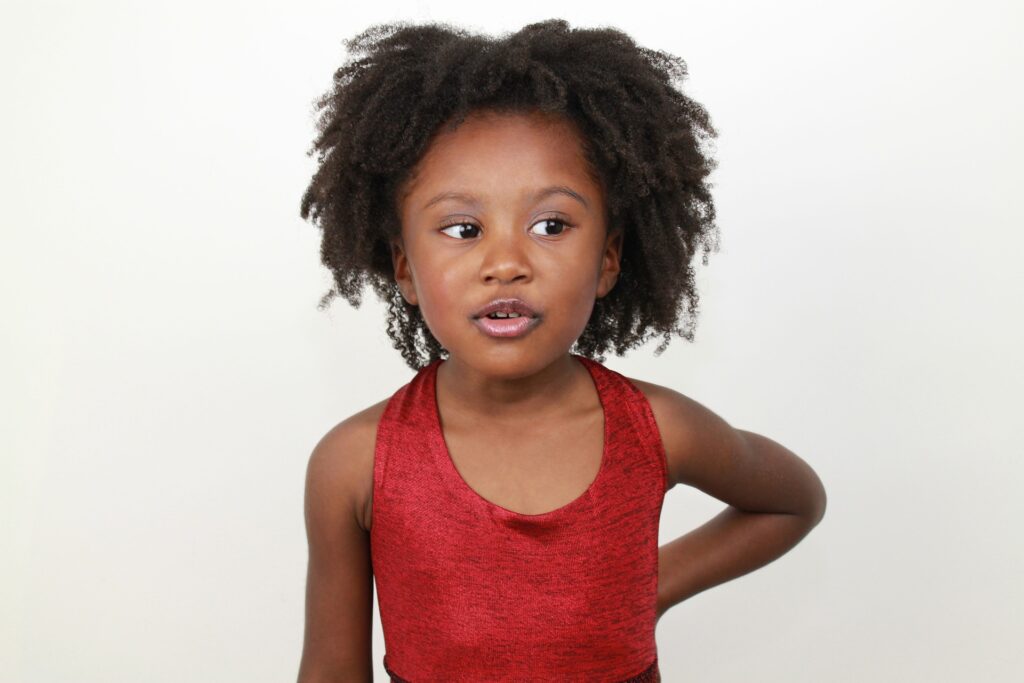
A young Black girl in a red top

It is astonishing that a conference on Black British Girlhood Studies was convened for the first time in Britain in 2025, and we support and applaud this shift and look forward to many more – nonetheless, this truth is telling of the intellectual and political space that we are in. It also reflects a wider issue of epistemic whiteness and neocolonial violence which permeates and bolsters academic and wider institutional practices and agendas. For Black girls, their communities/families, and Black girlhood orientated scholars, researchers, practitioners, and professionals, the field is unsupported and requires research, funding, and more coordination and movement to build momentum, and consequently, drive progress. 

a young Black girl typing on a laptop

In recognition of the work that is required to contribute towards building the field of Black Girlhood Studies in Britain and other countries in Europe, Black Girl Streams C.I.C. is launching the Black European Girlhood Studies Association (BEGSA) which is also convening/co-hosting Black Girlhood in Europe Symposium 2026 – Black Girlhood at the Intersections: Health, Disability and Neurodivergence, and it’s first Special Interest Stream (SIS), the Black British Girlhood – Health, Disability and Neurodivergence SIS.   

Co-hosted by the Centre for Social Change and Justice (CSCJ), and funded by the School of Childhood and Social Care, CSCJ, and Student Life at the University of East London, the main objective of the symposium is to delve into some of the complexities involved in Black British Girlhood as a site for understanding a range of ideas around race, ethnicity, culture, gender, health, community, dis/ability and neurodivergence.  It will grapple with Black girl experiences with consideration community, embodiment, and institutions such as school, social care, and technology – to name a few. 

This is an interdisciplinary discussion where Black girls (18 and over) and women, academic, practitioner, students, policy and other professionals and stakeholders are welcome to contribute and collaborate in moving the agenda forward. 

The symposium takes place on the 11th March 2026 at the University of East London, UK. 

Come join us – see our online platform for more information and to reserve your free spothttps://blackgirlstreams.com/symposium  


Follow us on social media: 
LinkedIn: https://www.linkedin.com/company/black-girl-streams/  
Instagram: https://www.instagram.com/blackgirlstreams/  
YouTube: https://www.youtube.com/channel/UCY_e9pIyMXYC_EGNZziZ3QA (launches on the 2nd March 2026)


If you have any enquiries regarding Black Girl Streams or more specifically BEGSA including the Special Interest Stream, email: info@blackgirlstreams.com  

I am Dr Silhouette Bushay, Senior Lecturer and Course Leader at the University of East London, and Founder, Executive Director and Lead Scholar at Black Girl Streams C.I.C.  

https://uk.linkedin.com/in/dr-silhouette-bushay-81419838  

Image credits:
@eyeforebony https://src.nappy.co/photo/oWGwCNU7llU-MQ4x_SjG4 
Photographer: 5DMedia https://picnoi.com/people/6566/ 
Photographer: Monstera https://picnoi.com/people/6443/

Three hands hold the letters EDI

When Inclusion Excludes: The Paradox of EDI in UK Higher Education  

by Chong Liu and Qiaohui Xue  

Equity, diversity, and inclusion (EDI) have become central terms in UK higher education. Universities release strategies, policies, and glossy brochures that proudly proclaim their commitment to fairness and belonging. On the surface, it looks progressive. Yet research and lived experience suggest something more complex: EDI discourse itself can sometimes reinforce exclusion rather than dismantle it. This blog is co-authored by Chong and Qiaohui. Both of us engage with UK higher education as international researchers. Chong currently serves as the EDI Lead of the Gender and Education Association, while Qiaohui is a Student Representative. Although our roles and perspectives differ, our stories intersect in showing the paradox of EDI, especially as it is experienced from international positions.  

Chong’s Story:  

One issue lies in the dominance of white-centric perspectives. Curricula shaped by Eurocentric traditions often leave out diverse knowledge systems, marginalising Black, Asian, and Minority Ethnic (BAME) students and staff. The acronym “BAME” itself, once introduced to signal inclusivity, has been criticised for producing alienation rather than belonging. Many people describe feeling reduced to a label that institutions choose, rather than a language of identity they claim for themselves.  

For me, the tension runs even deeper. The term BAME does not exist in my mother tongue. I encountered it only after coming to the UK, learning it as part of the institutional language of equity and inclusion. In that sense, I was learning a foreign word that seemed to describe me, yet I was not fully entitled to use it. The distance was not only linguistic but also emotional – I was learning how to name myself in someone else’s language, within someone else’s framework.  

I remember this tension vividly from a personal experience. While preparing an application for the Higher Education Academy, I described myself as a “BAME student” – a “fancy” word for me at the time, learnt from a university’s Inclusive Teaching course and thought I was using the right language. When a white academic staff member read my draft, she looked at me in surprise and asked, “Are you BAME?” At that moment, I said yes, but later I realised why it felt unsettling. The term seemed available for her to apply to me, but not for me to claim for myself. What stayed with me was a strong sense of being othered. A word that was supposed to include me instead created distance.  

Representation often works in similarly ambivalent ways. At one disciplinary conference, my photo appeared in a publication page alongside a middle-aged Black woman and an older white woman. The arrangement looked perfectly composed to illustrate “diversity”. Yet I could not shake the feeling that I was being positioned less for my scholarship than for my identity. We were placed together to signify inclusion, but the effect was structural, almost performative. I was visible, yet not fully recognised.  

For women of colour in particular, such dynamics are deeply familiar. In white-dominated spaces, identities are often simplified or essentialised. Even in institutions with formal EDI policies, structural practices remain that separate “marked” from “unmarked” identities. Members of dominant groups may unconsciously reinforce their own belonging, keeping boundaries intact despite intentions to erode them.  

At the same time, I hope my current role will allow me to approach EDI from a more transformative angle. As the EDI Lead at the Gender and Education Association, I want to move beyond symbolic gestures and foster genuine participation. My aspiration is to create spaces where international students and scholars can define inclusion on their own terms — where they can exercise agency, build solidarity, and reimagine what belonging means. While I am still learning how to do this in practice, I see this as a process of collective exploration, one that challenges the limits of existing EDI discourse and opens up possibilities for change.  

Moving beyond critique means asking what genuine inclusion could look like. Real inclusion is not about filling quotas, showcasing diverse faces on a webpage, or categorising people into acronyms. It is about listening to lived experiences and recognising individuals in their full complexity. It is about rethinking curricula so that knowledge is not narrowly defined by Eurocentric traditions but enriched by multiple voices. It is about shifting power, ensuring that those who have historically been silenced are not only present but also shaping the agenda.  

Qiaohui’s Story:  

The other issue is that international students often seem absent from EDI discourse. At first, I was not even sure whether EDI was meant to include students like me. In my first year in the UK, I noticed posters about EDI in university buildings. Curious, I searched for definitions and began to read related academic work. One article, ‘Feeling excluded: International students’ experience of equity, diversity and inclusion’ (Tavares, 2021), resonated strongly with me, which highlights this paradox: although universities often emphasise their commitment to EDI, international students are rarely treated as an equity-seeking group. As a PhD researcher focusing on gender and international student mobility, I was particularly sensitive to such ideas, and I started to wonder whether they could inform my own research.  

But when I raised these questions in conversations with other staff members, the responses I received were often ambiguous. Some people told me directly that EDI was not designed with international students in mind. Yet at the same time, many international students come from minority ethnic backgrounds, making it impossible to separate their experiences from the very concerns that EDI claims to address. This ambiguity pushed me to think more critically about whether international students are actually included.  

My interviews with other international students confirmed this uncertainty. Several had never heard of EDI. Others said they knew the term but felt it had little to do with them. The most visible sign of EDI, for many, was the rainbow flags displayed across campus. For some Chinese students, these flags felt novel, since in the Chinese cultural context, gender and sexuality are not always framed as diverse. The flags created a sense of curiosity, but also confusion. Students wondered what connection these symbols had with their own everyday lives.  

On the one hand, some international students see the posters of EDI in their University. On the other hand, many still encounter exclusion in daily practice, whether through racial microaggressions or moments when their voices are ignored. The gap between EDI discourse and lived experience can leave students feeling positioned outside the very spaces that claim to include them.  

These reflections also shape my current role as a Student Representative of the Gender and Education Association (GEA). For me, the goal is not simply to promote EDI as an abstract principle, but to make it real in practice. I want international students to feel not only that they are present in these conversations, but that they belong. This means creating space for their perspectives, supporting them to participate on their own terms, and ensuring they are recognised not just as symbols of diversity but as contributors to academic and social life. Only in this way can EDI move beyond words on posters and become something lived and transformative.  

Conclusion:  

Our different perspectives point to the same paradox: EDI can both include and exclude. Chong’s experiences show how label representation can create distance instead of belonging, while Qiaohui’s reflections reveal how international students often see EDI only as symbols, not as something that speaks to their daily struggles. Together, we argue that if EDI is to be transformative, it needs to move beyond posters and acronyms. Real inclusion means recognising international students as part of the conversation, shifting power, and creating spaces where people are valued for who they are and what they contribute. As universities renew their EDI strategies each year, perhaps the most radical act is not to add more words, but to listen more deeply.  

Reference:  

Tavares, V. (2021). Feeling excluded: international students experience equity, diversity and inclusion. International Journal of Inclusive Education, 28(8), 1551–1568. https://doi.org/10.1080/13603116.2021.2008536 

Image sourced from: https://phecanada.ca/professional-learning/equity-diversity-and-inclusion/understanding-edi-and-edi-intersectionality

a cluster of pegs and one peg alone

From Silence to Voice: Reclaiming the Curriculum for the Working-Class Feminist  

By Michaela Hall  

The intersectionality of class and gender is at the forefront of my experience and research as a PhD student exploring curriculum justice. In this blog post, I reflect on my higher education journey as a white, working-class, British woman and I touch upon how structural inequalities are embedded in curriculum design and delivery. I explore how neoliberal ideologies commodify education, marginalise working-class women, and erase diverse ways of knowing. My experience and reflections have shaped my commitment to advocating for curriculum reform that promotes epistemological justice, which has the potential to lead to broader social transformation.  

A Moment To Reflect  

Very recently, I attended a conference where one of the presenters mentioned that personal social injustices they face motivate them to change things for others. This resonated deeply with me and prompted me to reflect on my own intellectual journey through higher education, particularly my undergraduate studies. I reflected on how my experiences as a working-class white British woman not only shaped my path but also my research into gender and curriculum justice.  

I vividly remember the look in my dad’s eyes when I told him I was intending to go to university after completing my A Levels. I caught a glimpse of the heart-stopping, stomach-dropping panic.  

‘Are you sure?’ 

‘Have you thought about getting a job?’  

‘You don’t have to because your friends are, you know?’  

I knew I didn’t have to. I wanted to. Even in those self-absorbed teenage years, I did feel for my dad. I was asking for the equivalent of 2 years’ worth of food shopping for our working-class family of four, to be paid over the course of the next 3 years. Yet, with the most pained smile I will probably ever witness, he agreed.  

I studied Music, and it wasn’t until my third year that I came across my first female lecturer, a guest lecturer from the Music Therapy Master’s course. It was then that I realised there were no female lecturers in the department. We did not learn about any female composers and anything aside from Western music was crammed into a one-semester elective module in the first year – ethnomusicology – taught by a very charming, but very white, middle-class male. 

I didn’t think much of it at the time, but now I truly understand how teaching cannot be viewed as a matter outside of social class. Teaching is an overt genderised profession with evident historical roots within the capitalist system (Anyon, 1997; Arnot, 2002; hooks, 1994; Darder, 1991). I now question myself: Was it worth it? Is it worth it for working-class women now, after 20 years? What knowledge, or rather whose knowledge, are you paying for? These are just some of the questions I hope to answer through my research.  

Working-Class Realities and the Cost of Aspiration  

a white woman sits at a desk looking stressed

Class matters are deeply intertwined with gender and, needless to say, racial categories. (Davies, 2019; hooks, 1987; Darder, 1991) I have found that women are disproportionately affected by precarious work conditions, unpaid carer roles and responsibilities, as well as exclusion due to disability. Also, it is interesting to notice whose women one is referring to? In recent research, the UK Trades Union Congress (2025) revealed that women are 34% more likely to be on exploitative zero-hour contracts than men, BME women are 103% more likely than white men, and disabled women are 49% more likely.  

When I started my undergraduate studies in 2005, university tuition fees in England were set at £1,500 a year. At that time, the National Minimum Wage was £5.05 per hour for those aged 22 and over, and £4.25 per hour for those aged 18 to 21. Fees were the equivalent of 297 hours’ and 353 hours’ worth of work, respectively. Have things got better? Unfortunately, no. The National Living Wage, as it is now known, is set at £12.21, and a year’s fees can be charged at a maximum of £9,535 in England and Wales: an equivalent of 781 hours. So, what kind of curriculum are you paying all this money for? What will you learn? Who benefits from ‘such learning’?  Importantly, is it worth the mounting debt for the working class in particular? Alarmingly, if one pays attention to studies promoted by conservative psychologists, such as Jordan Peterson, equality policies, particularly in Scandinavian nations, have aggravated gender equality. 

It is essential to recognise that prevailing societal ideologies influence the dominant forms of curriculum theory, design, and development. At present, as research documents, neoliberalism has been capable of imposing itself as a public pedagogy aiming for educational outcomes that are directed by primary market drivers. Students are treated as a commodity, like any other commodity, a captive mass of customers, and knowledge is viewed as a commodity as well (Apple, 2000; Giroux, 2011). There is an emphasis on ‘marketable skills,’ which reinforces capitalist values, namely, individualism, competition, and instrumental views of reason and existence. Since the market dictates education, pedagogy is compartmentalized and individualized to be in tune with those markets. In the course of my research so far, I have observed that the majority of online prospectuses foreground workplace skills that can be acquired during the course, before describing the degree content.  For some, this isn’t very meaningful. The curriculum is designed to serve the labour market, not the students. It promotes skills for employability, assuming everyone is a potential worker, and adds little value for women who cannot work or are in insecure jobs, creating a sense of economic disempowerment. Notably, education is closely tied to a new emerging gendered class: the precariat. Distinct from the traditional working-class, the ‘precariat’ (a term originally coined in 2011 by British economist, Guy Standing (2014)) are characterised by their precarious employment, unstable living conditions and lack of rights both within and outside of the workplace.  

From a progressive feminist perspective, this assumption overlooks structural inequalities (such as access to employment, leadership roles, and equal pay, to name but a few) that disproportionately affect women—particularly those in caregiving roles, precarious employment, or excluded from formal work altogether. It adds little value for the women who cannot work or are in insecure jobs, creating a sense of economic disempowerment. By prioritising individualised success and employability, neoliberal curriculum design erases collective struggles and reinforces gendered marginalisation within education. 

Intersecting Inequalities: Who Is Left Behind?  

series of figures of similar colours grouped together while another of a different colour sits apart

Neoliberal framing also builds the curriculum as a site of power. Bernstein (1971) claims, “how a society selects, classifies, distributes, transmits and evaluates the educational knowledge it considers to be public reflects both the distribution of power and the principles of social control”.  The curriculum, therefore, is a selective tradition (Williams, 1983): when you select, you make choices of what is ‘in’ and ‘out.’…and in so doing, you murder countless knowledge platforms. ‘Educated knowledge’ is often defined by dominant Western, patriarchal, and capitalist ideologies, and higher education is no exception. The curriculum has an epistemicidal nerve (Paraskeva, 2011). The general curriculum engages in epistemological looting (Paraskeva, 2016), privileging Western Eurocentric narratives while silencing indigenous, feminist, and non-Western epistemologies. ‘Objective’ knowledge is masculinised, whilst socially constructed ways of knowing and emotional experiences are feminised and devalued. Actually, in many aspects, they have been produced as non-existent (Santos, 2014). Epistemological violence (Paraskeva 2016) against working-class women and other disenfranchised individuals and communities has historically been rampant -not just in the West – and this rode upon the wave of colonisation to the South. Hence, women from indigenous communities face double the marginalisation and oppression from both patriarchal and colonial powers 

How do the politics of the curriculum impact working-class women? They are systematically neglected: the curriculum rarely reflects the lived experiences of the working-class, as their knowledge is often rooted in survival, care, and community, and is not considered ‘academic’ or ‘valuable’. This invisibility also means that others, outside of their community, do not understand their realities. Women’s invisibility in the curriculum matters has been consolidated through men’s visibility. 

Additionally, the current curriculum perpetuates social hierarchies. As a result of the white, patriarchal Western Eurocentric norms embedded in the curriculum, working-class women are assumed to be uneducated and unskilled despite their different ways of knowing, reinforcing classism, ableism, racism, and sexism in both education and society. Constant exclusion from educational narratives and opportunities can lead to disempowerment and alienation, also limiting their ability to advocate for themselves or their communities. 

Towards Epistemological Justice  

I was fortunate enough to secure a full-time job, albeit at minimum wage, while attending school. Working full-time hours and studying on a full-time course was intense, and sure, I would have attained better marks if it had not been for cramming coursework in work breaks, but I managed to see myself through and come out with a piece of paper on the other side to show the world I had a degree. Looking back, however, it cost a lot more than money. My identity – my working-class ontology, my epistemology, and even my accent, which set me apart – all had to be shed for me to fit in with my peers and absorb white Western male knowledge. I am not ashamed to admit that, if it were not for employers covering the costs of my Master’s and PhD studies, nor for the fantastic support I receive from my supervisors, I would not be where I am today.  

someone holds a sign that says 'education for all'

I was, and still am, lucky — and it is not fair. As a society, we need to strive for something better, and I hope this is where my research will lead me. I cannot see how we can change society without changing education and teacher education. Although I am not naïve, as education alone cannot transform society, the truth is that the social transformation we so desperately need requires a radical shift in the way we think about and approach education. I am making it my mission to explore curriculum theories that promote epistemological justice, embrace diverse and plural ways of knowing, and break away from a territorialised curriculum that is fixed, canonised, and built on colonial and patriarchal frameworks.  

REFERENCES 

Anyon, J. (1997). Ghetto Schooling. New York: Teachers College Press. 

Apple, M. (2000). Official Knowledge. New York Routledge 

Arnot, M. (2002) Reproducing Gender. New York: Routledge 

Bernstein, B. (1971) ‘On the Classification and Framing of Educational Knowledge’. In M. F. D. Young (ed), Knowledge and Control. New Directions for the Sociology of Education (pp. 47- 69). London: Collier-Macmillan 

Darder, A. (1991). Culture and Power in the Classroom. New York: Routledge 

Davies, A. (2019) Woman, Race and Class. New York: Penguin. 

Giroux, H. (2011) Education and the Crisis of Public Values. New York: Peter Lang 

hooks, b. (1987) Ain’t I A Woman: Black Women and Feminism. London: Pluto Press. 

hooks, b. (1994) Teaching to Transgress. New York: Routledge 

Paraskeva, J. M. (2011) Conflicts in Curriculum Theory. New York: Palgrave 

Paraskeva, J. M. (2016) Curriculum Epistemicides. New York: Routledge 

Santos, B. (2014) Epistemologies from the South. Boulder: Paradigm 

Standing, G. (2014) The Precariat: The new dangerous class. London: Bloomsbury 

TUC (2025). Women are “bearing the brunt” of exploitative zero-hours contracts. 06 March 2025. Available at https://www.tuc.org.uk/news/women-are-bearing-brunt-exploitative-zero-hours-contracts (Accessed 2 June 2025) 

Williams, R. (1983) Culture and Society: 1780-1950. New York: Columbia University Press 

Free to use images sourced from Unsplash, and Pexels 

Catherine looks directly into the camera and smiles

Remembering Catherine Thomas

Tribute written by Tori Cann, with input from friends and family.

Catherine Wheel

You were fully committed to changing the world
This was your aim
That the barriers faced by young people today
Would no longer remain
You recognised the power of coercion and control
And the damage of self-blame
Your goal was to educate and validate and empower
So that lives were reclaimed

There was not enough time to complete the plan
As you were snatched away
Despite your energy and drive to make a difference
You were denied another day
Everyone you touched with your warmth and kindness
Misses your sunshine ray
Where Catherine was materially, is now an unoccupied space
But your legacy will stay

It was an absolute pleasure to work with you on your doctorate
Like a Catherine Wheel firework dancing
Always so passionate but pulled in different directions, all more important
Than grammar rules and referencing
You always had time to smile and laugh, despite the seriousness of your work
Taking pleasure in achieving
You will be much missed, but you leave behind an inspirational path
That others are now following.

Poem by Catherine’s PhD supervisor, Professor Dawn Mannay, School of Social Sciences, Cardiff University

In January 2023 the world of gender and education lost one of our newest and brightest shining lights, Dr Catherine Thomas (also known as Catherine Phillips). Catherine was midway through her (posthumously awarded) doctoral research into young people’s understanding of coercion and consent within and beyond education when her life was cruelly and unexpectedly cut short. For those that worked with Catherine, news of her passing was more than a shock, not least because Catherine was perhaps the most energetic and fearless of our friends. Sometimes the word ‘passionate’ is bandied around when describing our activist friends, but for us who knew and loved Catherine, passionate is likely the word that comes first and foremost to mind when we think of her. Fiercely passionate, protective, and tireless in her fight against injustice, Catherine wasn’t shy about letting you know what she cared about, and she wasn’t going to go easy on you if she thought you might be standing in the way of equality.

One of her friends recalled that he “had the opportunity to witness her profound care and concern for people, particularly those facing disadvantages in society. Catherine would often speak passionately about the children she met during her research interviews and her desire to change societal norms and systems that posed obstacles to their well-being. She would shed tears when discussing potential harm that children might have experienced. Her face would light up when she shared stories of positive changes resulting from her work and advocacy for the well-being of women and children. For Catherine, there was no dichotomy between work and personal life. Her dedication to gender equity and children’s well-being was her work, passion, and her life”

Such was her fire that it’s impossible to imagine a future without her, but it’s also impossible to imagine a future where her legacy doesn’t continue.

I first met Catherine when she was finishing up her MA in Human Rights at the University of West England where she received a Distinction, and she was introduced to me by EJ Renold who Catherine was a research assistant for at the time. We quickly became friends and subsequently worked together on three projects on girls’ rights for the charity Plan International UK, with Catherine taking on the focus on Welsh girls and young women. Anyone who worked with Catherine loved working with her, she approached any project with absolute enthusiasm, a commitment to justice and a fierce sense of humour. As part of her doctoral journey, working under the supervision of Professor Dawn Mannay and Dr Kevin Smith, Catherine continued in this vein. In 2022 Catherine was presented the Audrey Jones Awards for the work on her thesis to date, which further demonstrates the quality of her research and writing.

Friends and colleagues from her PhD community paint a picture of Catherine as just the best person to have around, funny, smart, generous in her spirit and unwavering in her support. Catherine was everyone’s hype-girl. While there were times when it was challenging for her, Catherine, like so many of us to be the first in our family to go to university, to be a mature student, to be at once both ‘Mum’ and ‘student’, delighted in connecting with other ‘misfit’ academics. She would always be the first to let you know that she was grateful for your presence, she was never shy to call out injustice and she absolutely delighted in lifting others. Her friend recalled “When I think of Catherine, I remember her as a source of empowerment and unwavering support for the well-being of people, especially women and children. She had an incredibly kind heart and would go above and beyond to assist others. She took the time to listen and always offered her helping hand to uplift those in need. Personally, she lifted me countless times, and her caring nature left a lasting impact on all who knew her. Many people who interacted with Catherine will fondly remember her asking, “hey, are you okay?”; and “how can I help, my love?”.”

In 2022 Catherine and I published a jointly written chapter on Girls and Mental Health and it was an experience I’ll always treasure. While I was off meeting the academic conventions Catherine would pull me back to make the writing more engaging for the intended audience. Whenever I reread this piece (which I have done a few times since Catherine’s passing) I can’t help but read this line in her voice: “Say it with us. Accountability is everything.” These seven words illustrate Catherine’s approach to writing, academia and activism perfectly. She didn’t just want you to understand the problem, she wanted to hear you say how you will be part of the solution.

Prior to her arrival in academia, Catherine’s career showed her deep commitment to gender equality for children and young people. In 2017 she joined Welsh Women’s Aid as a Children and Young People Public Affairs Officer and a Violence against Women, Domestic Abuse and Sexual Violence (VAWDASV) Trainer. As part of this role she worked with service providers, Welsh Government, schools and the police to advocate for young people’s rights and to train service providers in gender equality (you can read the Welsh Women’s Aid tribute to Catherine here). One of Catherine’s most valuable skills was her ability to speak across groups and to garner enthusiasm from others for gender equality work. Colleagues from Welsh Women’s Aid described Catherine as ‘unfaltering force for good’ an opinion that echoes across all of the tributes that have come from her friends and family. Her previous experience included copywriting, editing, and content management for not-for-profits and she also worked with CAFCASS Cymru on children and young people’s experiences. In 2014 she completed an internship with UN Women in New York which Catherine was immensely proud of (you can read her writing about this experience here). Catherine also took great enjoyment in writing poetry and fiction prose.

Words can’t do justice to the way Catherine made you feel; supported, loved, valued, and there remains a great sense of injustice to losing her so early. She was, and is, loved by so many and both professionally and personally, and her loss has been acutely felt, she still had so much to say and to do. So, in the spirit of Catherine, and her love for poetry I leave you with a poem of hope from Catherine herself:

Things don’t stay the same for long, so
wherever you are hang on. Even if your
fingernails splinter and all you feel is winter
deep in your bones

When there is no comfort at home, and no love
to call your own. When you feel like your soul is
broken and all the words spoken are of loss

You have the power to shower yourself with all
you need, you’re already complete.
You are not the actions or words of others, you
are not drowning in shame. You’re not to
blame.

So hang on, and soon you’ll plant your feet on
a different street. The season will change, cold
winds replaced by birds in trees and the low
hum of bees

You’ll have love at home, which will be your
own. Your heart will repair and you’ll feel safe,
in that place that reminds you you’re
strong and you’ve found where you belong.

So hang on.

Catherine Thomas, 1979 – 2023.

Developing ‘hybrid’ workshops for online feminist consciousness raising

Developing ‘hybrid’ workshops for online feminist consciousness raising: Reflections from our work with the Malaysian Youth Council 


by Dr Syafiqah Abdul Rahim (Malaysian Youth Council) and Dr Hannah Walters (UCL)


Two youth researchers in different time zones login to a Zoom meeting. For one, it is 6.45am, rainy and still dark, as she sits alone in her living room in Glasgow waiting for the meeting to start. For the other, it is 2.45pm and a warm Kuala Lumpur afternoon, where she anxiously waits with other members of the Malaysian Youth Council secretariat, head buzzing with the thought of technical issues and other members’ expectations of the event ahead.

Working together over a distance of over six thousand miles, they have spent the last few months preparing to hold a hybrid event aimed at bridging the material and virtual worlds in an effort to create a safe space for feminist discussion and consciousness raising activities with members of different Malaysian youth organisations from across the country.


In this blog post we discuss the aims of the workshop, the methods we developed to meet these aims, and where we see the project going in the future. In doing so we hope our work will speak to some of the challenges other youth, gender and education researchers have met since the outbreak of Covid-19 and consequent shift to online spaces for so much of our educational lives in recent times. More broadly, we hope to contribute ideas and strategies for educators, activists and researchers to make the most of online spaces – a way to bring  a sense of real-worldness and materiality to a virtual space, in particular around the use of arts-based and participatory methods. 


Themes and goals of the workshop

The current project started with a simple conversation around the place of feminism in Malaysian youth movements. We were cognisant that, in spite of its focus on intersectionality, Fourth Wave feminism as a movement for the most part remains entrenched in ‘Western’ ideas of gender and equality. We were curious as to how contemporary feminist debates were mobilised in Malaysian youth groups, and which issues were important to these young women and girls. It was out of these discussions came our plan to design an event that was part-consciousness raising, part-creative, participatory workshop. 

To this end we defined the broad theme of ‘What it’s like to be a girl in a youth movement’ for the event. We hoped this question – aimed at encouraging participants to interrogate their gendered experiences within their youth activism – would serve as a catalyst for consciousness-raising discussion and activities around feminism. We wanted to define a safe space which would allow participants to: discuss their feelings around their gendered experiences and standpoints; discuss their feminism/feminist identities; and/or facilitate feminist consciousness raising for those new to feminist theory and movement. Simply put, we hoped all participants (including organisers) would leave the event with a renewed energy and investment in their feminist identities as part of their broader youth activist work, regardless of whether these ideas were relatively new or well embedded in their practice.  

Based on these principles, we developed a module guided by the following key statements:

  • Feminism as an everyday practice
  • Feminism is for everybody

We wanted to ‘normalise’ feminism and emphasise the idea that feminist work can be part of routine, everyday activities and interactions which promote solidarity between women and girls, embed an ethos of support and care, and raise the profile of feminist causes. In doing so, we hoped to modify preconceived notions around what feminism is/means, and what kind of people feminists are, for participants. This served to (in part, at least) eschew problematic images of feminist-as-man hater, feminist-as-angry, feminist-as-dogmatic – commonplace ‘backlash’ narratives worldwide, which one of us had witnessed in the Malaysian context through the online scrutiny of young women who ‘called out’ sexism on social media. At the same time, we wanted to make it clear that we can all be part of a feminist cause without the need to take part in public modes of feminist politics, such as marches, protests, public discussions, campaigning, training and so on. Simply put, we hoped to encourage the feeling that feminism is for everybody, that feminists are just like me and you, and that the barrier to entry into feminism as a meaningful political movement are low, i.e. can be enacted as routine; in the everyday.

During the event, this took the form of sharing and prompting for examples of feminism as an everyday practice. We shared feminist memes and gifs; we discussed how solidarity could be as simple as a supportive text to a friend; participants raised and made visible examples of feminism in action in their own work (including those who might not have identified as feminist). We believe that this was an effective consciousness raising activity which served to make feminism both palatable and accessible, while still maintaining the meaning of the movement: equality and solidarity for and amongst women and girls. 


Bringing the virtual to life – finding real-worldness in online spaces

We did not want to replicate the online events we had seen elsewhere. It was important to us that the event felt interactive, and that the participants were partners in co-producing a safe space for feminist discussion. Consciousness raising activities were thus designed to probe our – both participants’ and facilitators’ – relationships with and understandings of feminism, feminist activism, and how gendered inequalities impact our lives. Taking this a step further, we developed a range of strategies designed to make the discussion feel less hierarchical, and encourage open communication between participants. We encouraged participants to use the chat box to respond to ideas raised, and to use the stamp function on Zoom to draw attention to items of interest on the screen.

Alongside these tactics for breaking down the artificiality of online spaces, we also wanted to bring in a sense of materiality. To do this we developed a poster-making workshop by creating craft packs which we sent out to participants in advance. 

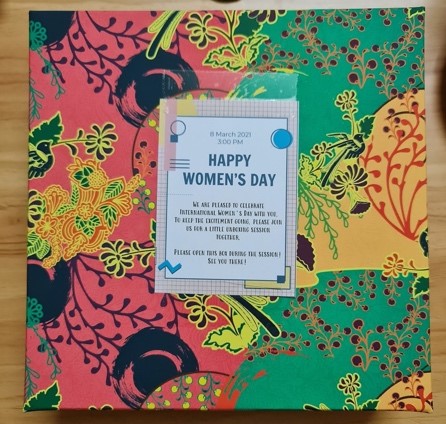
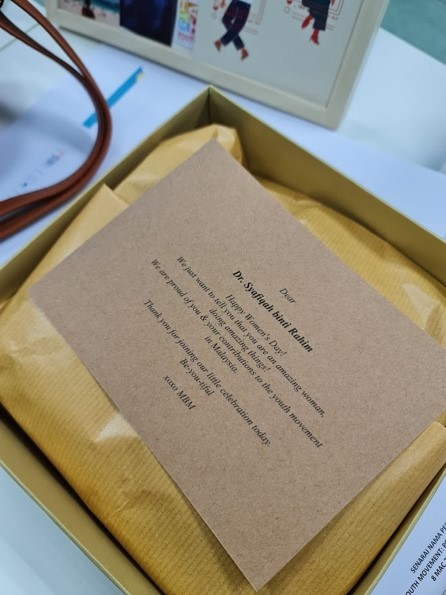
The packs contained hard backing paper, craft paper, scissors, glue, washi tape, glitter, pipe cleaners, stickers, pages from magazines pages and felt-tip pens. We also included items in line with an ethos of self-care and feminist caring practices, including face masks (one clinical, one sheet mask) and hand sanitiser. 

A strategy was adopted from the YouTube ‘unboxing’ trend, whereby all participants who had been posted the pack were asked not to open it until the event. Opening it together, all at once, gave the event a sense of being not only linked by the material sense of touching, feeling and engaging with the same materials, but also that we were working in a shared realtime. 

Following the discussion, we all opened our packs together. The enthusiasm in the space was tangible, as participants excitedly opened the package to discover the contents. 

We shared some images of simple feminist posters as inspiration, and discussed the ethos of DIY projects and ‘craftivism’ in feminist movement. Listening to a feminist-inspired playlist, broadcast via Zoom, we began making our individual posters. 

So, what did we learn and what’s next?

This was our first hybrid workshop and it taught us about the specific value of a feminist ethos in online spaces. Everyone, participants and facilitators, were working hard to be present in the virtual meeting space, and to build real connections online – in spite of our shared awareness that sometimes, as with many virtual events, we can feel like disconnected faces on a screen. We learned valuable lessons in the construction of a safe space to discuss feelings around sexism, feminism and gendered experiences, as well as a space in which to energise and inspire each other in our broader activist work. We were required to navigate the competing public and private spaces at work in activist circles, and respect these barriers when discussing complex, sometimes sensitive topics. This included considering the nature of sexism at work in activists’ lives, and the relationship these experiences had to their broader feelings about activism.  

We felt the posters that came out of the event demonstrated a keen awareness of specific feminist issues arising in participants’ lives. People explored body image issues, femininity, gender in workplaces, as well as broad themes of solidarity and sisterhood. Posters were as diverse in design as the topics discussed and there were many innovative and creative responses to the brief. Some made TikTok videos of their poster-making, sharing these online and bringing the virtual back in! More broadly, we felt the hybrid nature of the workshop, with physical craft packs and the tactile experience they facilitated, altered the feel of the event. It allowed for a greater feeling of connection between us all, and a sense that we were working in a shared space, with the same tools.

We had a few technical hiccups during the workshop, but believe that the feminist ethos of the event supported us to overcome them, with participants jumping into facilitator roles when technical issues occurred, and vice versa. We felt the way others stepped in when we as facilitators were faced with technical issues resonated with a broader feminist ethos of support. It highlighted the importance of solidarity and emphasised a feeling of: “it’s OK when things go wrong”. The less-/non-hierarchical facilitation allowed us to pass around the ‘power’, both in terms of making contributions to the content of the workshop, as well as in the facilitation of the event. 

We hope this ethos will continue into our future projects, and currently have two upcoming events :

1) an interactive movie screening featuring dialogue, discussion and debate around themes of feminism and sisterhood; and

2) A workshop on feminism and media, accompanied by an interactive workshop on gif and meme creation as a feminist practice. 

For updates on these projects follow @beliaMBM on twitter, Facebook and Instagram!

Call for Papers: Critically Exploring Co-production

Critically Exploring Co-production : A special issue of Qualitative Research Journal

The Gender and Education Association have been asked to share this call for papers for an exciting special issue of Qualitative Research Journal on co-production. Guest edited by Harriet Rowley, Kate Pahl, Gabrielle Ivinson and James Duggan, this special issue invites contributions that question whether university structures can accommodate research that is genuinely co-produced, highlight tensions in on-the ground co-productive practices, describe the often circuitous ways alliances emerge, and speculate about the limits and possibilities of co-production. 

This special issue invites people who are involved in co-production as practitioners as well as more academic pieces to contribute ideas. The editors envisage shorter pieces together with dialogues as well as asking discussants to reflect on some of the pieces. Experimentation with form is welcome. Initial abstracts are invited as part of this process. 

Contributions may cover the following areas: 

· Critical enquires into the role of the university in co-produced research projects 

· Co-production; research method or socio-political practice 

· Ethnography and co-production 

· Critical pedagogy and co-production 

· Arts practice and co-production 

· Creativity and co-productive practice. 

· Failure and co-production 

· Ethical dilemmas and co-production 

Submissions and deadlines

1. 500 word abstracts due 1st November 2020 – these can be sent to k.pahl@mmu.ac.uk .

2. Full papers of 3,000 to 7,000 words due 10 January 2021.

Download the full CFP here.

Engaging with trans/feminist herstories

By Kate Marston and Claire Thurlow

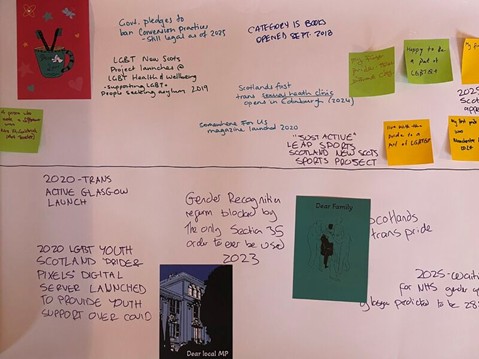
In the UK, the prominence of a number of anti-trans feminist voices in social and mainstream media has led American journalist Katelyn Burns to term anti-trans ideology as ‘the de facto face of feminism in the UK’ – but this belies a history of feminist and trans entanglements and alliances as well as the continued and resilient support of women for trans people to self-identify their gender. In June, the GEA Executive were amongst tens of thousands of individuals and organisations who wrote to the UK Prime Minister urging the government not to rollback trans rights or disregard the results of the Gender Recognition Act (GRA) consultation. For now, this show of support appears to have prompted the government to affirm that they will not restrict healthcare for young transgender people. Much more needs to be done however to safeguard and build upon existing protections for trans and non-binary people to ensure they can live their lives free of oppression, restriction and violence.

In this blog, we consider how academics and activists can build towards more trans positive futures through exploring some of the fraught yet rich herstories of ‘alliance-oriented trans and feminist politics’. Amid the intensified backlash against trans lives, it has been frustrating to observe the widespread circulation of ill-informed articulations of what feminism is and who constitutes a feminist subject. Dr. D-M Withers notes how so-called ‘gender-critical’ feminists in the UK ‘ventriloquize the building blocks of feminist knowledge upon which they stand, but simultaneously disavow’. Furthermore, Professor Talia Bettcher observes how prominent anti-trans academics fail to ‘display any sensitivity to the existence of a robust literature’ on the relationship between feminism and transgender theory and politics. Arguments against trans rights appear to require feminism to become a parochial single-issue project as opposed to a diverse set of intellectual and activist movements that have long recognised and challenged the complexities of patriarchal power as it intersects with other systems of oppression.

Legacies of anti-trans feminism

A number of feminist scholars have attempted to make sense of the historical legacies of trans exclusionary or anti-trans feminism that has taken particular hold in the UK. While feminist unease with the trans subject had been sporadically highlighted throughout the Women’s Liberation Movement (WLM), the foundational anti-trans text was Janice Raymond’s The Transsexual Empire (1979). It remains the most influential text and facets of it can be observed in most anti-trans feminist theorising and activism today. Crucially, Raymond’s book positioned trans identities as a threat to (cis) women. While initially more successful in the US, Dr. Sophie Lewis suggests that it is an import of this strand of US radical feminism that crossed over to the UK in the 1980s. Relatedly, Dr. Withers argues that the theoretical roots of anti-trans feminism in the UK were laid down by the renegade faction of ‘revolutionary feminism’ in the WLM associated with figures such as Sheila Jeffreys. Doubling-down on trans as threat, Jeffries was explicit in her belief in ‘transgenderism’ as a sexual perversion and the promotion of it as a men’s sexual rights movement. In a further attempt to make sense of trans exclusionary sentiment, Dr. Lisa Kalayji looks for the ideological and emotional foundations of anti-trans feminism within divisions over the ‘men question’ in the WLM and efforts to escape the unrelenting misogyny of the radical social movements of the ‘60s and ‘70s. Others still, trace the anti-trans stance to a continued colonial mentality that relies upon binary classifications and strict category policing (Phipps 2020; see also Lugones 2008). As Al-Kadhi argues, ‘Transphobia has its roots in the systems of colonial supremacy that sought to wipe out gender variance across the globe’.

The struggle for liberation

While the drive to uncover histories of anti-trans feminism offer valuable insights, scholars and activists have also sought to acknowledge the fruitful connections that exist between different struggles for gender justice (Halberstam 2017). Trans and women’s liberation have always been intimately linked by their struggle to escape patriarchal norms. The term gender (as now commonly understood) was developed by feminists from work by psychologists on trans and intersex subjects. Ultimately, women’s and trans liberation are both concerned with equity of rights and life opportunities, freedom from hegemonic gender and sexuality discourses and questions of power. Yet, the women-led social movements that arose during the 1970s have been persistently painted as inherently hostile to trans experiences, despite many trans and feminist scholars having challenged this characterisation.

Withers’ work highlights that the grand narratives ‘invoked within the paywalls of academic feminist theory or the rabid annals of twitter’ rarely do justice to the rich ‘conceptual and lived resources’ produced within the WLM which contributed to contemporary transfeminist discourse. Drawing on archival materials, they illustrate how the emergence of ‘women’s culture’ and women-only spaces was part of the ‘trans-formation of sex’ allowing for intensified experimentation where the ‘female sex was bent into new, irreversible shapes’. Women-only networks facilitated practices such as learning ‘how to fix PA systems, repair faulty car engines, explore the contours of a drum kit, or mend the plumbing’ which expanded the material politics of the female body and what it could do, be and become. Significantly, these spaces and networks were not marked by the same categorical differentiations between cis and trans women that shape contemporary feminist debates. Withers draws attention to testimonial and archival evidence that illustrates the presence of trans activists within the WLM noting, for example, that the keyboardist for the Northern Women’s Liberation Rock Band was a trans woman.

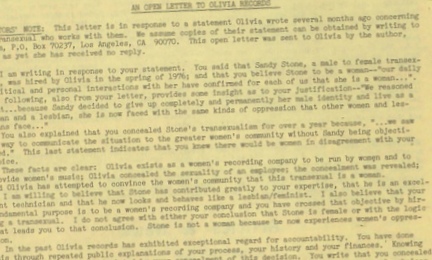
In a special issue on Trans/Feminisms, Stryker and Bettcher (2016) along with Cristan Williams (2016) and Emma Heaney (2016) map the involvement of trans activists in US-based lesbian feminist autonomous organisations in the early ‘70s. They explore, for example, the contributions of the lesbian trans folksinger Beth Elliot, Angela Douglas (the founder of the Transexual Action Organisation) and the trans inclusive politics of the radical feminist lesbian separatist music collective, Olivia Records. In an interview for Vice magazine, former Olivia Records engineer and pioneering trans studies academic Sandy Stone tells her story of living among lesbian separatists in the ‘70s. She details how revelatory it felt to discover ‘that you could be a woman without stereotyping anything, without encountering traditional cis female culture at all’ and travel through a ‘rhizome’ of ‘lesbian safe houses’ from ‘coast to coast and never encounter someone presenting as male, like a wonderful parallel subculture—or superculture.’

Margulies, Candace.  “An Open Letter To Olivia Records.”  Clipping.  1977.  Digital Transgender Archivehttps://www.digitaltransgenderarchive.net/files/ft848q88b  (accessed August 13, 2020).

When trans exclusionary feminists such as Janice Raymond began threatening and harassing Olivia Records, Stone details that she initially ‘felt really protected by the women of the Collective’. However, the unrelenting nature of the attacks and the risk of boycott action led Stone to leave. Following on from Olivia Records, Stone went on to earn her doctorate with supervision from Donna Haraway and in a faculty comprised of legendary feminist academics such as Angela Davis, Gloria Anzaldua and Teresa De Lauretis. Stone proceeded to publish one of the founding essays in transgender studies, The Empire Strikes Back: A (post)transsexual manifesto 

A place for trans lives in all feminisms

These collective and inclusive herstories question the current common understanding that particular strands of feminism are necessarily trans exclusionary. Furthering the view that there is no inherent need for tension between lesbian feminism and trans-inclusion, and calling for a revival of (a trans-inclusive) lesbian feminism, Sara Ahmed (2017, p. 227) notes: ‘I would suggest that transfeminism today most recalls the militant spirit of lesbian feminism in part because of the insistence that crafting a life is political work’. Ahmed’s assertion that transfeminist texts ‘assemble a politics from what they name’ (ibid), showcases one of the many commonalities between lesbian and trans feminisms. Both lesbians and trans people have been rendered menacing and monstrous killjoy figures within and outside of feminist spaces (see Mitchell and McKinney 2019; Stryker 1994).

Similarly, and contrary to the popular belief that radical feminism and anti-trans feminism are somehow synonymous (not least due to the infamy of the moniker ‘TERF’), radical feminism does not necessitate hostility towards trans people. Catherine McKinnon and Andrea Dworkin, two of the most prominent and celebrated radfems, were both supportive of trans inclusion. In 2015 McKinnon stated “I always thought I don’t care how someone becomes a woman or a man; it does not matter to me. It’s just part of their specificity, their uniqueness like, everyone else’s. Anyone who identifies as a woman, wants to be a woman, is going around being a woman, as far as I’m concerned, is a woman.”

Intersectionality and the category of ‘woman’ 

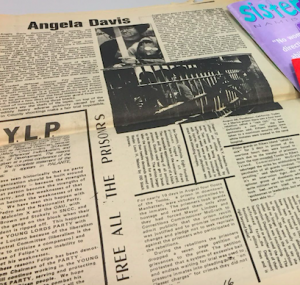
In the aforementioned TSQ special issue, Stryker and Bettcher (2016) also credit the intersectional feminist analyses promulgated by US feminists of color in the 1970s and 1980s with laying the foundation for transfeminist theories and practices. They observe that by raising the question of ‘whether “woman” itself was a sufficient analytical category capable of accounting for the various forms of oppression that women can experience in a sexist society’, Black feminists ‘called for an account of multiple “differences” of embodied personhood along many different but interrelated axes’ (Stryker and Bettcher 2016, p. 8).[1] Transfeminist scholars and activists have not only drawn from the work of Black feminists but also contributed their own intersectional analyses to the fight against racism, state violence and other oppressions (Bettcher 2007). Angela Davis recently credited trans and non-binary communities with contributing to abolitionist feminism by demonstrating that it is possible to imagine more socially just worlds that challenge ‘that which is totally accepted as normal’.

Article on Angela Davis in Women’s LibeRATion magazine (1970)

Black feminist and trans scholars have also explored the historical imbrication and interplay between Blackness and transness (Riley Snorton 2017; Bey 2017; Sharpe 2016). Marquis Bey (2018, p. 165) illustrates that the ‘subjective nexus of Black and woman, for example, irrespective of an identified trans gender, also experiences the surveillance and invasion of their bodies going through airport security (e.g hair searches), expulsion from bathrooms, housing discrimination and historical invalidation of their womanhood’. Scholars including Lola Olufemi (2020) and Alison Phipps (2020) have noted the ‘whiteness’ of the UK anti-trans feminist movement. Phipps further suggesting the paucity of British intersectional analysis, relative to the US work noted above, as a contributing factor to the prominence of ‘gender critical’ views in the UK. Dr. Gail Lewis observes how Black women’s work in Britain was denied credibility and respect by white feminists as they entered the Academy and formed women’s studies networks and reading lists.

Continuing to learn from one another

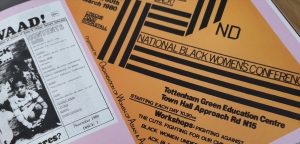
OWAAD poster (1980)

Given the marginalisation of Black British feminist thought within the Academy, it is important to re-visit and learn from the Black and working class women-centred social movements, such as Wages for Housework and the Black Women’s Movement, that thrived alongside the predominantly White and middle class WLM in 1970s Britain. Significantly, these movements did not share the same unease with trans subjectivity as expressed by minority factions of the WLM. Lewis, who was a co-founder of the Organisation for Women of African and Asian Descent (OWAAD) and member of the Brixton Black Women’s Group,  highlights that the Black Women’s Movement always questioned limited articulations of gender and notes her surprise at those who have been so troubled by trans* politics. The Black Women’s Movement and Wages for Housework were characterised by coalitional working between contingently autonomous groups, activating ‘an organizational tactic to mobilize across and beyond existing racial, gender, sexual, and class configurations while recognizing the irreducible differences’ (Capper and Austin 2018, p. 449). Wages for Housework, for example, was an international movement comprised of autonomous groups such as Black Women for Wages for Housework, Wages Due Lesbians (now Queer Strike) and the English Collective of Prostitutes.

Transfeminist scholars and activists have turned to the organisational tactics and theoretical interventions of these Black and working class women-centred social movements for inspiration. Dr. Nat Raha, for example, observes how the Wages Due Lesbians campaign provided important insights into queer social reproduction by challenging the heteronormativity within Marxist feminist conceptualisations of unwaged domestic labour. Unlike the lesbian separatist movements referenced earlier, the largely Canadian / UK-based Wages Due campaign did not advance lesbianism as necessarily liberatory in itself. Instead, they noted how economic power continued to shape and limit women’s sexual choices (Caper and Austin 2018, p. 449). Raha draws on the work of Wages Due in order to advance a radical transfeminism and highlight the limits of trans liberalism. Rather than focusing on securing a particular ‘packet of entitlements’ and rights for trans people, a radical transfeminist agenda explores possibilities for common struggle across the intersecting issues of precarious working conditions, transmisogyny and sexism, white supremacy, ableism and sex work. Raha looks to contemporay and historical queer and trans-focused mutual aid support as a strategy for survival and world-building. 

Conclusion

We are undoubtably living through a moment where trans lives are subject to unwarranted scrutiny and conjecture; where the historical imagining of trans as threat has reemerged and rejuvenated. That this image is often promoted by a small section of women from within the feminist movement remains disappointing. However, in the prevailing social and traditional media narrative it is easy to overlook the uplifting herstory of trans-feminist alliances which have been integral to the women’s liberation movement and which continue to inform and enrich our understandings; it is easy to overlook the collective struggles endured and the support and solidarity enjoyed. Scholars and activists demonstrate that it is in feminisms’ recognition of difference and shared experience that it is at its most sophisticated and demanding. At its best feminism is a movement that understands its role as a collective liberator of the margnalised and resists being reduced to a parochial border guard preoccupied with reserving womanhood for a privileged few.

Bio

Claire Thurlow is a PhD candidate in the School of Law and Politics at Cardiff University. Her current research looks at contemporary feminist reactions to trans identities in the UK. Her wider research interests concern the intersections and divergences of feminism, queerness and LGBTQ. She is a white cis-gender queer whose pronouns are she/her. 

Kate Marston is a PhD candidate in the School of Social Sciences at Cardiff University. Her research draws on feminist posthuman and new materialist theories to explore young people’s digital sexual cultures through creative, visual and arts-based methods. She is a white middle-class genderqueer lesbian whose pronouns are she/they.

References

Ahmed, S. 2017. Living a Feminist Life. Durham & London: Duke University Press.

Bettcher, T. 2007. Evil deceivers and make-believers: Transphobic violence and the politics of illusion Hypatia: A Journal of Feminist Philosophy, 22 (3), pp. 43–65.

Bey, M. 2018.  “Other Ways to Be: Trans.” Women and Language 41(1), pp. 165 – 167.

Bey, M. 2017. “The Trans*-Ness of Blackness, the Blackness of Trans*-Ness.” TSQ: Transgender Studies Quarterly 4(2), pp. 275 – 295.

Capper, B. and Austin, A. 2018. “Wages for housework means wages against heterosexuality”: On the Archives of Black Women for Wages for Housework and Wages Due Lesbians. GLQ: A Journal of Lesbian and Gay Studies 24(4), pp. 445 – 466.

Halberstam, J. 2017. Trans: A Quick and Quirky Account of Gender Variability. Berkeley: University of California Press.

Heaney, E. 2016. Women-Identified Women: Trans Women in 1970s Lesbian Feminist Organising TSQ: Transgender Studies Quarterly 3(1-2), pp. 137 – 145.

Lugones, M. 2016. The Coloniality of Gender in Harcourt, W. (Eds) The Palgrave Handbook of Gender and Development: Critical Engagements in Feminist Theory and Practice London: Palgrave Macmillan

Mitchell, A. and McKinney, C. 2019. Inside Killjoy’s Kastle: Dykey Ghosts, Feminist Monsters, and Other Lesbian Hauntings. Vancouver: UBC Press.

Olufemi, L. 2020. Feminism Interrupted: Disrupting power. London: Pluto Press

Phipps, A. 2020a. Me, Not You: The trouble with mainstream feminism. Manchester: Manchester University Press.

Phipps, A. 2020b. Transphobia, whorephobia and (as) capitalist-colonial gender Manchester: Manchester University Press

Raymond, J. 1979. The transsexual empire: The making of the she-male. Boston: Beacon Press.

Riley Snorton, C. 2017. Black on Both Sides: A Racial History of Trans Identity. Minneapolis: University of Minnesota Press.

Sharpe, C. 2016. In the Wake: On Blackness and Being. Durham: Duke University Press.  

Stryker, S. 2004. Transgender Studies: Queer Theory’s Evil Twin. GLQ: A Journal of Lesbian and Gay Studies 10(2), pp. 212-215.

Stryker, S. and Bettcher, T. 2016. Introduction: Trans/Feminisms TSQ: Transgender Studies Quarterly 3(1-2), pp. 5 – 14.

Williams, C. 2016. Radical Inclusion: Recounting the Trans Inclusive History of Radical Feminism TSQ: Transgender Studies Quarterly 3(1-2), pp. 254 – 258.