This post is part of the Countdown to Conference (C2C) series. We would love to feature a brief blog post from you too! Visit our main Countdown to Conference page for details! For more information about #GEAConf2019 visit the conference website
C2C: Keynote Speaker Professor Deevia Bhana Keynote Date: Wednesday 26th June
Keynote Title: Facing South: Love, sex and teenage sexual cultures in South Africa
Abstract: Under conditions of ongoing economic misery and precarious social existences, the sexualities of young South Africans are often positioned within the realm of sexual danger and written and thought about as loveless. Instead, close-up studies of teenage sexualities brings teenagers’ pleasures, pains and desires to centre stage, and takes heed of its gendered effects and local configurations of power. It remains an embryonic field of study, and in this keynote presentation I join in the conversation in facing teenage sexualities in the South. I situate teenage con-structions of love, sexuality and desire within a wider social and cultural context underwritten by the histories of colonialism and apartheid, chronic unemployment, poverty, and stark economic and infrastructural inequalities. I draw on a larger research project titled Learning from the Learners, which views teenagers as active agents and has thus generated a more nuanced picture of young peoples’ desires, and the dangers and dilemmas they must navigate as they explore their sexuality. I show how teenagers’ are deeply invested in—and concerned about—many types of love: queer, romantic, pure, violent, material, and provider. I argue that teenagers’ conceptions of love, romance, fear and desire serve as important anchors in the social constitution of teenage sexuality; conversely, the expression of sexuality is often distressing in the context of structural violence, cultural norms, the regulation of female sexuality, and the hegemonic power of heterosexuality. Taking into account African teenagers’ in-your-face realities, this paper encourages an acknowledgment of their sexualities that rejects the stereotypes of fear and danger, and offers new entry points into more relevant sexuality education that can meet the needs of those that matter.
Bio: Professor Deevia Bhana is the NRF/DST South African Research Chair and Professor in Gender and Childhood Sexuality at the University of KwaZulu-Natal. She is known for her interdisciplinary approach and critical stance in researching childhood sexuality, gender, schooling and young people in South Africa and her international outlook in shaping the field of young people’s sexualities. Among her recent book publications are Love, Sex and Teenage Sexual Cultures in South Africa; 16 turning 17 (2018) and Childhood Sexuality and AIDS Education: The price of innocence (2016); Gender and Childhood Sexuality in Primary School (2016) and Under Pressure: the regulation of sexualities in South African Secondary Schools (2014).
See Professor Bhana deliver her inaugural lecture at University of KwaZulu-Natal:
https://youtu.be/p0UPkBZ3RP8
If you are attending conference, let us know on Twitter using the hashtag: #GEAconf2019
This post is part of the Countdown to Conference (C2C) series. We would love to feature a brief blog post from you too! Visit our main Countdown to Conference page for details! For more information about #GEAConf2019 visit the conference website
C2C: Looking Back, Looking Forward Zibah Nwako, University of Bristol
So, how did I get here? Looking back, I would describe
my PhD study as an indirect consequence of my professional background as a
self-development trainer and consultant. Although my main experience is from
administration and informal education – as a proprietor of several
out-of-school clubs – my career trajectory has certainly not been a linear one.
Having spent 8 years serving children in pre-school/nursery, primary and secondary schools, I moved on to becoming a licensed trainer for the Springboard Women’s Development Programme, run by the Springboard Consultancy in the UK. In 2008, I had the privilege of establishing the programme in Nigeria, West Africa where I train up to 30 participants per course. One of the outputs from this was a culturalisation of the Springboard workbook to suit the Nigerian context, which was an enlightening experience.
Fast forward to 2014 and I headed to the
University of Bristol to study for a Masters’ degree in Educational Leadership,
Policy and Development. For my research dissertation, I studied the impact of informal learning on the aspirations and
experiences of girls in rural
Nigeria – including through folklore, ethnic practices, traditions and village
customs.
On the professional side, I expanded my
portfolio (again with the Springboard Consultancy) by becoming a ‘Sprint’
trainer – the Springboard equivalent for female university students. When it was
time to choose a topic for doctorate study, one of my previous supervisors
suggested, ‘Why don’t you marry your two interests – self-development and young
women?’ She was right, and the topic was birthed! I am now therefore exploring
the wellbeing of female undergraduate students in Nigeria from a social justice
perspective and using the capability approach.
From her research on the capabilities that matter for gender
equality, Prof. Melanie Walker wrote in a policy brief, ‘Women were expected to
study in conditions where the expectations, norms, values, traditions and ways
of behaving are derived from masculinised conceptions of what is “normal”’
(Walker, 2017 p. 1). This is certainly reflected in this study which I
conducted with the female students as my research partners.
As this is my first time of attending the GEA conference, I am keen to share some of my research partners’ lived experiences and to reflect on the wider factors (socio-cultural, environmental and political) that impact on their wellbeing. In accordance with the conference theme, I will highlight the prevailing gender-based invisibilities and inequalities that they face, particularly in student political activism. I also look forward to a communication of ideas with which to contextualise the Sprint programme in support of the wellbeing of female students in Nigerian higher education.
If you are attending conference, let us know on Twitter using the hashtag: #GEAconf2019
This post is part of the Countdown to Conference (C2C) series. We would love to feature a brief blog post from you too! Visit our main Countdown to Conference page for details! For more information about #GEAConf2019 visit the conference website
C2C: Keynote Speaker Professor Kalwant Bhopal Twitter: @KalwantBhopal Keynote Date: Thursday 27th June
Keynote Title: Competing Inequalities: Gender, Race and White Privilege in Higher Education Institutions in the UK
Abstract: This presentation will draw upon recent research from two projects exploring the impacts and institutional experiences of the Athena SWAN (ASC) and Race Equality (REC) Charter Marks in UK universities (Bhopal and Pitkin, 2018; Bhopal and Henderson, 2019). The findings from these studies examine how charter marks are shaping and influencing practice in universities, particularly in relation to gender, race and White privilege. I argue that in higher education policy making, there has been a privileging of gender over race in terms of addressing inequalities in higher education. Whilst acknowledging the persistence of inequalities in both groups, the data from these projects highlights a significant risk that gender and race inequalities become conflated in current equalities work. As a consequence of a logic of efficiency that drives Higher Education Institutions (HEIs) to combine gender and race equalities work, and the privileging within this combination of gender, HEIs publicly work towards equality and inclusion in general terms. Consequently they do so without having to confront uncomfortable and deeply embedded practices that perpetuate White privilege in the academy (Bhopal, 2018).
Bio: Professor Kalwant Bhopal is Professor of Education and Social Justice and Deputy Director of the Centre for Research in Race & Education (CRRE) at the University of Birmingham. Professor Bhopal’s research focuses on the achievements and experiences of minority ethnic groups in education. She has conducted research on exploring discourses of identity and intersectionality examining the lives of Black minority ethnic groups as well as examining the marginal position of Gypsies and Travellers. Her research specifically explores how processes of racism, exclusion and marginalisation operate in predominantly White spaces with a focus on social justice and inclusion. She is Visiting Professor at Harvard University in the Harvard Graduate School of Education and Visiting Professor at Kings College London (Department of Education and Professional Studies). Her most recent book, White Privilege: the myth of a post-racial society was published in 2018 by Policy Press.
This post is part of the Countdown to Conference (C2C) series. We would love to feature a brief blog post from you too! Visit our main Countdown to Conference page for details! For more information about #GEAConf2019 visit the conference website
C2C: Keynote Speaker Professor Heidi Safia Mirza Twitter: @HeidiMirza Keynote Date: Tuesday 25th June
Keynote Title: Dismantle, Decolonise and Disgrace: Black feminism and the challenges of racism and sexism in higher education
Abstract: What does racism and sexism look like in our institutions of higher education in so called post-race and post-feminist times? To answer this crucial question this keynote lecture draws on black feminist perspectives to explore the lives of Muslim, Black and Asian women who study and work within the unsafe spaces of patriarchal whiteness and asks how do we confront endemic sexual violence and dismantle embedded racism in our elite places of teaching and learning. Drawing on my intersectional research on gender, race and faith and the pedagogic practices, I reflect on the embodied work we must do as feminist teacher-learner-activists so we can survive and thrive and truly decolonise our institutions of higher learning.
Bio: Heidi Safia Mirza is Emeritus Professor in Equalities Studies, UCL Institute of Education and visiting Professor of Race, Faith and Culture at Goldsmith’s College, University of London. She is known for her pioneering intersectional research on race, gender and identity in education and has an international reputation for championing equality and human rights for women, black and Muslim young people through educational reform. She is author of several best-selling books including, Black British Feminism: A Reader;Race, Gender and Educational Desire: Why black women succeed and fail; Black and Postcolonial Feminisms in New Times: Researching Educational Inequalities; Respecting Difference: Race, faith and culture for teacher educators; and Young Female and Black, which was voted in the BERA top 40 most influential educational studies in Britain. Her most recent book is Dismantling Race in Higher Education: Racism, whiteness and decolonising the academy (Palgrave McMillian 2018).
See a video from a recent CRASSH Impact event featuring Professor Mirza in conversation with author Reni Eddo-Lodge, author of Why I’m No Longer Talking to White People About Race, chaired by NUS President Shakira Martin:
If you are attending conference, let us know on Twitter using the hashtag: #GEAconf2019
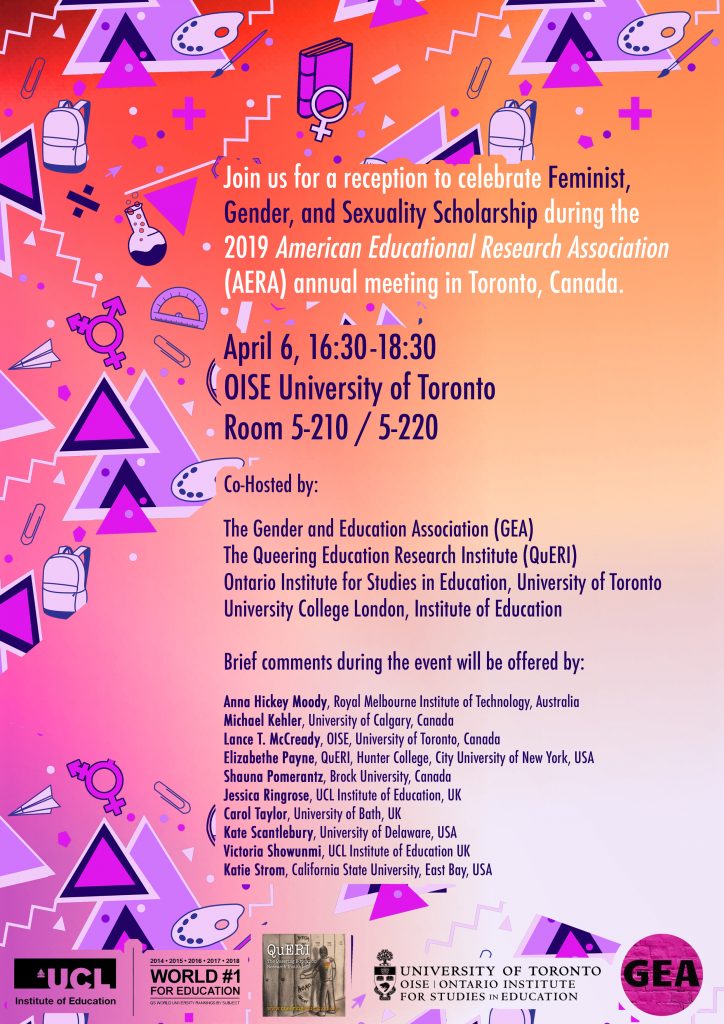
GEA is pleased to be co-hosting a celebration of Feminist, Gender and Sexuality Scholarship at the American Educational Research Association’s Annual Meeting this April.
In collaboration with the Queering Education Research Institute (QuERI), Ontario Institute for Studies in Education and the Institute of Education, UCL, this event will feature contributions from inspiring scholars in the field of gender and sexuality education. Speakers include:
Anna Hickey-Moody, Royal Melbourne Institute of Technology, Australia
This post is part of the Countdown to Conference (C2C) series. We would love to feature a brief blog post from you too! Visit our main Countdown to Conference page for details!
C2C: Why and How to GEA 2019 – Reflections from an early Career Researcher Dr Carli Rowell, University of Glasgow, Twitter @carliriarowell
In this short blog post Carli Rowell reflects on her experiences of attending GEA 2018 one month after completing her PhD. Whilst Carli could compile an entire handbook of reasons of why and tips of how to GEA 2019 here she reflects on her top three reasons.
Related to Carli’s post, check out tweets from GEA Conference 2018 at the University of Newcastle, Australia #GEAConf2018 Wakelet
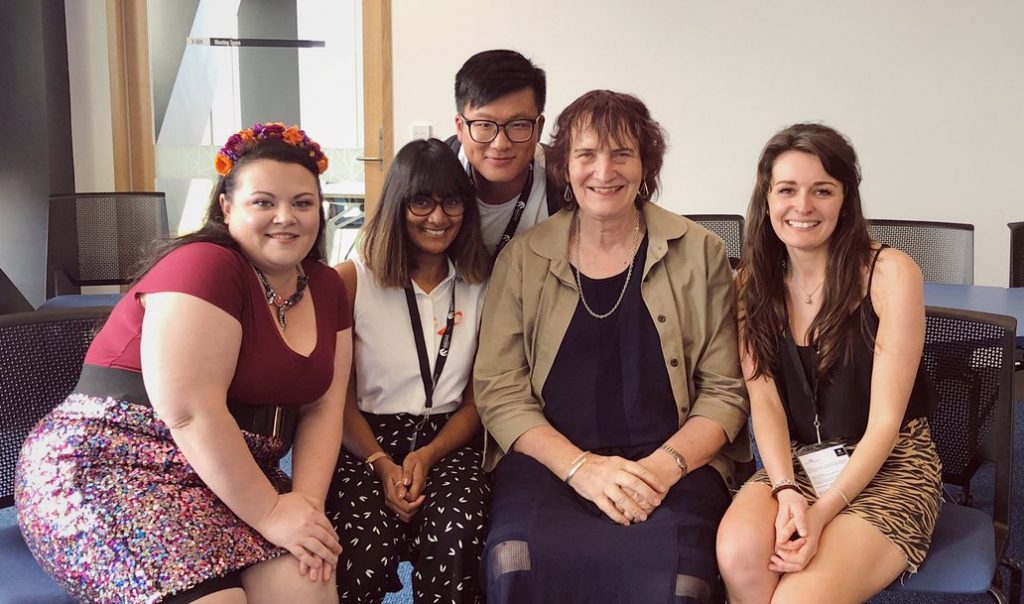
Early Career Researchers Dr Jessica Gagnon, Dr Yuwei Xu, and Dr Carli Rowell with Professor Vanita Sundaram and Professor Emerita Raewyn Connell at GEA 2018
Exactly one month after my viva oral exam I boarded a plane at London Heathrow and embarked on the some ten thousand plus mile journey that was to take over 24 hours, included two transfers (Singapore and Brisbane), three planes and a bus ride. How did I feel? Well, in all honesty, I was exhausted, physically and intellectually. Excited yes, but mostly energy less in an all-encompassing mind and body kind of way (my soul was very much fired up!).
I was exhausted from the roller coaster of emotions that is part of the parcel of submitting a PhD, awaiting the viva, preparing for the viva, having the viva and then planning for life after the viva… Gosh life after the viva!! As I boarded the plane, located my seat and took out my laptop and begun to work on reducing my ‘to do list’ I could not help but ask myself if travelling over ten thousand miles to attend GEA 2018 and give a paper on my doctoral research was really a sensible idea? Perhaps I should have stayed back and opted for some much needed R&R instead? Or simply spent the time tackling with my ever expanding ‘to do’ list? This would have been the sensible thing to do right? Well… sensible I am not, nor have I ever been and for that I am glad. Having attended and returned from GEA 2018 here are my reflections on why I would encourage fellow PhD’s and ECR’s to attend this year’s GEA, albeit for us UK based academics it doesn’t quite involve a ten thousand mile international commute.
Dr Carli Rowell presenting at GEA 2018
Attend GEA for it’s supportive, stimulating and collegiate environment: The first and foremost thing that stands out as being at the top of list of reasons why I would encourage anyone to attend GEA, but especially PhD’s and ECR’s is due to the collegiate, supportive yet stimulating nature of the environment in which one is presenting. From the outset, from the very first moment of attending the ECR pre conference day attending GEA felt like attending a family gathering. Meeting new researchers from the field felt a lot like meeting distance relatives that you have never met but nonetheless treat you like family. GEA was a welcoming and friendly environment in which to present my doctoral research (an ethnography of working-class students at an elite university) to an international audience. The discussion and questions that follows the presentations given were stimulating and supportive. My advice to any one presenting or attending for the first time – leave the nerves at the door, you need not be worried about how your paper will be received or what reaction it might evoke. Just enjoy the process of presenting.
Attend GEA because it is good to have an intellectual holiday from time to time: Conferences to me always feel like an academic holiday. Yes they are often characterised by long days, and deep intellectual thought and so, unlike an actual holiday you don’t really get the chance to turn your brain off. Nonetheless, conferences often feel like a holiday to because you get to go somewhere new, take a seat, sit back and listen to amazing research within and beyond ones field- and there is something rather luxurious about that. All, whilst sipping tea and scoffing cake (if you so wish). This provides a great opportunity to dip ones toes into a new area of research not previously considered, or to expand and consolidate existing areas of interests. Given this enjoyment, it does indeed feel like an academic holiday, or at least to me it does anyway. However, unlike holidays conferences take an immense amount of work. It is not simply a case of book and go. The conference is only possible because someone, somewhere, often along in collaboration with colleagues has taken the time to craft a conference proposal and then found the time to plan, host and execute said conference along with the help of many others from catering staff, to conference ICT staff (among many others). For this I am exceptionally grateful to the organising committee, GEA committee per se and all those involved.
My third and final reflection reads not much as a reason why one should attend by rather how to attend GEA 2019. Importantly, when at GEA, take time to take time out: Conferences are highly sensory experiences, you see, think, hear and in some instances feel. The papers we hear often impact us on an affective level and not solely an intellectual one. Added to this at conferences we meet new people, learn new things and all whilst navigating around a new city / university. As much as academic conferences are sites of excitement and inspiration they can be sites of exhaustion. So my number one piece of advice is thus: do not feel like you need to attend everything. If you are tired take time to sit out of a session and collect yourself. And remember, collecting one’s self takes different forms. For instance, you might want to find somewhere quiet, to sit on your own where you won’t be bothered. Or you might want to take a walk outside, get some fresh air or maybe treat yourself to a drink at a nearby coffee shop. You might simply just want to take 5 minutes to talk about something totally unrelated to academia or the conference per se.
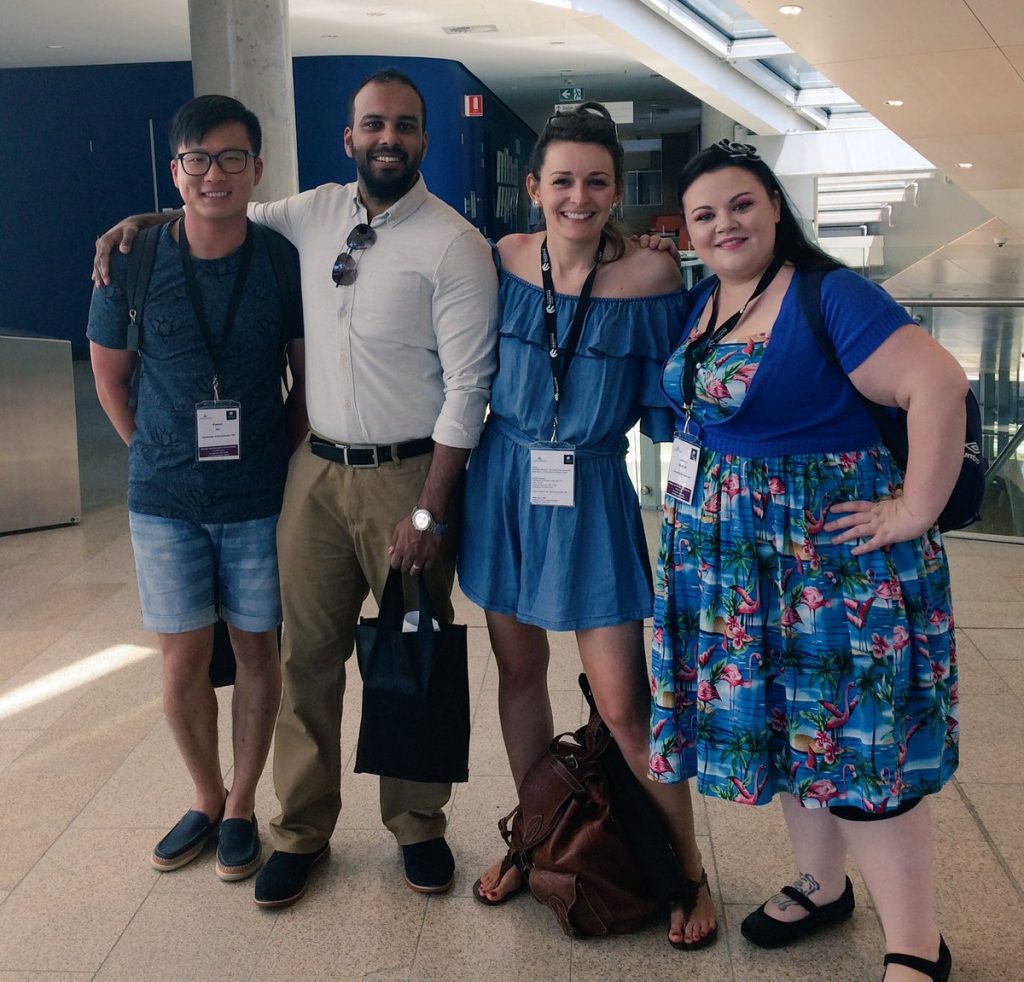
Early Career Researchers Dr Yuwei Xu, Dr Arif Mahmud, Dr Carli Rowell, and Dr Jessica Gagnon
Collecting yourself might also come in the form of making the
conscious decision to stay in bed that little bit longer, opting to re-charge
your battery by starting your day a little later as opposed to dragging
yourself half asleep to that 9am session or you might want to head home a
little earlier. Importantly, whatever you do to recharge mid conference, try to
do so without feeling like you are bunking off work, or feeling guilty that
you’re not attending a paper when others have attended yours. Importantly, try
not to give into the dreaded fear of missing out. Instead try to rechannel
you’re thinking to understand that taking time out it as vital component of
conference self-care. After all, you can’t pour from a glass that’s empty.
Biography Carli Ria Rowell is a Postdoctoral Research Fellow at the University of Glasgow in the GCRF ESRC funded Centre for Sustainable, Healthy and Learning Cities and Neighbourhoods. Carli is a sociologist, feminist and ethnographer and much of her work grapples with issues pertaining to contemporary social, spatial and geopolitical (im)mobilities particularly in relation to educational (in)equalities. Prior to Glasgow Carli held positions at the University of Sussex and the University of Warwick. Her ESRC PhD (Warwick) was an ethnography of working-class students at an elite university. She is passionate about the sociological imagination, feminist research and teaching and inclusivity within academia and currently serves on the Executive Committee of the Feminist and Women’s Studies Association (UK & Ireland) and as a co-convenor of the British Sociological Associations Early Career Forum.
If you are attending conference, let us know on Twitter using the hashtag: #GEAconf2019
This post is part of the Countdown to Conference (C2C) series. We would love to feature a brief blog post from you too! Visit our main Countdown to Conference page for details!
C2C: What to expect at GEA Conference 2019 Dr Jessica Gagnon, GEA Conference 2019 co-chair
Happy International Women’s Day 2019! #IWD2019 As we countdown to the next exciting Gender and Education Association International conference, we wanted to share what we have planned here at the University of Portsmouth.
The Conference programme is coming together We received a record number of abstract submissions this year and we are so pleased with the programme of keynotes, presentations, symposia, workshops, and social events. Presenters will be informed of peer review decisions today and tomorrow and the full programme will be published online on 29th April.
Through the conference theme, About face: Identities, In/visibilities, Inequalities, and Intersections in education, we look forward to exploring identities, in/visibilities, inequalities, and intersections in education through a gendered lens. Engaging with and expanding upon contemporary debates about educational inequalities (at both national and global levels), the wide and varied presentations this year will discuss, challenge, and address how structural forms of oppression – such as (hetero)sexism, racism, classism, and ableism – operate within and shape educational environments and institutions. Over the course of the conference, one of the primary aims is to move beyond discussion towards a collectively-created call to action to address systemic inequalities in education at local, national, and international levels.
Social Events In addition to hearing stellar keynotes and sharing research, activist, creative, pedagogical practices and ideas throughout conference, there will be great opportunities to share a dance and laugh. The social events for the conference include:
Monday 24th June: After the pre-conference sessions for students, early career researchers, and teachers, join us for a Feminist Pub Quiz with prizes for winning teams. Teams can form in advance or participants can be placed in random teams to get to know new people.
Tuesday 25th June: Kick off the first official night of conference with a Feminist Dance Party featuring DJ Rebel Girl. Brighton, UK-based feminist Vicki Cook is DJ Rebel Girl. She is the creator and organiser of Brighton’s FemRock, Queer Prom, and Grrrls to the Front. She is a resident DJ at The Green Door Store and DJs regularly at the Marlborough Pub & Theatre.
Wednesday 26th June: Weather permitting, we’ll be in the sunshine for a Wine Reception and BBQ, including giant outdoor versions of your favourite games like Jenga.
Join GEA or Renew your GEA Membership All presenters and attendees of the GEA conference must be GEA members. Please become a member or renew your membership before you register for the conference: http://www.genderandeducation.com/join/ GEA membership rates: £30 for standard membership; £15 for reduced/student membership (proof of eligibility required). Please note that it may take up to three business days for your GEA membership or renewal to be processed as GEA only has part time administrative support.
Register for the Conference Registration opens online next week on 15th March.
Apply for a Bursary Ten registration bursaries are available. GEA will also be granting two partial travel bursaries to support travel costs. To be considered for a bursary, please complete this online form by 1st April: http://bit.ly/GEAbursary Bursary decisions will be shared by 12th April.
About the University of Portsmouth The University of Portsmouth’s commitment to equality and diversity is aligned with the Gender and Education Association’s own commitments to challenging and eradicating sexism and gender inequality within and through education. The University is proud to have achieved an Athena SWAN Bronze Award, recognising our commitment to gender equality and the University is currently pursuing the Race Equality Charter. There is a strong gender studies and feminist research culture across the university. Highlights include the excellent research work of the academics within the Women’s and Gender Studies research cluster and the Global Education, Childhoods and Outreach research cluster.
About the city of Portsmouth Excerpts from the website https://www.visitportsmouth.co.uk/: Portsmouth is a dynamic and vibrant waterfront city packed with great reasons to visit. Ideally situated on the south coast of England, the UK’s only island city is ideal for a short break by the sea. There are lots of things to do in Portsmouth, with magnificent museums, live music venues, contemporary art galleries, two cathedrals, a diverse literary heritage, nightlife, festivals and countless events throughout the year. There’s also Portsmouth Historic Dockyard, the UK’s premier destination for Naval History. Inside you’ll find 11 attractions including Lord Nelson’s flagship HMS Victory, HMS Warrior 1860, the Mary Rose, and the National Museum of the Royal Navy. You can also get out onto the water on the Harbour Tour excursions, or take the waterbus to Gosport to see the Royal Navy Submarine Museum and Explosion Museum. More information about the city’s Accommodation, Hotels, Bed & Breakfasts, Self Catering, Restaurants, Pubs, Parking & Maps.
Important Dates:
15th March: Registration opens
1st April: Deadline to apply for a bursary
12th April: Bursary decisions shared
23rd April: Deadline for presenters to register for the conference
29th April: Full programme published online
12th May: Early bird deadline (for non-presenters)
7th June: Registration closes
24th June: Pre-Conference Day (free sessions for students, early career researchers, and teachers, spaces limited)
Check out tweets from GEA Conference 2018 at the University of Newcastle, Australia #GEAConf2018 Wakelet
Read two excellent blog posts: one by Dr Kara Kennedyblog post and one by Dr Charlotte Morris blog post, both covering highlights from GEA Conference 2018 at the University of Newcastle Australia
Check out the tweets from GEA Conference 2017 at the University of Middlesex in this #GEAConf2017 Wakelet curated by Kate Marston, GEA Social Media intern and watch video highlights from the 2017 conference
If you are attending conference, let us know on Twitter using the hashtag: #GEAconf2019
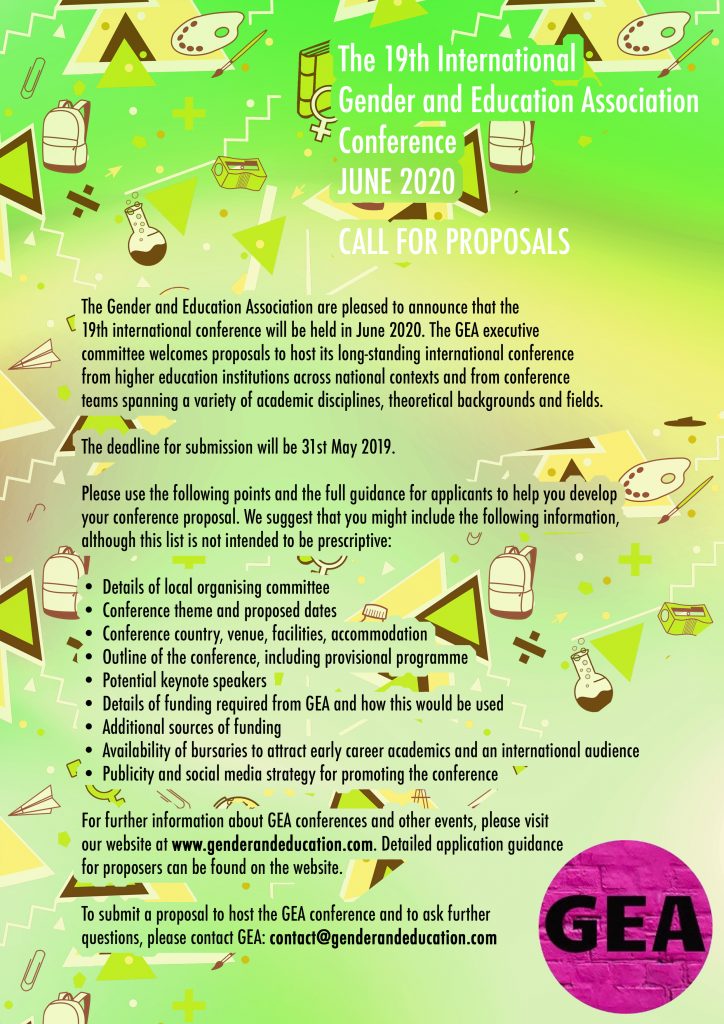
Could your institution host the Gender and Education conference in 2020?
With preparations well underway for #GEAconf2019 at the University of Portsmouth, we turn our attention to conference plans for 2020.
GEA are pleased to announce that the 19th international conference will be held in June 2020. The GEA executive committee welcomes proposals to host its long-standing international conference from higher education institutions across national contexts and from conference teams spanning a variety of academic disciplines, theoretical backgrounds and fields.
The deadline for submissions is 31st May 2019.
For further guidance on submitting your application, please click here.
To ask further questions e-mail contact@genderandeducation.com.
Wondering what to expect at a GEA Conference? Check out highlights from #GEAconf2017 below:
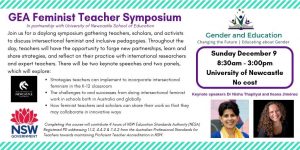
GEA FEMINIST TEACHER SYMPOSIUM 2018, NeW Space, The University of Newcastle, Australia
Join us on Sunday, December 9 from 8:30-3pm for a daylong symposium gathering teachers, scholars, and activists to discuss intersectional feminist and inclusive approaches to pedagogy. Throughout the day, teachers will have the opportunity to forge new partnerships, learn and share strategies, and reflect on their practice with international researchers and expert teachers.
This first-ever symposium, delivered as part of the 2018 international Gender and Education Association conference hosted by the University of Newcastle, will cover topics such as intersectional feminist theory; feminist digital literacies; anti-bullying and harassment; student-led activism and civic engagement; and inclusive pedagogical practices suitable for primary, secondary and tertiary educators.
The Gender and Education Association (GEA) has held biennial conferences since 1997 to facilitate the gathering of world-leading scholars in this area of research. Throughout the day, speakers will address how these areas can be included in curriculum design, student assessments, and institutional change.
There will be two keynote speeches and two panels, which will explore:
Strategies teachers can implement to incorporate intersectional feminism in the K-12 classroom
The challenges to and successes from doing intersectional feminist work in schools both in Australia and globally
How feminist teachers and scholars can share their work so that they may collaborate in innovative ways
Speakers include:Australian feminist teachers: Briony O’Keeffe, Alice Elwell, and Kira Jones; Australian feminist scholars: Penny Jane Burke, University of Newcastle; Kathleen Butler, University of Newcastle; Akane Kanai, Monash University; Nisha Thapliyal, University of Newcastle; UK-based feminist scholars: Emma Renold, University of Cardiff; Jessica Ringrose, UCL Institute of Education;Vanita Sundaram, University of York; and US-based feminist teacher and scholar, Ileana Jiménez, Teachers College, Columbia University.
Completing this Feminist Teacher Symposium will contribute 4 hours of NSW Education Standards Authority (NESA) Registered PD from the Australian Professional Standards for Teachers towards maintaining Proficient Teacher Accreditation in NSW.
There is no cost to attend this event. REGISTER HERE. Please share widely with professional teacher networks in Australia and globally.
The Feminism in Schools Network & WomenEd present their second annual Feminism in Schools Conference.
OnSaturday 17th November 2018, secondary age girls will join together with university students, teachers, parents, education professionals, and feminist activists to think about political, community and digital leadership. This inspirational conference sets out to encourage girls and their teachers to set up Feminist Societies in their schools, develop a network of Feminist Societies across schools and support women teachers to get into school leadership. It will feature a range of contributions including motivational speeches; workshops on leadership in politics, campaigning, community work and journalism; as well as networking opportunities & action planning sessions.
The conference will also present an opportunity to learn about and promote the Gender Equality award for schools.
To sign up to the conference please visit the eventbrite page.
If you would like to present/speak/give a workshop/advertise your organisation at the conference please get in touch by email: