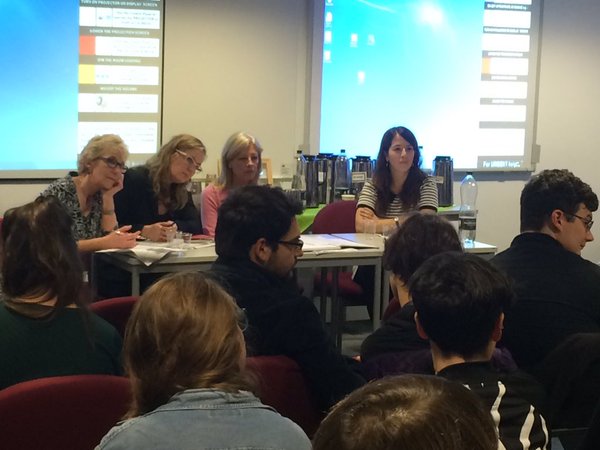
A conversation with Dr Joyce E. King

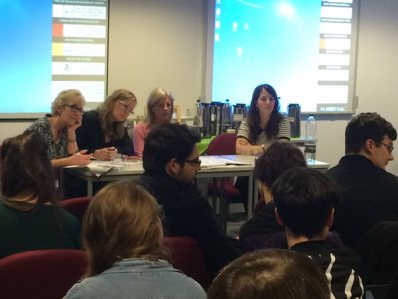
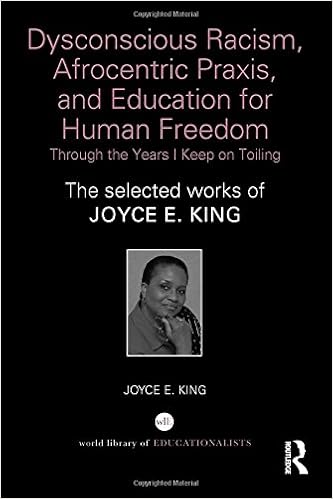
IOE UCL is delighted to announce that it will be hosting a conversation with  Dr Joyce E. King on the 8th November 2015.

Dr. Joyce King holds the Benjamin E. Mays Endowed Chair for Urban Teaching, Learning & Leadership in the Department of Educational Policy Studies at Georgia State University.

Entitled ‘African-centred Education: Healing the wounds of  Dysconcious Racism. Lessons for the UK from the Disapora,’ the event is sure to be inspiring and innovative for all.

For further details and to book a place contact: Dr Victoria Showunmi

v.showunmi@ioe.ac.uk

More info can also be found here;  JoyceKingFlyer final

Witch or Sexy Kitten; Girls, Double Standards and the Illusion of ‘Choice’ at Halloween

In the run up to Halloween, we are proud to publish this fantastic piece co-authored by Professor Jessica Ringrose, Emilie Lawrence, Hanna Retallack and Siri Lindholm which challenges the inherent sexism apparent in the costume choices open to young girls and women and the complex set of unwritten rules surrounding their behaviour during this holiday. 


“In the regular world, Halloween is when children dress up and beg for candy. In girl world, Halloween is the one night of the year when a girl can dress like a total slut and no other girls can say anything about it,” explains Lindsay Lohan in the 2004 cult teen movie, Mean Girls. This statement is testament to the existence of a set of complex unwritten rules that girls must navigate and negotiate with on a daily basis, to avoid being shamed by adults and peers.

Even small children aren’t immune from these pressures; the tweet quoted in the headline asks us ‘has Halloween become slutoween even for toddlers?’ Whilst the tweet poses ‘toddlers’ as the subject of debate it is immediately clear that it is girls we are dealing with here. There is no mention of young boys looking like sluts or skanks on Halloween; instead we are told to question why toddler girls are dressed up as cops and cats – opening up dialogue about their bodies and the ‘wrong’ choices being made – before they are even aware of the minefield ahead. We are subjecting these toddlers to scrutiny and failing them before they’ve even had a chance to understand the rules of the game.

The lead up to Halloween is a good time for parents, schools and young people to think more closely about debates over girls’ sexualised dress. Sexualisation is fast becoming a key aspect of protection and safe-guarding in social welfare and schooling. Some psychological research is claiming a direct causal link, with the implication that sexualised dress leads to psychological and social harm in girlhood (Zurbriggen and Roberts, 2012). In fact so powerful is the force of sexualisation said to be, that it is credited with causing anything from self-harm to human trafficking.

Critical sociological and feminist educational research suggests, however that it’s more complex. Positioning girls’ bodies as inherently suggestive or sexual can actually place them atmore risk and perpetuate a cycle of victim blaming that has long been common in public responses to rape and sexual assault. When schools participate in or fail to challenge what has been called ‘slut shaming’ they are perpetuating gender based inequality (Dobson and Ringrose, 2015). Education, starting at primary ages, needs to target the wider culture of sexism that promotes sexual objectification and violence against girls and women. Directing attention to the wider cultural values around (hetero)sexuality and sexual double standards, particularly masculinity and boys’ and men’s attitudes towards girls and women is also crucial.

Teenage girls face particular pressure and surveillance regarding their clothing ‘choices’. Halloween is a tense time. Girls are offered a dressed-up version of the same decisions they face every day: will they be a ‘sexy kitten’ ready to be objectified? Or the un-(hetero)sexy un-desirable witch? Girls often talk about extreme pressures, saying “you can’t win” when describing the minefield of both formal and informal rules that face them.

Issues of sexualised dress have had recent wide-spread media attention as young people have challenged school uniform dress codes as sexist, claiming they unfairly target girls’ clothes and bodies. The historical measurement and control over girls’ school uniform skirts have been joined by new debates over whether girls ought to wear trousers to avoid being a ‘distraction’ to male teachers and students

With occasions like Halloween, what constitutes ‘skanky’ fancy dress is vague and the social rules can be impossible to interpret correctly. Expressions such as ‘slutoween’ and ‘skankoween’ do not help on the path to a happier girlhood. There is a sexual double standard embedded in the term ‘slut’, with girls or women deemed bad and shameful through their dress, which is read as branding them sexually aware or active. Skank, slag, ho and slut are class-based labels also – they tell some girls that their tastes are poor, their behaviour wrong and that they are ultimately at fault for having made the wrong ‘choices’.

So this Halloween let’s look at the facts of sexism facing UK girls. The recently released 2015 Girls Attitudes Survey, a nation-wide survey that canvassed the views of 1,574 girls and young women from 7 to 21, found that three quarters of girls aged 11 to 21 (75%) report anxiety about experiencing sexual harassment that in turn affects what they choose to wear, where they go and how they feel about their bodies. Clear damage to girls’ wellbeing is evident. Almost half (46%) were found to have personally needed help with their mental health. A commodifying and sexualising consumer culture provides such conflicting messages around sexual appearance, which is seen as linked to sexual conduct. This causal link is the root of ‘rape culture’ myths of victim blaming that encourages girls to blame themselves when something goes wrong (Mendes, 2015).

One of the key issues here is the way in which adults engage with girls about their mental health and its link to ‘sexualisation’ and sexuality. According to the Girl Guiding Survey, girls feel adults are out of touch with the new threats to their wellbeing, ‘leaving them struggling to find the adequate support and information they need to remain resilient in the face of increasing pressures’ with 82 per cent of girls aged 11 to 21 saying adults don’t recognise the pressure they are under.

Projects such as Gender Equalities Leadership in Schools (GELS), led by researchers at the UCL IOE, connect up organisations like the Gender and Education Association and UK Feminista, who are working to tackle sexism in schools. GELS supports school-based activities such as feminist lunch and after-school clubs that provide young people with safe spaces in which to discuss conflicting messages and pressures around gender and sexuality. GELS is helping girls and boys with tools of critical thinking necessary to engage with dominant media texts on womanhood and ‘appropriate’ femininity and masculinity, as well as the chance to realise that the complexities they face are not only personal, but political. Watch this space for updates.


CFP to Host GEA 2016 Conference


CALL FOR PROPOSALS

The Gender and Education Association are pleased to announce that their next international interim conference will be held in June 2016. The GEA executive committee welcome proposals to host the interim conference from higher education institutions across national contexts and from conference teams spanning a variety of academic disciplines, theoretical backgrounds and fields.

Your conference proposal should include the following information:

  • Details of local organising committee
  • Conference theme and proposed dates
  • Conference venue, facilities, accommodation
  • Outline of the conference, including provisional programme
  • Potential keynote speakers
  • Details of funding required from GEA and how this would be used
  • Additional sources of funding

FOR DETAILS ON HOW TO APPLY, DEADLINES AND CONTACT INFORMATION, SEE THE ATTACHED FORM

Interim 2016 CfP genderandeducation.com semantic data

Consenting or consuming? What kind of sexuality is 50 Shades of Grey selling to young women?

Emilie Lawrence and Jessica Ringrose

From toilet rolls to sex toys, 50 Shades of Grey spin-offs show that the support for the trilogy has been huge and the backlash even bigger. The book has been criticised for romanticising domestic violence, mental health issues, and for its childish repertoire of words used to describe body parts, experiences and sex. But the pressing question about the enormous success of the book trilogy and now the first instalment of the movie is why now?

Why during a period of proclaimed postfeminist equality for women and girls in education, work, and the public sphere do we see the fetishisation of a narrative of masculine sexual dominance and feminine sexual pathology being writ large in the popular cultural imagination? Also critical for an educational audience are pedagogical questions about what type of fantasies does 50 Shades sell to women and girls? Given widely documented panics over the sexualisation of children and girls – and the questions of gender equity and ongoing sexual double standardsraised in debates on the impacts of sexualisation of femininity on girls’ self esteem – are texts that normalise male sexual dominance seen simply as playful fun? How can we engage in a meaningful discussion of these issues with young people?

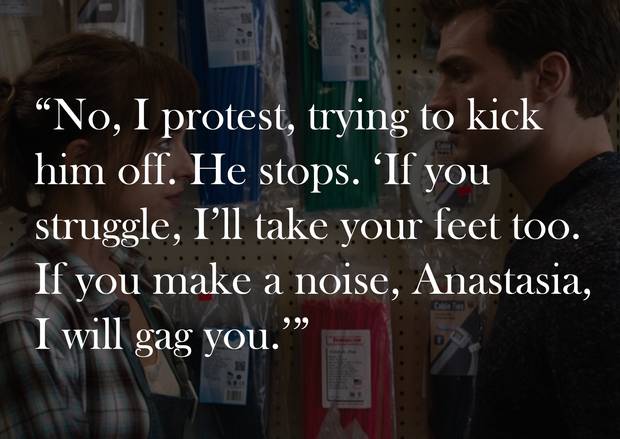
Interestingly, 50 Shades of Grey emerged from Twilight fanfiction. This explains the similarities both in writing style and reliance on staid and limiting gender roles. There is a myriad of cross-referencing and inter-textual referencing at play; for instance, in Twilight we see Bella presented as a shy, clumsy teen caught in a love triangle between an emotionally abusive werewolf and an emotionally abusive vampire (Gee, the choices open to teen girls nowadays) Then in 50 Shades we have Ana similarly depicted as a shy, socially awkward young woman. Both authors emphasise the fragility and naivety of the female leads, paying attention, and lending support to how ‘necessary’ the role of the male lead is in keeping them safe.

What is interesting is how the construction of the relationship between Bella and Edward in Twilight and Anastasia and Christian in 50 Shades rely on very stereotypical notions of male sexual desire as hardwired aggression, with girls and women the passive objects of prey. The gendered and sexual relationships presented in both the Twilight and 50 Shades are worrying at best, dangerous at worst. The authors also draw on notions of vulnerability, sexual innocence and yet being up for whatever the man desires as the ideal version of sexual desirability and‘sexy femininity’.

The primary focus of the female characters is to not only be sexually appealing but sexually innocent. These tropes are very interesting in relation to sex and relationship education in school, which have been critiqued internationally as leaving girls’ sexual desires and pleasure largely absent from most of the curriculum. Sex education is widely critiqued as foregrounding boys ‘parts’ (through use of condoms on erect penis for instance) and suggests implicitly and explicitly that male sex drives are to be managed by girls in appropriate ways to promote sexual health and virginity. Books like 50 Shades and Twilight perpetuate the idea that awoman’s worth is somehow inextricably linked to the state of her hymen and wide-spread purity myths. Anastasia is desirable because she has never had sex; Christian is desirable because he has.

50 Shades presents Anastasia as passive, naïve and sexually insatiable once Christian opens her eyes to the world of sex. Naturally she entered the relationship a virgin whilst he came to the bed of pain a gifted lover. This further reinforces the double standards around male ‘players’ and female ‘slut shaming’ that are so pervasive in society in relation to female sexuality. Broadly speaking women are expected to be sexy but not sexual; sexually active women run the wrath of being morally condemned for sexual activity whereas sexually active men are able to maintain both a moral high ground and ‘legend, top lad’ status. This plays out in very interesting ways in relation to the contemporary problems with lad culture and rape culture we are seeing in schools.

50 Shades presents a heady account of one man’s sense of entitlement and the unpaid, unappreciated emotional labour performed by Anastasia. She is constantly checking herself throughout the books; wary of upsetting, angering or confusing Christian. She is reluctant to open up or be honest with him because she ‘knows what he is like’ and at one point.

Anastasia breaks down at several points in the story, crying and blaming herself for Christian’s inability to love her the way she wants to be loved. This victim blaming response has again been widely critiqued in legal and criminological debates, as neglecting attention to gendered power dynamics and debates around sexual consent. Anastasia justifies his aggressive behaviour, brushing it off as the result of a bad childhood (which coincidentally involved being abused by a powerful woman). She also makes repeated allowances because she has never had a relationship before. She is isolated from her friends and family; add or change a few words and you have a crime report on domestic violence in your hands – all under the romantic guise of wanting to keep her safe and loving her so much.

In Twilight and 50 Shades, the relationships the women have with the men in their lives are presented as paramount but also literally integral to their bodily survival. Girls and women are presented as incomplete if they are not sexually desired (and loved) by men. Men are the granters of esteem to women in a classic binary of male superiority and human-ness against which women and girls are measured and dependent, particularly in relation to desire.

Without the affections of the male Bella and Ana literally fall apart when their relationships break down; both stop eating. This aspect of bodily breakdown is significant. The internalisation and self-punishment through bodily control in the face of male rejection echoes psychological notions of women’s internalisation and pathologization of aggression. Women are unable to cope rationally with aggression therefore they internalise and self-destruct. Endorsing and legitimating this narrative is relevant in relation to debates that naturalise female passive aggressive behaviour as well as debates on anorexia and self-harming. By shrinking themselves into insignificance and further infantilising themselves the narratives play into a story of male power and heroism, which relies on an idea of male saviours, duty bound to swoop in and ‘save’ girls and women. Anastasia regularly refers to how empty she feels, how she is unable to manage to eat and on reuniting with Christian, this is the first thing he notices. Instantly angry with her he forces her to eat; thus asserting his position as dominant and in control. This echoes discourses around eating disorders in ways that celebrate rather than question body shaming and body harming practices.

If we think of the books as sex education writ large in popular culture, there is a worry that they will leave girls and boys and men and women feeling inadequate about their sexual experiences; men will think it is as easy as providing a quick fumble and nipple bite to please a women, whereas girls might worry that there is something wrong with them if it takes them longer than thirty seconds to be in the mood and in a position where they can orgasm.

Feminist critiques argue that mainstream pornography neglects attention to the mechanics of arousal for women, focusing instead on fulfilling masculine fantasies for quick ejaculation. In the same way, the sex depicted in 50 Shades is unable to open up avenues for ordinary sexual play for women. Perhaps a fantasy of being suspended from the ceiling for a spanking twice a day does provide a potent if perhaps ridiculous fantasy for some, and maybe some of 50 Shades is partly innocent play and fun. kindprotect But the story lines that legitimize the sexual pathologization of women and celebrate male sexual and economic dominance, mean that, as feminists, we have much to do. We need to keep opening up debate and discussion about forms of femininity that do not subsume questions of feminine pleasure, desire and fantasy to the role of sexually and emotionally servicing men.


Education Gone Bad

cropped-education-future1.jpg

We are pleased to announce a call for papers for an upcoming special issue of Children’s Literature in Education Spring 2017 , edited by Elizabeth Marshall and Lissa Paul.

From Sarah Fielding’s The Governess, or The Little Female Academy, to television shows such as Buffy the Vampire Slayer to bestsellers like J.K. Rowling’s Harry Potter series, school stories remain a staple genre in young people’s literature and culture.

For more details on topics, deadlines and contact information, please see the attached document


Education Gone Bad

Healthy Sexual Development

SRE (Sex and Relationships Education) is VITAL in ensuring that we equip students with the confidence and knowledge needed to have healthy, positive and safe sexual relationships. Time and time again, research has shown that students are desperate for a curriculum that goes deeper than the biological mechanisms of sex; that goes beyond the scaremongering syllabus of STD’s and teen pregnancies and which delivers responsive and detailed information on a range of issues taking into account the emergence and influence of social media platforms, new media and pornography; pupils want to learn about pleasure, their bodies, relationships and the emotional responses to physical acts as well as being informed on consent and bodily autonomy.

With this in mind, and the understanding that great SRE can contribute to healthy sexual development, Naomi Rudoe and Alice Hoyle recently held a fantastic, and well attended event – Healthy Sexual Development Symposium: How relationships and sex education can contribute towards healthy sexual development. Here we provide GEA readers with a comprehensive report of their findings. This makes for fascinating reading and can go far in helping structure our practice when delivering effective SRE.


Report of HSD symposium


GENDER AND EDUCATION CONFERENCE – 24TH – 26TH JUNE 2015

The TENTH international biennial conference of the Gender and Education Association is now less than a week away. Hosted by The University of Roehampton,  Feminisms, Power and Pedagog is sure to be an informative, engaging and thoroughly enjoyable event and we hope to see you there!

There is still time to book your place via the Roehampton events page 


Keynote speakers:
Dr Katarina Eriksson Barajas, Linköping University, Sweden
Prof. Penny Jane Burke, University of Roehampton, UK
Prof. Marília Carvalho, Universidade de São Paulo, Brazil
Prof. Farzana Shain, Keele University, UK
Prof. Lois Weis, State University of New York, USA

For more information on speakers, abstracts and programme order, please click here

CALL FOR PAPERS

We are pleased to announce the following calls for papers; all three are fantastic opportunities and promise to be exciting events!


1. Neoliberalism, work and gender education (deadline for abstracts is  6 July)

2. Distance learning (deadline for abstracts is 10 July)

3. Theorising curriculum in colour and curves (deadline for abstracts is 5 July)

TC FINAL CfP


Good luck!

images

White Working-Class Boys’ Learner Identities in Neoliberal Times

Garth Stahl, now at the University of South Australia, discusses his research in London, UK, on white working class boys. Garth’s book Identity, Neoliberalism and Aspiration: Educating White Working-class Boys is now available from Routledge.

————————————————————————————————

In recent years there has been growing concern over the pervasive disparities in academic achievement that are highly influenced by ethnicity, class and gender. Within the neoliberal policy rhetoric, there has been concern over the underachievement of working-class young males in the United Kingdom, specifically white working-class boys. The historic persistence of this pattern, and the ominous implication of these trends, has led to a growing chorus that something must be done to intervene.  However, as evidenced by Parliamentary hearing on the Underperformance of White Working Class Children in February 2014 (Select Committee on Education, 2014), the phenomenon of white working-class ‘underperformance’ is incredibly complex.

My research examines the identities of white working-class boys in school and problematises some of the barriers that are commonly (and crudely) associated with white working-class culture in educational contexts, such as lack of aspiration, parental attitudes toward school, insufficient work ethic and poor attendance (Evans, 2006; Demie and Lewis, 2010). We must consider how high levels of so-called ‘disaffection’ towards education in white working-class communities actually represent a certain struggle to negotiate an identity out of limited repertoires of social and cultural resources within these institutions. My focus is on how white working-class boys make sense of social mobility and aspiration in their school contexts and how it shapes their subjectivities (Gillborn and Kirton, 2000; McLeod, 2009).

Today’s urban youth construct their identities in ‘local/global contexts’ (McLeod, 2009) and the participants of this study are ‘working out their “place” and “legitimacy” within urban arrangements that are, at their best, residual spaces of surplus meaning pointing to previous forms of intense working-class resilience’ (Dillabough and Kennelly, 2010: 105). Such identity negotiations may result either in them ‘finding’ or ‘losing’ certain traditional working-class identities (Reay, 2001; Skeggs, 2004).

The data collection for this study occurred immediately following the financial crisis of 2007–2008 and during the July 2011 riots in London, Manchester and Birmingham. Both events shaped discourses around economic austerity, benefit culture and anti-social behavior.  The young men in my study exist in urban spaces which are continually pathologised as ‘“unfit” and undesirable’ (Archer et al., 2010) or ‘rubbish’ and ‘shit’ (Lucey and Reay, 2002). Therefore, the intermeshings of ‘place’, ‘legitimacy’ and ‘respectability’ are considered to be crucial components of both social and learner identity construction.  It has become increasingly difficult for these young males to establish a so-called ‘good life’ within an era of high neoliberalism (Stahl, 2012).

The current neoliberal discourse, which prioritises a view of aspirations that is competitive, economic and status-based, shapes the subjectivities of these young males and contributes to the formation of counternarratives. Through observation, interviews and focus groups over the course of nine months, I collected evidence which strongly indicated how boys centered their ‘identity work’ on what I call egalitarianism, an egalitarian habitus, defined as the internal process of reconciling dispositions, which allowed them to constitute themselves as ‘having value’ in the hegemonic neoliberal discourses of ‘best’ and ‘worst’ where they are often devalued.

Egalitarianism is defined through a disposition toward ‘fitting in’ and being ‘loyal to oneself’, where everyone has an ‘equal say in the world’ and where ‘no one is better than anyone else’ or ‘above their station.’  With egalitarianism, there are strong echoes here of traditional working-class dispositions toward historic, solidarist, communal values.  The boys often articulated their desire to disassociate themselves from being classified as aspirational subjects; interestingly, such disassociations came from their conceptions of their own social class and masculine identities.  As a counter-habitus to the neoliberal ideology, egalitarianism is how the boys come to understand the cards they have been dealt in life. I explore egalitarian habitus as a process of internalizing future academic failure where there are overlaps with Bourdieu’s theoretical framework of symbolic violence (Bourdieu and Wacquant 1992).

With this investigation of white working-class boys we see the tangled relationship between school structures and practices. I am interested in how social class is (re)formed through identities and historic cultural practices rather than a simple reflection of economic capital and occupations.  In investigating classed identities I consider how white working-class boys are ‘socially positioned and discursively constituted subjects within educational sites’ (Burke, 2007: 412).  Simultaneously, the research considers the influence of different discourses of aspiration that youth draw upon.

About the author: Garth Stahl (@GarthStahl) is a Lecturer in Literacy and Sociology at University of South Australia.  He is a theorist of sociology of education. His research interests lie on the nexus of neoliberalism and socio-cultural studies of education, identity, equity/inequality, and social change.  Currently, his research projects and publications encompass theoretical and empirical studies of learner identities, gender and youth, sociology of schooling in a neoliberal age, gendered subjectivities, equity and difference, and educational reform.  Of particular interest to him is exploring counternarratives to neoliberalism around ‘value’ and ‘respectability’ for working-class youth.

 References in the text:

Archer, L., Hollingworth, S. and Mendick, H. (2010) Urban youth and schooling: The experiences and identities of educationally ‘at risk’ young people. Berkshire: Open University Press.

Bourdieu, P. and L. Wacquant, 1992. An Invitation to Reflexive Sociology. Cambridge, Polity Press.

Brown, P. (2013) Education, opportunity, and the prospects for social mobility. British Journal of Sociology of Education, 34(5–6), 678–700.

Burke, P. (2007) Men accessing education: Masculinities, identifications and widening participation. British Journal of Sociology of Education, 28(4), 411–424.

Demie, F. and Lewis, K. (2010) White working class achievement: An ethnographic study of barriers to learning in schools. Educational Studies, 33(2), 1–20.

Dillabough, J.A. and Kennelly, J. (2010) Lost youth in a global city: Class, culture and the urban imaginary. New York: Routledge.

Evans, G. (2006) Educational failure and working class white children in Britain. Palgrave: Macmillan.

Gillborn, D. and Kirton, A. (2000) White heat: Racism, under-achievement, and white working-class boys. Inclusion and Special Educational Needs, 4(4), 271–288.

Lucey, H. and Reay, D. (2002) Carrying the beacon of excellence: Social class differentiation and anxiety at a time of transition. Journal of Education Policy, 17(3), 321–336.

McLeod, J. (2009) Youth studies, comparative inquiry, and the local/global problematic. Review of Education, Pedagogy, and Cultural Studies, 31(4), 270–292.

Reay, D. (2001) Finding or losing yourself? Working-class relationships to education. Journal of Education Policy, 16(4), 333–346.

Select Committee on Education. (2014) Underachievement in Education by White Working Class Children. 1st Report. Session 2013–2014. London: UK Parliament, House of Commons.

Skeggs, B. (2004) Class, self, culture. London: Routledge.

Stahl, G. (2012) Aspiration and a good life among white working-class boys in London. Journal of Qualitative and Ethnographic Research, 7(8–9), 8–19.

Wexler, P. (1992) Becoming somebody: Toward a social psychology of school. London: The Falmer Press.


Forthcoming GEA sponsored symposium

Forthcoming Symposium on Healthy Sexual Development. Friday 3rd July 2015, Bristol.

The RSE Hub and the University of Westminster would like to invite you to a
symposium on Healthy Sexual Development, exploring how research in sexuality,
relationships and sex education can translate into practice. Using the framework of
the Fifteen Domains of Healthy Sexual Development, this event aims to support
practitioners and teachers involved in SRE/PSHE and young people’s sexual health
at all key stages, as well as to enable dialogue and collaboration between academics
and practitioners engaged in this area. The event is suitable for any practitioner or
academic with an interest in healthy sexual development and relationships and sex
education. Confirmed presenters include Professor Alan McKee, and GEA member Dr. Esther McGeeney.


Click on the flyer below to see more details.

Healthy Sexual Development Symposium flyer