C2C: #FEAS are coming to GEA! (And looking forward to it)

This post is part of our new Countdown to Conference (C2C) series. We would love to feature a brief blog post from you too! Visit our main Countdown to Conference page for details!

C2C: #FEAS are coming to GEA! (And looking forward to it)
by Dr Emily Gray
Twitter:@FEASproject

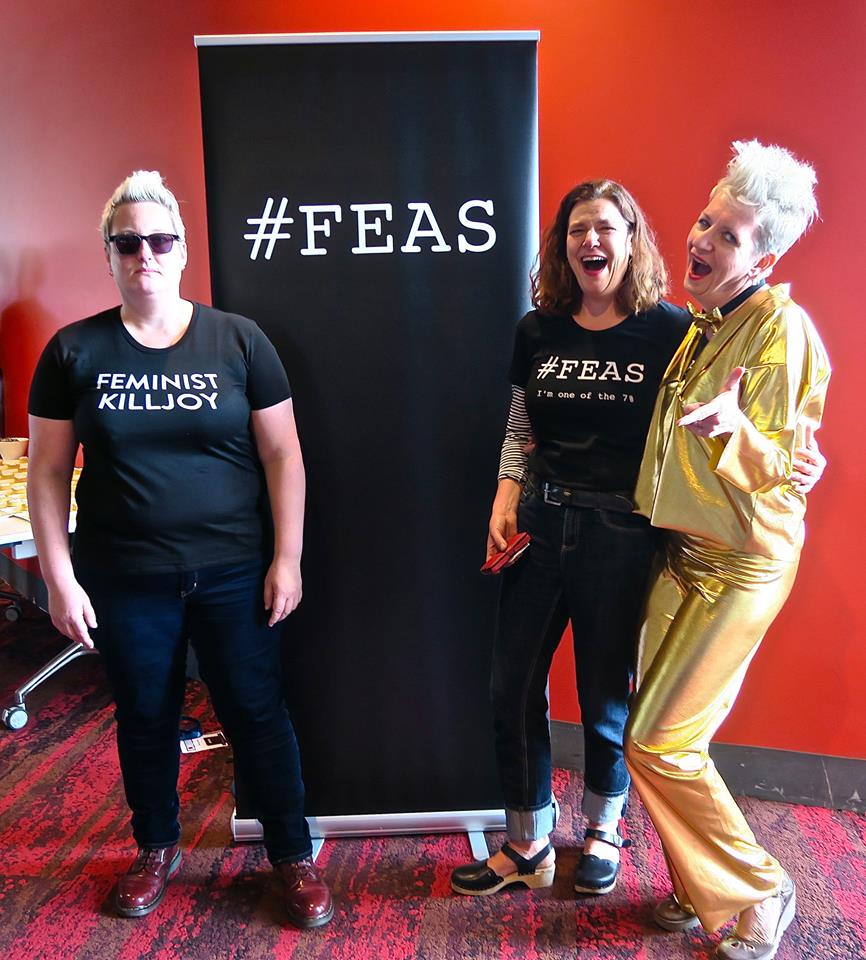
L-R Emily, Mindy and Linda following a stand up Performance at AARE Conference, Melbourne 2016

Feminist Educators Against Sexism #FEAS are an Australian-based international feminist collective committed to interrupting, challenging and otherwise shouting out about sexism in the academy and other educational spaces. #FEAS was formed by Mindy Blaise, Emily Gray and Linda Knight in 2016 and emerged out of a funded project to develop arts-based interventions into sexism in higher education. Workshops were run with diverse women academics from all career stages and together we developed interventions that were performed at a large education conference. The interventions included sexist/anti-sexist bingo cards, pipeline myth t-shirts that display statistics about women’s employment in Australian universities, whistles to blow when no-one’s listening, butterfly nets for catching those elusive opportunities and a stand up comedy performance that used participants’ experiences as one-liners that aren’t really very funny at all, as well as deploying the literal figure of the feminist killjoy. By challenging sexism through humour, irreverence and collective action we hope to highlight the inequalities, absurdities and the dreary everydayness of sexism in the academy. From the original 3, #FEAS now number over 400 and are located in Australia and all over the world including UK, Aotearoa New Zealand, Sweden, Belgium, the USA, Canada and Saudi Arabia.

This year, #FEAS have teamed up with Gender and Education and we are busy designing a new range of t-shirts, business cards and working on a brand new stand up performance for your viewing pleasure at the conference. We will also be presenting our research-creation journey so far, including our recently formed Cite Club where #FEAS share research with each other and cite each other where we can.

Mindy and Emily are familiar faces at Gender and Education conferences, both having attended many times in the past. Linda is brand new to Gender and Ed and so we are looking forward to introducing her to our favourite conference and to sharing our ideas and interventions with you all!

If you are attending conference, let us know on Twitter using the hashtag: #GEAconf2017
C2C: Learning from Across Borders

This post is part of our new Countdown to Conference (C2C) series. We would love to feature a brief blog post from you too! Visit our main Countdown to Conference page for details!

C2C: Learning from Across Borders: What Canadian Multiculturalism Teaches Us about Happiness
by Natalie Wall
Twitter: @mdximpact

When I was a little girl, my father told me that I could be anything; I could be Prime Minister of Canada, if I wanted to.

He was and still is… wrong.

Canada has never elected a female Prime Minister and the only woman (Progressive Conservative Kim Campbell) to have held the position attained it through hatred of the previous PM and was replaced by the Liberal Jean Chrétien within six months, and this is after having called the election because she showed a demonstrable lead in the polls. Canada has never had a non-white Prime Minister. Even as a child, I knew that my chances were not good and I can’t say that my father approved of my defeatist attitude when I explained my unlikelihood of becoming Canada’s first black, female Prime Minister. This was my first moment of being a black feminist killjoy.

Wait… can I be a black feminist killjoy?

Killing Joy and Taking Names

Sara Ahmed tells us that the feminist kill joy “is an affect alien for sure: she might even kill joy  precisely because she refuses to share an orientation towards certain things as being good” and that “[w]e can place the figure of the feminist kill joy alongside the figure of the angry black woman.” Let us suppose that the angry black woman and the feminist kill joy can exist in one body, so that I can become a black feminist kill joy. In fact, let me assume the mantle of black, Canadian feminist kill joy.

Crossing Borders and Becoming Foreign

Over the course of my PhD, I have become foreign. However, I have never felt so Canadian as I have once I became foreign. My foreignness makes me nostalgic for a home that never was, a place to which I never really belonged. I am a black Canadian woman whose father was an immigrant who moved from Trinidad to Canada in the seventies and whose mother grew up on in a country house in rural Cape Breton. I belonged to a group of friends who all shared the common experience of being first generation Caribbean Canadian black women. We were antiracist activists living in West Toronto where my high school was lauded as a stellar institution despite my memories of white supremacists handing out hate literature on site and girls being told that they should not speak out against the sexual harassment from faculty members. My antiracism and feminist sensibilities grew in this environment and were intrinsically linked to my self-identification as a black Caribbean Canadian woman.

But, I have become foreign.

As I have become foreign, so has the world around me.

Brexit campaigners told us that the British population needed to “take back control” and control was taken back. And where did Brexit campaigners find inspiration for taking back that control? Michael Gove cites Canadian and Australian immigration policies when pressed about migration on Question Time.

What Can We Learn from Canada?

After the introduction of Donald Trump’s Muslim Ban on January 28th, 2017, the Prime Minister of Canada’s Twitter account (smugly, one might argue) posted the following:


Amid a flurry of criticism and, yes, some popular approval, the Muslim Ban opened up an opportunity for Canada to remind the international community that it holds the line in North America for diversity and hospitality.

I started my PhD examining multiculturalism in Canada under the Harper government, at a time when the Conservative government was taking liberties with its population’s human rights and making Canada a less tolerant environment than it has traditionally painted itself. See Human Rights Watch’s “World Report 2016” where among other concerns are the refusal to conduct an inquiry into missing and murdered Indigenous women and the Anti-Terror Act of 2015, “law that imperils constitutionally enshrined human rights, including the freedoms of expression and association.”

I am finishing it up under a Justin Trudeau government, a Liberal Canada expressing itself through its proclaimed feminist and hospitable Prime Minister. Trudeau’s likeability and international popularity are reflective of a system of government that always works best when portrayed as idealistic and inclusive. It is a Canada that benefits in real, marketable, ways from its reputation as a multicultural utopia that operates to oppress and manage non-white bodies by using them as objects to parade before other, international and white, audiences.

What’s Multiculturalism Got to Do with It?

Multiculturalism, both official and idealized, works to help define the culture of Canada, by offering a gesture to diversity that has become synonymous with Canadian identity, but also offering a mirror against which Canadian identity can articulate itself. The trope of multiculturalism in Canada works to define culture in two ways: policy that has become a part of the fabric of Canadian self-construction and the persistent differentiation of citizens so that there are real Canadians and the others that help to demarcate the relationship between real and marginalized.

Canada was the first country in the world to integrate idealized constructions of multiculturalism into official policy.  Multiculturalism is intrinsic to Canada’s understanding of citizenship: the Government of Canada says on its website that “Canadian multiculturalism is fundamental to our belief that all citizens are equal. Multiculturalism ensures that all citizens can keep their identities, can take pride in their ancestry and have a sense of belonging.” However, we also have to understand that immigration serves the state’s purpose, “national immigration policies are seen as mechanisms to supply workers for various industries” (Satzewich and Liodakis 62). As state policy, that is to say, multiculturalism can never be purely without benefit to the host state. In fact, immigration is part of nation-building project, where multiculturalism is both reliant upon that immigration and one of the methods with which the nation ensures the obedience of its subjects, allowing them their cultural identity so long as it is subsumed under their identities as productive Canadian citizens. The success of Canada’s multiculturalism policy is rooted in its marriage of ideology and policy into the very fabric of how Canadians understand what it means to be and act Canadian.

So, while “Canada has its own historical graveyards of shame which are routinely relegated to the footnotes of history” (Mullings et al.), including genocide, Chinese Head Tax, missing and murdered Indigenous women, just to name a few, Canadians are not willing to go on record as xenophobic bullies. In the end, Canadian’s identify so strongly with multiculturalism that Trudeau won against Harper’s xenophobic campaign in 2015. Canadians supported freedom of cultural identity instead of anti-muslim rhetoric, going so far as to wear traditional mummer’s costumes to the polls in protest over the niqab debate. The focus on the niqab in tandem with the enacting of the Zero Tolerance for Barbaric Cultural Practices Act, which focused unduly on Muslims, was the Conservative government’s undoing.

Alternatively, in the UK, multiculturalism is dead at the hands of home grown terrorism. Immigration fears largely influenced the Brexit vote and continue to make headlines as we head towards 8 June, 2017. As Ahmed tells us, “multiculturalism becomes a problem by being attributed as the cause of unhappiness. When we are ‘in’ multiculturalism, we are ‘out’ of our comfort zone.” As we head into another General Election, I am wondering to what degree the British public is voting for a happiness that stems from having neighbours that look like you, sound like, and think like you. Is multiculturalism the root of all unhappiness?

Or is there a lesson to be learned from across the pond?

A harsh and pragmatic lesson to be sure, but a lesson to be learned nonetheless. Because that’s what being a feminist kill joy is all about…

“Generative Feminism(s): working across/ within/ through borders”

At the upcoming Gender and Education Association Conference, titled “Generative Feminism(s): working across/within/through borders,” researchers and practitioners will be coming together to think about demarcation and delineation as feminists who are building new, innovative spaces that impacts the world around them.

The 2017 conference is being organised and hosted by Middlesex University, London and runs from run from Wednesday 21st until Friday 23rd June, 2017. As a member of the organising committee, I am excited by the breadth of topics and how disparate the backgrounds of the presenters. You can see the conference programme here and register using the following link.

If you are attending conference, let us know on Twitter using the hashtag: #GEAconf2017

 

C2C: What feminism’s got to do with dance

This post is part of our new Countdown to Conference (C2C) series. We would love to feature a brief blog post from you too! Visit our main Countdown to Conference page for details!

C2C: What feminism’s got to do with dance
by Tamara Borovica
Twitter: @Blackie_in_Ozz

As a PhD candidate researching gender and the body, I find the key themes of this Gender and Education Conference – working through temporal, spatial, material and disciplinary borders – as appealing and challenging at the same time. My interest in the body as an active and agential assemblage comes from witnessing some of the extremes of human suffering, violence, hope and resilience when I was growing up in now ex-Yugoslavia, in 1990s. While most of these experiences carried a strong affective and emotional charge and made many of us irreversibly different, I got curious about the ways people continue to ‘become’. When as an adult I begin working with young people in Balkans and across Europe, my interest was in noticing complexities, contradictions, open-endedness and unevenness in their continuous becomings, even when situated in what appeared to be a grip of social structures. The same interest led me to discover and eventually start teaching dance as a form of embodied inquiry and to how the idea of this research was born.

My interest in the body as an active and agential assemblage comes from witnessing some of the extremes of human suffering, violence, hope and resilience when I was growing up in now ex-Yugoslavia, in 1990s.

In my work on the embodiment of womanhood, I imagine embodiment as relational, interconnected, always in flux and becoming, as a part of various assemblages and in numerous encounters (some of which are increasing and some decreasing bodily potentials). To explore young women’s embodiment, I have conducted a performance ethnography with a group of Melbourne University students interested in creative methods and feminist issues. We were a group of non- dancers who danced to produce and explore new feelings, thoughts, ideas, sensations and/or creative artefacts about embodied womanhood, in order to, potentially, open up ‘the affective economy’ of our bodily beings. The paper I will present, ‘Dancing the strata- affective flows of moving/dancing bodies and the possibilities for becoming otherwise’, will illustrate my approach to researching the embodiment of young womanhood where I aim to engage with the materiality of (human and more-than-human) bodies while attuning to movement, rhythm, fluidity, multiplicity and flows.  This paper will focus on one encounter of dancing bodies where we danced with the strata (categories such as sex, gender, race, ethnicity, religion, sexuality, age, and ability) to look at what embodiment of these categories produces for young women’s lives and how our bodies take an active role in this production.

At the beginning of the third year of my Candidature, I can profoundly benefit from presenting at conferences such as Gender & Education, where a number of academics are engaging in similar kinds of work. More than a few of G&E scholars have been influential in informing my approach to this research, and I am looking forward to being further inspired by their work presented at GEA2017. Until we meet in London!

If you are attending conference, let us know on Twitter using the hashtag: #GEAconf2017

C2C: Social media and gender identity work

This post is part of our new Countdown to Conference (C2C) series. Are you attending conference? We would love to feature a brief blog post from you too! Visit our main Countdown to Conference page for details!

C2C: Social media and gender identity work
by Josie Anne Reade
Twitter: @JosieAnneReade

As a PhD candidate researching gender and the body, I was delighted to receive an invitation to present a paper at the 2017 GEA Conference hosted by Middlesex University in London. In my paper, ‘Assembling fitspirational bodies: Social media and gender identity work’, I will be sharing some of the emerging data from my PhD which explores how women experience their bodies and gender in relation to the digitally mediated ‘fitspo’ phenomenon. This paper will be highly theoretical as well as empirical and will directly relate to this year’s thematic emphasis on generative feminism(s). After the conference, I intend to submit a journal article for publication based on the paper I present and will also be writing a blog post for the GEA website reflecting on my conference experience.

One of Australia’s defining characteristics is its geographical isolation from the rest of the world. As an PhD candidate who wishes to achieve greater connectivity with scholars working in my field globally, this creates a significant challenge. Presenting at this conference will provide a unique opportunity to share and collaborate with scholars globally alongside my colleagues and supervisors traveling from Australia. Given my thesis draws upon relatively recent developments in feminist theory, such as feminist new materialism and the ‘affective turn’, this connectivity is imperative. Receiving feedback on the development of my ideas half way through my PhD candidature will moreover be extremely beneficial.

I look forward to attending the conference and sharing my work with the GEA community!

If you are attending conference, let us know on Twitter using the hashtag: #GEAconf2017


C2C: My current research is my teaching and my teaching is my current research

This post is part of our new Countdown to Conference (C2C) series. Are you attending conference? We would love to feature a brief blog post from you too! Visit our main Countdown to Conference page for details!

C2C: My current research is my teaching and my teaching is my current research
by  Dr Zoe Charalambous

My attendance at the Gender and Education Conference will immensely benefit my students by undoubtedly advancing my professional and academic development. I have been “chased after” by students in halls asking me when the “Genderisms” club will run again. Being a teacher at a private school, and in a traditional patriarchal Greek society, (though nowadays in a not so salient way), it is difficult to be granted the time and space to help bring awareness to gender issues.  My attendance at the Conference will provide me with the academic possibility of an articulation of my efforts as a feminist teacher, with the support and knowledge of other feminist teachers and researchers in order to generate more collaborations and funding to keep this project going. This “teaching project” goes beyond our generation, this generation and affects all generations. Within/across and through borders of what can be generated within/across and through gender. I will be informed and further educated by attending the conference in a manner that will provide me with further “armoury” and openness to advocate for my efforts at running a feminist club in my school and at bringing awareness, even at school level.  Exchanging ideas with other feminist teachers will most certainly help me develop professionally as a teacher and potentially find new, both academic and pedagogic, resources with which to continue my teaching/work/generation of “Genderisms.”

Some initial concrete goals I have set upon my return from the conference are:

a) a presentation for the faculty with regards the content I have accessed and the exchanges I have had informing them of recent approaches with regards gender and education
b) a re-submission of a proposal to conduct research with a school in London and New York designing a feminist unit of teaching in our curriculum with the goal to unite/share and create knowledge within/across and through borders,
c) a re-organization of the club Genderisms forging new connections with students from other schools in the world via classroom connections and other media, such as using our Facebook page : AC GENDERISMS (https://www.facebook.com/acgenderisms/ (run by my students).

My current research is my teaching and my teaching is my current research as I navigate a world of having to carefully “name” a club, “explain myself” as a feminist teacher in Greece and negotiate delicate borders of understanding and acceptance in my classes.  I think that without knowing I have been helping generate a generation/generations of generative feminism.

My current research is my teaching and my teaching is my current research as I navigate a world of having to carefully “name” a club, “explain myself” as a feminist teacher in Greece and negotiate delicate borders of understanding and acceptance in my classes. I think that without knowing I have been helping generate a generation/generations of generative feminism. Since November 2014, I teach English Literature and language at Anatolia College high school, an International private school in Northern Greece. My pedagogic stance connects to my previous doctoral research and my feminist orientation vis-à-vis feminine creativity.

My doctoral research between 2011 and 2014 focused on the concept of a non-directive pedagogy of Creative Writing in Higher Education using a Lacanian psychosocial methodology. In a simple formulation, I was wondering how it might pedagogically affect student/writers to have their assumptions about their writing abilities questioned via in-class writing interventions.  In a broader context, however, my thesis explored a way to investigate fantasies of subjectivities and their disruption (or interference with) using the whole enigmatic research project and setting – as an intervention inherent in the investigation, aimed at disrupting or shifting fantasmatic attachments. This constitutes an approach to exploring fantasy that has not, as far as I am aware, been used in other psychosocial projects.  Parts of the analysis used Bracha Ettinger’s theory of the matrixial object to begin to conceptualize moments in the creative process where a shift of fantasy – a shift in the way a student/writer would write- occurred.  Thus, metaphorically, my w(a)ndering began from an interest in the phallus/discourse to be born again in the primordial space of womb: a wondering for what (my) desire is…

Having explored a non-directive pedagogy at Higher Level Education during my PhD research I have been very keen to consider how such an approach might work at a secondary education level and what it might mean to facilitate discussions that shift students’ assumptions about their learning. I have found, both via my daily teaching experience and from student feedback, that ambiguity in providing answers at the age of 16 is not well-received. It makes teenagers much more uncomfortable than adults.  On the other hand, it has been this very “faith” in ambiguity and enigmatic facilitation that helped initiate the beginnings of a club called “Genderisms” at Anatolia College.  The club has ran for two years in an attempt to generate awareness about gender issues in multiple ways: research gender attitudes via questionnaires and interviews (student-led), educating students about sociological research methods and discussions/explorations of key texts in the feminist field. My teaching integrates and embodies the above approaches in one of the English Literature thematic units I have created. My contribution at the conference would be key in generating an impetus at my school and in Northern Greece to help me address this research more officially.

Finally, starting from this year I began to help organize the annual TeAch conference, a conference for teachers which runs at Anatolia every year. I am currently working on the call for proposals, which will include the issue of gender in education in the broader theme of “Education for Active Citizenship.”

If you are attending conference, let us know on Twitter using the hashtag: #GEAconf2017

C2C: Connections and new directions

This post is part of our new Countdown to Conference (C2C) series. Are you attending conference? We would love to feature a brief blog post from you too! Visit our main Countdown to Conference page for details!

C2C: Connections and new directions
by  Nicole Christen

Attending the Gender and Education Conference will benefit my academic development by adding to my knowledge of the research that exists at the intersection of gender and education, and the new directions that are being explored. For the sake of ensuring that my research is based on a rich, theoretical foundation, this knowledge is imperative. Furthermore, professionally speaking, as my goal is to establish a research career at the nexus of education (digital learning ecologies and informal learning), gender, and capacity development, I want to connect with and build relationships with others in the field.

My research is highly applicable to the theme of generative feminism and the concept of borders. Through a sequential mixed design strategy, that applies both quantitative and qualitative methodologies, I will describe and analyse the digital learning ecologies of Canadian entrepreneurs (who pursue entrepreneurship within the context of motherhood). The primary research goal it to explore how these entrepreneurs scaffold and develop their digital learning ecologies for capacity development through informal learning. The expectation, as a result of the multidimensional and pragmatic nature of this study, is to deliver educational recommendations, guidelines, strategies, and actions regarding the development of digital learning ecologies for informal learning and, ultimately, for capacity development.

If you are attending conference, let us know on Twitter using the hashtag: #GEAconf2017

C2C: On teaching, research, and activism

This post is part of our new Countdown to Conference (C2C) series. We would love to feature a brief blog post from you too! Visit our main Countdown to Conference page for details!

C2C: On teaching, research, and activism
by  Briony O’Keeffe

Attendance at the GEA conference will offer me the opportunity to gain exposure to a broad array of academic research around gender and education, and to contemplate how to best use that research ‘on the ground’. In short, the key themes of the conference – to work through temporal, spatial, material and disciplinary borders – make the attendance of practicing teachers at the event critical.

In 2013 I founded a Feminist Collective group at Fitzroy High School in Melbourne, Australia, alongside my students. It very quickly transformed into a timetabled subject, which I continue to teach twice a week for 90 minutes. As a consequence of the class – and informed directly by the activist mentality within it – I wrote a feminist teaching resource for secondary school educators entitled ‘Fightback: Addressing Everyday Sexism in Australian Schools’. The resource is intended to provide educators with a set of tools to address issues ranging from systemic sexism to masculinist language to the discourses surrounding young women’s bodies, with the ultimate goal of addressing the gendered norms that underpin the very high rates of violence against women in Australia.

My research does not occur within a traditional academic setting, but informs my daily practice in the classroom, which is inarguably a critical site within which to explore, theorise and implement cutting edge research on gender and education. Though I am not currently undertaking a PhD (one of the consequences of taking time off to have a child) I participated in a research project in 2016 with Deakin University researchers examining the efficacy and relevance of Sex Education for secondary school students. That project was undertaken in partnership with my Feminist Collective class. In 2017 Deakin University has sought funding to extend that research, with myself as a co-researcher working alongside Dr. Deborah Ollis and Dr. Leanne Coll to explore how sexuality education can have an impact on reducing the rates of violence against women. Drs Ollis, Coll and myself have submitted an abstract for the conference relating to our collaboration in 2016.

My current teaching practice suffers somewhat from existing within a vacuum. Though it’s possible to access research, it’s difficult to engage directly with academics. This is a consequence of geography, but also of finances: there is little to no funding available for teacher practitioners to attend conferences, and women working part-time in the teaching system are further disadvantaged. Attendance at the GEA conference will enable me to establish ongoing collaborative relationships with others working in this field and to give the research presented a practical application by reflecting on how to embed it in my daily teaching practice. That practicality also extends to the work I am doing as a key member of the Education Committee of a proposed Women’s Museum for Victoria, Australia, where I am responsible for writing and curating curriculum content. The need to remain fluid, flexible, and critically informed whilst writing that curriculum is key: I see the conference as an important stepping-stone in terms of continuing my personal theoretical journey with regard to feminist educational theory.

In addition, Fitzroy High School has recently been awarded leading school status with regard to implementing state-mandated curriculum focused on reducing violence against women, the impending implementation of which was one of the outcomes of the recent Victorian Royal Commission into Family Violence. I have been invited to sit on the committee overseeing the whole-school approach to ‘Respectful Relationships’ curriculum this year, and can see a clear connection between that role and future pathways in terms of my career – I am interested in exploring opportunities both within and outside the classroom with regard to demanding equity in educational policy and practice, and the conference will allow me the opportunity to consider ‘where to next’ in terms of addressing what the GEA identifies as the ‘fissures that persist and enfold between practice, policy, theory and activism’.

If you are attending conference, let us know on Twitter using the hashtag: #GEAconf2017

C2C: My first GEA conference

This post is part of our new Countdown to Conference (C2C) series. We would love to feature a brief blog post from you too! Visit our main Countdown to Conference page for details!

C2C: My first GEA conference
by Dr Jessica Gagnon

The first GEA conference I attended was in Melbourne in December 2014. It was my first conference outside of my home country (the United States) and outside of the country in which I was pursuing my PhD (the United Kingdom).  I was in the analysis and writing up phase of my PhD at the University of Sussex.  As a first generation student from a working class family, attending any academic conference still makes me feel a little bit anxious. For me, academic conferences are one of the spaces where imposter syndrome rears its head — where I feel out-of-place and insecure about whether I’m “good enough” to be a part of academia. Belonging in academia was at the heart of my GEA presentation too, since my presentation was titled, “People like me: The university experiences of the daughters of single mothers in the UK”.

The GEA conference was one of the best I attended while I was a PhD student. The keynote addresses were engaging, the individual presentations covered a range of research topics from global perspectives, and I met some amazing fellow researchers at all levels of their careers (from master’s research students through to more senior level academics). The conference organisers were warm and friendly, which was refreshing in comparison to some of the cold and unwelcoming experiences I’ve had at other academic conferences.

I had the opportunity to get to know some of my fellow conference attendees, but the one thing I wish I had done during my time at the GEA conference in Melbourne was be a bit more bold and take the opportunity to introduce myself even more.

If you’re attending GEA conference this year for the first time, feel free to message me by Jessica.Gagnon@port.ac.uk or Twitter @Jess_Gagnon I am happy to talk about GEA conference with you.

If you are attending conference, let us know on Twitter using the hashtag: #GEAconf2017

CFP to Host GEA 2016 Conference


CALL FOR PROPOSALS

The Gender and Education Association are pleased to announce that their next international interim conference will be held in June 2016. The GEA executive committee welcome proposals to host the interim conference from higher education institutions across national contexts and from conference teams spanning a variety of academic disciplines, theoretical backgrounds and fields.

Your conference proposal should include the following information:

  • Details of local organising committee
  • Conference theme and proposed dates
  • Conference venue, facilities, accommodation
  • Outline of the conference, including provisional programme
  • Potential keynote speakers
  • Details of funding required from GEA and how this would be used
  • Additional sources of funding

FOR DETAILS ON HOW TO APPLY, DEADLINES AND CONTACT INFORMATION, SEE THE ATTACHED FORM

Interim 2016 CfP genderandeducation.com semantic data

GENDER AND EDUCATION CONFERENCE – 24TH – 26TH JUNE 2015

The TENTH international biennial conference of the Gender and Education Association is now less than a week away. Hosted by The University of Roehampton,  Feminisms, Power and Pedagog is sure to be an informative, engaging and thoroughly enjoyable event and we hope to see you there!

There is still time to book your place via the Roehampton events page 


Keynote speakers:
Dr Katarina Eriksson Barajas, Linköping University, Sweden
Prof. Penny Jane Burke, University of Roehampton, UK
Prof. Marília Carvalho, Universidade de São Paulo, Brazil
Prof. Farzana Shain, Keele University, UK
Prof. Lois Weis, State University of New York, USA

For more information on speakers, abstracts and programme order, please click here