C2C: Keynote Speaker Professor Raewyn Connell

This post is part of the Countdown to Conference (C2C) series. We would love to feature a brief blog post from you too! Visit our main Countdown to Conference page for details!


C2C: Keynote Speaker Professor Raewyn Connell


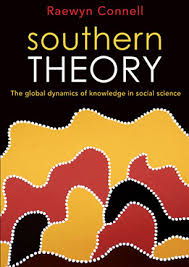
Raewyn Connell is Professor Emerita at the University of Sydney and a Life Member of the National Tertiary Education Union. She has taught at Macquarie University, Flinders University, and several universities in other countries. Recent books are Southern Theory (2007), about social thought in the postcolonial world; Confronting Equality (2011), about social science and politics; Gender: In World Perspective (3rd edn, with Rebecca Pearse, 2015) and El género en serio [Gender for Real] (2015). Raewyn’s other books include Schools & Social Justice, Ruling Class Ruling Culture, Gender & Power, Masculinities, and Making the Difference. Her work has been translated into nineteen languages. She is the 2017 recipient of the American Sociological Association’s Jessie Bernard Award. Details can be found at her website www.raewynconnell.net and on Twitter @raewynconnell


As a keynote speaker for #GEAConf2018, Professor Raewyn Connell will be discussing the conference theme by highlighting the global dimension in gender relations, and current debates about knowledge.  ‘Post-truth politics’ is not peculiar to the global North, and is not separate from contemporary imperialism. Power on a world scale is still concentrated among groups of privileged men, including corporate managers, the super-wealthy, and military power-holders.  But their legitimacy is fragile, which is a reason for the revived appeal to violence in global politics and the turn, in media and domestic politics, to hostile fantasies of threat and protection.

Global feminism has disrupted patriarchal authority very widely, and mass education is one of the most important sites where this has happened. Feminist critique of the mainstream curriculum remains essential.  Yet we need to look critically at the global politics of our knowledge about gender, which itself has an imperial history and is challenged by decolonization campaigns

Global feminism has disrupted patriarchal authority very widely, and mass education is one of the most important sites where this has happened. Feminist critique of the mainstream curriculum remains essential.  Yet we need to look critically at the global politics of our knowledge about gender, which itself has an imperial history and is challenged by decolonization campaigns. Claims for the universality of knowledge, which provide some resistance to post-truth politics, are subject to familiar feminist critiques, yet cannot be replaced by claims of epistemic privilege.  We need, in current conditions, a feminist model of truthful practice as a basis for knowledge and curriculum. Professor Connell hopes to illustrate what this means for teachers’ working lives as well as in theory.


If you are attending conference, let us know on Twitter using the hashtag: #GEAconf2018

C2C: Women’s stories in mathematics

This post is part of our new Countdown to Conference (C2C) series. We would love to feature a brief blog post from you too! Visit our main Countdown to Conference page for details!


C2C: Women’s stories in mathematics
by  Sam Prough, University of Wisconsin-Madison


I am thrilled to become part of GEA as well as have the opportunity to attend the GEA 2018 conference! I’m excited to share my research that unpacks the math stories of individuals who identify as women in an effort to understand how they can be supported in learning by looking at their collective experiences as a new and meaningful form of truth.

As the world spirals into a realm of post-truth, people seem to be scrambling to find facts and prove objectivity in order to counteract statements and opinions lacking evidence and substance. When this tightening of accepted truths and truthful stories occurs across the news and even research, what or whose truth is valued? What or whose stories are heard?

What or whose truth is valued? What or whose stories are heard?

There’s a profound irony in how I have placed myself within the hierarchy of stories and truth telling in research. I was more than surprised to have my work accepted for the GEA 2018 conference. In fact, as an early graduate student, I had chalked up the application merely as an opportunity to practice my skills of promoting and concisely writing about my work. This entrenched lack of confidence that such work would be considered meaningful by others was really an internalized thought about what stories or truths would be considered meaningful within academia as a whole.

Within mathematics education the accepted truth of what counts as math learning is narrow and additionally emphasizes the perspective of men. Math is frequently framed as highly masculine and often accessible only to a select few. The ideas and learning of underrepresented individuals, such as women in mathematics, are frequently made invisible.

Research is at a crucial crossroads. I would argue that research can recognize a more meaningful array of truths by listening and embracing the stories of these often made invisible individuals. I’m interested in what new things this can show us about women’s experience in math education. By exploring multiple women’s stories in math, it is possible to recognize a range of experiences that create an environment of what counts as math learning for women.

What are other ways that gender education research can function in a post-truth society without erasing the voices of the very individuals that they study? I look forward to attending #GEACONF2018 to find out!


If you are attending conference, let us know on Twitter using the hashtag: #GEAconf2018

CfP – GEA Conference 2019

With preparations well underway for the 2018 GEA conference at the University of Newcastle, Australia (for details, please see here), we now turn our attention to gearing up for GEA Conference 2019.

The Gender and Education Association are pleased to announce that their next international conference will be held in June 2019. The GEA executive committee welcome proposals to host their long-standing conference from higher education institutions across international contexts and from conference teams spanning a variety of academic disciplines, theoretical backgrounds and fields.

The deadline for submission will be 30th June 2018. We welcome proposals from across international contexts.

For guidance on how to apply to be a host for our 2019 conference, please see here: GEA Conference CfP 2019

For proposal guidance please see here: GEA Conference Proposal Guidance 2019

Resistance, identities, and reducing pressure: Reflections on GEA Conference 2017

Resistance, identities, and reducing pressure: Reflections on GEA Conference 2017
by  Nicole Johnson, PhD Student, Open University of Catalonia

After enjoying the keynotes, sessions, and conversations at the 2017 GEA Conference, I found myself reflecting over the past month on the themes that emerged and impacted me. I’ve been sitting on this blog post, pondering, as I try to find the right words to describe the way this conference has shaped me as an academic.

Through deep discussions on privilege, identity, resistance, and feminism in all its forms, I was reminded of the importance of creating space for diversity and the importance of actively listening to the wide range of perspectives and experiences from around the globe as we seek to address inequity and injustice worldwide. I met people with similar life experiences to mine and I met people whose experiences were very different. We laughed together, we debated pressing issues, we helped one another see our potential blind spots, we discovered commonalities amidst our diversity, and we heard one another.

While I thoroughly enjoyed the keynote presentations, I found the most value in the parallel sessions, discovering the vast scope of research that is being undertaken in the field of gender and education. Furthermore, the discussions resulting from those sessions were powerful, insightful, and encouraging.

My key takeaway: When we surround ourselves with diversity, we are better able to understand our own biases and blindspots.

My key takeaway: When we surround ourselves with diversity, we are better able to understand our own biases and blindspots. In other words, when we open ourselves to hearing the experiences of others, we see our own experiences in a new light and the lens through which we design studies and analyze data is reshaped. We also begin to see the unique and ever-evolving shape of our personal lens more objectively, as well as our personal distortions due to this shape of our lens . As other voices, that tell of experiences very different from our own, penetrate our understanding of concepts and events, we begin to understand how privilege (whether it be due to gender, race, or class) has given some of us a pre-shaped lens. We can then, hopefully more willingly, create space for those with different experiences to correct our distortions so we see our world more accurately.

For more about the GEA Conference 2017, check out the #GEAConf2017 Storify curated by Kate Marston, GEA Social Media intern. Do you have reflections to share about your experience at GEA Conference 2017? Let us know!

We look forward to seeing you at GEA Conference 2018 at the University of Newcastle Australia!

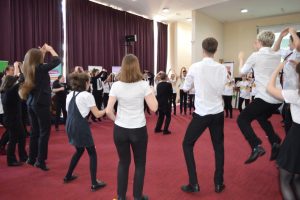
Featured photo by Ileana Jiménez‏ of a performance by Kranti Mumbai girls at GEA Conference 2017


Young people light up the AGENDA for a better sex and relationships education 

Guest post by Victoria Edwards

Generating more energy than the  blazing July sun, over 70 young people (age 13-18) streamed in to the Educating Agenda conference, in Cardiff University last week. They came to participate, share, reflect and build the event into a powerful and inspiring call to arms. Joining them in the building, and in purpose, were some of the teachers and heads of department who continue to give their time and support to  young people speaking out in their schools and communities. Representatives from a range of charities and statutory organisations profiled the services they are able to offer young people across an array of colourful and engaging stalls, contributing to the carnival-esque feel of the event. This was not a typical conference, more of  a celebration of the many achievements of all involved. It was also about bringing together these young people who are working tirelessly and bravely to show that, far from alone, they are part of a bigger movement with a shared collective aim: improving the provision of sex and relationships education for everyone. And so, it was also a strategic meeting, looking to the future, building onwards, with Agenda.

Professor Emma Renold opened the conference, welcoming back the young people and practitioners who co-produced the Agenda resource and attended its launch in Cardiff bay last year.

Reflecting on this amazing journey so far, which clearly inspired many of the performances we were to enjoy that day, Emma highlighted the many directions Agenda has moved in. Taking the resource across Wales, physically, digitally and emotionally. From the Welsh Assembly, to police and teacher training, and the Welsh Baccalaureate conference, across schools town and cities, it was clear much has been achieved.  We saw how Agenda has become a living archive in motion, amplifying the creations and messages of all the young people involved in its creation, many of whom were gathered in the room. We saw Agenda gaining momentum through its appropriation and adaptation in each new encounter and forging onwards as a powerful vehicle for change, as we were about to see.

‘Children’s champion for Wales’, commissioner Sally Holland drew our attention to Agenda’s value as a human rights based approach, commending the work of everyone involved. The children’s commissioner applauded Wales’ brilliant young people who, using Agenda as a launch pad, are demanding, better sex and relationships education in powerful and creative ways. Cabinet secretary for Education Kirsty Williams echoed these sentiments describing Agenda as a platform for discussing complex issues, helping teachers to provide the sex and relationships education young people deserve.

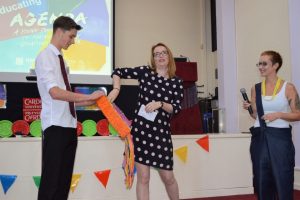
Classrooms, the cabinet minister said, have to be free of intolerance and, she added, sex and relationships education must be inclusive, comprehensive and delivered by trained experts. The talk concluded with messages from primary school pupils, sent to Kirsty Williams via a fantastic Pride-inspired, rainbow piñata, calling for gender neutral toilets in schools, more teacher training, awareness raising and protests.


Two outstanding performances followed featuring pupils from Ysgol Gyfun Plasmawr and Mountain Ash comprehensive schools. Siriol Burford introduced these Agenda ambassadors, firstly Plasmawr performing a new drama production ‘Hidden’ that highlights the potentially unseen harm of homophobic bullying. A powerful representation of the insidious effects of ‘harmless banter’, exploring the impact of phrases such as ‘that’s so gay’ from the perspective of a non-heterosexual pupil, overhearing them. #WAM (We Are More) maintained the high standard delivering their own dramatization of the kinds of everyday sexism they experience. Their rallying call ‘WAM: We Are More’ was the response to derogatory marks about skirt length, make up and body shaming. Mountain Ash students also shared a video of their activism and its path through their school and beyond, out in to communities in Cardiff, at the International Women’s day event and onwards to Paris for the European Children’s Rights summit!

Rhian Bowen-Davies, National Adviser for Violence against Women, other forms of Gender-Based Violence, Domestic Abuse and Sexual Violence emphasized the need to listen to young people in designing and delivering the necessary preventative work to advance gender equity and address all forms of gender-related and sexual violence via a whole school approach.

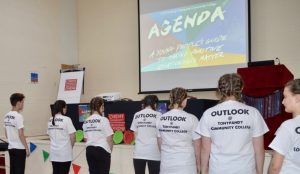
Young people from Tonypandy community college’s ‘Outlook’ group performed their drama exploring, among other things, sexting. Introducing them, their teacher emphasized that these young people had created the characters and the script themselves, without assistance.  All of the powerful messages were their own and they made a strong case for the importance of inclusive and student-led sex and relationships education.


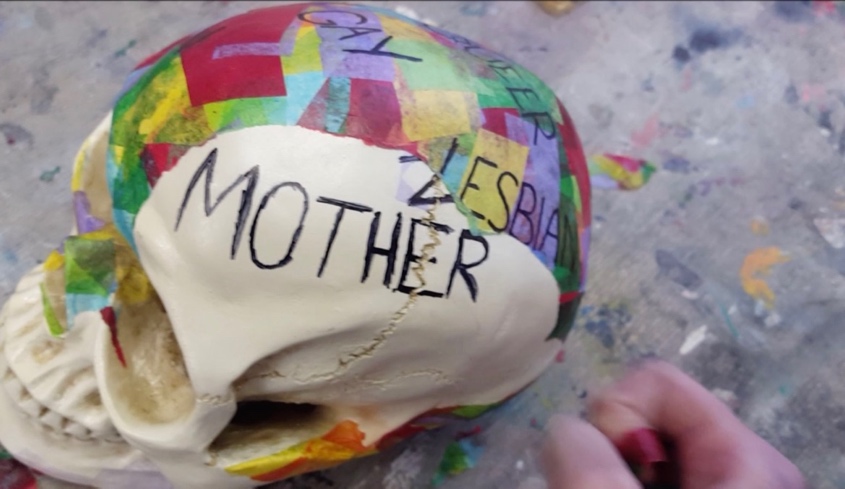
Tonyrefail comprehensive school students brought a musical flavour to close this first section of the day. Firstly, with backing from Mountain Ash Comprehensive school’s male voice choir, Charlie (age 13) performed her own song ‘Face to Face’, inspired by Agenda. It’s a beautiful song about respect, ambivalence and the challenges of growing up. With barely a moment to dab our moistening eyes Tonyrefail introduced the GCSE art project of one of their most talented students, Lauren. Set to the Macklemore track ‘Same Love’ a short film chronicled the impact of contemporary society on understandings of LGBTQI identities, from media representations to the uncertainty of the current political climate. Punctuated by the removal of rainbow coloured tissue paper from a skull inscribed with all of the intersecting identities that can sometimes become lost when we think of people only in terms of their sexualities. It was both sobering and uplifting to be invited to view these issues from this young person’s perspective, seeing what they see in the world around them. For real emotional impact when delivering your message, think creatively.

After a short break young people from Ysgol Gyfun Plasmawr led students from all of the schools through the Agenda starter activities (‘the runway of change’, ‘stop/start plates’ and ‘what jars you’), using them as a kicking off point for

developing a pledge of the top five key things that need to change in their schools.

These pledges were videoed, filtered through a ‘glitch app’ which distorts images to obscure participants identities. And these pledges were made to be gifted back to the schools the students originated from, glitch-activism in action. This industriousness filled the hall with conversations between schools about the strengths and weaknesses of their own current provision. Aptly, while this was going on, teachers and professionals were enjoying presentations in another part of the building. Emma shared details from the AGENDA case studies and accompanying Welsh Baccaluerate resources on Feminist Activism, Healthy Relationships; LGBT Rights; Selfie Culture; Digital Gaming and more. Inspiring feminist teacher Hanna Retallack made the journey from London to share about her experiences as a feminist teacher and facilitator of feminist groups, sharing ideas and strategies with professionals in Wales. The Spectrum Hafan Project also helped to outline positive moves and whole school approaches that all schools could make to get conversations started.

During the lunch break most of us migrated to the grounds to sit in the sun, continue conversations and share thoughts and reflections on the day so far. With sun soaked backs lulling us all gently towards inertia we made our way back indoors. The glitch pledges were screened at the front of the hall and the main themes of better staff training and listening to student voice came across clearly from all groups.

Minutes after, Jên Angharad  (Voices in Art) was re-energising everyone and waking us all up, working with some of the thoughts and feelings of the day to create a series of  movements. Capturing the spirit of the day Jen took her cues from the young people, moving with their feelings. For me, this was what the conference was about, it really was their day. A day that united the representatives from national charities, Government, academia, educators, county councils and youth groups, through the awe-inspiring enthusiasm, determination and creativity of the young people whom their work affects.


The talent, passion, commitment and strength of all the young people who came together on July 5th outshone the ferocity of the midsummer sun, they are our brightest stars. Captured in image, movement and song, here are some of the day’s best bits: https://vimeo.com/224546331


Padam… Padam… GEA Conference 2017: Dr Zoe Charalambous

By Dr. Zoe Charalambous, Anatolia College

“Cet air qui m’obsède jour et nuit
Cet air n’est pas né d’aujourd’hui
Il vient d’aussi loin que je viens
Traîné par cent mille musiciens
Un jour cet air me rendra folle
Cent fois j’ai voulu dire pourquoi
Mais il m’a coupé la parole
Il parle toujours avant moi
Et sa voix couvre ma voix”

Written by Henri Contet and Norbert Glanzberg, sang by Edit Piaf

Padam… Padam… the sound keeps being repeated in my head as my past returns.

“Not having a voice means you become empty from inside, you become dead,” I had mentioned consciously and unconsciously during the panel discussion titled:  “Teaching Intersectional Resistance: Global Feminist Teachers in Conversation.” I had said that actually not having a voice as a feminist may be symbolic of being a Greek feminist. I am still unsure of what feminist I am; I have to tell you the truth here before you read. We (myself and my students at Anatolia College) created Genderisms, a club exploring gender relations in high-school doing “amateur or not” research, reading Butler and Lacan, and playing with ideas on how to bring awareness of sexism going on – we created ‘AC Genderisms’ too on Facebook. Musings on Gender; we called it in Greek:  ‘ Φυλο-λογισμοί» (unsuited quotes here intended).

I have not read much Feminist theory, though I love Irigaray’s wave-like writing and Bracha Ettinger’s echoes of the primitive womb of all connections for that which we all seek. I am also in love with fantasies and their stories of prohibition, and the uncontrollable madness of the symbolic muting the Real – Padam- Padam- Lacan…so bear with me, with the fruit I shall bear. We always begin with a disclaimer in this capitalist society, don’t we?

When you are given a voice, how does the chimera of all that you have concealed come out unlike a tsunami?

I am thinking of a conference as a vessel packed with voices speaking their directions in the wind; then letting go of their articulated creations into the crowds of understanding to become something: what? Where do we go from here?

What happens after a conference? It is not just about the knowledge shared. It is about the solidarity and the generation of connections. Thank GEA we are not alone. Even the most minimal of discussions which happen between strangers about their work and passions produce threads of connections- interlacing us all back into realizing that we do can have an actual impact.

The 2017 Gender Education Association Conference at Middlesex University contained oceans of both visible and invisible questions about what it means to explore gender in education and what it means to be a feminist, (for me).

As I start this blog very abstractedly I wonder can the personal take on a communal meaning?

I begin with my story returning to London for this conference after unexpectedly returning to Greece, due to personal circumstances. From being an academic at university I became a teacher at a high-school : quite a violent return to my old school and being a metaphorical teenager myself.  And now, a re-turn to the future I was building here in my you-topian home London. The place where I found my own language, English, to write my dreams. I walked down a cemented pathway after leaving the Middlesex campus on day 1 of the conference and I thought of “circles- cycles” of generations.  We are generating new–reconfiguring material “discursive apparatuses” (someone and everyone) quoted from the conference) as we engage deep in and on the space (De Certeau, The Practice of Everyday Life, 1984 ). Documenting a walk of thought.  How can documenting our walks of thought in the past and in the present help us better understand how we are shaping our future as feminists?

For me this question becomes very important having to teach girls and boys at school, touching their minds with theory that may mean something or nothing or anything to them. How do we manage to make them aware of their own desire, their agenda, their human rights without imposing our own convoluted projections for what never came to be for us, or for what has become for us? I touch upon this concern as this is the key question in my own teaching/research – how do we teach without indoctrinating? How do we liberate without imprisoning?

This conference was a concave mirror for the practices and transformation currently going on within and beyond the academic landscape about ways of understanding gender and feminism. Here is a generalization. I will become more specific.

What I heard in this conference became separated in my mind in these four categories, themes touched on:

a) The safety in learning and education linked with community connections and boundaries.                                   

Leading and relating to…

b) Reflections: is it about us? Teachers? Academics?

Producing wondering experiments/discussions/presentations on the question of…

c) How do we do this? via projects/workshops/bodies/art discussing bags, music, dirt .

Moving to Metaphors in order to view these issues and understand them….

d) Theory about and conceptualizations of situations linked with gender and feminism.

All of these moves/categories happening at the same time and not in a linear sequential order.

All of these articulations (for me) somehow encompassed by the echo of Ahmed’s title: “Leading a Feminist Academic Life”

It is impossible to touch upon all the presentations and material covered in the conference. So, I will briefly mention the presentations/ideas that most relate to teaching English at my school.

Jessica Ringrose, Hanna Retallack and Ileana Jimenez have been significant in my coming to this conference. They have been my supporters and believers. Thus, attending “Nasty Feminist Teachers” took on a special meaning for me at the conference.  During this session, Hanna and Ileana spoke about their ongoing collaboration to create a feminism syllabus to teach their classes and Hanna’s visit to Ileana’s school in New York. Ileana touched upon the unsaid incidents happening within her school having to do with sexual harassment and how this course actually managed to push for an actual change in the school’s policy. Activism and education hand-in-hand.   It was most inspiring to listen to Briony O’Keefe’s efforts to create a campaign with her students, creating posters against sexism, her funded writing of teaching resource material and the open manner she conducts her classes.  I loved that her students call her by first name. She highlighted that she always tries to be at one level with them, not playing the “monopoly” of the teacher, as I understood this.  Briony really helped me understand how far we, as teachers, can take a multi-modal project we do with human rights into having an effect on the community.

“Bag experiments: Working the borders of gender fluidity” by Constance Elmenhorst, Nikki Fairchild, Carol Taylor, Mikra Koro-Ljunberg, Angelo Benozzo and Neil Carey was especially poignant in that in the doing and undoing and writing about and for bags we were just creating and breaking down borders in our minds with our bodies.  In many ways, embodying the social borders of gender and the fluidity of gender is not an easy reality to mouth! Thus, I found great inspiration in doing and undoing bags, and the idea of what is inside, what is an extension. This is  an activity high-school students could use to wonder – along perhaps with a small excerpt from “Gender Trouble” or “ On giving an account of oneself.”

Other useful ideas were:  using music projects to communicate (“troubled”) masculinities. Elly Scrine’s project of using Drake’s song and re-making it with two students in order to help them work through anger was also an inspiration. At the same time, via the presentations of Anne-Sofie Nystrom, Minna Salminen Karlsson and Carolyn Jackson the importance of exploring the “masculine” anxiety reared its beautiful head.

Dr Iris van der Tuin’s key note lecture on “The Generative Curriculum: On the Past, Present and Future of Feminist Teaching and Learning” was hugely intriguing in the sense that as I listened to the melodies of theories and wondrous abstractions – going against the grain in terms of simple and accessible key note lectures – I recognized many of the Middle Years Practices (in IB Schools) which we attempt to work with at our high-school – allowing students to find their own questions – their topics – the Personal Project, which colleagues of mine have been working on and have really been watching wonders happening in the minds and passionate pursuits of the students. That is the beauty of when theory and practice actually meet and recognize each other as always having been each other’s fate.

In many ways, this is an ongoing question at schools – a question I had encountered when I was teaching a module for the B. Ed at the Institute of Education UCL – and one that I am now also faced with as a teacher- “Oh Zoe, this is theory – practice is what is important.” The dismissal of other ways in which we can see our life –practice-profession – the dismissal of our imagination is one of the biggest disappointments; yet it is not anymore.  One must waddle through the water one chooses to waddle in. I wonder whether the acceptance of the struggle is the first step towards grounding our fears of subjection to a system that requires us to be “practical” and not “theoretical” ;but we must view (theorize ) what we do (praxis).

Research too is significant: to listen to the very detailed results of the session titled: “Examining family and educational experiences of gender diverse and transgender children and young people: methodologies, policies and practices” chaired by Rachel Skinner and presentations by Ulman, J, Davis C., and Robinson, K. was precious evidence pinpointing the significance of realizing that concealing hurts ;  the percentages of self-harm and suicide rates of kids who are not allowed a voice to speak what they are exploring- the lack of sexuality education – looking through the internet to find a label for what you are going through- the harm we cause because we are afraid of the Other. This reminded me of Zizek’s “Neighbours and Other Monsters”(2005). We are afraid to look at our neighbour’s mangled/hurt arm because it is something we contain inside of us – the shame of containing that which you cannot talk about.

This takes me to the very interesting following sessions about “Affective Relationality as Response-ability” with presentations by Gowlett C, Hook G, Mayers, E and Wolfe, M. What really stayed with me was the “resistance” discussed by Genine Hook in her undergraduate teaching and the attacks she underwent for having a feminist syllabus.  I wonder aren’t we teachers for those who attack us? What is the limit? Lacan argues that when we perceive resistance from others it is always our own. (Charalambous, 2014, p. 126) – Someone at the conference told me “You are very generous Zoe” when I had said that we must listen and ask questions when someone disagrees with us, instead of going on the attack or defense.  Here comes the mirror – do we look into the other’s mirror and become one with them or do we mirror back to them – what we create with our stance? Do we surprise others with our generosity? Can this generate a new generation of feminists? Of genderists….? Of human beings?

I absolutely was touched and troubled by all the dance performances and through the work of “Moving with the not-yet: choreographing with young people in space and time.” Something came out of my body with this embodied experience:  tears and sweat.  Fluids. It was really hot in that theatre. It is vital to become uncomfortable and comfortable with our bodies contacting us with the truth of our practices and theories. I somehow gazed into the abyss of so much emotion contained in the research by Renold, Ivinson and Anhgharad. This was too much/the unspoken excess needed to exit via a generous transmission of bodies.

Generosity and Viscous Porosity= the workshop by Carol Taylor and Nikki Fairchild played with our limits with “DIRT” – After the “theory” – the presenters presented us with bags and boxes containing dirt (teeth, hair, nails, etc.) and we engaged in a free-associative discussion about our reactions to these. I absolutely was fed with thought [–as the conversation somehow spiraled into “breastfeeding” and the role of the mother – whether it is natural or not – criticisms about discourses created- ] by what was said by the presenters : “Dirt is always with us” linked with what Marx has said (it was said) “the Poor are always with us”  and I must add “the Other is always with us.”

“Being Porous,” it was added, “is a good thing, skin is the boundary.”  A final entertainment of boundaries was discussed using Haraway’s concept of the cyborg (1984) – a little girl from Fairchild’s research working with a rice-tray that was one with her – as she was moving and going away and being with it at kindergarten school.

Playing. Punctuating, playing with punctuating. Playing with our bodies- with the bodies – with the body of this conference – in a manner that recognizes the validity of Other’s desires.  This text.

Somehow I have tried. In an incomplete manner and yet as complementary as I could and with EXCESS I had to process [one week I am unsure is enough to write into this].

I will finish off with a reference to our panel discussion on Day 2 – when Ileana, Hanna, Robin, Briony, and myself were put in discussion facilitated by Professor Miriam David. It was a joy to connect with all of the teachers/academics and to realize the many ways in which we are connected!  A true embodiment of “intimacies of solidarity” – which I have now experienced – and felt – not just thought about. This takes US back into the beginning of the cycle I have been writing into – : ultimately what we are seeking is a connection as human beings, as feminine<masculine<transgender<whatever the signifier. GEA conference 2017 absolutely and yet openly communicated this need to allow for connections rather than dismemberment and cut offs in both education and in our communities at large.  The matrixial borderspace of Ettinger (2006) comes to mind and something mentioned by Dr. Iris van der Tuin:

The phrase “You can’t challenge what remains unsaid,” which I heard in one of the sessions, made me curious.  What does it mean to “challenge”?

Can we challenge with the aim to return to each other rather than move away from?

Thank you all for openly connecting with me and disconnecting too.  Let me break the narrative of this blog post with my own “moral panic” –(using Jessica Ringrose’s phrase here, though not being unable to quote the paper) through the words of another:

“What is the agency of the one who registers the imprints from the other? This is not the agency of the ego, and neither is it the agency of one who is presumed to know. It is a registering and a transmutation that takes places in a largely, though not fully, preverball sphere, an autistic relay of loss and desire received from elsewhere, and only and always ambiguously made one’s own.” (Ettinger, 2006, p. xi)

References

Charalambous, Z. (2014). PhD Thesis. “A Lacanian Study of the Effects of Creative Writing Exercises: Writing Fantasies and the Constitution of Writer Subjectivity.” Institute of Education, University of London.

Ettinger, B. (2006).  The Matrixial Borderspace. Minneapolis, London: University of Minnesota Press.

Žižek, S.( 2005). Neighbors and Other Monsters. In : S. Žižek, E. Santner and K. Reinhard (eds) The Neighbor: Three Inquiries in Political Theology.  Chicago and London: University of Chicago Press, pp. 134-190.
GEA 2018 ANNOUNCEMENT

Next year’s GEA conference will be held in
University of Newcastle,  AUSTRALIA!!
DATES: Sunday 9 to Wednesday 12 December, 2018
Organising Committee: Professor Penny Jane Burke; Professor Lisa Adkins; Professor Rosalind Gill; and Associate Professor Ros Smith; Dr Julia Coffey and Dr Akane Kanai, along with the broader CEEHE administrative team.
Theme: “Gender, Post-truth Populism and Pedagogies: Challenges and Strategies in a Shifting Political Landscape”
The conference theme is intended to provide a platform to critically engage with and interrogate the current political landscape in which debates about knowledge, authority, truth, power and harm are resurfacing and require feminist intervention. A central question underpinning this conference theme is: what does it mean to be pedagogical in a post-truth landscape? And how might feminist scholars work to intervene in this environment? The GEA 2018 conference will provide a forum to explore the challenges and strategies for educators, researchers and participants in higher education in these complex times.
The CFP for abstracts will be announced shortly.
WATCH THIS SPACE! #GEAconf2018

GEA Editors Workshop for Early Career Researchers

Carol Taylor and Susanne Gannon led the editorial team from the Gender and Education journal on a pre-conference workshop for Early Career Researchers on “The secret life of journal articles: selecting, writing, reviewing, revising”. Over 15 participants from England, the Netherlands, Australia, and the United States attended. The editors discussed criteria for evaluating manuscripts, the reasons for rejection, and choosing a suitable journal. Background information on Gender and Education journal logistics such as who owns the journal, number of issues per year, impact factor, quartile ranking, readership and authorship were discussed – and reasons why authors might want to take these factors into account were explored. Participants were introduced to the Author Services provided by the publisher.

The criteria and selection of choosing reviewers, the timing and timeline for reviewing and also how to interpret reviewers’ ratings of a manuscript were discussed. The editors provided an overview of the characteristics of a ‘good reviewer’, and explained that timely response to an invitation to review or decline to review is much appreciated in order to ensure a timely review process.

Carol provided participants with an extract from an article she had submitted to Gender and Education along with the reviews the initial submission had received She talked through how she changed the article in response to the reviews and the resubmission process through to eventual publication. There was a broader discussion on how an author responds to reviewer and editor’s comments, the process for re-writing manuscripts and the expectations for re-submission.

ECR’s commented that the workshop helpful and informative.  They also appreciated having the opportunity and time to share their experiences in submitting manuscripts for review and raise questions about the process.  The workshop created a collaborative space to share insights on research approaches, reviewing practices, publishing strategies and impact narratives for gender/feminist scholars doing qualitative and quantitative research.

If you are an ECR or doctoral student and you are interested in reviewing for Gender and Education please contact Helen Rowlands, our Editorial Manager.

Email: genderandeducation@outlook.com

Carol Taylor, Susanne Gannon, Jayne Osgood, Kathryn Scantlebury

http://www.tandfonline.com/toc/cgee20/current

C2C: Your guide to the #GEAconf2017 Keynote Speakers

This post is part of our new Countdown to Conference (C2C) series. We would love to feature a brief blog post from you too! Visit our main Countdown to Conference page for details!

C2C: Your guide to the #GEAconf2017 Keynote Speakers
by Kate Marston, GEA Social Media Intern

We are delighted to have six amazing keynote speakers presenting four keynote sessions at the 2017 GEA Conference: Generative Feminism(s): working across / within / through borders.

Below we offer a brief overview of our speakers and what is in store for #GEAconf2017!

Professor Kerry Robinson, Western Sydney University
(Day 1 – 10:30 – 12:00)

Schooling, gender and sexuality: Children’s and young people’s narratives in an era of global conservative backlash.

Despite notable gains for feminist, queer and trans politics in Australia, the global expansionism of conservative right-wing politics in recent years has led to a culture war as key institutions see the reestablishment of heteronormative social orders and dualistic conceptions of sexuality and gender. Framed by this unfolding Australian experience, Professor Robinson will discuss several qualitative and quantitative research projects conducted over the past six years: exploring schooling, gender and sexuality with children, young people, parents/carers and educators. She will consider what we are learning from children and young people about gender, gender diversity and sexuality in the early 21st century and how this knowledge is being received in an era of global conservative backlash. Drawing on feminist, trans and queer theory, this keynote will be looking for ways forward offered by generations of feminist thought.

Kerry Robinson is a Professor in Sociology in the School of Social Sciences and Psychology at Western Sydney University, Australia. She is the director of the Sexualities and Genders Research group in the School and her expertise lie in the fields of gender and sexuality studies; childhood; children’s sexual citizenship; diversity and difference; sexuality education; sociology of education; and sociology of knowledge. She has published widely in these areas, including: lead co-author of Growing Up Queer; monograph, Innocence, Knowledge and the construction of childhood: The contradictory relationship between sexuality and censorship in children’s contemporary lives; a co-edited collection Rethinking school violence; and is the co-author of Diversity and Difference in Early Childhood Education: Issues for Theory and Practice.


Dr Iris Van Der Tuin, Utrecht University
(Day 1 – 17:00 – 18:00)

The Generative Curriculum: On the Past, Present and Future of Feminist Teaching and Learning

Re-directing generational logics of feminism away from phallogentricism and simplistic ideas of conflict, Iris Van Der Tuin paves the way for a more complex notion of generationality. In this keynote she will address the generative approach to generational feminism as it reconfigures exchange of women in patriarchal societies, the mother-daughter plot in feminism, and correspondence theories of truth and method: providing a theory and practice for 21st century feminist teaching and learning. Reading generative generational feminism specifically through the growing phenomenon of Liberal Arts & Sciences (LAS) education in Europe, Iris Van Der Tuin explores a developing feminist education for, and of, the future.

Iris van der Tuin is an associate professor in and program director of Liberal Arts and Sciences at Utrecht University (The Netherlands). Trained as a feminist epistemologist, she specializes in gender studies and new materialisms (especially pertaining to humanities scholarship that traverses “the two cultures”). She co-authored New Materialism: Interviews & Cartographies with Rick Dolphijn, and edited Gender: Nature for Macmillan Interdisciplinary Handbooks. Her book Generational Feminism: New Materialist Introduction to a Generative Approach inspired, in part, the theme for #GEAconf2017.


Professor Emma Renold, Cardiff University;
Professor Gabrielle Ivinson, Manchester Metropolitan University;
&
Jên Angharad, Future Matters Collective
(Day 2 – 12:30 – 13:30)

Moving with the not-yet: choreographing the political with young people in space, place and time

Extending a long tradition of feminist work on the marginalised position of minoritarian Others (Irigaray, 1984; Braidotti, 2006) and new materialist feminist philosophy (particularly Manning 2012, 2013, 2016), Emma Renold and Gabrielle Ivinson will present aspects of their on-going pARTicipatory research with young people (aged 12 – 18) living in the ex-mining/coal/steel towns of the south Wales valleys. Working with choreographer Jên Angharad they will share a series of dartafacts (Renold 2017) created across a range of research creations and contribute an interactive performance piece that brings to life new materialist feminist research methodologies. The intention is that through creative research practices the team will demonstrate the means by which educational research can transcend conventional boundaries and expectations to put the in-act into enacted activism.

Emma Renold is a Professor of Childhood Studies at the School of Social Sciences, Cardiff University. Her research explores gendered and sexual subjectivities across diverse institutional sites and public spaces across the young life course. She chairs the Welsh government’s expert advisory group on healthy relationships and recently led the production of Wales’ – and the UK’s – first online toolkit to support young people to raise awareness of gender-based and sexual violence in schools and local communities (in collaboration with Welsh Women’s Aid, NSPCC Cymru and the Children’s Commissioner).

Gabrielle Ivinson is Professor of Education and Community in the Faculty of Education, Manchester Metropolitan University. She is interested in how the specific habits, practices and gender worlds that supported dangerous work in industrial locales can be regenerated as social and educational resources for children and young people today. She leads the BERA Poverty and Policy Commission, which aims to influence and broaden public debate on the role of education to improve the life chances of children & youth living in poverty.

Jên Angharad trained in Dance Theatre and Advanced Performance at the Laban Centre for Movement & Dance, London. Her career began in performance before building a portfolio of work independently as a bilingual choreographer, workshop facilitator and movement director in education, community, theatre and television. She is a member of the Future Matters Collective in Cardiff and collaborates with Cardiff University colleagues and artists on research projects as movement facilitator, choreographer and performer.

https://vimeo.com/160137856


Professor Ann Phoenix, Institute of Education, University of London
(Day 3 – 14:40 – 16:00)

Generating feminisms? Negotiating intersectional borders and boundaries over time

The power struggles that result from intersectional differences between women have been central to the generativity of feminisms, fuelling new ways of seeing and shifts in relations between women and new claims to feminist theory. Whilst it can be easy to romanticise these histories, fissures within feminisms in and out of the academy have been intense in some sites and ignored in others over the last few years. At the same time, borders have proliferated as migration, concerns about terrorism and state responses to it have made many citizens contributors to the policing of national borders in their everyday lives (including in the academy).

In this closing keynote, Professor Ann Phoenix will examine some of the ways in which feminisms, through intersectional lenses, are currently generating new ways of seeing and working across borders. This process is often a heated and painful one, where new generations of feminists, multiply positioned in terms of ethnicisation, racialisation, genders and sexualities, find their own ways of taking up affordances from feminisms and resisting exclusionary practices within and outside feminisms. Professor Phoenix will consider the ways in which old issues (e.g. of racialisation, genders and sexuality) are both recursive and take new forms. Her presentations explores how disciplinary practices in the academy serve to (re)produce hierarchical gendered inequalities by shoring up old borders that sometimes exhaust generative energy and examines the psychosocial impact of this in policy, practice and research.

Ann Phoenix is a Professor in Psychosocial Studies based at Thomas Coram Research Unit, Department of Social Sciences, UCL Institute of Education and she is the Principal Investigator of the research network NOVELLA (Narratives of Varied Everyday Lives and Linked Analyses). She has over 200 publications which include work on narratives, theoretical and empirical aspects of social identities, gender, masculinity, youth, intersectionality, racialization, ethnicisation, migration and transnational families. From 2016-7 she is the Erkko Professor at the Helsinki University Collegium for Advanced Studies.


If you are attending conference, let us know on Twitter using the hashtag: #GEAconf2017

C2C: Science, Social Justice, and ‘Southern Discomfort’

This post is part of our new Countdown to Conference (C2C) series. We would love to feature a brief blog post from you too! Visit our main Countdown to Conference page for details!

C2C: Science, Social Justice, and ‘Southern Discomfort’
by Dr Leslie S. Jones

I am not much of a blogger, in fact this is my first blog post EVER, but I am willing to give up my status as a “virgin blogger” in the spirit of the upcoming conference.

If there were a gene for feminism, I would be absolutely certain that I have it. My earliest memories are constant battles with my mother over being forced to do things because “that is what girls are supposed to do.” I hate dolls, pastel pink dresses, and lacey anklet socks to this day, since they symbolize the gender roles I found so oppressive as a child. I know she meant well, considering it her duty to socialize me properly so that I would fit into the prescription of a “nice girl” that my two sisters found so easy to accept. The more she tried, the wilder I got, and the more I grew to resent ridiculous cultural boundaries, some fifty years ago, that kept me from doing things I wanted to do. When she told me “not to beat a boy” on a golf or tennis date because “they would never want to marry me,” I thought she was crazy. I have never been able to understand how a well-educated woman who majored in mathematics at a very prestigious college could wonder, “Why you girls insist on over-educating yourselves?” when my sisters and I went to graduate school leading to two MBAs and a PhD. My wonderful father, who came from a much less-privileged childhood, was tremendously proud of us and always defended my right to grow into whatever I wanted to be.

I hate dolls, pastel pink dresses, and lacey anklet socks to this day, since they symbolize the gender roles I found so oppressive as a child.

My first conscious exposure to racism was in 1961 when I saw 3 bathrooms and 2 water fountains with signs for “colored people” at a gas station on a visit to Mississippi. I insisted on an explanation, and my parents must have been terrified that the Ku Klux Klan was going to appear if they did not get their out-spoken child in the car. I spent a large part of my childhood in Hawaii, learning island cultural values including the fact that the world is full of different people. Growing up during the Civil Rights Era I could never accept any justification for what was happening to African Americans. The ugliness of both racial segregation and gender roles in the latter part of the 20th century were so obnoxious throughout my secondary, university, and early graduate schooling in the natural sciences that by the time I chose a dissertation topic, it was “The Impact of Racism and Sexism in Post-Secondary Science Education.”

I learned the word intersectionality twenty years after I had completed that research on racism and sexism in the natural sciences, but I had always said that the most profound conclusion I could make from the study was that Women of Color are treated worst, because these forms of discrimination are compounded when they both come into play. I had learned why my mother had pushed me to be compliant when I was punished in subtle ways for being smarter or a better athlete than males. However, more importantly, I consider what racism continues to do to African Americans is much crueler than the gendered discrimination I had experienced. I teach in a Biology department and trying to get white men to recognize the stubborn persistence of sexism in a department that is 50% women is almost a waste of time. Therefore, I devote most of my energy to challenging racism and other discrimination because nobody can dismiss that diversity work as being in my own self-interest. As a white woman, people listen when I speak about scientific racism and “race” being nothing more than a cultural artifact. As a scientist who studied reproductive physiology, I get plenty of respect when I challenge heterosexism within the complexity the influences of nature and nurture on human sexuality. Finally, with the academic freedom we have in the USA, I can teach biology in a deliberate manner to promote social justice as long as what I say is scientifically legitimate.

I wanted to share the link to a film that my friend and former colleague just released, Southern Discomfort (2017) because it sets the backdrop for the talk I will be giving at the conference. This is shocking, but no exaggeration.

http://www.filmsforaction.org/watch/southern-discomfort-2017/

If anyone has any requests for American things you would like me to take over to the UK, I should have room in my suitcase.  Sweets?  or any foods you can’t get easily even with the web? I am going to take some candy-covered pecans to pass around because they are the big treat from my current home in Georgia.

I know I am going to be on a search for a special English hard candy that is honey-flavored and has very tart lemon powder inside.

See You Soon – I am psyched to visit England again!

If you are attending conference, let us know on Twitter using the hashtag: #GEAconf2017