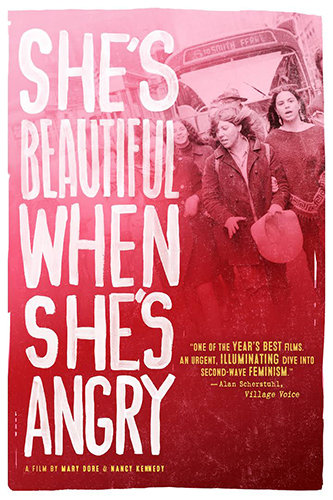
She’s Beautiful When She’s Angry

Earlier this month Gender and Education Association Gender Equality Leadership in Schools (GELS) Network members led a panel discussion of the film ‘She’s Beautiful When She’s Angry.

The film is an incredible narrative account of second wave feminist activism in USA, which raises many questions about the current state of feminism globally today. GELS Network members including students from The City of London Academy Islington Feminist Group debated how best to inject feminist content into the secondary school curriculum in England, given the gaps and omissions in the common curriculum.

Here, Yvonne Ehrstein (PhD candidate in the Centre for Culture and the Creative Industries) reviews the event.

The Centre for Culture and the Creative Industries at City, University of London, hosted a screening of the critically-acclaimed film She’s Beautiful When She’s Angry that was followed by a Q&A discussion on feminist activism past and present with an intergenerational panel.

The event was organised as part of the 40th anniversary celebrations of the Centre for Culture and the Creative Industries, in association with Gender and Sexualities Research Forum (GSRF).

Mary Dore’s documentary stands out due to the multiplicity of voices that are expressed and made heard in this portrait of the early phase of second-wave feminist activism in the US.

Smoothly blending historical footage and current interviews with movement participants, the film recalls activist landmarks such as the publication of the Boston Women’s Health Book collective Our Bodies Ourselves and the underground abortion service provided by the Jane Collective.

In looking at the present, veteran activists observe: “We have gone backwards in terms of reproductive rights and childcare.”

The chair of the panel was Dr Jo Littler, a Reader in the Department of Sociology, who pointed to the wide range and scope of the film and said the documentary’s value was to show “the visual history” of second-wave feminism, which was not that familiar.

Sue O’Sullivan, who has been an active member of the London Women’s Liberation Workshop, said a subtle yet deep undercurrent would characterise the present-day backlash against feminism. She was joined on the panel by the UCL Institute of Education academic Professor Jessica Ringrose, who said we lived in a “frightening period” and raised the question whether misogyny was the right word to capture what is going on nowadays. However, social media and more generally “collectivity online”, she argued, “does have potential” and could be used as an important political tool to facilitate involvement in contemporary forms of feminism.

The founder of the Highgate Wood School Feminist Group, Rosa Tully, said that while feminism today was predominantly social-media based, there was “a lack of protests on the streets, and a sense of unity”. Getting together and sharing experiences of being a female would still be relevant to building awareness for gender equality.

Neil Robertson, Curriculum Leader for Social Sciences at City of London Academy, Islington and facilitator of school feminist groups, said it was crucial to keep up the connection to second-wave feminist vigour and transmit the message “don’t think that you can’t do that”.

The discussion ended in a re-evaluation of the potentials of feminist education, which could include compulsory sex and relationship classes to tackle women’s harassment and revive feminist political energy.

*this review was originally published here

GEA Conference 2017 Update


Update from the Lead of Gender and Education  2017 Middlesex Conference Organising Team, Professor Jayne Osgood. More information can be found here

via

The theme for the upcoming GEA 2017 conference has been finalised as Generative Feminism(s): working across/within/through borders. The stellar line up of Keynote Speakers and performers go a long way to addressing a concern with the border crossing work that feminist educational research and theory does, has done, and continues to do across time, space and place. It is intended that delegates will be inspired, challenged, unsettled and (re)invigorated by the keynote presentations.

We want the conference to be a space for dialogue and a place for doing; alongside recognisable sessions where impassioned feminist scholars stand and deliver from their latest work, there will also be gatherings, interventions, exhibitions and ruptures. Via these, the conference aims to continue the tradition of putting on an engaging event that stimulates and generates debate and ignites thoughts that reverberate long after the farewells have been said.
During June, we want to make the most of the open spaces and the communal spaces at Middlesex University to offer opportunities to share practices and experiment and innovate. To that end we welcome conventional paper presentations, panels and symposia but we also want to create opportunities for scholars to cross disciplinary borders and to seriously play with theory, methods and to engage in intra-active and inter-active becomings.
We expressly want less recognisable contributions to form part of the main programme. With this in mind, we are planning an Open Space during day one, which will bring together generations, and local communities (school pupils, teachers, local residents) to come and share their views and experiences about gendered lives and the importance of equity – and the many forms that can take. We invite submissions for performances, exhibitions, interventions and experiments etc. that address the conference theme and push us to think more and other but retain a firm focus on feminist agendas.
The conference will unfold in lecture theatres, seminar rooms, theatre spaces, atriums, courtyards, and green expanses. We are so excited by the possibilities to cross borders – but pushing boundaries – even those of conference organisation – requires a steely nerve and buckets of creativity which thankfully the organising committee has in abundance.
We look forward to receiving any submissions that embrace the conference theme.
More information about the conference including how to submit, dates, cost and keynote speakers can be found here

Developing Critical Feminist Sex Education in Teacher Training Institutions (Scotland and China)

The Gender and Education Association has kindly funded research visits between Beijing Normal University and Strathclyde University, in order to pump prime the new research project ‘developing critical feminist sex education in teacher training institutions’. In response to divergent and convergent challenges in sex education in our two country contexts of China and Scotland, and our positions at teacher training institutions, we hope to draw on our expertise in critical and feminist sex education pedagogies and methodologies to effect (inter)national change. Using a collaboratively developed Research Apprentice Course (RAC), we will conduct comparative research on feminist sex education inquiry, for educational practitioners, researchers & policy-makers. This cross-institutional initiative will be housed in our respective teacher training and educational leadership degree programmes on which we teach. While sex education may be experienced differently in different country contexts, we aim to create comparative dialogue, practice and publication, engaging with various stakeholders including colleagues, students, and community partners e.g. Equally Safe in Higher Education, Trans-Alliance, and the China Zigen Rural Education and Development Association.


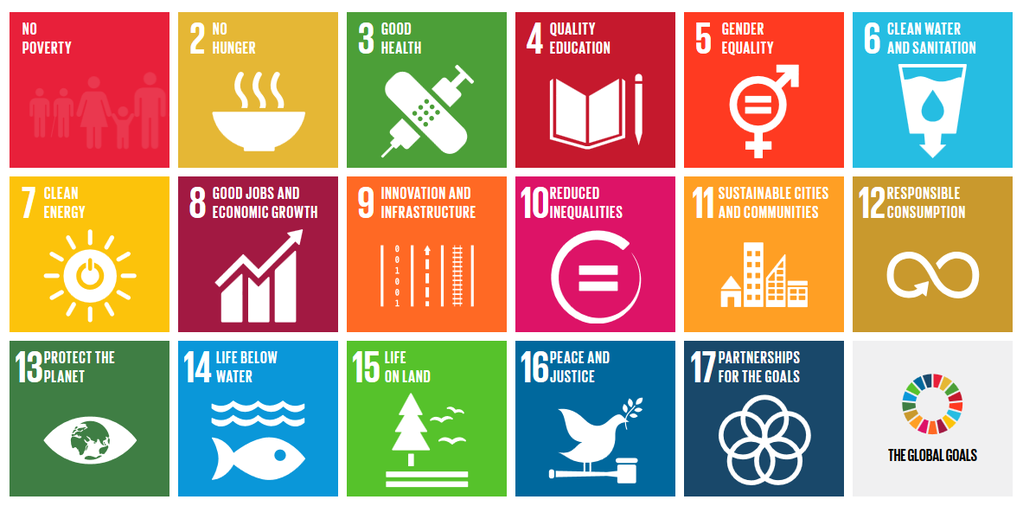
The project is well aligned with the 2016 release of the United Nations Development Programme Sustainable Development Goals (SDGs), particularly Goal 3: Good Health and Well-Being (sexual and reproductive health care) and Goal 5: Gender Equity (sexual violence and exploitation as a barrier to ending all forms of discrimination against girls and women). Other SDGs that fundamentally intersect with these Goals include:

Goal 1: End to Poverty (a gendered objective given the greater likeliness that women will live in poverty);

Goal 4: Quality Education;

Goal 6: Clean Water and Sanitation;

Goal 8: Decent Work and Economic Growth;

Goal 10: Reduced Inequalities (economic inclusion regardless of sex, race, or ethnicity);

Goal 16: Peace, Justice and Strong Institutions (protection from sexual violence)

(United Nations Development Programme, January 2016).

These SDGs, along with the fact that the UNDP has highlighted the importance of viewing them as interconnected, strengthen the international visibility and legitimacy of the present manifestations of the historical issues that this GEA project foregrounds and the urgent need for work that confronts these issues.

Alongside such development goals, an established body of work now exists about challenges schools face in the organisation and delivery of sex and relationships education (SRE. In the UK, most teachers are expected to deliver some aspect of sex and relationships education: sex and relationships education is not currently rigorous, comprehensive or statutory, nor are the subjects within which it might most frequently be taught, such as Personal, Social and Health Education, Personal Development or Life Education. In 2014 the UK Department for Education agreed to promote supplementary advice to the SRE Guidance of 2000: Sex and Relationships Education for the 21st Century, stating that schools have a duty to ensure that ‘teaching is accessible to all children and young people, including those who are lesbian, gay, bisexual and transgender (LGBT)’ and the Office for Standards in Education, Children’s Services and Skills now provides a Good Practice Resource (Ofsted, 2012). Yet often teacher-training programmes do not systematically include training around sex education with existing research indicating that teachers lack the confidence to teach about these issues. The lack of time given to SRE within school timetables and confusion about what should be taught further compounds this (Sex Education Forum, 2008), together with limited knowledge about teachers’ feelings towards delivering SRE (Harris and Gray, 2014; Henderson, 2015).

In China, which has a ‘large youth population in urgent and diverse needs of sexual and reproductive health knowledge’, there is no national overview of youth perspectives. In both countries, less work has been conducted to explore the perspectives of teachers tasked with delivering SRE and barriers experienced. While the Chinese government has stipulated sex education across all grades, there is no standard national curriculum and professional sex education teachers are nonexistent. Continuity of delivery is an ongoing challenge and in China the Ministry of Education sex education guidelines have ‘embodie[d] conservative conceptions … prohibit[ing] such behaviors rather than provide all-round information and effective guidance’ (Liu & Su, 2014, 66). In the UK, debates continue about the place of sex and relationships education in increasingly multi-cultural and faith-based schools, including the remit of educational staff in relation to child protection and safeguarding. Thus in both countries, there are extensive gaps and questions around teacher training ad sex education, for example in the UK, there is confusion about what should be taught, and the place of this within school timetables (Sex Education Forum, 2008) and in China, the focus on examinations and admission into higher schools has meant that sex education has historically been ignored, and the national curriculum standards have not clearly articulated what and how content should be delivered (Yu, 2010).

The material support of the GEA for this initiative will undoubtedly accelerate our ability to institutionalize interdisciplinary sex education research in teacher training institutions of our respective countries, which we anticipate to have reverberating effects in school, governmental, and non-governmental settings. This has much potential in fulfilling the need for inclusive, critical and feminist comparative collaboration, responsive to the vision of governments, institutions, including public higher education, civil society and citizens working to address the SDPs (United Nations Development Programme, January 2016).

As we begin this project, we believe that the explicit interconnectivity of the SDGs provide a useful framework within which to situate our work and it also enables us to frame it in relationship to the work in our country contexts and the connection of its work to the goals of the national government (eg China UNDP work on Poverty Reduction (United Nations Development Programme, 2016); Scotland’s positioning as one of the first nations on Earth to commit to adapting the SDGs, was praised by the UN as “…showing Scotland’s international leadership on reducing inequality within Scotland as well as beyond [its] borders” (Scottish Government, 2016)).

In the coming months, the rationale that we have outlined in this blog post will serve us well as we focus on gaining institutional and civil society support for the project and as we simultaneously work to establish the first cohort of participants.

Investigators :

Dr. Lauren Ila Misiaszek,

Institute of International and Comparative Education,

Faculty of Education,

Beijing Normal University http://fe.english.bnu.edu.cn/t003-ti-1-34-64.htm

Email: limisiaszek@gmail.com


Prof. Yvette Taylor

School of Education

University of Strathclyde http://strathclyde.academia.edu/YvetteTaylor

Email: yvette.taylor@strath.ac.uk


References

Liu, W.-l., & Su, Y.-F. (2014). Sexual and Reproductive Health Education and Service for Young People in China.

Harris, A. and Gray, E. (eds) (2014) Queer Teachers, Identity and Performativity. Basingstoke:

Palgrave.

Henderson, E. (2015) Gender Pedagogy. Basingstoke: Palgrave.

Scottish Government. (2016). Background to the SDGs. Retrieved from http://www.gov.scot/Topics/International/int-dev/IDconsultation/SDGsbackground

United Nations Development Programme. (2016). UNDP in China. Retrieved from http://www.cn.undp.org/content/china/en/home/ourwork/overview.html

United Nations Development Programme. (January 2016). Sustainable Development Goals. Retrieved from http://www.undp.org/content/undp/en/home/sustainable-development-goals/

Yu, J. (2010). A study on the challenges of health education in Primary and Middle schools. Journal of Teaching and Management, 5, 49-50.

Brexit and The Rise of Right-Wing Populism: a Politics of Othering

Over the last week, members of GEA’s executive committee have been sharing their views on Donald Trump’s election success; Andrea Peto started by examining how Trump’s win was a boost for illiberial regimes in Europe. Jessica Ringrose and Victoria Showunmi then considered how to call out Trump pedagogy by turning the 2016 USA election into a teachable moment. Finally, we saw a piece by Sally Campbell Galman that reinforced the phrase ‘the personal is political’ as she articulated what the win meant on an intimate level with her postWe ain’t whupped yet: Memo from America 11/10Today, exec member, Marie-Pierre Moreau shares her views on Brexit and the politics of othering.

Here at GEA we are proud that our executive committee are dedicated to sharing good practice and their views on life events; this series has been popular with readers and we have enjoyed reading your comments on Twitter, Facebook and in the comments section of the posts. We are also proud of the fact that we offer writing opportunities to readers – if you would like to share your views on Trump’s election, Brexit or any other issue, please contact us!

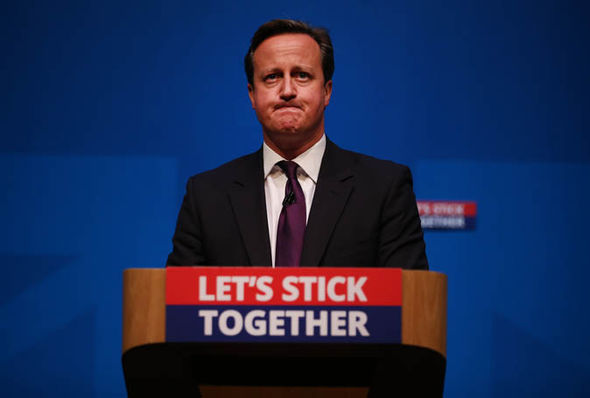
When David Cameron promised, during the 2015 general election campaign, to hold a referendum on the EU, very few would have anticipated that his pledge would result in months of intensive campaigning during which politicians would turn against each other in the harshest imaginable ways. Nor was it anticipated that Leave/Remain would become the new significant political divider that it is. In a country which prizes itself for being inclusive and where items printed with ‘keep calm and carry on’ sell like hot cakes, the level of turmoil associated with the referendum has been unusual in recent history.

On a personal level, the shocking realisation that 52% of voters expressed a preference for the UK leaving the EU has been painful, especially given the racist undertones of the campaign. Having felt welcome in this country for many years, I experienced feelings of betrayal and powerlessness, with the latter exacerbated by the fact that I could not vote. Yet I was not so prepared for the emotional turmoil that my British friends and colleagues went through (none of them, from their own admission, had voted Leave). They were full of anger, sadness, but also shame. This was not the future they envisaged for themselves, nor for their children. They identified with being the victim and with being the culprit – some even apologised to me, as if they bore some form of responsibility in what had just happened.

So when I woke up after just about three hours of interrupted sleep on Friday 24 June, there were still two camps, except now the one I was not part of had won. Months of debate had unleashed racism and xenophobia. This, of course, was not new. We know, thanks to a wealth of research on the topic, that in the UK, as in many other countries, ethnic and religious minorities have been subjected to considerable levels of racism and hatred for decades. If anything, this has been exacerbated by the referendum campaign. However, with the referendum, a new figure of hatred has been revealed: that of the ‘European’ migrant. Of course, this too is not completely new. German and French people, for example, are regularly subjected to stereotyping and mockeries. Irish and, in the more recent period, Polish and other Eastern European migrants have attracted some particularly negative feelings. During the referendum and in the days that followed it, this form of racism seemed to have intensified.

Anecdotes of daily micro-aggressions were shared with European friends. Tabloids, in favour of the Leave campaign, published abusive articles about European migrants. ‘Leave the EU/No more Polish vermin’ leaflets were delivered in several towns across the UK; xenophobic graffiti were sprayed outside a Polish cultural centre; European citizens suffered extreme abuse, including one instance of a racially motivated killing. This political turmoil culminated with the death of Jo Cox, a Labour MP in favour of Remain, murdered by a member of her constituency as he shouted ‘Britain First’. The political rhetoric of the Leave camp and of many among the new post-referendum Government became increasingly tainted by the melancholic fantasies of a lost empire (Cain, 2016). European migrants are ostracised in increasingly overt ways and a politics of othering is at play. While we are soon to be ‘out’, racism is definitely ‘in’, and Europhobia has joined in on a new scale. This of course finds an unfortunate echo across the Atlantic, as the US presidential campaign and its aftermaths have been tainted by considerable levels of xenophobia, misogyny, transphobia and ableism, ending with a victory of a man whose political rhetoric and personal life resonate with each other when it comes to these matters.

But, as I quickly came to realise, something else had happened. This process of othering had now extended to a range of groups ‘suspected’ to have voted Leave en masse. On BBC Newsnight, a few days after the referendum, a journalist interviewed four voters (the clip can be seen here, from 27:25). On the left, two Leave voters: both women from Boston, Lincolnshire, middle-aged, White British and working-class. On the right, two Remain voters: both young men from Lambeth, London, one White British, the other British Asian, one a lawyer, the other a student, middle-class. Asked why she voted Leave, one of the participants mentioned the many ‘European EU workers’ living in her town who ‘can’t even say “hello” in English’. On the other side, the two Remain voters listened politely. While the racists words used by the Leave supporters were violent, so was the media mise en scène, contrasting the confused, provincial, female, White, middle-aged, working-class narrative of the Leave voter with those of their articulate, confident, young, cosmopolitan, male, middle-class Remain counterpart. Their bodies became the signifiers of class, gender and race, with one group embodying bigotry and ‘chavism’, the other modernity and the charme discret de la bourgeoisie-in other words, privilege. The symbolic violence of this scene has stayed with me. With it came the realisation that ‘Brexit’ was about much more than the othering of (a group of highly diverse) European migrants.

What played out in this scene and in many others which would be repeated ad libitum and ad nauseam by the media in the following days (Gill mentions a similar video to the one I discuss above, which can be viewed here) was the awakening and possibly strengthening of divisions which have long been present in British and other Western societies. The association of the Leave voter with (White, working-class, middle-age) femininity is only one of several narratives which have emerged during the referendum, but it is one of particular significance. The scene I recalled above fits the post-industrial deficit discourse of the working-class as ‘chavs’ discussed by Owen Jones in his eponymous book. Although exit polls show a positive correlation between being working-class and voting Leave, gender parity prevailed when it comes to political allegiances. Fifty-two percent of female voters voted in favour of Brexit, that is exactly the same percentage as men (unfortunately, more intersectional data are hard to come by). However, as for class, the scene fits a narrative that goes back a long way and constructs women as irrational and politically incompetent. Those who take a political stance are often demonised, as in the case of Hilary Clinton and of Gina Miller, when they are not simply invisible and silenced, as has happened to female politicians during the UK referendum campaign.

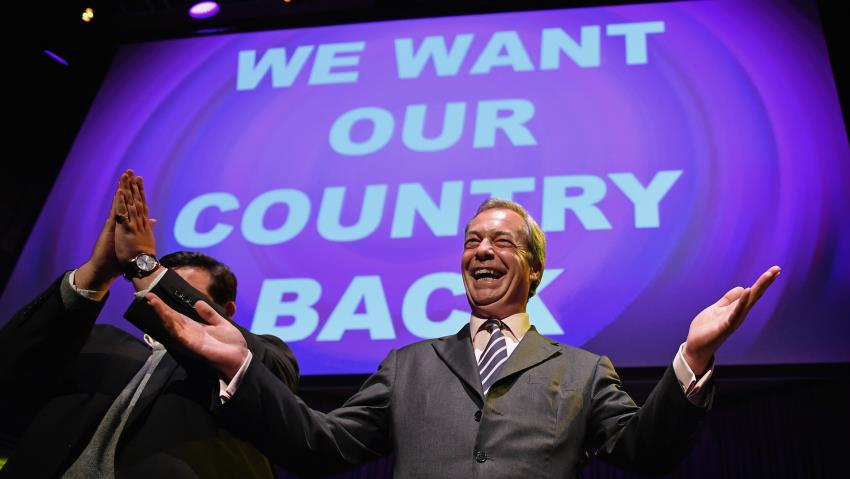
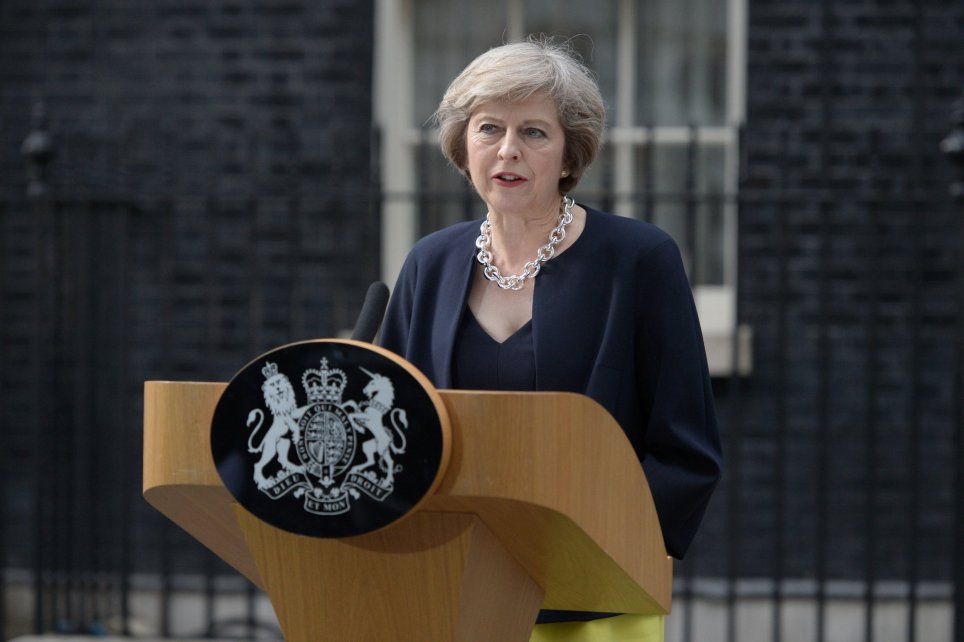
Let us remind ourselves that in the UK women gained the right to vote in 1928 as a result of the Equal Franchise Act (although some women were able to vote from 1918). Today, women represent less than 30% of Members of Parliament. They face incredible barriers and will frequently lose elections against less experienced and less competent male candidates, a point strikingly illustrated by the recent US elections. Theresa May and, before her, Margaret Thatcher are exceptions in an incredibly male-dominated environment and in many ways are highly privileged. There is also an irony of constructing working-class women as the abject figure of the Leave workers. The EU has invested some considerable resources in tackling gender inequality and social exclusion. Working-class women are among the most likely to be affected by the economical uncertainties associated with Brexit, with limited impact on the likes of Boris Johnson and Nigel Farage.

Concluding this piece on a hopeful note would have proved to be a challenge, if it had not been for my spell checker coming to the rescue and changing the subtitle of this piece into the politics of ‘bothering’. After all, as long as we bother, we remain political animals who, I am naïve enough to think, care about the public good and individual rights. When young voters have been blamed, rightly or wrongly, for their political apathy, the referendum campaign and subsequent turmoil may help to bring divides to the fore and provoke the political awakening which we needed. A consequence of the social segregation and territorialisation of inequalities is that, like many, I have yet to meet somebody who has voted Leave (an admission which I am sure would be complicated by the fact that I am after all a European migrant with a distinctive foreign accent). Let us recall here that voters based in London and Scotland overwhelmingly voted for Remain and so did 3 out of 4 voters in the town where I live. Segregation facilitates the demonisation of those who are ‘not like us’. Thus, there is a real onus on all of us to move away from the simplistic, divisive fantasies of ‘social abjection’ (Tyler, 2016) revealed by the referendum and draw on critical and intersectional perspectives.

We also need to ask who benefits from a politics of othering which reasserts social, gender, race, national and other divides. While Brexit has been sold as a victory for the working-class, we should not forget that the leaders of the Leave camp are by a huge majority wealthy, privately educated White men. In many ways, the rise of right-wing populisms in the UK, the US and elsewhere, can be interpreted as a backlash aiming to maintain the privileges associated with being part of these groups. So while we should not encourage the emergence of a new figure of hatred, we need to challenge the racist, misogynistic, classist and nationalist rhetoric of Brexit and of the US elections that plays certain groups against each other. Academics can play a key role in this, although this is a difficult task at a time when universities and workers of the knowledge economy are derided. Yet, in the face of hatred, we must continue to engage with social justice issues through our ongoing scholarship, our contribution to national, international and transnational public debates and our pedagogical practices. We owe it to those with less privilege and we are certainly not short of research material.

Dr Marie-Pierre Moreau

Reader in Sociology of Education and Director of the RISE Research Centre

University of Roehampton

Donald Trump Wins US Election: GEA Members Respond

Today, GEA members are responding to the news that Trump has won the US presidency. Andrea Peto started us off by musing how Trump’s win is a boost for illiberial regimes in Europe. GEA Chair, Jessica Ringrose and Equality and Diversity Officer, Victoria Shouwnumi then considered how to call out Trump pedagogy and their ways of turning the 2016 USA election into a teachable moment. Now we turn to exec member Sally Campbell Galman, Asociate Professor in the Department of Teacher Education & Curriculum Studies at University of Massachusetts Amherst for her take on the situation. We hope that these posts demonstrate not only how international our executive committee here at GEA is, but also how internationally and far reaching the results of this election are, and will continue to be. Sally’s post is a raw and intimate account highlighting how this result impacts on every facet of our lives; from the academic to the personal. Never has the phrase ‘the personal is political’ been more relevant.

We ain’t whupped yet: Memo from America 11/10

I’ve never worked so hard in an election. Ever. I made over 600 phone calls. I knocked on doors. I marched carrying signs. I had a rotating list of 15 Trump-endorsing legislators that I called every three days for months to ask them what they were thinking, and Could You Please Explain the Logic Here. I donated what I could. I wrote, and I read, and I had hard conversations with my own Conservative mother, who said she could not ‘bring herself’ to vote for Hillary Clinton. I wore white for suffrage on Election Day. I told my three daughters that this was a moment to remember, to tell their grandchildren about. I voted for the first woman for President ever. I taught my doctoral seminar that night, and we joked around about which among us would be deported in the morning. I settled in on the night of the election expecting a victory, and promising myself unity and renewed energies for teaching and service and a better world. I was cautiously hopeful.

Instead I was up all night shaking with dread as the election returns came in. I did the thing every parent did—wander into the children’s bedroom and wonder what on earth I was going to tell them in the morning. Predictably, when my partner and I did break the news, they were shattered. My eight year old, who is transgender, began to cry. “Will Trump come to the house to take me away? Some kids at school say he will come for me and take me to a jail because trans people not belong here.” I assured her that this was not true, even though I know that, on some level, she is right. Though I’m ashamed to admit it, I pulled all three children out of school and took them to apply for passports that very morning. The line was long even when the post office opened, and it was made up mostly of families with young children. The parents and I exchanged tearful, puffy glances. The room vibrated with fear. I held hands with another mother, a woman I had never met before while our children sat at our feet, waiting.

I was supposed to go on a data collection trip for the Gender Moxie Project , with my flight to the Midwest leaving that afternoon. Predictably, I didn’t go: my children needed their mother at home, I was in no emotional or physical shape to take on three days of arduous fieldwork, and my participants—transgender children and their families– were, frankly, too frightened to meet with me. One mother told me that her daughter went to bed in a world filled with hope and awoke to fear. “My life is going to be hard now, isn’t it Mommy?” she asked. Another child, age 6, asked his father when he would be killed, so he could be “ready.”

Later that day I called my parents. I wanted to hear something comforting: maybe my 70 year old father, despite having voted for Trump, could reassure me somehow, or soothe in the way a parent can and should. Instead he shouted at me for upwards of ten minutes about how stupid and “irrational” I was for being even remotely upset. He raved about how Trump was more qualified to hold office than Barack Obama. I usually don’t talk politics with my parents, and I didn’t intend to. But the parent-child interaction took on the tone of a Trump rally, and I got off the phone as quickly as I could and had a good cry. Like a lot of Trump supporters, he’s not a bad man. He’s just terribly misinformed, and unwilling to listen to anyone who doesn’t look like him. I still haven’t heard from my mother, who finally did vote for Clinton after some pressure, saying that the best case scenario is that Clinton, upon being elected, would die or be impeached, and then her VP could be president.

Today the children are back in school, and I’m back at my desk trying to figure out what to do next. Lots of people are calling for love and acceptance and kindness and moving forward, and that is all well and good. But, as the campaign slogan goes, we tried that, and hate won. Of course, I believe in the power love and acceptance and kindness, but I also believe they are meaningless without action. So, here is my list of Good “Deeds” for the coming days.

Keep doing your work. It is very easy to get overwhelmed, and to believe that nothing you do will make a difference. After all, we worked and worked and it seems like nobody cared. Shouting into the wind is no fun. However, you must keep doing your work, however you define that work. In some forms of Jewish mysticism, there is a belief that the messiah will come when a certain, unknown number of mitzvahs, or good deeds, are done. We never know what that number is. You never know where you are, so it may seem like it is a very dark day, but in reality we could all be one mitzvah away from healing the world. With apologies to the rabbis, we never know when our victory might come—it might be just one more phone call, one more blog post, one more article, one more tweet, one more kind word to a child, one more attempt at dialogue, one more protest, one more deed away. Today could be the day we heal the world.

Do not skimp on self-care. Audre Lorde taught us to care for ourselves when she said, “Caring for myself is not self-indulgence; it is self-preservation, and that is an act of political warfare.” Also encourage other people to care for themselves. And interrogate those practices and neoliberal work ethic discourses that valorize self-abnegation through ‘busy-ness’. Because it is in these practices that we are kept exhausted and unable to fight.

Find support. Find it wherever you can. Provide it. Social media is fantastic. Consider joining at Pantsuit Nation group in your area. Not ready to deal with your racist uncle at Thanksgiving? Host a group of students in your home instead. Organize a group of other people to check in with every day over the phone, email or social media. Ask how people are doing. Isolation is distorting.

Resist the lure of comfort. More white women voted for Trump than did for Clinton. These were mostly white women without college degrees. Feminists, we need to step up our intersectionality game, and I don’t mean just sitting around thinking about being anti-racist, I mean doing something about the racism we see every day and being brave enough to call it out. This means confronting the racists in your lives, however painful. This one is hard. As Brigitte Fielder writes, it’s time to stop being polite to the racists, because that, too, is the face of white privilege:

“Every last one of you with a racist uncle or grandfather or neighbor or co-worker to whom you just remain polite, who accepts their racist trash in order to avoid white interpersonal conflict, those of you who “don’t want to argue about politics” with friends or acquaintances, who stay silent when they spout hate to preserve some sense of contentment at family gatherings, you who continually complain about racist family but say “what can you do?” …You who allow your loved ones and colleagues to blame immigrants for their own mediocrity, you who have continually stood by when the people you know or even love have denigrated people like me, who have emphatically valued your own comfort over the rights and the safety of the marginalized and oppressed: I blame you for this. This is your fault. You have just let hate win.” (Brigitte Fielder, Nov 9, 2016)

Get uncomfortable. White people, confront your racist uncles and speak truth to power with love. Rely on your chosen support systems for courage and debriefing. Support people who are affected by racism. Believe them when they tell you. Listen to them. If you are white, talk to other white people; especially white women, about race. Take that heat so sisters of color do not have to. Because it is our job to be uncomfortable.

Have Courage. Courage isn’t the absence of fear, it is the strength to continue. Trust me, I’m shaking in my boots as I write this. In the words of American author Harper Lee, “I wanted you to see what real courage is, instead of getting the idea that courage is a man with a gun in his hand. It’s when you know you’re licked before you begin, but you begin anyway and see it through no matter what.” Or, better still, Democratic VP candidate Tim Caine, who quoted William Faulkner: “They killed us, but they ain’t whupped us yet.”

Let’s get to work, friends.

Donald Trump Wins US Election: GEA Members Respond

Calling out Trump Pedagogy: Turning the 2016 USA election into a teachable moment


Jessica Ringrose and Victoria Showunmi, UCL Institute of Education

Many teachers at schools and universities internationally have been asking how to discuss the 2016 USA elections with children, young people and university students as they head back to their teaching and learning work in the aftermath of what has been called the most ‘divisive’ election in USA history.

Last night in the wake of the 2016 USA election results Victoria Shoumni and Jessica Ringrose of the UCL Institute of Education and Gender and Education Association Executive Members were presented with the timely opportunity to re-tune their planned MA lecture in Sociology of Education on “Racism and Black Feminist Intersectionality” into a discussion about the world events of Donald Trump elected as USA President.  It is probably already clear that given the lecture was on Black Feminism and the contributions to sociological thinking from Intersectional scholars such as Kimberly Crenshaw and Patricia Hill Collins, we would be addressing the racism and misogyny and also the deep class cleavages that became the focal points of American culture through the events of the run for presidency the battle between Hilary Clinton and Donald Trump and finally Trumps ‘win’ of the election. We acknowledge our great privilege to be working in a university context with highly educated young people, but also note that these students come from a wide variety of backgrounds in the educational sector both regionally in the UK and internationally with members of the module from Columbia, Argentina, Chile, Hong Kong, China, Japan, South Korea, Malaysia, Canada and USA.

Here are some highlights of our session

We opened the session discussing some of the hateful  language championed by what we call “Trump Pedagogy” – that is a form of popular speech that is supposed to be hard hitting, honest and reflective of the ‘common interest’,  but is actually hate-speech and a rejection of global equality initiatives and human rights. It is pedagogical therefore in teaching and legitimizing hate. Recall, Trump has called women ‘nasty’, ‘bitches’ and boasted about ‘grabbing them by the pussy’, said African Americans  were “lazy fools only good at eating, lovemaking and thuggery” and called Mexican’s “rapists”,  Chinese “cheats” and all Muslims “potential threats”, with the list going on and on.

In counterpoint we argued it is important to clarify Trump’s identity defining him as a RACIST RAPIST and to have detailed discussions about how to make sense of the popular embrace of Trump despite of, or indeed because of, these attributes.


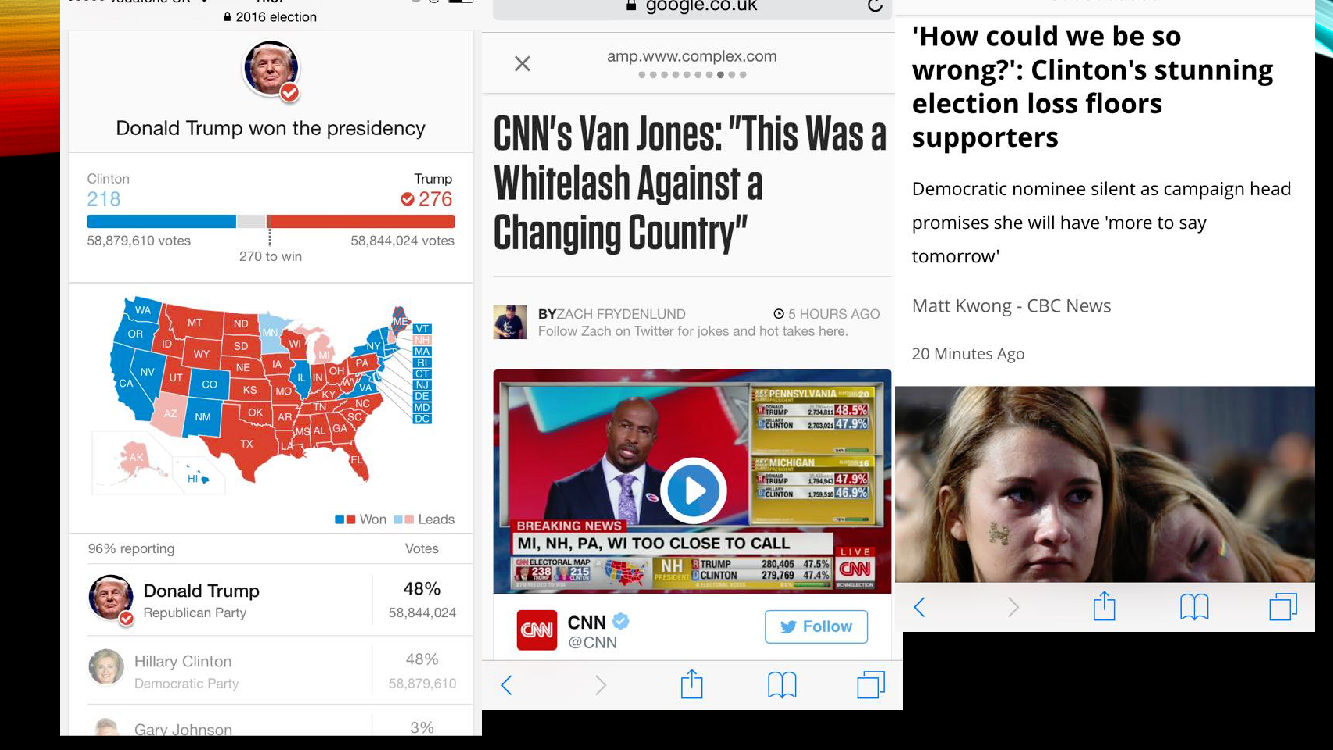
The early coverage of Trump’s win was based on the idea that the ‘rust belt’ of disenfranchised voters had voted with their ignorance for Trump, similar to how working class Britain had made a ‘protest vote’ with Brexit.  This was disputed, however,  with the evidence that middle class white Americans (men and women) had voted to secure their privilege, which commentators were calling a ‘whitelash’ (white backlash).

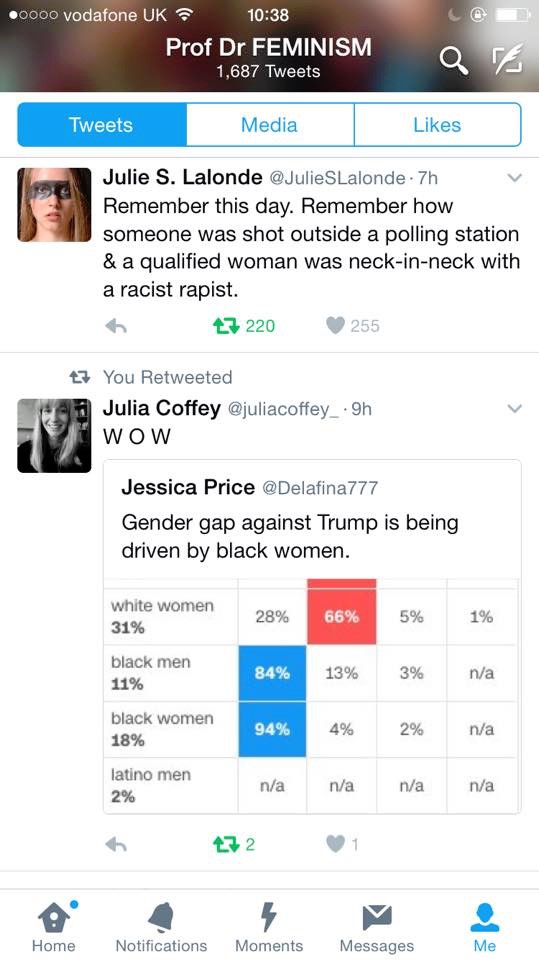
Social media data showed that Black women in America were the heaviest supporters of Hillary, a White woman, and how we need to address the intersections of racism, sexism and class to understand how some women will identify with a white male rapist before their own ‘sex’ which complicates the very idea of women’s natural commonality and shared sex, given identity and position is always organised through class, race, gender and locations and relative degrees of privilege and oppression defined through access to structural power.

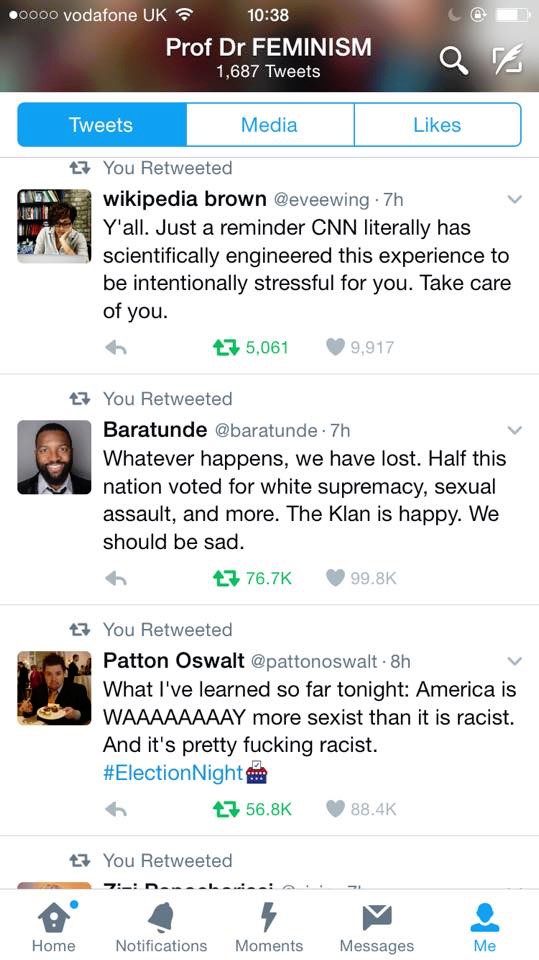
Why is it is so common for people to say that one aspect of identity is more important than the other – for example, in the below Tweet that argues America is “more sexist than racist”. Can you actually tease apart these dimensions in the lived experience of Black women?

Next, in true feminist pedagogical fashion, we all discussed out own positionality and social location in relation to unfolding election events and how it was shrouded in racism.

Going around the room to gather reflections on the election it was striking that a group of white USA women in the room were crying. We had a useful discussion of whether they felt they must act as the affective containers for white grief and despair crying on cue as part of ideal white femininity, something that has long been problematic in the feminist movement. We also questioned are white women the ones who are sanctioned or legitimized to cry? In counterpoint, we discussed the figure of the Black woman who is angry yet ‘resilient’ and how this related to discussions of character education in British schools – how can we bottle up some of the courage and resilience of the ‘minorities’ who do well in the face of disparity and profit from this in UK schooling market?

The only Black USA woman in the room spoke passionately, declaring that Trump ran the election like a reality TV show, claiming she knew since Hillary winning the Democrat lead that they couldn’t win because she was associated with ‘establishment’ and she told her Black friends ‘not to vote’. A British white man noted that ‘the system is broken’ in the vein of the ‘broken Britain’ trope suggesting everything is corrupt and today was no different than yesterday; and although Trump was terrible, it wasn’t about an individual man but a failing system.  A white British woman continued by saying, you couldn’t now turn on the voters as they had exercised their ‘democratic rights’.

We discussed whether we are actually in a new paradigm or era of unabashed racism and sexism and how Trump Pedagogy – hate speech against ‘women’ and minorities’ pedaled by Trump worked to hide class cleavages in USA (and his own ivy league education) in very clever ways.

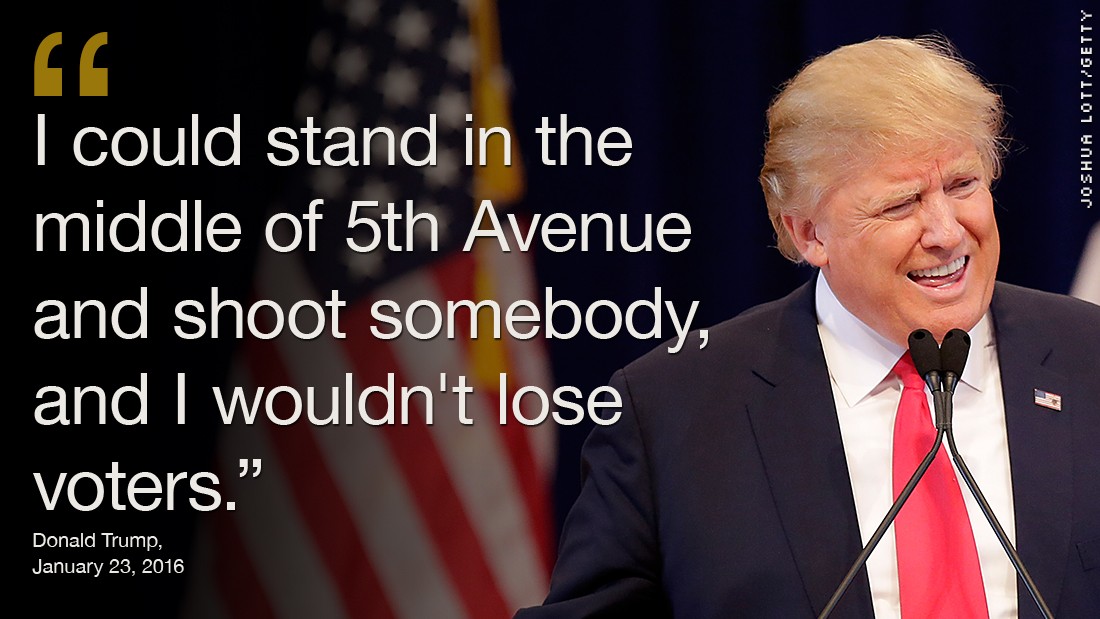
We also wondered if we could limit a discussion of democracy to voting in a two party system where the popular vote doesn’t determine presidency. Next we wondered what democracy and ‘choice’ can mean in a context of mass media conditioning or what Massumi calls ‘affective modulation’ where media loops of Trumps angry face work on an endless repetitive cycle, affirming the  apt observation by one student that reality TV had become real life. That Trump’s main talent is unrelenting self-marketing performance, a key badge of successful ‘winners’ to use his term in a neo-liberal age is clear. Indeed this is something Trump was very well aware of in orchestrating the media and voters over time:

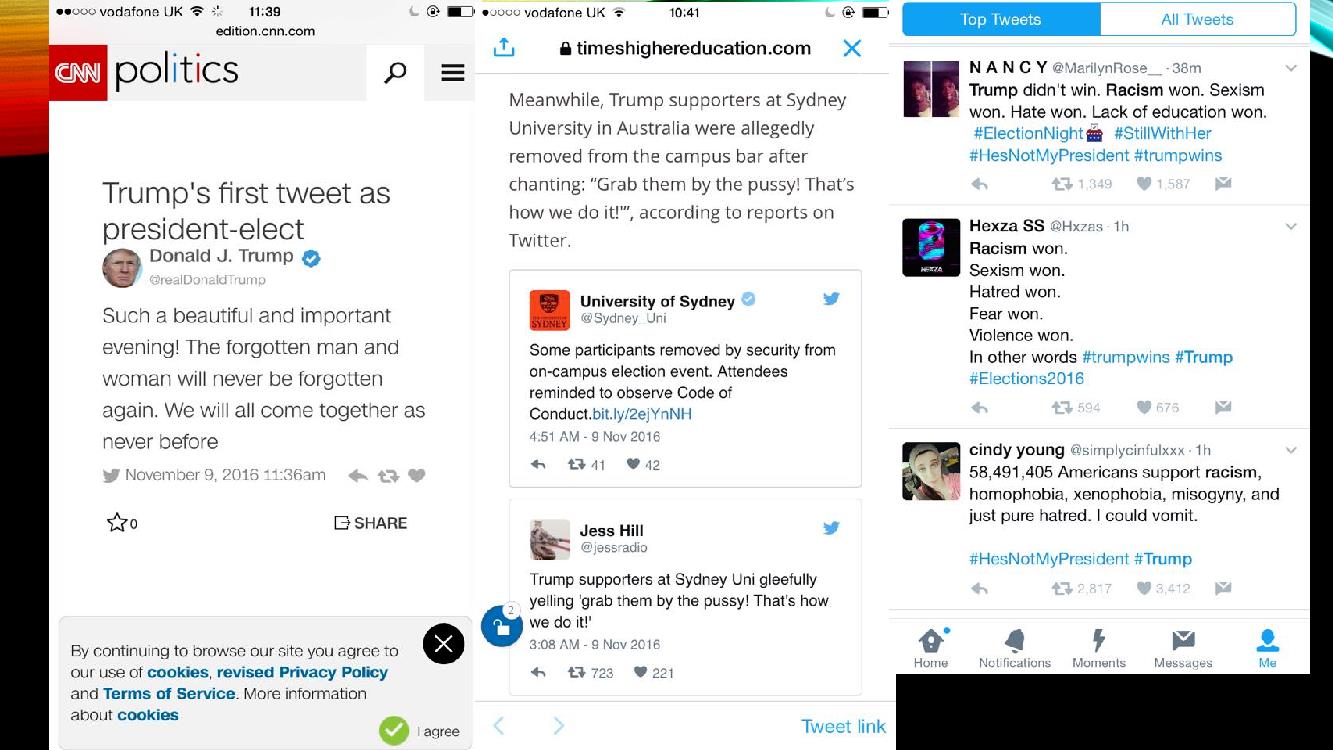
We explored what Sampson has called mediated viral contagion (Sampson, 2012) and how repetition worked to legitimize hate through what we are calling ‘Trump Pedagogy’.  For instance, immediate behavioral contagion was evident such as young men at the university of Sydney who chanted ‘grab them by the pussy’ on campus:

Students worried how rape culture would be sustained and flourish further than even before in a context where unbridled misogyny and performances of aggressive, violent masculinity are rewarded and the man who said of women he would ‘grab them by their pussy’s’ was now the leader of the ‘free world’?!

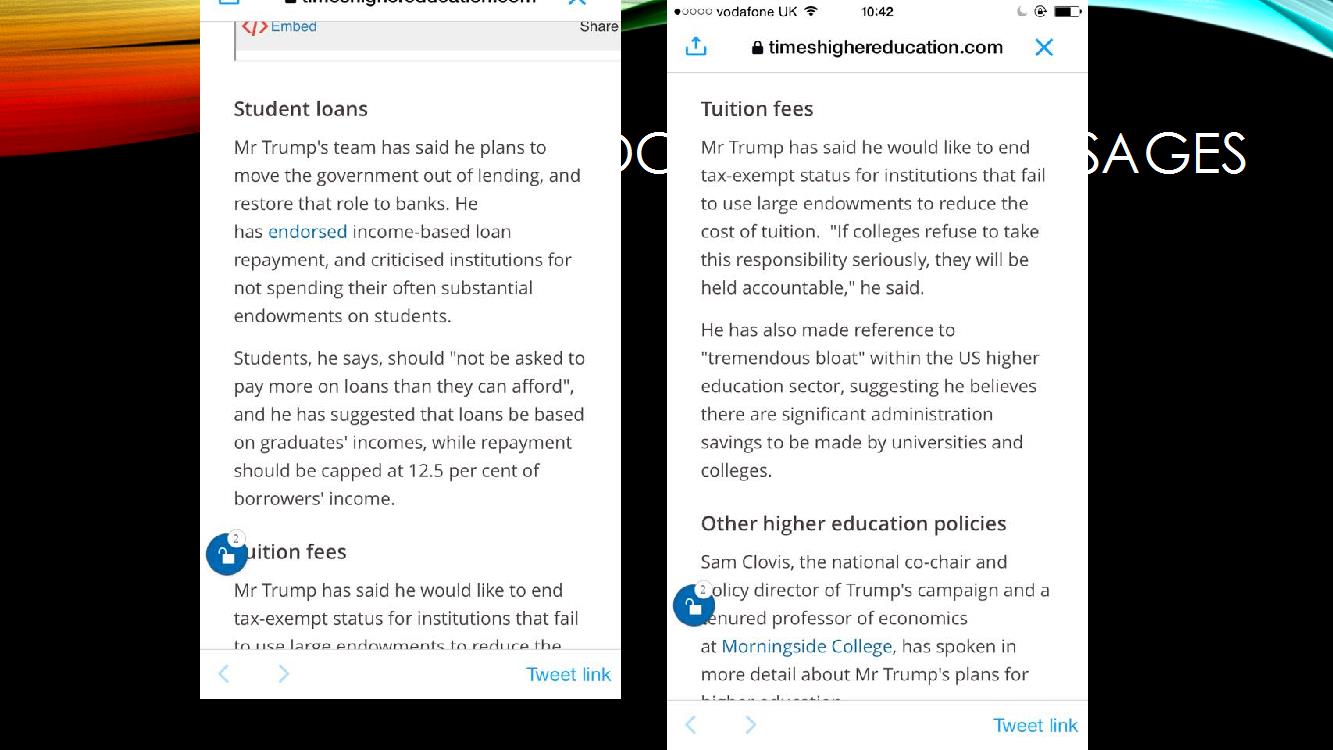
Because our teaching moment was in sociology of education in a University MA module we also raised the specific issue of Trump’s views on higher education, noting Trump’s plans for deregulation of student loans away from government inputs putting lending more fully into the hands of banks (because that worked so well in the housing market?); and we noted Trumps aversion to a ‘tremendous bloat’ at the level of university administration.  We wondered what exactly that meant, surmising it was likely about further reducing support services and resources for students and staff in the neo-liberal university where profit is increasingly accrued to the center with less staff taxed with ever heavier workloads, and ever fewer faculty in secure tenured positions and ever more university workers faced with dramatically increased precarity in the form of contract and adjunct work with little hope for other routes to participate in academia.


Returning to the pedagogical and educational issue of how to discuss these issues with young adults, teenagers and children we considered perhaps the most hopeful aspect of the election was the age demographic of under 25’s voting overwhelmingly in favor of Hillary Clinton.

Overall, then, we would say we need to encourage discussion of young people’s own views and standpoints, and to not shy away from the fact that powerful leaders may well be the most morally and materially corrupt of all citizens, to turn the logic of who leads in our political systems under critique and explanation, rather than sheltering young people from an analysis of institutionalized power and inequality.  Indeed we would encourage all educators to enable debate over theses issues so that young people can feel more empowered to engage in the political process defined not only through party system elections but everyday relationships in their lives including their participation in various types of educational spaces.  This is why if it turns into simplistic hostility between different supporters or camps, we need to keep reminding young people that respect, consent and consideration are tools of communication that they need to champion even if this seems hypocritical and paradoxical in the current moment where ‘punch em’ in the face’ mentality is being rewarded.  Just because something has won out in the popular vote doesn’t make it right. Indeed the first image that appeared on social media above – a gif of a swastika swirling across Trump’s face entangling his face with Hitler’s is a good way to think historically about moral crisis, and to renew debates about the meanings of terms like ‘fascism’ and whether they still hold explanatory value or not.

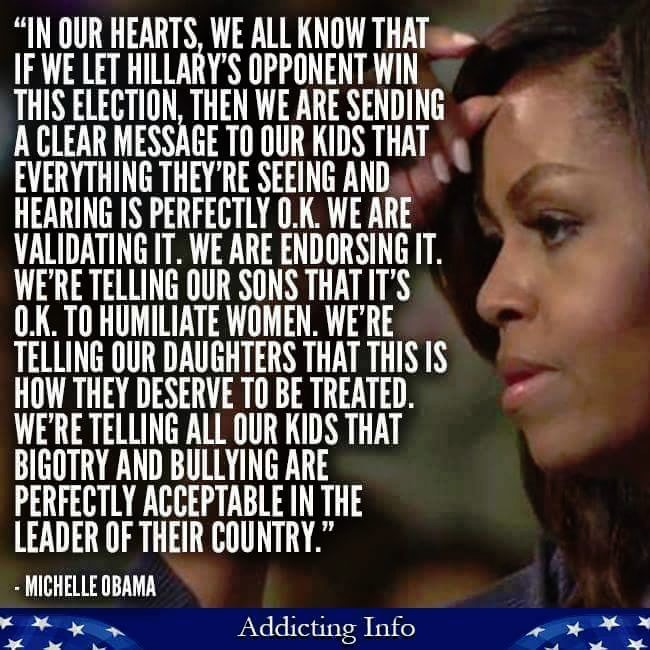
We concluded our session by invoking the feminist slogan the ‘the personal is political’ and the black feminist mantra ‘the masters tools will never dismantle the masters’ house’ (Audre Lorde). This was accompanied by images and quotes from Michelle Obama whose confrontation of Trump’s sexual violence and support of ‘we will rise’ campaign about the power of education to rethink gendered power relations has resonated so powerfully for so many.

Donald Trump Wins US Election: GEA Members Respond

The news that Donald Trump has been elected President of the United States has left many shocked and outraged with Twitter hashtags such as #NotMyPresident starting up and protests in 25 US cities, including New York. Those who have witnessed the recent rise of rape culture, unchecked male entitlement and media fueled racism and Islamaphobia however, are not so much shocked, as devastated at the direction in which society seems to be heading. Here at GEA, our executive members work within fields that research rape culture, gendered violence, sexism and racism and, much like the despair felt when Brexit happened in the UK, have watched the election of Trump with a sense of foreboding and fear of what is to come. Several of our executive committee have put into words what this election result means for them and we start with Andrea Peto, a professor in the Department of Gender Studies at the Central European University whose research areas include European Comparative social and gender history, gender and politics, women’s movements, qualitative methods, oral history and the Holocaust.

Andrea Peto and Weronika Grzebalska: Trump a boost for illiberial regimes in Europe

For Central Eastern Europe, Trump’s victory is a green light for the consolidation of illiberal majoritarian regimes which promise people a sense of existential security at the cost of individual freedoms, minority rights and checks and balances.

Trump’s election will definitely strengthen the neo-conservative, fundamentalist networks and shift the global political balance in the direction of familialism, nationalism and further away from human rights and an open society. Weak states such as Poland and Hungary in which democratic transition privileged free market measures over social and cultural ones are all the more vulnerable to the loss of a strong, democratic, pro-human rights voice.

Clinton’s defeat might also serve as a wake up call to the last of the hard-headed supporters of the neoliberal status quo in Central and Eastern Europe. Those who still believe illiberal turns in Poland and Hungary are just a local, provisional backlash, who think it is still possible to go back to the political solutions from the pre-illiberal era will have to rethink their position.

With the victory of Trump, human rights supporters are pushed into a doubly difficult situation. Not only do they have to protect the little provisions there are left and create a space of resistance but also at the same time reformulate their message. This message should be different from going back to the pre-Trump era, which has been the prison of technocratic, quasi-rational policy discourse for way too long. Instead it should revive great ideologies and offer an equally captivating political vision capable of re-enchanting voters.


GEA Conference 2017; News and CfP


CALL FOR SUBMISSIONS

11th International Biennial

Gender & Education Association Conference:

Generative Feminism(s): working across/within/through borders

Middlesex University, London.

GEA is thrilled to announce that the 11th International Biennial conference will be hosted by Middlesex University and take place on the  21st-23 June 2017. 

The GEA Conference has long provided an important home for established and aspiring feminist researchers to foreground and share deep commitments and passions to addressing gender inequity across all educational contexts and spheres. The Association and the Gender & Education Journal share an overt and proud commitment to feminist modes of publishing, theorising, praxis and activism. The Association, journal and annual conferences collectively provide a key global platform for a wide network of international scholars to (continue) to inform theoretically, methodologically and empirically cutting edge debates about gender, education and culture.

The 11th GEA conference intends to build upon this tradition to create space and opportunities for a range of feminist scholars, working at disciplinary interstices, to share innovative interventions that push at generating understandings about impact – upon research, practice, pedagogy, policy and activism. Crucially, the conference also intends to inspire and support emerging gender scholars and to act as an international collaborative resource for those fighting gendered inequality in multiple ways in local contexts.

Feminist research makes a crucially important contribution to developing diverse and collaborative ways to understand gender, feminism(s), sexual identities, education and embodied experiences. The new material/affective turn in feminist research has produced a wider range of methodologies and interdisciplinary approaches with which to theorise and research gender. The ‘newness’ of these exciting developments owe an enormous debt to generations of feminist scholars; the overriding aim of the conference is to recognise and celebrate the inter and intra-connections that generate such a rich feminist landscape. The conference will open up opportunities for generative, generating and generational feminist research – so that past, present and future feminist theorisations and practices of education research might coalesce. There is much to be gained from affirmatively relating across time and space – to continue to contemplate what feminist research is possible of, and what it does best: unsettle, intervene and insist upon demonstrable impacts for greater gender equity in educational policy, practical pedagogies and within communities.

With these factors in mind the theme of the conference is: Generative Feminism(s): working across/within/through borders and is inspired by the work of Gloria Anzaldua (1987, Borderlands/La Frontera); Sylvia Wynter (2015, On Being Human as Praxis) and Iris van der Tuin (2015, Generational Feminism: New Materialist Introduction to A Generative Approach). Through their work, these feminist scholars pull together the interconnectedness of creative and theoretical resistances and affordances to contemplate borders (temporal, spatial, material and disciplinary) and so grapple with fissures that persist and enfold between practice, policy, theory and activism.

The invited keynote presenters will respond to this theme with reference to their own extensive feminist educational research:

Keynote Presenters:

  • Professor Kerry Robinson (Western Sydney University, Australia);
  • Professor Farzana Shain (Keele University, UK)
  • Professor Emma Renold (Cardiff University, Wales)
  • Professor Gabrielle Ivinson (Manchester Metropolitan University, UK)
  • Jen Angharad (Community Dance Wales);
  • Associate Professor Iris van der Tuin (Utrecht University, The Netherlands)

Abstract submissions

The conference invites contributions that open up generative ways to work towards broader understandings and practices in feminist educational research. As well as conventional conference papers, Keynote addresses and symposia, the conference will include opportunities for creative, arts-based contributions and practical workshops, performances and “soup kitchens” as a means to generate ways to share ideas and make connections.

We welcome submissions from feminists working across/within and through (temporal, spatial, material and disciplinary) borders to push how gender is theorized, researched and practiced with the aim of generating creative ways to reconsider what might be meant by impact – on educational practices, policies, theories and activism.

We invite proposal submissions for individual academic papers, symposia, performances, personal narratives, and artistic installations. We also welcome panels and workshops around the theme of the conference.

All submitted abstracts, panel proposals, and workshop proposals will be peer reviewed by the conference committee. Deadline for abstracts is 31st January 2017. Send submissions to: a.elwick@mdx.ac.uk General enquiries about the conference should be sent to Dr Sundaram, GEA Executive at v.sundaram@york.ac.uk

For more information on keynote presenters and practical information regarding submissions, please see here; GEA Middlesex Conf

More information can also be found here

Feminist Readings/Lectures Féministes – A Room For Reading

The Feminist Readings Network provides a space to explore the question of reading with feminist thought, art and pedagogy. We’re delighted to have been awarded funding by the Gender and Education Association to further develop and extend our network.

A transnational and multilingual initiative, this project is for our feminist colleagues, and those that follow. The network is also known as Réseau Lectures Féministes or Feminististen luentojen verkko, in French and in Finnish respectively. In Arabic, you can call it Chabaket el kiraat nesswiya, النسوية القرائات شبكة, in Czech Sdružení feministického čtení, in Swedish Nätverket feministiska läsningar, and in Afrikaans Netwerk vir Feministiese Lesings.

We believe that academic (but also activist, artistic and other everyday spaces that we each of us inhabit) need to be opened up to linguistic difference and various kinds of expression. Besides translation we need an open attitude toward the languages and expressions of the other. For us, the space in between differences is where reading happens: what we do not immediately understand we need time and space to re-read together.

Kohti moninaisia luentoja – For a plurality of readings

Our emphasis on bilingual and multilingual encounters as well as encounters between artists, activists and academics stems from an engagement in intersectional feminism. Living at the crossroads, we realize we need to allow ourselves to pay attention to what seems particular and sometimes not immediately important, to what seems trivial and not central in our surroundings, our backgrounds and situations, in order to engage our many particular differences in our readings. Our trajectories inspire us to search for a plurality of readings, of thinking and of writing. This means we need to read feminism that is not ‘from the centre’, engage with art and texts that are not written principally for English or French speakers. There is no real plurality as long as, as Shu Mei-Shih puts it in 2005, “’Western’ feminism is something you have to read, have to think about, while the reverse flow is not. Reading ‘Third World’ feminism really seriously […] is not encouraged.” Like her, we understand central or ‘Western’ and peripheral or ‘Third World’ not as oppositional, but already interwoven, creolized, métissés.

Lectures féministes would like to prompt you to go beyond what you already know, to explore others’ languages and texts, so as to pluralize the space of reading itself. In academia, this could mean going beyond traditional academic language and presentation, so as to find out how readings can be put in wor(l)ds in transformative ways. It could also mean reading ‘unknown’ or ‘queer’ texts and putting them in the centre of our thought, instead of an umpteenth reading of a tradition ‘from the centre’ we supposedly all share. In artistic or activist thought and practice, going into the unknown could instead mean reading theory and engaging with academic practices. All of the spaces we inhabit are spaces of learning, and for us, feminist readings are a magnificent (and even a cost-efficient!) way to learn.

Reading thus appears as a collective, political endeavour, far from being a solitary, elitist practice. In order to open up monolingual and hierarchical spaces, there is nothing more essential than working with feminists who have different linguistic competences and habits, who inhabit different spaces, who have different experiences, who have read different texts and know different contexts, and who are therefore able to approach feminist readings from different angles and with different transformations in mind. We conceive of reading as a chance to use all of our languages and to learn from other languages so as to transform fields of thought, to imagine different wor(l)ds. We would like for reading to be less about mastering a language or a subject, and more about questioning ourselves and the societies we live in.

Who are we? – Nos itinéraires croisés

We are a group of readers, performers, activists, curators, musicians and writers who are also doctoral students based in four different universities, Paris 8, Leeds, Helsinki and the University of South Africa in Pretoria. We grew up in different places, from Kolari to Kabylia, Paris to Trhové Sviny, London to Bethlehem, speaking and reading often in more than one language. We met each other in the ‘centre’: in Paris and in Leeds. We’re working in academia and in other spaces in English and in French, but also in Finnish, Arabic, Berber, Afrikaans or Czech. We realize we need to transform the ‘centre’, a place of rich encounters but also of great precariousness, of monolingual and hierarchical practices.

Lectures féministes has encouraged us in different ways in our collective and individual lives. As an exiled academic woman, Akila’s readings of Taos Amrouche highlight and analyse multiple relations of domination. Lectures féministes is for her about innovative interpretations that take into account individual trajectories and approach knowledge as a savoir situé developed, for instance, by Donna Haraway. She loves reading those who place women as subjects in the heart of the political while turning to pluralism and diversity. For Leandra, feminist reading is a transformative tool, through which a plurality of ‘beings’, ‘doings’ and ‘becomings’ can be imagined, discovered or re-claimed. She conducts feminist readings of various texts and discursive events ranging from government reports to existing articles and conversations with people. She does so by reading with Olivia Guaraldo, Michel Foucault and Jacques Rancière. Leandra is also reading the House Rabbit Handbook: How to Live with an Urban Rabbit by Marinell Herriman.

Lenka is exploring feminism’s relationship with the university; right now she’s reading Keith Hoskin on accounting and accountability, Joan Wallach Scott on seduction or Roger Phillip on mushrooms (that she loves to gather and cook). For Heta, Feminist Readings provides more courage to play with performance and multilingualism in her academic work and, ennen kaikkea, the possibility to try to read her privileges as a blondi with doctoral funding from a company dedicated to “moving people smoothly, safely, comfortably, and without waiting in and between buildings”. She also enjoys reading too much or too little into sexist texts or situations. For Elspeth the project of reading extends to visual culture, in particular film. There are some films that inspire a particular way of reading, such as the work of Eija-Liisa Ahtila, Trinh T Minh-Ha or Sadie Benning. Or there are films that read you, whether by asking you to reflect on your position in the world or by conjuring an affective response so strongly that you lose yourself in the work, like the work of Chantal Akerman or Tracey Moffatt.

منجزاتالشبكة – Join us!

With support from the Gender and Education Association we are able to continue and build on our current activities. This includes developing a website to archive materials from the previous and future symposia and to blog our activities. The website will act as a central hub for other online projects we want to develop related to the network aims and concerns. We also plan to organise a workshop and to discuss publications and other forms of dissemination activities. With support from senior feminist academics based in our respective institutions, we have already facilitated two international symposia, Lectures Féministes – Feminist Readings in Paris 2015 and Feminist Readings in Leeds 2016. The next one will take place in Helsinki, Finland, May 2017.

Naturally, Feminist Readings are free for anyone to steal! Volantes, les lectures féministes sont aussi à voler ! We welcome you to join us; we would especially like to learn from and join our forces with people who practice different reading habits and read in completely different geographical or linguistic spaces. If you wish to organise a happening in your university, bar, art space, etc. anywhere in the world, please let us know about your idea, and we’ll do what we can to help you find feminist readings and put you in touch with the people who have contributed to earlier happenings.

We are incredibly happy that the Gender and Education Association supports our endeavours and our thanks extend to the committee and other members. We look forward to regularly sharing updates, calls for performances and papers and other creations via Gender and Education Association’s website and other channels. Read this space, and help us build this room for reading!

Feminist Readings Network / Réseau Lectures Féministes / Feminististen luentojen verkko / Chabaket el kiraat nesswiya النسوية القرائات شبكة / Sdružení feministického čtení / Netwerk vir Feministiese Lesings

Akila Kizzi, Leandra Koenig-Visagie, Elspeth Mitchell, Heta Rundgren, Lenka Vráblíková


Where you inspired by Judith Butler in the 1990s?


Today GEA brings our readers something slightly different to sink your teeth to! Eva Bendix Petersen, PhD, Professor of Higher Education
at Roskilde University in Denmark is seeking participants for a small study investigating the relationship between time, timeliness and social theory.

She asks;

Where you inspired by Judith Butler in the 1990s? Are you still an active researcher? Please complete this anonymous survey.

If you feel able to anonymously participate, the survey can be found here and any help will be gratefully received.