DISCOVER SOCIETY


Victoria Robinson, Professor of Sociology and Director of the Centre for Women’s Studies, University of York, has guest edited a special issue of Discover Society. She argues;

More than ever, we need to talk about the continuing, and frankly, not very helpful demarcation between the academy and the ‘real world’. The current UK higher education impact agenda is framed so that academics are increasingly asked (required even) to work with ‘external partners’ and to foster knowledge exchange across this assumed spacial and intellectual chasm. Theorists consistently define their work in terms of how their ideas have ‘real life’ implications. They make efforts to demystify the ‘ivory tower’ and allow greater access for previously marginalised groups outside of it. Government rhetoric demands that higher education provides students with transferable skills to equip them for work in ‘everyday life’.

But, in breath-taking changing social, economic and political times a failure to re-examine the linguistic premise of this terminology, and the terms in which the resulting dialogue takes place, can unwittingly maintain these barriers and not break them down. Not that these impact intentions do not have merit, or indeed, have not had meaningful consequences at local and national levels. However, looking at Women’s and Gender Studies in historical, contemporary and global contexts serves as a reminder that these fields have always strived, and still do, to problematise the relationship of the academy to the evolving and shifting world ‘outside’.

This special edition focuses on these issues and in sum, the articles here are conceptually and empirically focused on the structural manifestations of questions around knowledge and activism, in the academy and beyond. 

With articles on the outsourcing of domestic work, a look back at the history of the women’s liberation movement and exploring feminist teaching amongst many other pieces that are culturally relevant and engaging, this special edition is a fantastic read and we wanted to take the opportunity to share it with the GEA audience.

GEA Conference 2017 Bursary Application Form

The GEA Conference has long provided an important home for established and aspiring feminist researchers to foreground and share deep commitments and passions to addressing gender inequity across all educational contexts and spheres. The 11th GEA conference intends to build upon this tradition to create space and opportunities for a range of feminist scholars, working at disciplinary interstices, to share innovative interventions that push at generating understandings about impact – upon research, practice, pedagogy, policy and activism. Crucially, the conference also intends to inspire and support emerging gender scholars and to act as an international collaborative resource for those fighting gendered inequality in multiple ways in local contexts.

In order to help with the costs involved in attending the conference, a number of small bursaries are available. To apply, please download and complete the following application form.

Please return your application form to Anna Vadilonga at Middlesex University by 7th March 2017

email address: a.vadilonga.mdx.ac.uk

Conference Bursary Form

Guest Post – What’s Up?

We have a great guest post from sj Miller today, discussing how we can work together to collectively challenge instances of injustice in light of Trump’s presidency.

sj Miller, a transdisciplinary award winning teacher/writer/activist/scholar, is Deputy Director of Educational Equity Supports and Services at NYU’s Metropolitan Center for Research on Equity and the Transformation of Schools and AERA’s Queer SIG Co-Chair. For more information please see sj’s website: www.sjmiller.info

What’s Up?

“And so I wake in the morning

And I step outside

And I take a deep breath and I get real high

And I scream from the top of my lungs

What’s going on?”

-4 Non Blondes

“What’s Up?” In 1992, The 4 Non Blondes sang these lyrics “what’s going on” which were once (and still) prophetic but now, timely. Drawing from this song, I am reminded that our country has always been at war just in different ways and about different topics. So, why is “now” any different than then? As we say at Passover—slight turn of phrase- “Why is this election different than any other?” Well, here’s why.

Many people including myself, are struggling with sleep, reacting more hastily and with agitation than ordinarily. My anxiety is at an all-time high, my mind is racing 129 miles an hour. My head is spinning around like the head spinning doll in The Exorcist. I have become possessed by the government and my gaze is completely hijacked by the demagogue in DC. Lest I turn off the news, I fear that something else is going to happen and I want to, er, need to know, as much as I can— or, that is actually being shared with us—so I/we can take immediate action. The problem is, where to start? The Trump Plan is to uber-overwhelm the general population into protest fatigue, and wear ourselves so thin, that we will be divided, rather than united in our struggle for equity and equality. When a population is stunned into stratification, it ceases to dismantle the interlocking infrastructures that incarcerate and surveil. I find myself in a constant state of saying, “What now?” “Is this for real?” “Uhm, what’s going on?” but, my wish is to say, “YOU’RE FIRED!”

Taking up this litany of questions, we can find ourselves renewed by each other’s commitment to reclaim our country as we put foot to pavement, soil, dirt, trail, leaves, cobblestones, water, etc., and move ourselves into individual and collective actions. Looking at the massive protests spawned as a result of the feckless brush of a strangled pen, held by an impetuous man-child who lacks dexterity, our country and its allies around the world are not taking these executive orders lightly. We are finding common ground in spaces and on issues that many had not considered, or who had yet to stand up or in for. Now, people are coming out of the woodwork like termites, ready to use the natural materials and gifts of our earth to co-create universal sanctuaried-spaces and rebuild fissured and gutted infrastructures in the image they want it to be, need it to be. We are swarming like bees, and will make honey along the way. We will fight for our refugees, for our Muslim kin, LGBT folk, and any persecuted group now or in the not-so-distant future. We will leave the government to ask, “What’s going on?”

So, what do we do?

* Coalition Building-We can create coalitions and work together in our communities and unite with different constituents across our states and the country;

* Protest and Demonstrations-We can walk in the streets, gather in airports, speak out, speak up, be loud, be concise, be where we need to be, and stand in solidarity;

* Sing and Chant- We can remind ourselves and each other of the important quotes and turn of phrases that inspire us:

* Revisit the Visionaries- We can re-read (or read for the first time) works of the great thinkers, activists, spiritual guides, artists, etc., who can help to guide each of us down these roads that we are co-creating.

I leave you with these lyrics as you continue to build, protest, demonstrate, and sing:

“And I pray, oh my god do I pray

I pray every single day

For a revolution.”

In the struggle with you,

sj

Guest Post – The Prince on the Black Horse

We are thrilled to share a feature written by Dr Marios Kostas. Marios is a Senior Lecturer in Early Childhood Education and Care at Canterbury Campus of the University. Marios has a doctorate in Social Psychology of Education from the UCL Institute of Education. His current research focuses on post-structuralist approaches to gender and subjectivity and in particular on the work of Judith Butler. Prior to working for Canterbury Christ Church University, Marios lectured at higher education institutions in the UK and abroad and trained and taught in primary schools in London.

The Prince on the Black Horse: Is unlearning to ‘bet on the Prince’ possible through reading classic fairy tales against the grain? 

In the 1960s, second-wave feminists raised concerns about the potential deleterious impact of the traditional portrayals of male and female characters in children’s literature on boys’ and girls’ perceptions of gender roles and their gender identity development, for storytelling is one of the most high-yielding ways of conveying values and cultivating attitudes. Feminists of the ’60s argued that ‘putting children to sleep’ with traditional princes and princesses may be a source of social ‘nightmares’ of gender inequality, because through literature children crystallize society’s expectations of them on the basis of their gender.

Traditional folktales such as Cinderella, Snow White, and Sleeping Beauty were at the centre of the feminist critique. The ostensibly innocent male and female characters in classic fairy tales promote gender stereotypes. In these tales, female characters are often portrayed as passive, sweet, naive, conforming, and dependent on men, whereas male characters appear strong, adventurous, independent, skilled, and talented. The prosaic and utopian portrayals of beautiful and weak princesses in need of rescuing by a strong, heroic and handsome prince predisposes children not to question existing social relationships and encourages them to behave in gender-stereotyped ways.

To many people, these traditional gender portrayals in children’s stories reflect biological differences between the two sexes. To feminists, however, these rigid gender representations do not mirror a social reality but, on the contrary, create and perpetuate a social actuality by reinforcing traditional patriarchal values, which make gender differences appear natural and the product of innate biological differences.

The feminist response to traditional folktales was to provide alternative stories with female protagonists portrayed as physically powerful, dynamic, and autonomous. In these tales, heroines subvert existing power structures and conventional expectations with the intent of shaking off the shackles of gender stereotypes promoted through classic fairy tales.


Based on the theoretical foundations laid by Bandura’s conceptualisation of socialisation through observational learning, feminist fairy tales were seen as a panacea for deconstructing patriarchy and promoting gender equality in society. In particular, through the lens of social learning theory children were perceived as passive recipients of the socialisation process who simply soak up the gender stereotypes promoted through the literature they read. In this view, children’s exposure to non-normative gender representations would be a sufficient antidote in combating sexism and cultivating gender-egalitarian views.

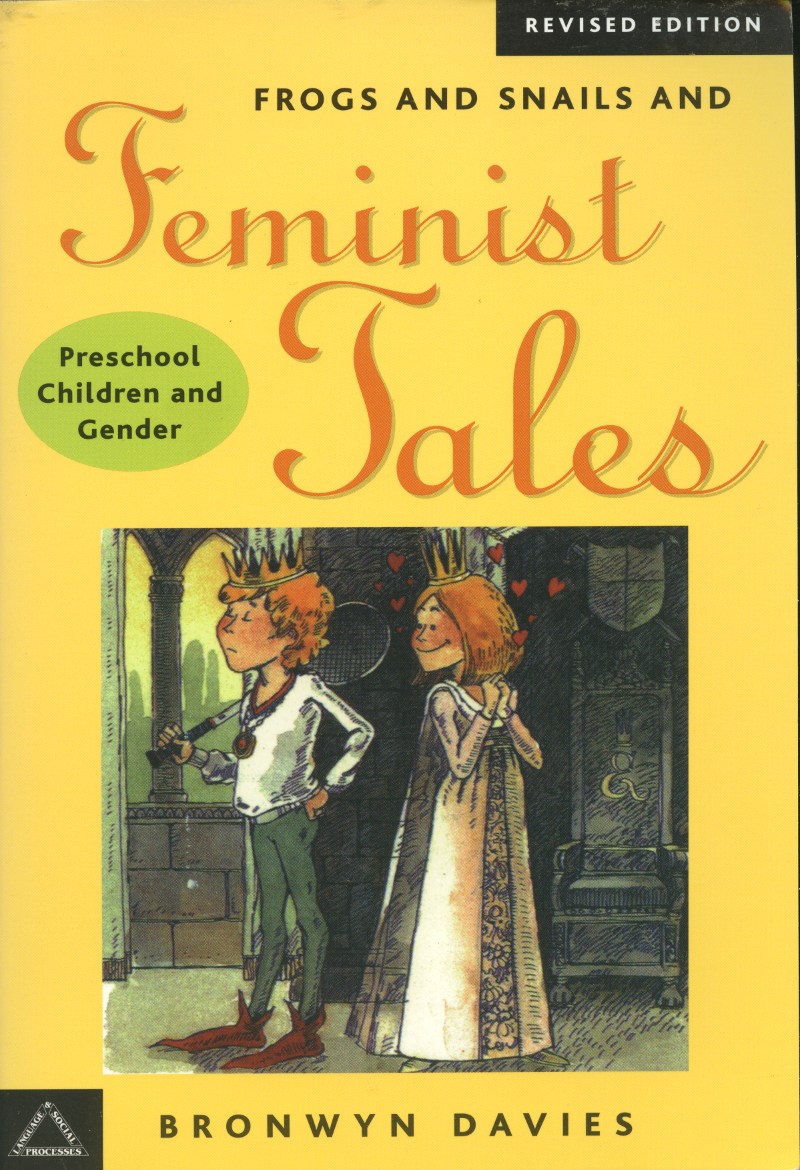
Nevertheless, scholars who have explored children’s sense-making of non-traditional gender representations have postulated that children as readers are active producers of meanings, not merely passive recipients of pre-determined denotations in texts (see Davies, 1989; and Kostas, 2016). More specifically, children give multiple meanings to texts by either challenging or reproducing specific gender stereotypes, for they use their own understanding and knowledge of other stories as well as their own experiences of the social world to make sense of gender roles in narratives. In addition, parents’ professional statuses and education levels, especially the mothers’ professional statuses, seem to affect boys’ and girls’ sense-making of gender stereotypes. Children with mothers in paid employment, in particular, are more critical of traditional gender representations in children’s literature. This positive relationship is even stronger when the mother holds a position that gives her agency or authority. Similarly, several studies have shown that gender exerts a catalytic influence on children’s ability to break away from gender stereotypes. In particular, girls are often more prepared than boys to participate in the disruption of traditional gender stereotypes, mainly because by negating traditional gender structures they challenge the disempowerment of femininity, which is reinforced by these traditional representations of womanhood in the children’s literature. In this sense, texts are polysemous sites and children are not passive learners/readers who do not passively take on the gender stereotypes of male and female roles promoted through the literature.

Although feminist tales provide an alternative to a traditional, sexist worldview and encourage children to challenge traditional gender stereotypes, they are often not powerful enough to disrupt it. While several catalysts affect children’s ability to break away from traditional gender stereotypes in literature, previous exposure to gender-egalitarian views of masculinity and femininity appears to be the most influential. Therefore, amendments to the content of gender socialisation in the family (e.g. gender-neutral toys) and a complete reform of the education system (e.g. rewriting school textbooks from a gendererspective and training educators on gender-equality issues) are imperative for overcoming the obstacles to promoting gender equality in society.


If you would like to contribute to the GEA site, please see here for details.

Women’s March 2017; Australasia Women’s March on Melbourne

GEA Internalisation Exec Member, Emily Gray is up now to share her experience of marching in Melbourne. Don’t forget to check out our other stories on this issue;

Jessica Ringrose

Victoria Shouwnumi

Sharon Lamb

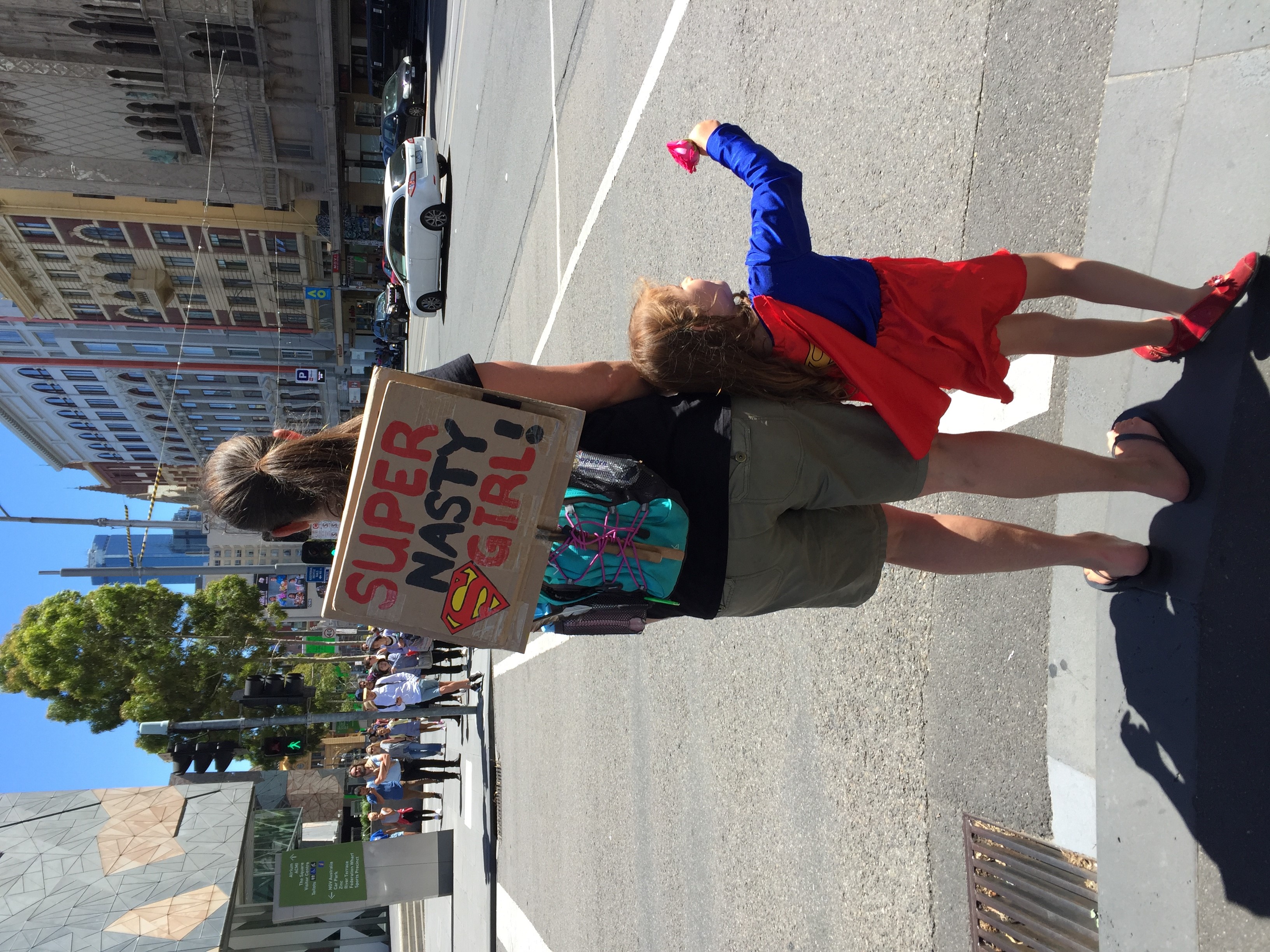
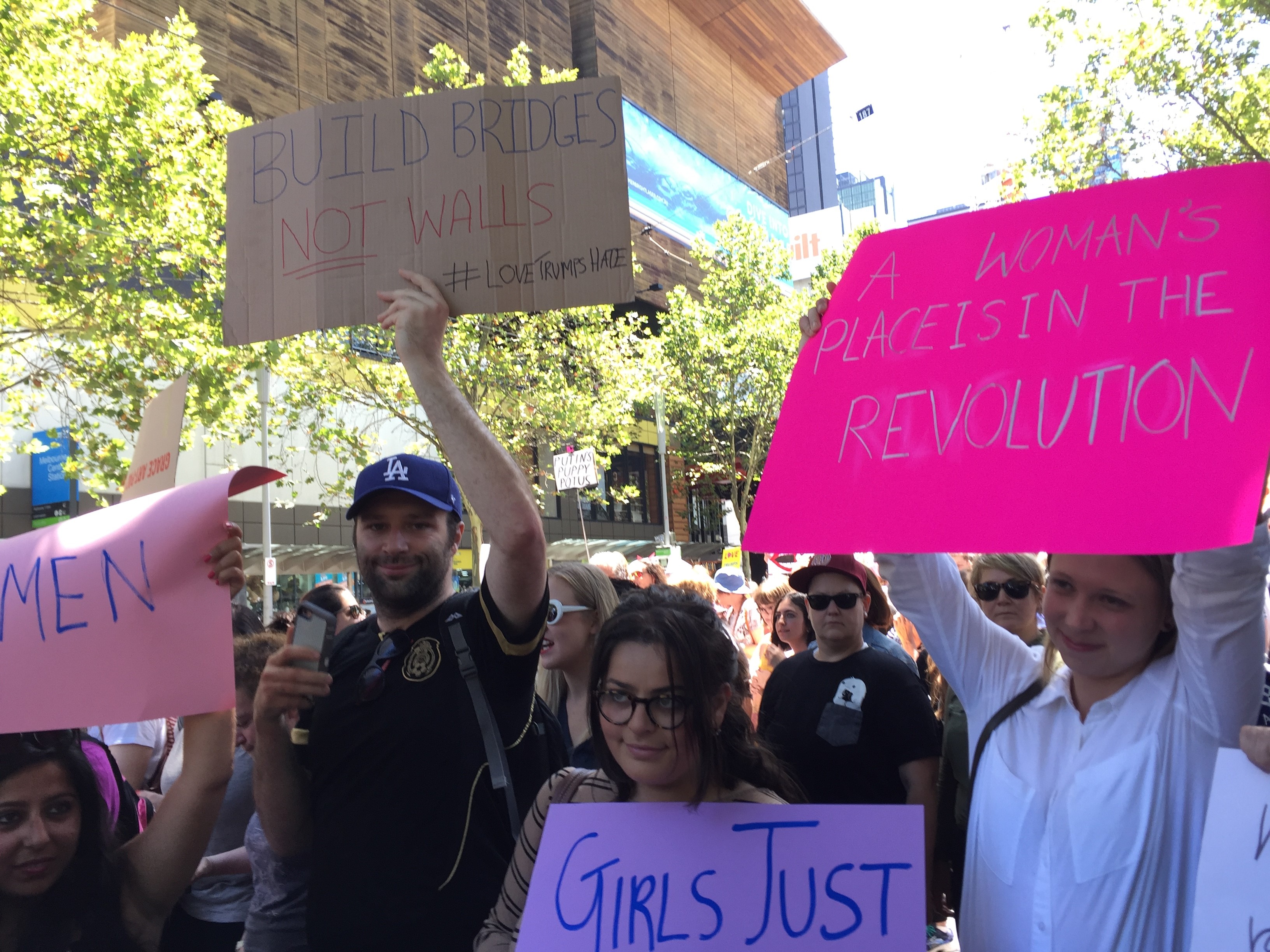
The backdrop to the women’s march in Melbourne was male violence. The day before, a man had deliberately driven a car into people in the centre of the city during a police chase, killing five. Before that, he had stabbed his own brother allegedly because his brother is gay and he “couldn’t handle it”. Such violent actions underscored the need to stand up and speak back, not only to Trump but also to our own people, to our own politicians. In Australia in 2016 71 women were murdered by violent partners, refugees rights continue to be violated at Australian offshore detention centres on Manus Island and Nauru, Indigenous children continue to be disproportionately removed from their families by social services and Aboriginal deaths in custody also remain unacceptably, shamefully disproportionate.  In addition same-sex marriage has still not been legalised and the One Nation party led by Pauline Hanson is gaining ground with their own brand of Islamophobia and post-truthisms and have “had it up to here with tolerance”.

The Women’s March placed these issues at the centre, so that the 5000 strong gathering was not just about an angry, orange-faced man in a faraway place but also a chance to stand up to our own angry white men and women and to demonstrate that they do not represent us.

There have been numerous critiques of the women’s marches and of the exclusionary nature of them, that they are too white, too heteronormative, too middle class. We have to engage with these critiques and do better. In this moment, which feels so seismic I wanted to follow Lauren Berlant’s principle, “which is that you have to show up with whatever you have to fight the unacceptable situation”.


GEA Conference 2017 Update

GEA 2017 abstract deadline extended till 14th February
We have extended the call for abstracts, symposia and performances to GEA 2017 by two weeks until 14th February 2017. The 2017 conference theme emphasises the value of feminist knowledge production across disciplinary borders, as well as material/theoretical/empirical boundaries.
We welcome the submission of conventional paper and symposia formats, as well as performance and expressive pieces.
The conference is particularly keen to welcome early career and postgraduate researchers and we are offering 8 bursaries to support postgraduates specifically.
There will also be a dedicated day for doctoral students ahead of the conference, which will include a Gender and Education journal session on writing for academic journals and getting published.

Feminist Readings Workshop – How to Practice and Disseminate Transnational Feminisms?

Thanks to the Gender and Education Association’s support, Feminist Readings Network held a dissemination workshop in suburban Paris in mid-December 2016. This was an occasion to come together, older and new members, to debate and invent meanings and practices for the young network that aims to approach reading as a pedagogical, creative, transformative movement.

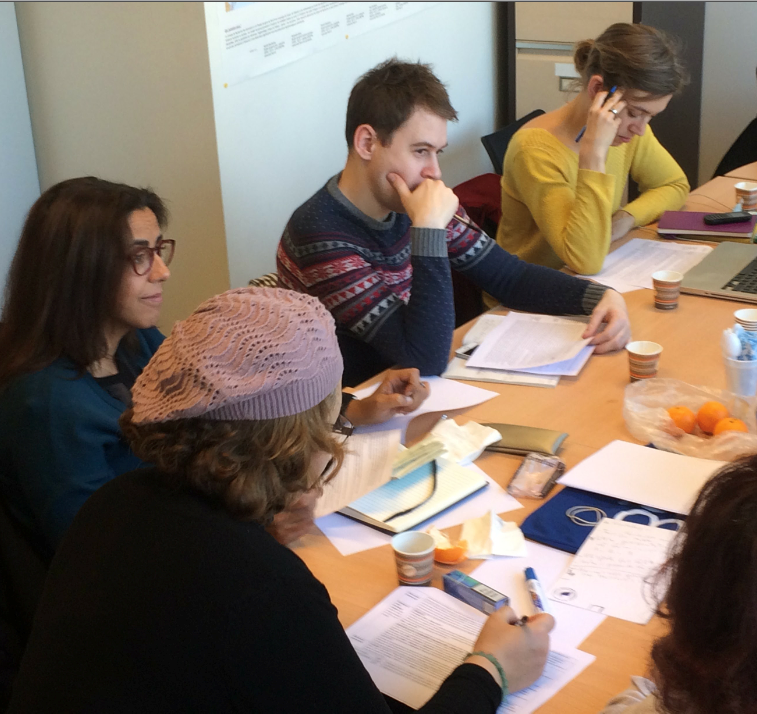
The first day, six members of the network met to discuss the practicalities of organising a new network at Ivry-sur-Seine, in the southern suburb of Paris at Laboratoire d’études de genre et de sexualité (LEGS). The following day an open workshop took place at the Paris 8 University in Saint-Denis, a northern suburb of Paris. Here a group of participants coming from Leeds, Paris and Helsinki came together for a day of activities, discussing main ideas and practices that the network will engage with and push forward. The question we put to ourselves was: how can we help create a platform, not only for our work but feminist research more broadly?


Practical matters, involved with setting up a new international network, were obviously a key concern as well as more theoretical issues. We, thus, pinpointed some central challenges and key directions for a transnational and bi- or even trans-lingual network across several geographical locations.


We began with the important task of tracing the history of the network so far. It began in 2015 in Paris with the first bilingual event Lectures féministes/Feminist Readings.  Thanks to our energetic participants from Leeds another event was held in the following year in Yorkshire, and now our colleagues in Helsinki are organising another symposium where we will come together and share our research.  In our workshop we reiterated the initial ideas behind the network and consolidated our main ideas going forward. In particular, we noted our desire to work together not only as academics but also as feminists and creative thinkers interested in cultivating and nurturing transnational friendships.
We discussed the specific issues relevant to early career feminist researchers. Talking about how we are situated, not only intellectually but also institutionally and geographically. As such, we stressed the importance of trying to figure out what are the particular feminist practices that each context calls for. One of the key questions we thought about was how can the network work for everyone with our different locations, languages and contexts individually respected? Developing feminist readings as a creative and transformative tool has its roots in our concrete situations to start with, in the mix of cultures, languages and disciplines that create the conditions for thinking about and practising intersectionality and transdisciplinarity inside and at the borders of the academia.


Given this history, we were particularly happy to talk about the call for papers for the upcoming symposium in Helsinki on May 26th and 27th 2017. Feminist readings III will revolve around feminist writing, based on our collective experience that reading and writing are indeed not separable from each other. Helsinki organisers were free to choose the shape of the two-day event, and during the workshop discussion all the participants were inspired by their idea to organise the event partly outside university premises, and to encourage presentations in between academic and artistic formats.


While our South African partners could not physically participate in the workshop, we were in touch with them by mail and thought hard about the importance of shifting perspectives outside of central Europe for the network. This included practical issues, for example call for papers need to be shared with enough time for people to raise funds and get visas to come to events in Europe. Thinking about this raised a bigger point: partners who are not based in Europe are often expected to come to European countries, more than the other way around. As it stands, the Feminist Readings Network will work toward events outside of Europe, in South Africa in 2018. We also talked about organising workshops in North Africa, since several members of the Paris 8 research group have important networks in Maghreb countries. This led us to discuss the importance of practicing intersectionality and transnational feminism through inventing modes of action that do not always favour those with European passports.

The final aim of the workshop was to talk about the challenges of disseminating feminist readings and create ideas for the pluri-lingual website, which will be launched in February. All participants were invited to contribute to an intensive brainstorming around the website. The aim with the website is to create a central platform to connect ideas and disseminate our work. Doing this we hope to get more people involved in feminist readings of all kinds!


The main challenge of the website is building a bi- and pluri-lingual online space capable of attracting different readers. We want to share information about the events we organise so more people can get involved and archive online the work already done, while also keeping it a lively and interesting site for people to encounter.


Two interesting ideas put forward were the “feminist reading of the week” and the “pluri-lingual dictionary for feminist terms”. The first one would be a weekly changing very short “feminist reading”, addressing something that just happened, that we just read or saw, whether it comes from an old book or from a scene on the street. The latter is imagined as a space that challenges – to a certain degree since the texts will often still be written in English or French – the hegemony of our two main languages. We want to take specific terms related to feminism and gender from languages such as Kabyle or Finnish that do not exist in English or French. Through the dictionary we want to try and describe what their presences allows in their respective languages, or what is left unsayable in other languages by such an absence. We also aim to write about the ways different terms and concepts coming from hegemonic languages have been translated into e.g. Czech or Afrikaans.


For the participants, the workshop was a much welcome opportunity to (re)connect with other feminists passionate about gender issues and the many ways to read them, inside and outside academia. It was inspiring to exchange ideas with colleagues and peers who are looking to forge new writings and readings and to seek out international feminist alliances. We all felt this as something that is deeply important as we face political regression that is often coupled with university cutbacks and intellectual setbacks.


Check out our earlier post. If you would like to join Feminist Readings Network, or to offer suggestions about any aspect of our project please get in touch!


Contact: feministreadings@gmail.com


Women’s March 2017; Unity and Identity Politics

Today is the turn of GEA exec member Sharon Lamb to share her experience of The Women’s March 2017. Sharon marched in Washington and her post discusses identity politics and why we ALL need to come together, now more than ever, to challenge sexism and inequalities. 

You can also read Jessica Ringrose’s and Victoria Shouwnumi’s posts on The Women’s March

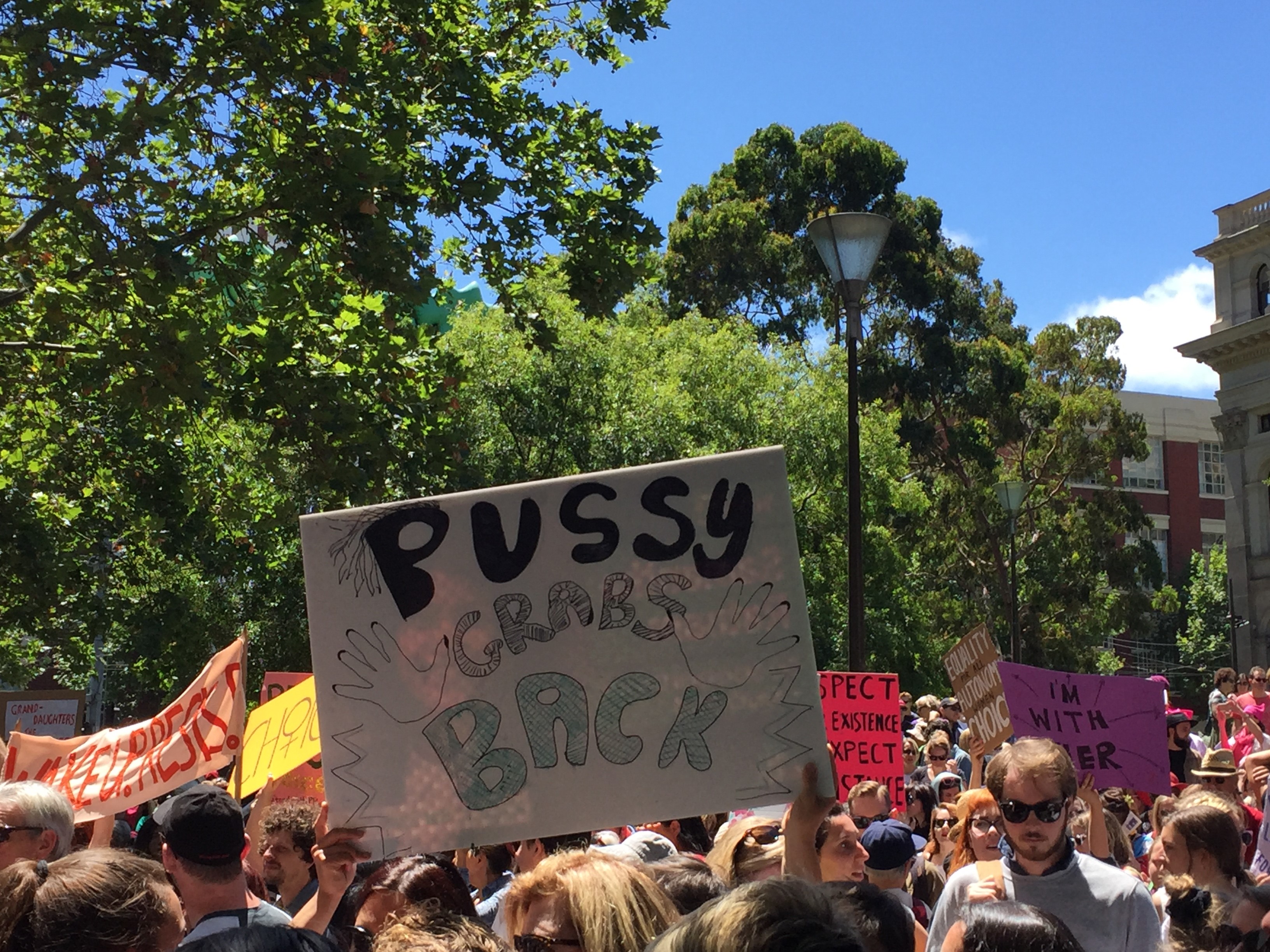
The Women’s March on Washington, which began as the Million Women March and ended as a 3 million women march in the US with many more around the globe, was a revelation on how women can unify. I marched in DC and was truly amazed at the coming together of a number of issues, demands, and approaches all co-existing for a moment without contradiction: Viva La Vulva; Black Lives Matter; Climate Change is Real; My Body My Choice; Say it loud and say it clear, Immigrants are welcome here; Sí se puede – yes we can; What does democracy look like? This is what democracy looks like; Build bridges not walls; Intersectional feminism; My body my choice my country my voice; Immigrants are who make America great; Oh America, what have you done?; Friends of Dorothy Support Women; Viva la Vagina; Do Justice, Love, Mercy March Proudly; Not the church and not the state, women will decide their fate; Keep your laws off my body; Women don’t back down; This pussy grabs back/has claws; If you’re not angry, you’re not paying attention; Not on our watch; and Are you fucking kidding me? A multitude of chants. One voice.

Not so true of the days and weeks leading up to the march. Any sniff of lack of unity among women was sent around by bloggers, journalists, and tweeters as one more sign that women can’t get along and also of the continuation of demoralizing identity politics. White women did not reflect on their privilege enough. Black women had to fight for visibility. Brown women and Native American women and Asian-American women’s voices weren’t heard very often because there was no nifty opposition of pro/con, yes/no, us/them that the media loves to present as Black and White. And then everyone forgot about class, the biggest divide, even after ignoring socioeconomic class was what cost democrats the election.

There were tensions for sure. A coalition that size can’t avoid them. But as usual, the divisions and not the effort to engage a diversity of voices made the news. Women bickering is almost too great a story for the media to ignore. The NY Times couldn’t resist a front page article on a Facebook post by a Black 27-year-old activist from Brooklyn who made one 50-year-old White woman from South Carolina feel “uncomfortable” marching.

Ms. Willis, a 50-year-old wedding minister from South Carolina, had looked forward to taking her daughters to the march. Then she read a post on the Facebook page for the march that made her feel unwelcome because she is white.

The post, written by a black activist from Brooklyn who is a march volunteer, advised “white allies” to listen more and talk less. It also chided those who, it said, were only now waking up to racism because of the election.

“You don’t just get to join because now you’re scared, too,” read the post. “I was born scared.”

Stung by the tone, Ms. Willis canceled her trip.

The title of the article was “Women’s March on Washington Opens Contentious Dialogues about Race.” Opens? I have to ask the New York Times, where’ve you been? Why is this 50-year-old minister’s hurt feelings suddenly newsworth?

It’s true that the first few people who said, “Let’s have a march” were White women. But when they faced justifiable criticism, they were responsive to these critiques to such an extent that one initial critic later called the platform truly “intersectional.” But haters gonna hate and dividers gonna divide and the media gotta sell ads.

Next came the news that pro-lifers were uninvited. And when I tried to find where and how that happened, I discovered that they decided themselves not to march but not that they were uninvited. I did find that their “partnership status” in the planning of the march was revoked. But I’ll betcha anything that there were pro-lifers marching out there who also cared about immigrants, police brutality, and climate change. Most likely some right wing pro-life organization made public that they’re not going to march as a way to get a little press. Trump has shown the world how to get publicity and the media doesn’t seem to change on that score.

There were also tweets, posts, and blog pieces that were heartfelt about how some individuals felt not included. These personal “why I won’t march” stories, (like one by a former student of mine who complained on Facebook that the very women who mistreated her once were now on Facebook ironically promoting women’s rights), describe real hurt for sure. But when these opposing voices are promoted to front-page news it becomes part of the fodder that men have always used to divide and conquer when they say that women just can’t get along.

Yet during the march, we were, as one sign put it: “indivisible.” And that’s where we need to remain in spite of the fact we don’t always agree and sometimes hurt each other’s feelings. Really. How are you going to get half the world to agree on anything when they can’t even agree on climate change?

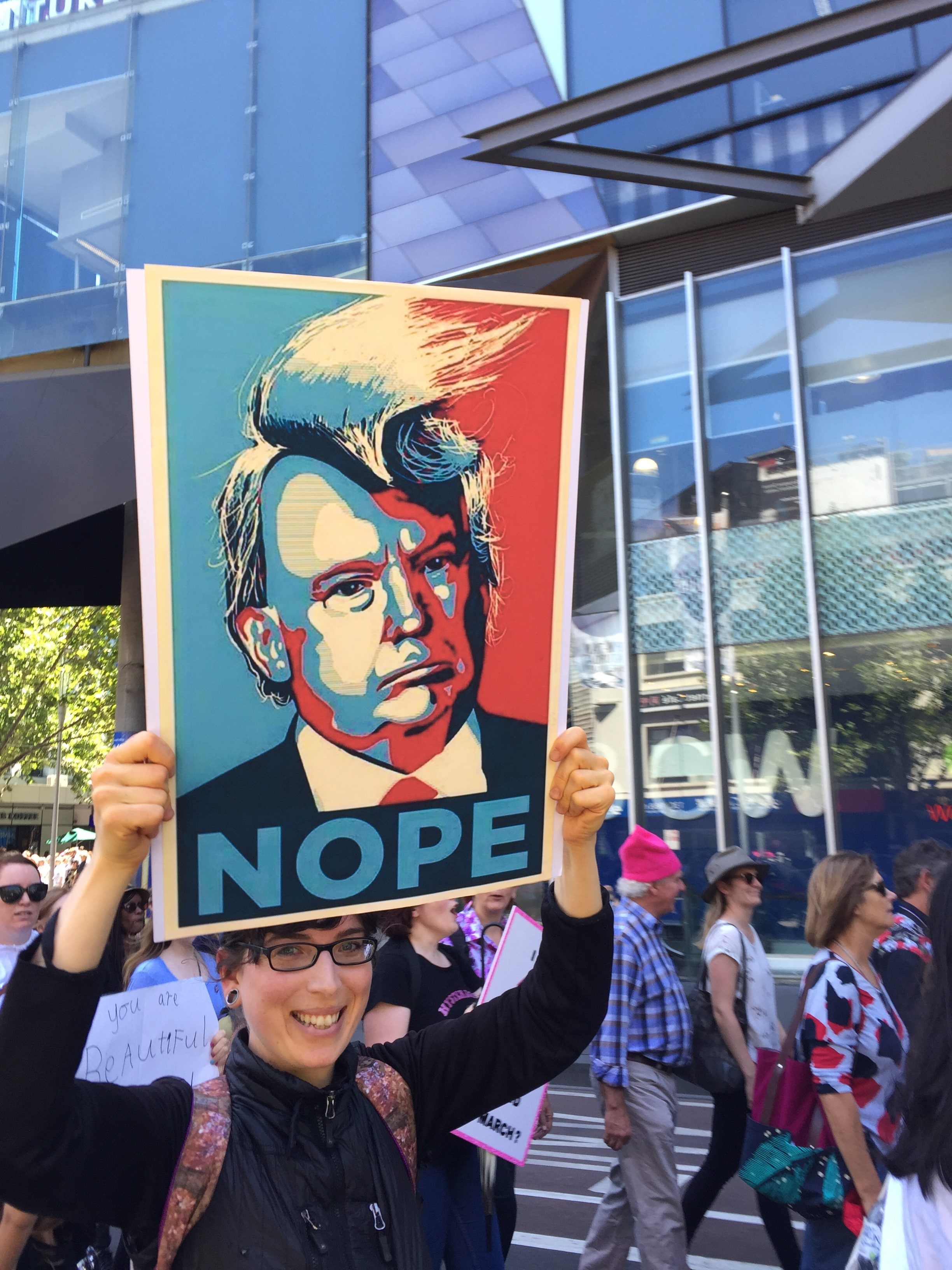
I didn’t supporteverything on the platform, nor every poster or slogan or chant. I marched, shouted when the feeling was heartfelt, and was quiet when I didn’t agree. For example, I didn’t like signs with a picture of a pile of poop on Trump’s face. They seemed slightly contradictory to the slogan, “When they go low, we go high.” But I was there and not chastising my sisters, because, well, the overarching message that Trump is dangerous and women’s rights everywhere are at risk is just too important to be derailed by my discomfort around a pile of poop.

I am personally done with the idea that “the personal is political.” In a neoliberal society, where personal choice is elevated, and individual rights are reduced to the right to shop for schools and carry assault rifles, the 2nd wave slogan that the personal is political has a different meaning. It no longer means: look at what’s personally happened to you and connect it to a political movement, to politics, to other women. Today we stop at what is personal and bring it to voice as if that and only that is political. And we see other people unidimensionally as representing only one voice, one race, always acting out of self-interest or interest for “one’s own kind.” And this interferes with the ability to see an ally as an ally when she comes forward.

The personal is political is not only used to describe the individual coming to voice. It morphed into identity politics, which is unashamedly a politics of self-interest, even if it is well-deserved self-interest, as in “If I am not for myself, then…” Next came interesectionality, which is a concept that seems to me to be supported only when it means the adding on of oppressions and not used very frequently when intersecting privilege undermines any voice of oppression. As with identity politics, the voice of interesectionality continues to honor personal feelings and story telling, and the stories that make the rounds are those that mark the greatest victimization where multiple identities have been oppressed. It encourages individuals to look at how you yourself have been harmed in so many ways rather than how others have been harmed. Personal story trumps history, trumps facts, trumps context. (Someone stop me from using that word ever again!)

There is a genre that I and others noted in the 1990s in popular writing about the sexual abuse or rape victim, a story of stigmatization and never-ending trauma, a genre that undermined the empowerment of victims because it required them to call themselves survivors and never recover. Today many race and ethnicity stories follow this same genre with the tag ending of “And still I rise.” I want to be clear that I do believe that some rape victims as well as victims of racism and racial violence are traumatized for life. But how do these trauma stories work? What do they do? What purpose do they serve? And quite separate from their intent, how are they taken up into an ideology of female weakness, the need to protect rather than empower, and the suppression of voices of unity and strength. Voices of unity? How about “And yet we rise.”

Finding one’s voice. Becoming a subject. Writing from first person perspective. This is encouraged in schools with endless self-reflection papers. I assign them. I read them. And they are earnest and feel to the writer as if her self-discovery is original but, when you read a number of these, you begin to see that an individual’s coming to voice often reflects ideologies and movements in history sometimes quite unknown to the author. The lens is brought to bear so inwardly or so close to oneself and one’s own identity that it is suffocating and the outcome is that we believe one can only speak for oneself and one’s own identity or identities. We teach that you have a voice and that is the voice to cultivate. Precious voice. A jewel. Do not be silenced. It’s a lesson on individualism rather than unity and instead of similarity.

That is the Western individualized identity politics mindset that we need to get out of in order to march together, the mindset we did get out of if only for a day. We didn’t march to express ourselves. Well, maybe some of us did. But in spite of that very Western urge to make one’s voice be heard, we marched for other people, and now, hopefully, we are prepared to fight for them, even if politics won’t allow us to speak for them.

The women’s march was a coming together of people with diverse interests and diverse views. For the last time I hope I will have to identify myself as a White cisgender heterosexually inclined, Jewish but not religious woman who grew up in the lower class but whose family moved to the middle class by the time I was 16, who was the only White high school student who took the African American history course, who grew up with a grandmother immigrant in the household, and who is the mother of two young men and the grandmother of a disabled grandson. With Trump as president, some groups’ rights are more at stake than other groups’ rights. For sure. And some people need to be a lot more scared than I am right now. But when I say I’m scared. I don’t mean I’m scared for myself. (Some critic of the march chastised a White woman saying something like, you’re scared? Well I’ve been scared all my life.) When I say I’m scared, I mean I’m scared for you. And you. And you. And the earth. And the future. So if we need to be divided, let’s divide the world the way Michael Che did on Saturday Night Live – there are reasonable people, and then there are dicks. We have a dick in the White House. Let’s bring reasonable people together to fight for other people, reasonable or not. The Women’s March is just the start.


Women’s March 2017; “You will never again feel the comfort of my silence”

Following on from GEA chair Jessica Ringrose sharing her experiences of participating in the London Women’s March, Equality and Diversity Lead, Victoria Shouwnumi now shares her story of her time marching in Frankfurt.

I was fortunate enough to participate in one of the many marches across Germany on 21st Jan 2017.  The women’s march I joined was in Frankfurt.  I had been disappointed that I would not be able to take part in the London march so was delighted to be invited by an active group of LGBT young women and other colleagues.

We all met the main station of Fulda and went to the march as a group.  Our group was intersectional and international as the group included LGBT along with straight women from Poland, Albania, England and Germany. Our grouping offered a space for intellectual discussion and debate whilst we made our way to the march.

We were able to be energized by the unexpected and how the day was going to unfold. To be honest I was rather nervous as this would be my first march in another country – and it was not until I saw all the police (given there had been a recent attack in Germany) that it actually dawned on me I could be heading into a potential dangerous situation.   During that brief moment of fear, I took a deep breath along with a short prayer and decided that it was going to be a glorious day.

It was hard to believe that the sky was so blue and the sun was so bright if it had not been for the coldness one could have mistaken the day as the beginning of spring.  Walking along with the crowd was just bliss.  It was as though I was having continued conversation with different people along the march.  I could be speaking about politics with one person and continue with a different aspect of the conversation with a totally different set of people.

However what was clear was the message of the day ‘we are all one’ and that felt good.

I asked the group if they would like to share their thoughts of the day, the following paragraphs offers a reflection of their thoughts of the day; 

Miranda’s (name changed) thoughts ….

My name is Miranda. I am an Albanian woman and I have been living in Germany for the past six years. Actually, I didn’t know anything at all about the women’s march in Frankfurt. Thanks to an English colleague of mine, who is teaching at the same university I am working, I got to know about it. I am really happy that I came. It was a unique experience! It is hard to describe what I felt during the women’s march in Frankfurt, but I somehow felt safe and secure. I felt safe because people from different nationalities or cultural backgrounds were marching not only in Frankfurt, but also all around the world looking for gender equality, women´s empowerment in societies as well as their full participation to political, economic and social decisions. Personally, I see these marches as a great effort to raise our voices and put an end to all existing forms of discrimination of women. It is time to say no to people who artificially maintain the myth ‘we are all equal’!


Jacqueline’s thoughts …

I went to the women’s march with you last Saturday. My name is Jacqueline Glasbrenner, I’m 21 and from Germany. After traveling the world for two and a half years, I began to fight for human rights. Since I have seen too much suffering in the world and the non-respect of human rights in a lot of different countries.

Furthermore, I find it terrifying that a homophobic and sexist man is the new president of the USA, one of the leading countries in the western world. That’s why we came together on Saturday, but not only to stand with our Sisters in the states. We also marched for women all over the world whose voices cannot be heard because of oppression, we stood up against Sexism, Homophobia, Racism and any other form of discrimination. We are all worth the same, we do all deserve respect and acceptance and we should all have the same fundamental rights!!!!

Carolina’s thoughts …

During the march, I was full of emotions. All type of emotions which at times ranged between happy and the feeling of anger. I had never experienced so many emotions in such a short time.

To see all the people standing up for justice with their loud voices and messages on their posters made me feel euphoric and to be a part of a peaceful movement, to walk and scream and stand up against discrimination made me feel so happy. I believed it wasn’t “just” a solidarity march against Donald Trump and his statements, it was a march that stood for social justice.

I had the feeling I´m standing up for myself.  It is really hard to describe the emotions which have erupted inside of me, hence I have no words just a new sense of feeling. It is something between happy and angry it’s hard to put words to the feelings.

I also saw that at this march there was place for everyone. It was like an open demonstration where everyone could broach an issue of what she/he wants. Whether it was for against sexism, homophobia, climate warming, against The Transatlantic Trade and Investment Partnership it did not matter.

From children to old people, everyone walked for themselves or stood for their messages.

On Sunday when I opened the newspaper I again was overwhelmed with emotions. Millions from across the world of people had stood up for equality. What a Loud message and with such expression with colour, with music, speeches and posters it was just wonderful.

In Frankfurt there was a woman who had a poster with “You Never Again Have the Comfort of Our Silence!” I read this and thought “YES!”. Everywhere in the world in so many cities people where loud. Peacefully loud.

While I am writing you I again have this emotion inside me which I cannot express in words. Not only because of my English but also because I´m just not able to. I think the march has triggered (I don’t know if this is the right word) something inside me. And probably I need time to find out, what´s happening inside of me.

The march makes me think about me, about what is going on in the world, not only in the USA or Germany.

I don’t know if I could help you for your article with my words but to sit here, to think about Saturday and to write some things down helps me. And I´m thankful for that Victoria.


Jusytana’s thoughts…

“you will never again feel the comfort of my silence”. This was one of the statements I saw in the crowd during the Women’s March in Franfurt. It has moved me so much and I still keep thinking about it. I was there to raise my voice too for social justice and diversity. I saw how important it is to show our presence, keep together in solidarity when fundamenatal human rights are disrespected and vilated. To be there was empowering, as it gave me hope and a sense of belonging. I also saw againthe need and urgency to listen to each other – to all the diverse voices, perspectives, expereinces  and struggles. Racism, ( hetero) sexism, clasism, ableism, homo/transphobia… all intersects.

We need to act against oppression in the way that everyone feels represented, seen and heard.  Because as Audre Lorde said …” I am not free, while any women is unfree, even when her shackles are very different from my own”.

The End


Dr Victoria Showunmi

GEA Executive and Diversity Lead

Women’s March 2017

The Women’s March was a worldwide protest on January 21, 2017, to protect women’s rights and protest at the injustices evident in areas such as immigration, health care, reproductive justice, LGBTQIA rights, rape culture, labour and worker’s rights and racial injustice. The marches were aimed at the recently inaugurated POTUS, Donald Trump who, in his public statements, policies and positions has made his anti-women stance clear.

Over 5 million people participated in the marches, in locations such as The United States, The U.K, Germany, Paris, Denmark, Japan and Spain. Celebrities such as Rihanna, Madonna, Miley Cyrus, Emma Watson and Ariana Grande were in attendance at some of the protests and the media coverage was wide, rendering this one of the most successful marches in history that  aimed to unite women and send a message of strength and solidarity. GEA members also took part and over the next few posts we will look at their individual experience’s and analysis of the event.

*if you would like to contribute to GEA with your own experience of attending a march, please get in touch*

Professor Jessica Ringrose Co-Chair of Gender and Education Association participated in the London Women’s March January 20th 2017 Here are some of Social Media Posts that capture her experiences

The London march was inclusive and participatory, with 100,000 people marching! Responding to the march the day afterwards on Facebook I enthused:

It was incredible to march with 100,000 people on London yesterday but next time we need MILLIONS!! My best moments were hearing the energy ripple through the crowd as screaming went in waves up and down long roads packed with protesters. We were with the good/cool people all together as Carolyn Pedwell said and it was like we were lightbulbs getting recharged with hope in these tough times. I especially loved seeing so many men on the March and the moment I hold in my heart is the young guy carrying his ‘her body her choice’ sign around Waterloo as we caught our trains home. Many more thoughts to percolate but marching is still one of the most powerful and important forms of solidarity and contagious consciousness raising around! ?

In the wake of the Global Marches questions have been raised about the possible racism and trans-phobic messages of a woman’s march with the dominant symbolism of ‘pink and pussy’. Elizabethe Payne’s, founder of QuERI Queering Research in Education Centre and Director of posted on the importance of women’s craft and foregrounding women’s bodily organs for all to defend:

Of course, Women’s organising has always been a struggle that involves conflict and negotiation over space, place and participation, and it is understandable that a single march is not going to overcome structural economic and race barriers in USA or across other global contexts. Many questions were raised about making the marches more genuinely intersectional and I loved the sign from Washington DC that said ‘I’ll see you nice White Ladies at the next #Black Lives Matter March right?’.

Moreover, one of the central images of the women’s march captures intersectionality in all its glory

Art from ‘We the people’ is designed to “capture the shared humanity of our diverse America” https://www.kickstarter.com/projects/amplifierfoundation/we-the-people-public-art-for-the-inauguration-and


These images provide important starting points for discussing the fundamentals of intersectionality with your students and you can find an excellent set of tips on how  to build feminist activism that is more intersectional in Hart’s speech about the women’s movement http://gomag.com/article/important-speech-womens-march/ . Hart suggests we need to start with the “anti-black origins upon which gynecology was built… and starting with black pussy’. Using the  very materiality of body parts to start thinking about how a colour like pink can get coded as feminine, white and therefore white girly, is a way to get a discussion about gender going! It can help us grapple with intersectionality, positionality and identity in ways that recognize the power relations happening even within a protest march ostensibly for ‘all women’.