C2C: Science, Social Justice, and ‘Southern Discomfort’

This post is part of our new Countdown to Conference (C2C) series. We would love to feature a brief blog post from you too! Visit our main Countdown to Conference page for details!

C2C: Science, Social Justice, and ‘Southern Discomfort’
by Dr Leslie S. Jones

I am not much of a blogger, in fact this is my first blog post EVER, but I am willing to give up my status as a “virgin blogger” in the spirit of the upcoming conference.

If there were a gene for feminism, I would be absolutely certain that I have it. My earliest memories are constant battles with my mother over being forced to do things because “that is what girls are supposed to do.” I hate dolls, pastel pink dresses, and lacey anklet socks to this day, since they symbolize the gender roles I found so oppressive as a child. I know she meant well, considering it her duty to socialize me properly so that I would fit into the prescription of a “nice girl” that my two sisters found so easy to accept. The more she tried, the wilder I got, and the more I grew to resent ridiculous cultural boundaries, some fifty years ago, that kept me from doing things I wanted to do. When she told me “not to beat a boy” on a golf or tennis date because “they would never want to marry me,” I thought she was crazy. I have never been able to understand how a well-educated woman who majored in mathematics at a very prestigious college could wonder, “Why you girls insist on over-educating yourselves?” when my sisters and I went to graduate school leading to two MBAs and a PhD. My wonderful father, who came from a much less-privileged childhood, was tremendously proud of us and always defended my right to grow into whatever I wanted to be.

I hate dolls, pastel pink dresses, and lacey anklet socks to this day, since they symbolize the gender roles I found so oppressive as a child.

My first conscious exposure to racism was in 1961 when I saw 3 bathrooms and 2 water fountains with signs for “colored people” at a gas station on a visit to Mississippi. I insisted on an explanation, and my parents must have been terrified that the Ku Klux Klan was going to appear if they did not get their out-spoken child in the car. I spent a large part of my childhood in Hawaii, learning island cultural values including the fact that the world is full of different people. Growing up during the Civil Rights Era I could never accept any justification for what was happening to African Americans. The ugliness of both racial segregation and gender roles in the latter part of the 20th century were so obnoxious throughout my secondary, university, and early graduate schooling in the natural sciences that by the time I chose a dissertation topic, it was “The Impact of Racism and Sexism in Post-Secondary Science Education.”

I learned the word intersectionality twenty years after I had completed that research on racism and sexism in the natural sciences, but I had always said that the most profound conclusion I could make from the study was that Women of Color are treated worst, because these forms of discrimination are compounded when they both come into play. I had learned why my mother had pushed me to be compliant when I was punished in subtle ways for being smarter or a better athlete than males. However, more importantly, I consider what racism continues to do to African Americans is much crueler than the gendered discrimination I had experienced. I teach in a Biology department and trying to get white men to recognize the stubborn persistence of sexism in a department that is 50% women is almost a waste of time. Therefore, I devote most of my energy to challenging racism and other discrimination because nobody can dismiss that diversity work as being in my own self-interest. As a white woman, people listen when I speak about scientific racism and “race” being nothing more than a cultural artifact. As a scientist who studied reproductive physiology, I get plenty of respect when I challenge heterosexism within the complexity the influences of nature and nurture on human sexuality. Finally, with the academic freedom we have in the USA, I can teach biology in a deliberate manner to promote social justice as long as what I say is scientifically legitimate.

I wanted to share the link to a film that my friend and former colleague just released, Southern Discomfort (2017) because it sets the backdrop for the talk I will be giving at the conference. This is shocking, but no exaggeration.

http://www.filmsforaction.org/watch/southern-discomfort-2017/

If anyone has any requests for American things you would like me to take over to the UK, I should have room in my suitcase.  Sweets?  or any foods you can’t get easily even with the web? I am going to take some candy-covered pecans to pass around because they are the big treat from my current home in Georgia.

I know I am going to be on a search for a special English hard candy that is honey-flavored and has very tart lemon powder inside.

See You Soon – I am psyched to visit England again!

If you are attending conference, let us know on Twitter using the hashtag: #GEAconf2017

C2C: #FEAS are coming to GEA! (And looking forward to it)

This post is part of our new Countdown to Conference (C2C) series. We would love to feature a brief blog post from you too! Visit our main Countdown to Conference page for details!

C2C: #FEAS are coming to GEA! (And looking forward to it)
by Dr Emily Gray
Twitter:@FEASproject

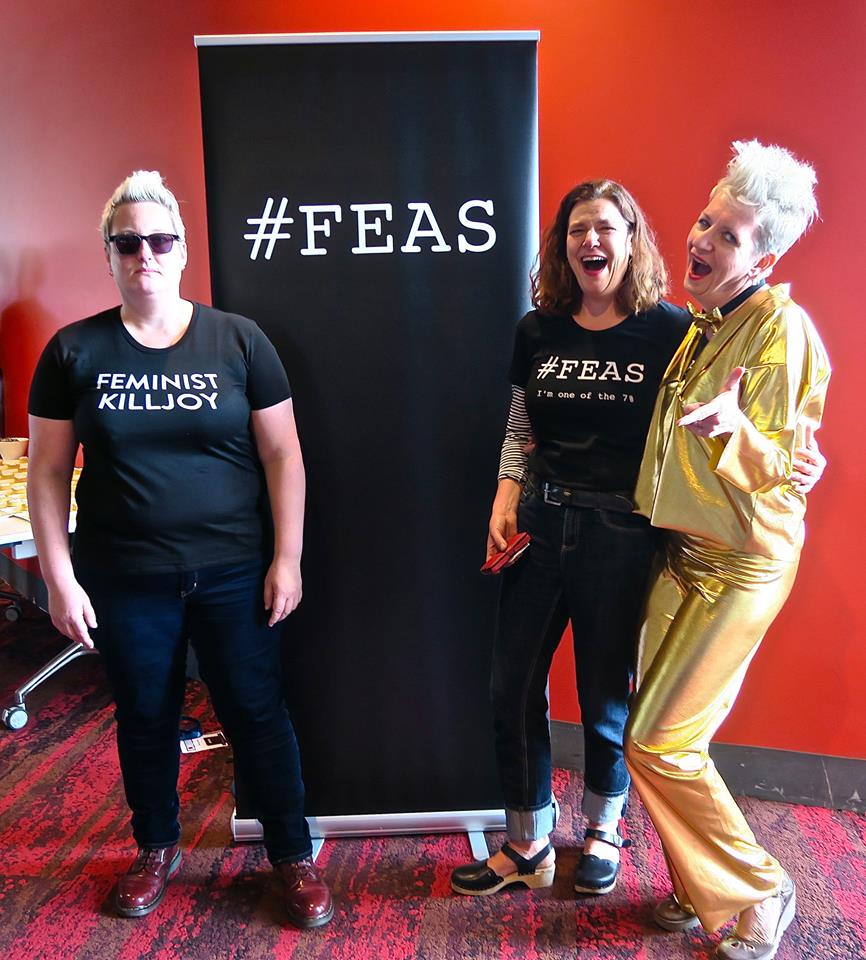
L-R Emily, Mindy and Linda following a stand up Performance at AARE Conference, Melbourne 2016

Feminist Educators Against Sexism #FEAS are an Australian-based international feminist collective committed to interrupting, challenging and otherwise shouting out about sexism in the academy and other educational spaces. #FEAS was formed by Mindy Blaise, Emily Gray and Linda Knight in 2016 and emerged out of a funded project to develop arts-based interventions into sexism in higher education. Workshops were run with diverse women academics from all career stages and together we developed interventions that were performed at a large education conference. The interventions included sexist/anti-sexist bingo cards, pipeline myth t-shirts that display statistics about women’s employment in Australian universities, whistles to blow when no-one’s listening, butterfly nets for catching those elusive opportunities and a stand up comedy performance that used participants’ experiences as one-liners that aren’t really very funny at all, as well as deploying the literal figure of the feminist killjoy. By challenging sexism through humour, irreverence and collective action we hope to highlight the inequalities, absurdities and the dreary everydayness of sexism in the academy. From the original 3, #FEAS now number over 400 and are located in Australia and all over the world including UK, Aotearoa New Zealand, Sweden, Belgium, the USA, Canada and Saudi Arabia.

This year, #FEAS have teamed up with Gender and Education and we are busy designing a new range of t-shirts, business cards and working on a brand new stand up performance for your viewing pleasure at the conference. We will also be presenting our research-creation journey so far, including our recently formed Cite Club where #FEAS share research with each other and cite each other where we can.

Mindy and Emily are familiar faces at Gender and Education conferences, both having attended many times in the past. Linda is brand new to Gender and Ed and so we are looking forward to introducing her to our favourite conference and to sharing our ideas and interventions with you all!

If you are attending conference, let us know on Twitter using the hashtag: #GEAconf2017

Introducing the new GEA Social Media Intern: Kate Marston

Hello! I’m Kate, the new Social Media Intern for the Gender and Education Association (GEA). As a Cardiff University PhD student concerned with the intersection of young people’s digital practices and relationship cultures, I am delighted to be contributing to GEA’s work eradicating sexism and gender inequality in and through education. Over the next few months I will be tweeting, posting, blogging and sharing content that affirms GEA’s key aims of promoting feminist scholarship and informing policy and practice relating to gender and education.

Prior to commencing my PhD, I worked in the voluntary sector on a range of projects that challenged homophobia and transphobia in schools. The organisations I worked for relied on a strategic web and social media presence to reach educators, policy makers and young people in order to enhance the visibility of their work. Here I learnt the discipline of maintaining an up-to-date social media presence along with creative strategies for engaging people, but as a PhD student I have enjoyed the freedom my PhD twitter account affords me to engage with feminist, anti-racist and trans activism online. I have valued GEA’s commitment to spotlighting intersectional feminist perspectives on gender and education from academics, activists and practitioners alike and I am eager to continue this work.

As a PhD student, twitter has also been invaluable for building academic networks, tracking Calls for Papers, keeping abreast of relevant literature and supporting academic events and conferences. Having attended a variety of GEA coordinated conferences and seminars I am familiar with the dynamism of these events and the value of actively engaging with conference hashtags and handles. Social media has enhanced my experience as a conference attendee through enabling me to connect with speakers, follow the development of research projects and continue discussions online. As GEA Social Media Intern I hope to facilitate similar connections in the build up to, during and beyond events and conferences. So if you’re attending our upcoming Gender and Education Conference 2017 let us know by tweeting #GEAconf2017!

A key aim over the next few months is ensuring we signal boost the work of PhD students and early career researchers. We are hosting a dedicated free day of workshops for Early Career Researchers ahead of #GEAconf2017, as well as inviting blog contributions for our website. You can write about a publication you’ve read or one you’ve written, a film you’ve seen or one you’ve made, an event you’ve been to or one you’re hosting. Whatever it is you are working on at the moment, if it is related to gender, education and feminism we’d love to hear from you.

Overall, I am excited to learn more about the amazing work of GEA members and look forward to meeting some of you at #GEAconf2017!


C2C: Learning from Across Borders

This post is part of our new Countdown to Conference (C2C) series. We would love to feature a brief blog post from you too! Visit our main Countdown to Conference page for details!

C2C: Learning from Across Borders: What Canadian Multiculturalism Teaches Us about Happiness
by Natalie Wall
Twitter: @mdximpact

When I was a little girl, my father told me that I could be anything; I could be Prime Minister of Canada, if I wanted to.

He was and still is… wrong.

Canada has never elected a female Prime Minister and the only woman (Progressive Conservative Kim Campbell) to have held the position attained it through hatred of the previous PM and was replaced by the Liberal Jean Chrétien within six months, and this is after having called the election because she showed a demonstrable lead in the polls. Canada has never had a non-white Prime Minister. Even as a child, I knew that my chances were not good and I can’t say that my father approved of my defeatist attitude when I explained my unlikelihood of becoming Canada’s first black, female Prime Minister. This was my first moment of being a black feminist killjoy.

Wait… can I be a black feminist killjoy?

Killing Joy and Taking Names

Sara Ahmed tells us that the feminist kill joy “is an affect alien for sure: she might even kill joy  precisely because she refuses to share an orientation towards certain things as being good” and that “[w]e can place the figure of the feminist kill joy alongside the figure of the angry black woman.” Let us suppose that the angry black woman and the feminist kill joy can exist in one body, so that I can become a black feminist kill joy. In fact, let me assume the mantle of black, Canadian feminist kill joy.

Crossing Borders and Becoming Foreign

Over the course of my PhD, I have become foreign. However, I have never felt so Canadian as I have once I became foreign. My foreignness makes me nostalgic for a home that never was, a place to which I never really belonged. I am a black Canadian woman whose father was an immigrant who moved from Trinidad to Canada in the seventies and whose mother grew up on in a country house in rural Cape Breton. I belonged to a group of friends who all shared the common experience of being first generation Caribbean Canadian black women. We were antiracist activists living in West Toronto where my high school was lauded as a stellar institution despite my memories of white supremacists handing out hate literature on site and girls being told that they should not speak out against the sexual harassment from faculty members. My antiracism and feminist sensibilities grew in this environment and were intrinsically linked to my self-identification as a black Caribbean Canadian woman.

But, I have become foreign.

As I have become foreign, so has the world around me.

Brexit campaigners told us that the British population needed to “take back control” and control was taken back. And where did Brexit campaigners find inspiration for taking back that control? Michael Gove cites Canadian and Australian immigration policies when pressed about migration on Question Time.

What Can We Learn from Canada?

After the introduction of Donald Trump’s Muslim Ban on January 28th, 2017, the Prime Minister of Canada’s Twitter account (smugly, one might argue) posted the following:


Amid a flurry of criticism and, yes, some popular approval, the Muslim Ban opened up an opportunity for Canada to remind the international community that it holds the line in North America for diversity and hospitality.

I started my PhD examining multiculturalism in Canada under the Harper government, at a time when the Conservative government was taking liberties with its population’s human rights and making Canada a less tolerant environment than it has traditionally painted itself. See Human Rights Watch’s “World Report 2016” where among other concerns are the refusal to conduct an inquiry into missing and murdered Indigenous women and the Anti-Terror Act of 2015, “law that imperils constitutionally enshrined human rights, including the freedoms of expression and association.”

I am finishing it up under a Justin Trudeau government, a Liberal Canada expressing itself through its proclaimed feminist and hospitable Prime Minister. Trudeau’s likeability and international popularity are reflective of a system of government that always works best when portrayed as idealistic and inclusive. It is a Canada that benefits in real, marketable, ways from its reputation as a multicultural utopia that operates to oppress and manage non-white bodies by using them as objects to parade before other, international and white, audiences.

What’s Multiculturalism Got to Do with It?

Multiculturalism, both official and idealized, works to help define the culture of Canada, by offering a gesture to diversity that has become synonymous with Canadian identity, but also offering a mirror against which Canadian identity can articulate itself. The trope of multiculturalism in Canada works to define culture in two ways: policy that has become a part of the fabric of Canadian self-construction and the persistent differentiation of citizens so that there are real Canadians and the others that help to demarcate the relationship between real and marginalized.

Canada was the first country in the world to integrate idealized constructions of multiculturalism into official policy.  Multiculturalism is intrinsic to Canada’s understanding of citizenship: the Government of Canada says on its website that “Canadian multiculturalism is fundamental to our belief that all citizens are equal. Multiculturalism ensures that all citizens can keep their identities, can take pride in their ancestry and have a sense of belonging.” However, we also have to understand that immigration serves the state’s purpose, “national immigration policies are seen as mechanisms to supply workers for various industries” (Satzewich and Liodakis 62). As state policy, that is to say, multiculturalism can never be purely without benefit to the host state. In fact, immigration is part of nation-building project, where multiculturalism is both reliant upon that immigration and one of the methods with which the nation ensures the obedience of its subjects, allowing them their cultural identity so long as it is subsumed under their identities as productive Canadian citizens. The success of Canada’s multiculturalism policy is rooted in its marriage of ideology and policy into the very fabric of how Canadians understand what it means to be and act Canadian.

So, while “Canada has its own historical graveyards of shame which are routinely relegated to the footnotes of history” (Mullings et al.), including genocide, Chinese Head Tax, missing and murdered Indigenous women, just to name a few, Canadians are not willing to go on record as xenophobic bullies. In the end, Canadian’s identify so strongly with multiculturalism that Trudeau won against Harper’s xenophobic campaign in 2015. Canadians supported freedom of cultural identity instead of anti-muslim rhetoric, going so far as to wear traditional mummer’s costumes to the polls in protest over the niqab debate. The focus on the niqab in tandem with the enacting of the Zero Tolerance for Barbaric Cultural Practices Act, which focused unduly on Muslims, was the Conservative government’s undoing.

Alternatively, in the UK, multiculturalism is dead at the hands of home grown terrorism. Immigration fears largely influenced the Brexit vote and continue to make headlines as we head towards 8 June, 2017. As Ahmed tells us, “multiculturalism becomes a problem by being attributed as the cause of unhappiness. When we are ‘in’ multiculturalism, we are ‘out’ of our comfort zone.” As we head into another General Election, I am wondering to what degree the British public is voting for a happiness that stems from having neighbours that look like you, sound like, and think like you. Is multiculturalism the root of all unhappiness?

Or is there a lesson to be learned from across the pond?

A harsh and pragmatic lesson to be sure, but a lesson to be learned nonetheless. Because that’s what being a feminist kill joy is all about…

“Generative Feminism(s): working across/ within/ through borders”

At the upcoming Gender and Education Association Conference, titled “Generative Feminism(s): working across/within/through borders,” researchers and practitioners will be coming together to think about demarcation and delineation as feminists who are building new, innovative spaces that impacts the world around them.

The 2017 conference is being organised and hosted by Middlesex University, London and runs from run from Wednesday 21st until Friday 23rd June, 2017. As a member of the organising committee, I am excited by the breadth of topics and how disparate the backgrounds of the presenters. You can see the conference programme here and register using the following link.

If you are attending conference, let us know on Twitter using the hashtag: #GEAconf2017


Introducing #FEAS Cite Club

Introducing #FEAS Cite Club
by Kate Marston, GEA Social Media Intern

The first rule of Cite Club is: You do talk about Cite Club! Feminist Educators Against Sexism (#FEAS) are an Australian-based, international feminist collective committed to developing interventions into sexism in the academy and other educational spaces. One of their most recent interventions is Cite Club, an e-mail group where #FEAS members send their works to one another and cite one another where possible.

#FEAS Cite Club is inspired by Sara Ahmed’s (2013) call to be mindful of ‘who appears’ within feminist work, to not necessarily go to male theorists to understand women’s diverse lives but to cite feminist work to do so. Cite Club is also inspired by the Citational Practices Challenge issued by Eve Tuck, K. Wayne Yang and Rubén Gaztambide-Fernández (2015) on the Critical Ethnic Studies blog, and their call to, “consider what you might want to change about your academic citation practices. Who do you choose to link and re-circulate in your work? Who gets erased? Who should you stop citing?” We aim to develop a network of feminist scholars with diverse identities and research interests and to build an archive of work that we can draw upon.

In collaboration with #FEAS, GEA will be profiling a Cite Club publication on this blog each month. To start we are introducing a paper by Kerry H. Robinson, Elizabeth Smith & Cristyn Davies (2017) that explores parents’ perspectives on children’s sexuality education in Australia. Kerry Robinson is one of the keynote speakers at the upcoming GEA conference 2017, and this paper addresses #GEAconf2017’s interest in exploring key issues in the field of sexuality education. Cite Club is in its infancy, we are excited to see where it takes us! If anyone would like to join the Cite Club mailing list please e-mail Emily Gray: emily.gray@rmit.edu.au


May 2017 #FEAS/GEA Cite Club Featured Publication

Responsibilities, tensions, and ways forward: parents’ perspectives on children’s sexuality education

To cite this article:
Kerry H. Robinson, Elizabeth Smith & Cristyn Davies (2017) Responsibilities, tensions and ways forward: parents’ perspectives on children’s sexuality education, Sex Education, 17:3, 333-347, DOI: 10.1080/14681811.2017.1301904

Children’s sexuality education lives under the burden of societal anxieties around sexuality as a developmentally inappropriate, risky and dangerous topic for children. Informed by socio-cultural discourses of childhood ‘innocence’, sexuality is often deemed too ‘adult’ and something from which children should be protected. Despite the notable benefits of sexuality education to children’s health and wellbeing, policy-makers can be wary of sparking controversy with parents on this matter.

Exploring these tensions Kerry H. Robinson’s, Elizabeth Smith’s & Cristyn Davies’ paper provides insights into parental perspectives on primary sexuality education in New South Wales (NSW) and Victoria, Australia. The authors note that despite the recent development in Australia of a National Curriculum with a Health and Physical Education syllabus, children’s experiences of sexuality education varies considerably across schools, states and territories with content decisions left to individual schools and teachers. Parents/carers generally have the right to remove their children from sexuality education classes. Additionally, sexuality education policies in NSW and Victoria point to the need for collaboration and communication between parents/carers, schools and community health organisations. Therefore, parental attitudes have significant implications for sexuality education policy and practice.

Undertaken as part of a larger research project on ethical and respectful relationships education in primary schools, this study set out to identify what and how discourses affect parents’ concerns, anxieties and perceived responsibilities concerning sexuality and relationships education for their children. A sample of 342 parents/carers were recruited (60.5%, n = 207 women and 39.5%, n = 135 men) and asked to participate in an online survey, interviews and focus groups exploring their perceptions and experiences of a variety of topic areas related to sexuality and relationships education. Whilst the findings indicated that the majority (71%) of parents/carers surveyed did consider sexuality education to be both important and relevant to the lives of primary school children, attitudes differed on how this should be delivered and a third of parents indicated that sexuality education was not relevant or were unsure of it’s relevance.

The paper goes on to explore why parents did and did not consider sexuality education relevant; views on who should be responsible for sexuality education; and aspects of sexuality education considered more appropriate for families to address than schools or other sources. In doing so, it provides an overview of some of the opportunities and challenges facing families, practitioners and policy-makers who wish to see more effective sexuality education available for children. Challenges include the persistence of profound fears around sexuality education as developmentally inappropriate amongst some parents, whereas potential opportunities for development were evident in the recognition amongst many parents that they have a responsibility for their children’s sexuality education, but often feel unconfident instigating these conversations at home.

Suggesting ways forward the authors note that sexuality education as a health and wellbeing issue should continue to be recognised as a shared responsibility between families, schools and health organisations, but with greater support in place to address the gaps in adults’ learning in this area. For example, community sexuality education programmes could provide evidence-based information, skill development, resources and support to parents/carers in regards to best practice. They argue that such community programmes could also support school-based sexuality work and offer valuable signposting to children and young people. Furthermore, better communication from schools about the sexuality curriculum and pedagogical approaches may help address any parental concerns. Finally, they argue that greater consistency and monitoring of the implementation of sexuality education could ensure equitable access for all students.

This paper offers valuable insights into how particular socio-cultural discourses and narratives shape parental approaches to primary age children’s sexuality education. For further information about the wider project exploring teacher attitudes and approaches, as well as children’s understandings click here.

If you are attending the GEA conference, and looking forward to hearing more about the work of Kerry Robinson, Cristyn Davies or #FEAS members, let us know on Twitter using the hashtag: #GEAconf2017

Imagining the Body in France & the Francophone World – CfP

We are delighted to support our members and events they host that may be of relevance to our readers; today we bring you details of a fantastic conference to be held at The University of Birmingham.
We are delighted to announce the release of a call for papers for ‘Imagining the Body in France & the Francophone World’, a bilingual conference to be held at the University of Birmingham, 19-20th January 2018, with the generous support of the IMLR and SFS.  Through this cross-cultural and interdisciplinary conference, we hope to facilitate dialogue and debate about the body and its representation in French and Francophone culture and society.
 If you are interested in submitting a proposal, abstracts of 300 words in either French or English should be sent to us at imaginingthebody@gmail.com.
Please do visit our twitter page, facebook event and/or blog for full details and a call for papers, and if you know of any PG(R)s or academics interested in representations of the body in French and Francophone culture and society, please do pass this information on! We hope to hear from you very soon,
with warm wishes from the organisational team (Antonia Wimbush, Maria Tomlinson, Polly Galis).
@imaginingbody
imaginingthebody.wordpress.com

C2C: What feminism’s got to do with dance

This post is part of our new Countdown to Conference (C2C) series. We would love to feature a brief blog post from you too! Visit our main Countdown to Conference page for details!

C2C: What feminism’s got to do with dance
by Tamara Borovica
Twitter: @Blackie_in_Ozz

As a PhD candidate researching gender and the body, I find the key themes of this Gender and Education Conference – working through temporal, spatial, material and disciplinary borders – as appealing and challenging at the same time. My interest in the body as an active and agential assemblage comes from witnessing some of the extremes of human suffering, violence, hope and resilience when I was growing up in now ex-Yugoslavia, in 1990s. While most of these experiences carried a strong affective and emotional charge and made many of us irreversibly different, I got curious about the ways people continue to ‘become’. When as an adult I begin working with young people in Balkans and across Europe, my interest was in noticing complexities, contradictions, open-endedness and unevenness in their continuous becomings, even when situated in what appeared to be a grip of social structures. The same interest led me to discover and eventually start teaching dance as a form of embodied inquiry and to how the idea of this research was born.

My interest in the body as an active and agential assemblage comes from witnessing some of the extremes of human suffering, violence, hope and resilience when I was growing up in now ex-Yugoslavia, in 1990s.

In my work on the embodiment of womanhood, I imagine embodiment as relational, interconnected, always in flux and becoming, as a part of various assemblages and in numerous encounters (some of which are increasing and some decreasing bodily potentials). To explore young women’s embodiment, I have conducted a performance ethnography with a group of Melbourne University students interested in creative methods and feminist issues. We were a group of non- dancers who danced to produce and explore new feelings, thoughts, ideas, sensations and/or creative artefacts about embodied womanhood, in order to, potentially, open up ‘the affective economy’ of our bodily beings. The paper I will present, ‘Dancing the strata- affective flows of moving/dancing bodies and the possibilities for becoming otherwise’, will illustrate my approach to researching the embodiment of young womanhood where I aim to engage with the materiality of (human and more-than-human) bodies while attuning to movement, rhythm, fluidity, multiplicity and flows.  This paper will focus on one encounter of dancing bodies where we danced with the strata (categories such as sex, gender, race, ethnicity, religion, sexuality, age, and ability) to look at what embodiment of these categories produces for young women’s lives and how our bodies take an active role in this production.

At the beginning of the third year of my Candidature, I can profoundly benefit from presenting at conferences such as Gender & Education, where a number of academics are engaging in similar kinds of work. More than a few of G&E scholars have been influential in informing my approach to this research, and I am looking forward to being further inspired by their work presented at GEA2017. Until we meet in London!

If you are attending conference, let us know on Twitter using the hashtag: #GEAconf2017

Healthy Sexual Development Symposium

GEA recently contributed to funding a vital sex and relationships education symposium in Bristol – we are delighted to announce that The University of Westminster is hosting a further event on the 30th June.

Using the framework of the Fifteen Domains of Healthy Sexual Development* , this event aims to support practitioners and teachers involved in SRE and young people’s sexual health at all key stages, as well as to enable dialogue and collaboration between academics and practitioners. The event is suitable for any practitioner, teacher or academic with an interest in this area.

* Developed by Professor Alan McKee and colleagues at Queensland University of Technology, and adapted by the RSE Hub*

Guest speakers include Dr Ester McGeeney, a Youth Researcher and Practitioner who will be exploring pleasure in sex education and ensuring young people’s healthy sexual development and Jo Taylor, Associate Head at Chestnut Grove Academy, London – winner of Accord Inclusivity Award 2016 who be discussing how to tackle pornography and sexualisation in schools

The event looks set to be a fantastic and informative space.

For more details, download the flyer here;

Healthy Sexual Development Symposium flyer


C2C: Social media and gender identity work

This post is part of our new Countdown to Conference (C2C) series. Are you attending conference? We would love to feature a brief blog post from you too! Visit our main Countdown to Conference page for details!

C2C: Social media and gender identity work
by Josie Anne Reade
Twitter: @JosieAnneReade

As a PhD candidate researching gender and the body, I was delighted to receive an invitation to present a paper at the 2017 GEA Conference hosted by Middlesex University in London. In my paper, ‘Assembling fitspirational bodies: Social media and gender identity work’, I will be sharing some of the emerging data from my PhD which explores how women experience their bodies and gender in relation to the digitally mediated ‘fitspo’ phenomenon. This paper will be highly theoretical as well as empirical and will directly relate to this year’s thematic emphasis on generative feminism(s). After the conference, I intend to submit a journal article for publication based on the paper I present and will also be writing a blog post for the GEA website reflecting on my conference experience.

One of Australia’s defining characteristics is its geographical isolation from the rest of the world. As an PhD candidate who wishes to achieve greater connectivity with scholars working in my field globally, this creates a significant challenge. Presenting at this conference will provide a unique opportunity to share and collaborate with scholars globally alongside my colleagues and supervisors traveling from Australia. Given my thesis draws upon relatively recent developments in feminist theory, such as feminist new materialism and the ‘affective turn’, this connectivity is imperative. Receiving feedback on the development of my ideas half way through my PhD candidature will moreover be extremely beneficial.

I look forward to attending the conference and sharing my work with the GEA community!

If you are attending conference, let us know on Twitter using the hashtag: #GEAconf2017


Science and Gender Policy Reproduces Privilege

It has become global-policy commonsense that we need more people working in Science, Technology, Engineering and Mathematics (STEM) and that we must increase the proportion who are female, and that these goals are linked. As a 2014 UK policy report on Women in Scientific Careers stated, a ‘compelling reason to tackle’ the gender gap ‘is that the UK economy needs more STEM workers and we cannot meet the demand without increasing the numbers of women in STEM’. The report does not ask which women are able to progress along ‘the pipeline’ from school science to post-16 STEM qualifications and careers. Typically, it makes only passing reference to ‘moral arguments’ for equality, focusing on the business case that increasing women’s STEM participation will boost the economy and create better working environments. In this blog we argue that pursuing economically-driven policies to increase the number of women in STEM without considering gender in intersection with race and class risks reproducing privilege.


An intersectional approach to gender and STEM

Kimberlé Crenshaw coined the term intersectionality in the 1980s to capture ‘the need to think and talk about race through a lens that looks at gender, or think and talk about feminism through a lens that looks at race’. It’s since been developed to incorporate relationships between disability,  gender, race, sexuality and social class. There is evidence of intersectionality’s importance for STEM recruitment, as statistical research shows that race, class and nation impact women’s relationships with STEM. For example, studies show that US-born women studying science and engineering see STEM careers as less compatible with their values than international-born women on these courses and STEM stereotypes impact more on European-American than on African-American women. Indeed, minority ethnic and working-class women are more likely to drop out of computing courses for economic reasons than because of stereotypes of technology as masculine.

This suggests that gender and STEM policies reflect the experiences of white middle-class women. Speaking on the ‘urgency of intersectionality’, Crenshaw argues that overall improvements for women do not ‘trickle down’ to marginalised women: ‘Without frames that allow us to see how social problems impact all the members of a targeted group, many will fall through the cracks of our movements’. It is difficult to change how we see the world, which experiences we notice and which are ignored. Doing so takes more than statistical data. It takes powerful stories. We offer one below to show intersectionality in action and that gender inequality does not trickle down.

Gabriella’s choice at a crossroads of gender, race, nation and class

Gabriella is studying the high-status Natural Science Programme in upper-secondary school in Sweden, a country with an international reputation for gender equality but persistent gender gaps in STEM participation. Although academically unsuccessful, getting a mix of Cs, Ds and Es, she is planning to become a forester which includes taking a Masters in Biology. Given her lack of conventional success, how does Gabriella maintain an identification with science?

Gabriella has unstyled short hair, wears tracksuit bottoms and sweaters, sometimes the same ones for a week, and uses no make-up. In refusing the demand that young women pay careful attention to their appearance, Gabriella strongly rejects femininity and so aligns with masculinity. We also see this alignment in her interests. She gives her hobbies as reading ‘fantasy mainly’ and playing computer games. Gabriella displays a knowledge of specialist genres of games (including retro and ‘indy games’) which marks her out as geeky. Although women are increasingly identifying as geeks, this identity remain associated with masculinity.  Gabriella also breaks with dominant gender norms by distancing herself from from feminine-coded science professions. She favours forestry as it makes it less ‘likely that I’ll be stuck in a lab somewhere, as that’s what biologists usually end up doing’. She rejects the diligence and attention to detail that are typically attributed to women in science, dismissing STEM areas that are ‘so finicky and lots of sitting still’.

Gabriella’s career choice is a way of realising her passion for the outdoors. As she explains: ‘in a lab, I would be far too bored and feel boxed in’. We can see this as another way of Gabriella aligning with masculinity since work indoors is socially coded as for women and work outdoors for men. However, it is also part of her Swedish identity. Exercising one’s rights to experience and appreciate nature is key to Swedish national identity. This is enunciated in ‘friluftsliv’, the Scandinavian back-to-nature movement with its roots in the eighteenth century. This identity is attached to whiteness. As Tobias Hübinette and Catrin Lundström argue, ‘being white constitutes the central core and the master signifier of Swedishness, and thus of being Swedish’.  White men are shown more positively in relation to nature than women and immigrants with the latter portrayed as in need of training to relate appropriately to the natural world.

Gabriella’s middle-class position also plays a role in her science aspirations. Research connects science choices to ‘science capital’, that is ‘scientific forms of cultural capital (scientific literacy; science dispositions, symbolic forms of knowledge about the transferability of science qualifications), …  [and] of social capital (e.g., parental scientific knowledge; talking to others about science)’. Gabriella has strong science capital within her immediate and her extended family. Her sister and father work with technology, her cousin recently graduated from forestry and two family friends are foresters. Despite this, Gabriella presents forestry as an individual choice. To develop science policy that can support women in less privileged positions than Gabriella, we need to see her choice as social.

Final thoughts

Dominant policy frames stop at the fact of Gabriella’s gender, seeing her progression to a science university course as an economic (and moral) success. The deeper analysis of her identity above points to the significance of her non-normative gender performance and of social class, race and nation in her choice to pursue science. This suggests we need to ask which women can aspire to science careers and how other women (and men) are positioned in relation to science through their success. Gabriella’s rejection of conventional femininity supports her science identification and vice versa, but it reaffirms rather than challenges the dominant gendering of science as masculine. In forestry, Gabriella has found a STEM field where her participation is enabled by her intersecting gender expression, Swedishness, whiteness and middle-classness. But, where does that leave less-privileged women? And, how can we make gender and STEM policies that work with the messiness of intersectionality? As Crenshaw says, these are urgent questions.


This article is written by Heather Mendick, Maria Berge and Anna Danielsson. It is based on their article ‘A critique of the STEM Pipeline: young people’s identities in Sweden and science education policy’, published in the British Journal of Educational Studies. It draws on the project ‘Power, Knowledge and Identity in Science and Technology Classrooms’ funded by the Swedish Research Council.