school toilets

Toilet Talk: Empowering young people in schools to research and talk about toilet issues

A GEA Funded project

By Alice Little, Josh, Oscar, Elliot, Charlotte Haines-Lyon, & Nathalie Noret

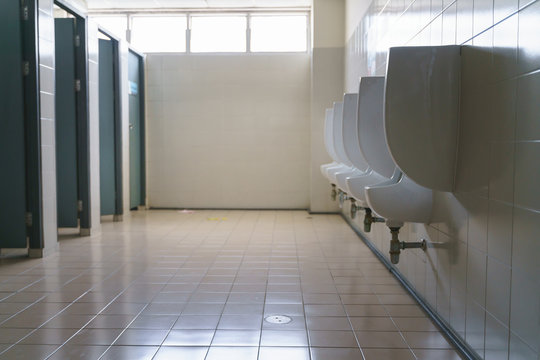
Pupil toilets are a problematic space in school. Pupils often report feeling unsafe and being concerned about the cleanliness and hygiene of school toilets. As such are often reluctant to use the toilets in school time. We aimed to work with young people to explore and challenge common toilet narratives to develop healthier, more equitable toilet practice.  

Working with young people, we developed a participatory research project to examine: how can young people work with schools to develop toilet policy and practice that is safe, healthy, and socially just? We successfully recruited a secondary school in South Yorkshire to participate in the project. The school had recently conducted a student voice survey and identified a problem with the school toilets. Our student as researchers group decided to investigate this further.

Consistent with our participatory approach to the project, our blog post is co-authored with members of our young people research team, Josh, Oscar, and Elliot. This approach was approved by our institutional ethics board. We highlight why the young people decided to get in the project, what they have done so far in the project, and why they feel Toilet Talk is important.

Why get involved?

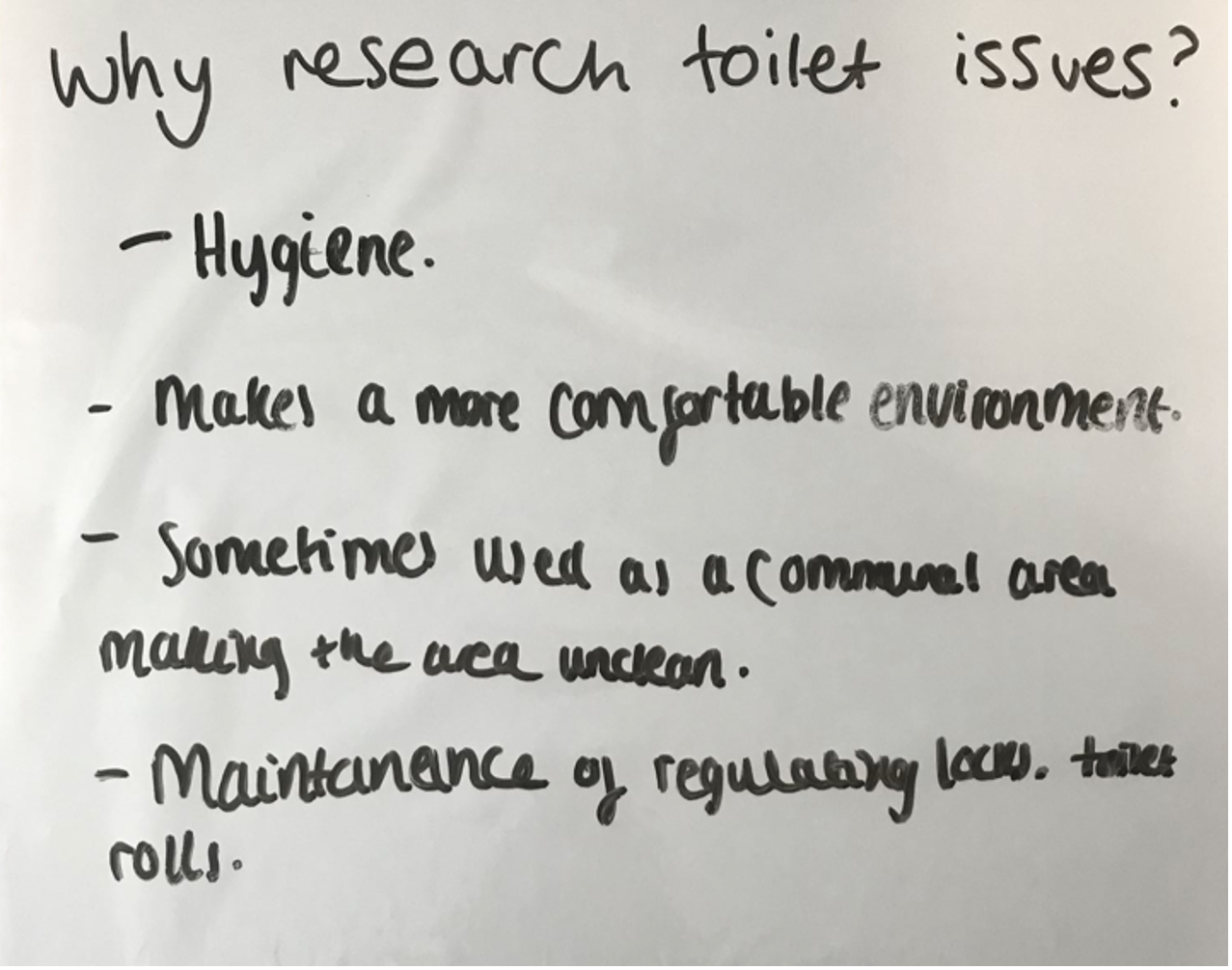
JoshMy motivations for joining Toilet Talk was to gain an insight into the processes and factors considered during a research project at University standard. I joined Toilet Talk with these intentions in mind and soon became invested into the opinions and attitudes towards toilets and their usage from the answers given by students at my school and sixth form.

OscarI joined Toilet Talk because I have always felt that the quality of school toilets is below adequacy – I believed that through Toilet Talk, we would be able to make meaningful change to our Sixth Form, lower school, and schools across the country. I also felt that the research aspect would be quite interesting, i.e., looking at statistics from peers etc. I was interested in seeing if my opinions on the toilets in and around Sixth Form were shared among peers.

What we have done so far

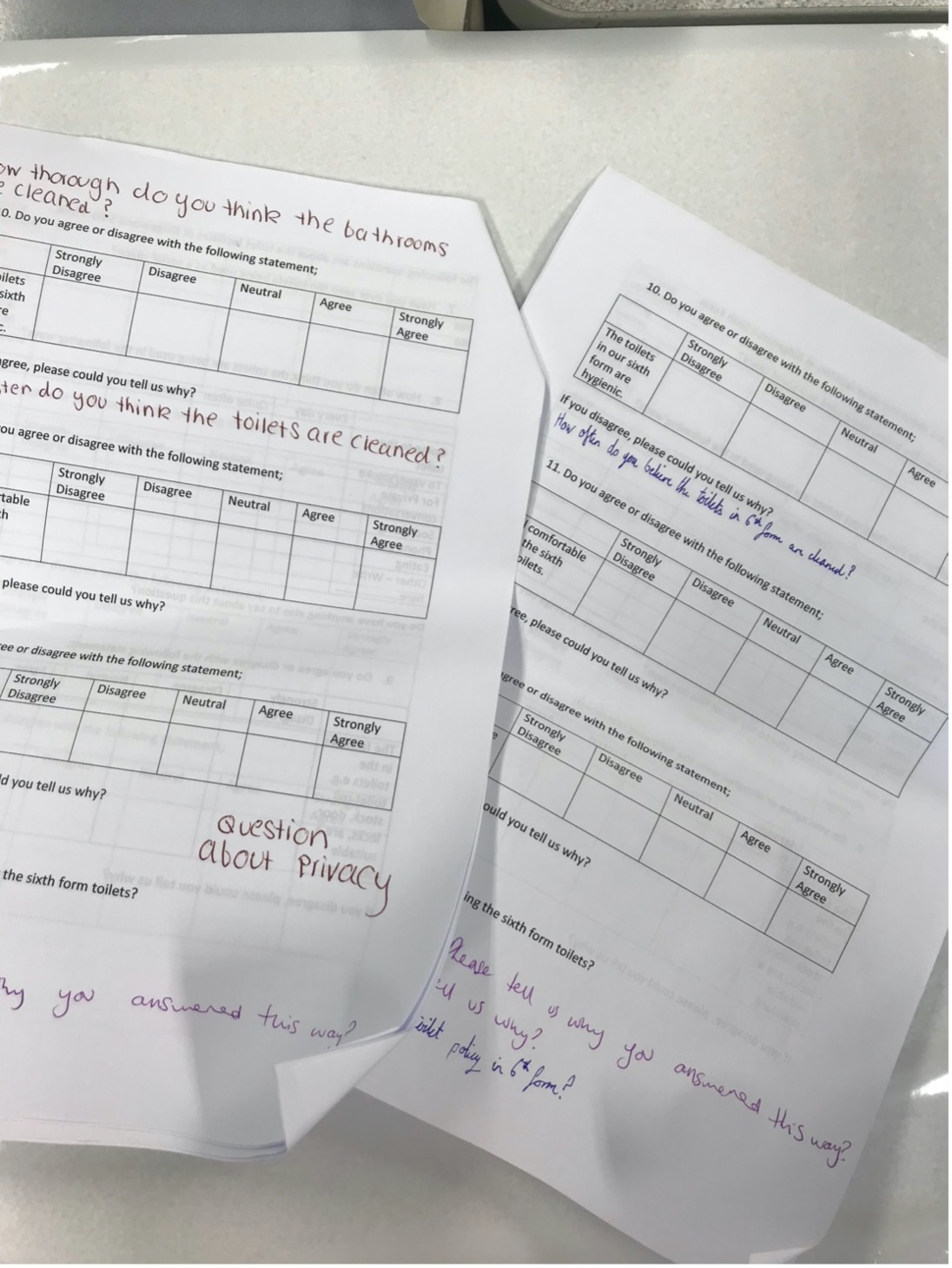
Alice, Josh & OscarInitially we set out to work in a participatory way where the young people could lead the direction of the project. The young researchers chose a method for collecting data about school toilets. We began collaborating on choosing questions that could be asked to other pupils within the sixth form. We discussed ethical considerations such as confidentiality and safeguarding. An aim was to provide reassurance to pupils that we would respect their anonymity when answering the questionnaire. The team of pupil researchers wanted to make sure that respondents felt comfortable and could answer truthfully without any worry of any repercussions. The sessions were held in 25-minute form time slots, which fitted into the school day and were flexible to accommodate those who wanted to take part.  

Some of our findings so far

Josh & Oscar – Initially we believed that social space and toilets were connected; our finding concurred that our predictions and estimations were closely matching to the outcome of the Student Voice Survey. 62% of respondents stating that the toilets in Sixth Form were being used as a social space, with 23% specifying that the toilets do not address all needs of pupils. It would be interesting to see if these findings and statistics are generally found across the country in all genders and age brackets – it would be helpful to research further into school toilets to confirm this belief. It was insightful to discover that many of our views on the toilets were shared with our peers as well.

Why these findings are important and our next steps

Josh & Oscar – Collectively, we agreed that sharing our findings with the head of our Sixth Form would be helpful in working towards a solution with the Student Voice Surveys in mind. An intention was to specifically address the findings on social space and accessibility, as we believe these are the key elements that are contributary towards achieving a more comfortable environment for students using the toilets. We believed that through our research being conducted alongside York St John University researchers, our student voice was elevated, and responses would be better received by our Sixth Form and its management. Therefore, hopefully the findings will result in a higher chance of action being taken towards the facilities, better improving the overall conditions for ourselves and our peers. We believe a higher quality environment is deserved for pupils within our sixth form, especially with equitable toilets being a basic human right.

The young researchers facilitated a meeting with senior leadership, and it became clear that no toilet policy existed within the sixth form. An action plan was created that included the co-creation of a toilet policy, and clear expectations to be set out in whole year group assemblies. The young researchers have opened dialogue with the leadership team about expectations and conditions of the sixth form toilets and they wanted to continue this discussion moving forward.

The Toilet Talk project has highlighted the benefits of employing a participatory approach when undertaking research in schools on sensitive and challenging topics. The young researchers in this project have highlighted how important it was to feel listened to and contribute to a meaningful discussion with their school leadership on their research findings. This has led to a change in school policy and practice related to school toilets.

This research secured ethical approval from the York St John University, School of Education, Language and Linguistics, Ethics Committee in January 2022. Written consent was received from the young people to take part in the Toilet Talk project and those involved in writing the blog attended a workshop session on authorship and anonymity within academia, and verbally consented to being named co-authors.

This blog post explores the Gender and Education Association 2021 funded research project titled Toilet Talk: Empowering young people in schools to research and talk about toilet issues, led by Dr Charlotte Haines Lyon.

GEA 2013: Compelling Diversities, Educational Intersections: Policy, Practice, Parity

Gender and Education Association Biennial Conference 2013

Weeks Centre for Social and Policy Research, London South Bank University

Tuesday 23rd– Friday 26th April 2013


Confirmed keynote speakers:

– Prof. Lisa Adkins, University of Newcastle, Australia (What Do Wages Do? Feminist Theory After the Financial Crisis)

– Prof. Val Gillies, Weeks Centre, LSBU (From Baby Brain to Conduct Disorder: the New Determinism in the Classroom)

– Bidisha: From Eastern Primitivism to Western Decadence? Overcoming the Notion of Cultural Differences in Gender, Race and Class Politics


Plenary Panel:

– Dr Tracey Reynolds, Weeks Centre for Social and Policy Research, LSBU

– Dr Jin Haritaworn, Helsinki Collegium for Advanced Studies

– Dr Kay Inckle, Trinity College Dublin

– Dr Jayne Osgood, London Metropolitan University

– Dr Vanita Sundaram, University of York


Performance:

– Dr Claudia Brazzle, Liverpool Hope University

– Teddy Nygh, Director of Riot From Wrong and Co-Founder of Fully Focused


The ninth international Gender and Education Association conference, Compelling Diversities, Educational Intersections hosted by the Weeks Centre for Social and Policy Research, engages with key debates surrounding the interplay between dynamics of education, work, employment and society in the context of crisis, upheaval and cutbacks, which reconfigure axes of intersectional inequalities. In considering diversity in education, this conference will explore the relationship between new equality regimes and continued educational inequalities, exploring organisational ambivalence, change and resistance. It will ask important questions about the role of feminist research at a time when education, and its variously placed subjects (academics, pupils, students, and policy makers), wrestle with the commitments and contentions in doing diversity and being diverse.


Book your place

If you are paying by debit or credit card, please book online using Eventbrite at http://www.eventbrite.co.uk/event/4743075667

If you wish to receive an invoice or have any queries, please email enterprise-events@lsbu.ac.uk


Conference Fee

£380 – Standard conference booking fee – Member*

£420 – Standard conference booking fee – Non-member

£150 – Standard day rate


* To obtain your discount code, necessary for member discount, please contact Alice Jesmont (a.jesmont@lancaster.ac.uk)

The sexually available versus the crooks; gender and HIV prevention education in Mozambique

The cynic in me was not surprised to find that young women in Mozambique experienced sexual harassment in schools. I had thought carefully about this eventuality prior to setting out to Mozambique to gather data for my doctoral study on HIV- and AIDS-related education, and the possible action I might take if and when confronted with a situation such as this. What did take me by surprise was the extent to which the young men were put away as inherently unreliable. It seemed they were, to paraphrase one research participant not really worth ‘speaking about’. Young women and men appeared to be firmly stuck between a ‘rock and a hard place’. In a setting such as this, the potential impact of HIV prevention education seems rather questionable. Continue reading “The sexually available versus the crooks; gender and HIV prevention education in Mozambique”

Into the Woods

As a practicing middle school English Language Arts teacher and researcher in the Northeastern US, I am interested in the stories adolescents tell about their lives. To this end, my research in classrooms is ethnographic and privileges the stories girls tell about their experiences of being marginalized, silenced, and punished, often by other girls. One story in particular has resonated with me, and I have come to refer to this story as “The Story of the Sluts” – thus named, however crudely, because that is how the story was presented to me by the girls who told it. It all came about when Lily (a pseudonym), an eighth grade student, was meeting with me during a writing conference about revisions for a short story she was writing in my class. During this writing conference, it came out that a party had taken place the previous weekend. Lily explained that two of my other students, Melanie and Kelly, had gone ‘into the woods’ with two boys who also attended our school. Continue reading “Into the Woods”

‘Keeping it Real’: teenage girls and everyday feminism

It is an overcast Friday in mid-October as the Cardiff University contingent (that’s us!) pull up outside a rated-but-dated business hotel in Newport; we are attending the #KeepingItReal conference for teenage girls, run by the South Wales charity Full Circle, who seek to support aspiration in young people, and as we find our way into the conference suite the atmosphere of excitement and enthusiasm is already building. A large room is decked out as if an awards ceremony is about to take place, with over a dozen huge round tables, bedecked with linen and festive balloons, arranged in front of a stage where a sound check is underway. The walls are lined with exhibitors from local charities promoting sexual health, domestic violence services, and education opportunities, and what we thought to be a big purple bouncy castle in the corner turns out to be an inflatable ‘Big Brother Diary Room’ for the teenage attendees to record their thoughts about their lives and the conference away from adult eyes. No bouncing for us then, we sigh, and set up our stall nearby.  Filling the table with pamphlets and adverts for our gender and sexualities research group, we also lay out our GEA leaflets and journal copies, later eagerly seized by both teachers and charity representatives alike. Continue reading “‘Keeping it Real’: teenage girls and everyday feminism”

Physics Education: It’s Different for Girls?

Back in the late eighties I was one of two girls out of thirty pupils in my 5th form Physics class. While girls were happy to take up the Biology and Modern Language options, in my Physics class I languished- ignored by the boys that did not care to pair up for experiments with lens and pendulums with these odd girls that had bizarrely chosen this apparently most ‘male’ of subjects. Sadly, my experience in the Physics lab mirrored that of the sports playing field. Last to be picked, my teenage love of hockey and Physics soon waned.  It seems little has unfortunately changed in the intervening decades. Continue reading “Physics Education: It’s Different for Girls?”

Bad Animals Sitting Sweetly: Some Thoughts on Naughtiness, Gender and What We Learn in School

Let it be known that my six-year-old daughter is a child rife with frolicsome mischief.  

The experience of parenting said child fostered my interest in naughty youngsters, the connections between misbehavior and personhood and how all children—especially girls– are socialized in schools. Thus socialized through behavior management practices, many are taught to equate obedience with learning and conformity with personhood. Recently I came across two different pieces in the mainstream media that piqued my interest along these lines: The first was Bill Lichtenstein’s September 9th New York Times reflection on the all-too-common strategies for ‘managing students in US schools and the second was a BBC interview with Michael Kenny, the first male graduate of Norland College.   Continue reading “Bad Animals Sitting Sweetly: Some Thoughts on Naughtiness, Gender and What We Learn in School”