A GEA Funded project
By Alice Little, Josh, Oscar, Elliot, Charlotte Haines-Lyon, & Nathalie Noret

Pupil toilets are a problematic space in school. Pupils often report feeling unsafe and being concerned about the cleanliness and hygiene of school toilets. As such are often reluctant to use the toilets in school time. We aimed to work with young people to explore and challenge common toilet narratives to develop healthier, more equitable toilet practice.
Working with young people, we developed a participatory research project to examine: how can young people work with schools to develop toilet policy and practice that is safe, healthy, and socially just? We successfully recruited a secondary school in South Yorkshire to participate in the project. The school had recently conducted a student voice survey and identified a problem with the school toilets. Our student as researchers group decided to investigate this further.
Consistent with our participatory approach to the project, our blog post is co-authored with members of our young people research team, Josh, Oscar, and Elliot. This approach was approved by our institutional ethics board. We highlight why the young people decided to get in the project, what they have done so far in the project, and why they feel Toilet Talk is important.

Why get involved?
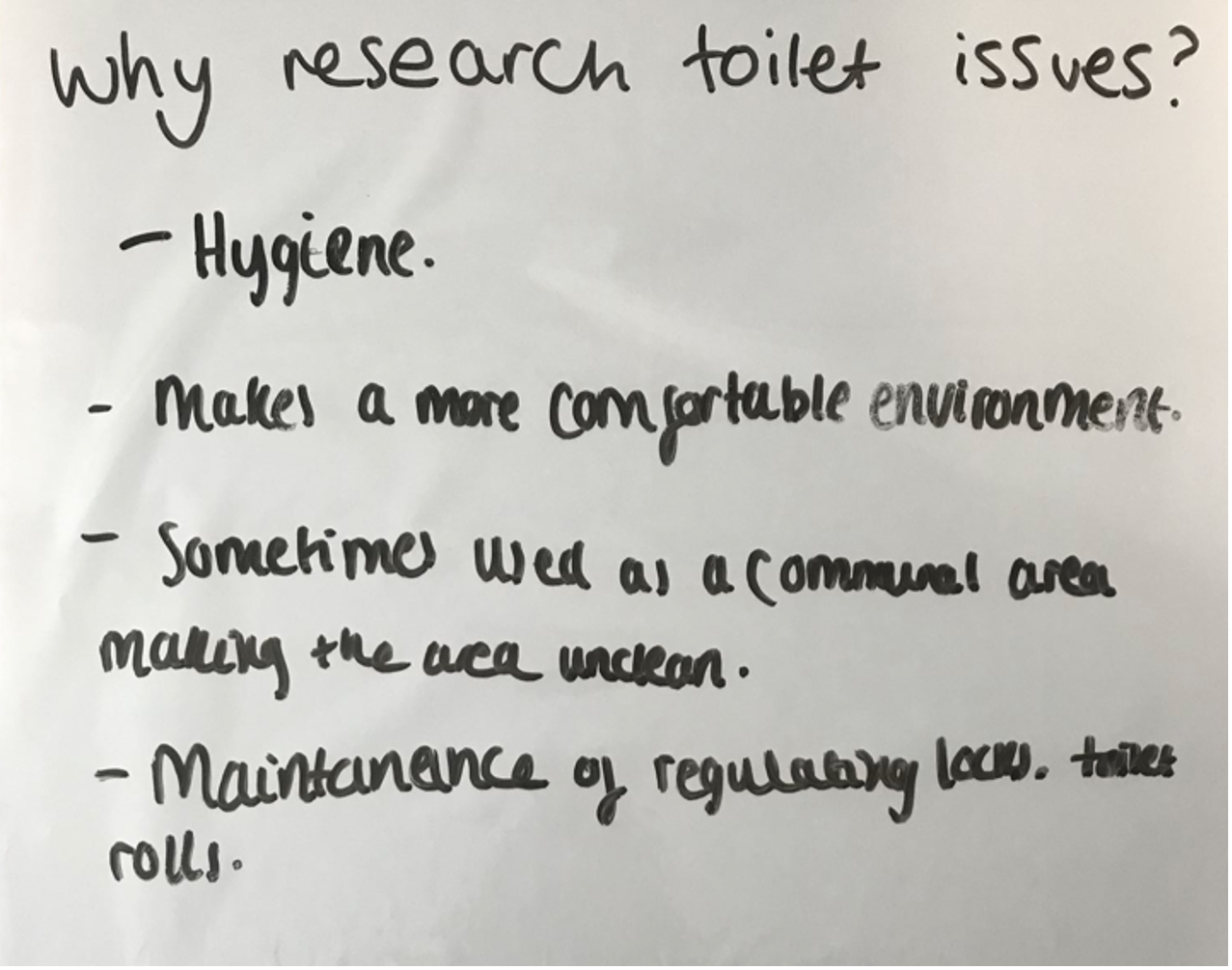
Josh – My motivations for joining Toilet Talk was to gain an insight into the processes and factors considered during a research project at University standard. I joined Toilet Talk with these intentions in mind and soon became invested into the opinions and attitudes towards toilets and their usage from the answers given by students at my school and sixth form.
Oscar – I joined Toilet Talk because I have always felt that the quality of school toilets is below adequacy – I believed that through Toilet Talk, we would be able to make meaningful change to our Sixth Form, lower school, and schools across the country. I also felt that the research aspect would be quite interesting, i.e., looking at statistics from peers etc. I was interested in seeing if my opinions on the toilets in and around Sixth Form were shared among peers.
What we have done so far
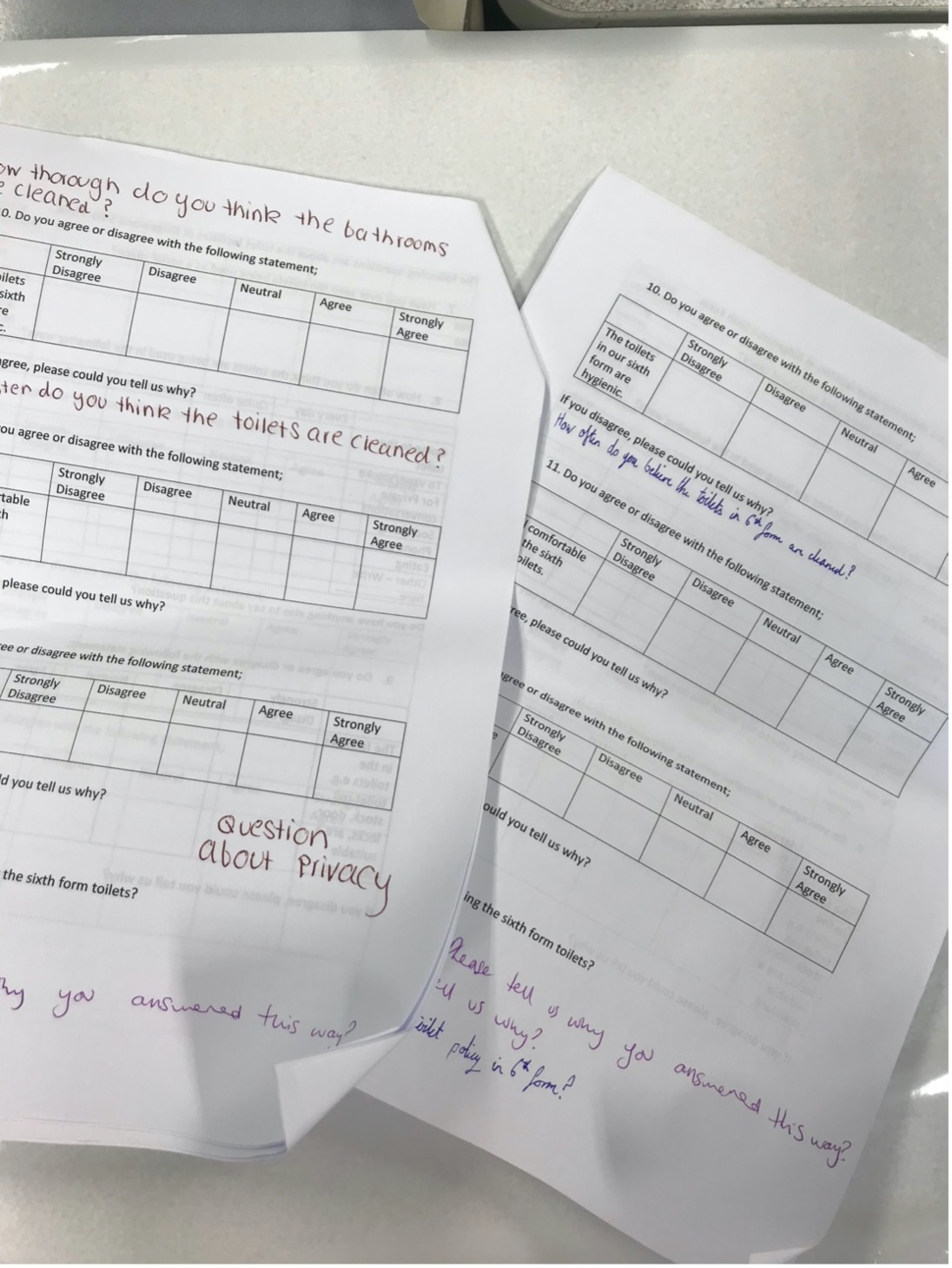
Alice, Josh & Oscar – Initially we set out to work in a participatory way where the young people could lead the direction of the project. The young researchers chose a method for collecting data about school toilets. We began collaborating on choosing questions that could be asked to other pupils within the sixth form. We discussed ethical considerations such as confidentiality and safeguarding. An aim was to provide reassurance to pupils that we would respect their anonymity when answering the questionnaire. The team of pupil researchers wanted to make sure that respondents felt comfortable and could answer truthfully without any worry of any repercussions. The sessions were held in 25-minute form time slots, which fitted into the school day and were flexible to accommodate those who wanted to take part.
Some of our findings so far
Josh & Oscar – Initially we believed that social space and toilets were connected; our finding concurred that our predictions and estimations were closely matching to the outcome of the Student Voice Survey. 62% of respondents stating that the toilets in Sixth Form were being used as a social space, with 23% specifying that the toilets do not address all needs of pupils. It would be interesting to see if these findings and statistics are generally found across the country in all genders and age brackets – it would be helpful to research further into school toilets to confirm this belief. It was insightful to discover that many of our views on the toilets were shared with our peers as well.
Why these findings are important and our next steps
Josh & Oscar – Collectively, we agreed that sharing our findings with the head of our Sixth Form would be helpful in working towards a solution with the Student Voice Surveys in mind. An intention was to specifically address the findings on social space and accessibility, as we believe these are the key elements that are contributary towards achieving a more comfortable environment for students using the toilets. We believed that through our research being conducted alongside York St John University researchers, our student voice was elevated, and responses would be better received by our Sixth Form and its management. Therefore, hopefully the findings will result in a higher chance of action being taken towards the facilities, better improving the overall conditions for ourselves and our peers. We believe a higher quality environment is deserved for pupils within our sixth form, especially with equitable toilets being a basic human right.
The young researchers facilitated a meeting with senior leadership, and it became clear that no toilet policy existed within the sixth form. An action plan was created that included the co-creation of a toilet policy, and clear expectations to be set out in whole year group assemblies. The young researchers have opened dialogue with the leadership team about expectations and conditions of the sixth form toilets and they wanted to continue this discussion moving forward.
The Toilet Talk project has highlighted the benefits of employing a participatory approach when undertaking research in schools on sensitive and challenging topics. The young researchers in this project have highlighted how important it was to feel listened to and contribute to a meaningful discussion with their school leadership on their research findings. This has led to a change in school policy and practice related to school toilets.
This research secured ethical approval from the York St John University, School of Education, Language and Linguistics, Ethics Committee in January 2022. Written consent was received from the young people to take part in the Toilet Talk project and those involved in writing the blog attended a workshop session on authorship and anonymity within academia, and verbally consented to being named co-authors.
This blog post explores the Gender and Education Association 2021 funded research project titled Toilet Talk: Empowering young people in schools to research and talk about toilet issues, led by Dr Charlotte Haines Lyon.
