by Reshmi Lahiri-Roy, Rachel Daniel & Kelly Hart
Some stories need sharing. And sometimes we must be our sisters’ keepers. As three women working in the same regional Australian university, our sisterhood and solidarity grew as we shared the vicissitudes of our lives, conversing in corridors, online, and occasionally, sharing meals. These interactions, interwoven with our passions, interests, and emotions offered an unusual academic freedom. We shared on parenting, life events, cultural responsibilities, and the emotional labour of being mothers in academia.
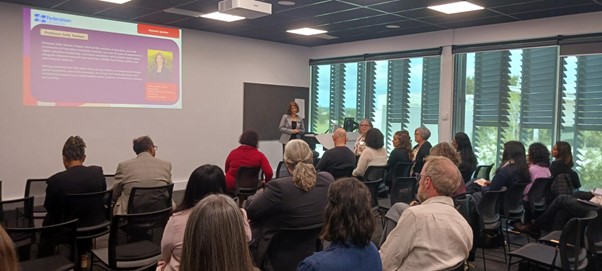
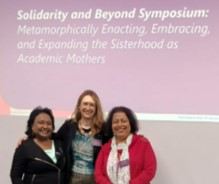
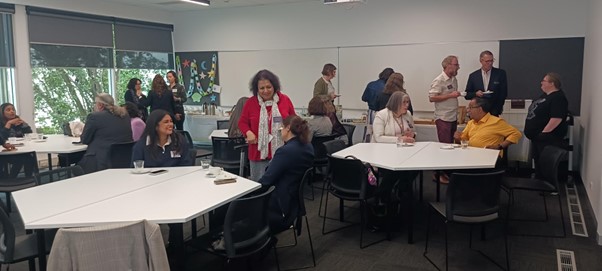
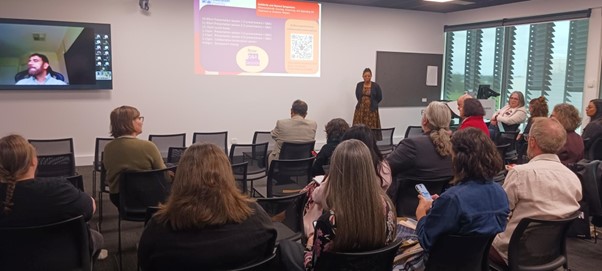
Working as collaborative autoethnographers, our conversations became a journal paper. Encouraged by reviewer responses to our now accepted paper and a faculty conference grant, we hosted a symposium based on solidarity, sisterhood, and allyship around academic motherhood. It was gratifying to be joined by enthusiastic scholars, on-campus and online, who proactively queried “what happens when we stop pretending these experiences sit outside academia and instead recognise them as central to it”? Instead of a single narrative of “academic motherhood,” all voices asserted that gender, care, and education are deeply entangled. And to be meaningful, solidarity must extend beyond tokenistic celebrations of diversity, perfunctory policy changes, or advocacy of endurance.
From the symposium’s presentations and collaborative discussions, strong themes emerged:
Stories beyond “work–life balance”
Women academics are conditioned that balancing academic work and care responsibilities is a personal responsibility. Our presenters (of all genders) resisted this idea, contending that the issue is not women, mothers, carers, or marginalised academics failing to manage competing demands. It stems from neoliberal academia’s fossilised academic stereotype of the heterosexual male, preferably single, or supported by the ubiquitous wife, ready to meet academic demands (Anderson et al., 2020). Overlooked narratives ranged from academics based in regional universities, struggling with travel, to the penalties paid by others who cannot relocate or attend conferences; illuminating that care responsibilities are not incidental. Given the institutional preference for rewarding staff visibility, research productivity, and traditionally linear careers, those encumbered with care responsibilities remain behind.
Whose motherhood counts?
Running like a silken ripple through the symposium was the refusal to treat academic motherhood as a single, universal experience. Indigenous, migrant, working class, adoptive motherhood, and first in family academics convivially intertwined different realities.
For Australian First Nations scholars, caregiving is interwoven with kinship, community, and Country (Minthorn et. al 2018). Motherhood is imbricated in their lives as a knowledge source rooted in accountability, not viewed as a distraction from intellectual life. Institutional systems mostly devalue these ways of being and knowing, designating care as an individual rather than a collective responsibility.
For migrant academics, motherhood comes layered with stresses of visa insecurity, fractured professional networks, and the task of caring across borders based on cultural expectations. Some navigate “third space” roles, straddling academic and professional spaces, as a flexible compromise, which raises questions around academic legitimacy, recognition, and authenticity. We heard from those struggling to achieve parenthood, for whom conversations centred on motherhood become exclusionary. Reflections on topics usually avoided in academia, including infertility and miscarriage were shared, highlighting the profound impact on wellbeing, identity, and participation. Solidarity based on preconceptions that everyone’s reproductive journey is similar risks silencing many.
Invisible labour and audible bias
With a smattering of international scholars, an emergent global theme was the lack of recognition and reward for that which academics deem as essential work (Reid 2021), encompassing emotional and individual labour including mentoring students, fostering collegiality, organising workloads, defusing conflicts, and professional and domestic care work, essentially ‘women’s work’, often racialised and ignored. Workplace microaggressions (Blithe & Elliott, 2020) were mentioned: being interrupted, spoken over, dubbed unproductive and excluded from decision-making spaces post motherhood.
The exhaustion from this marginalisation through motherhood was a palpable presence. The need to constantly prove credibility, mask grief, fatigue, or vulnerability to be perceived as professional, and the painful knowledge that stepping back, even briefly, has long-term consequences remains omnipresent.
We learned that:
Solidarity needs expanding beyond support in stressful times to be designated as genuine sisterhood; capturing elements of resistance, advocacy, and collective action. Several contributors argued for solidarity as a clearly developed collective practice. This includes challenging visible bias, advancing transparent workload models, planning meetings and events acknowledging care responsibilities, refuting longstanding narratives of inevitable, and recognising diverse allyship outside gender groups. A core feature of solidarity is listening, especially to those traditionally suppressed in universities, the ‘invisibles’, ranging from BIPOC scholars to those with disabilities.
Why gender and education matter right now!
We rethought Epictetus’s assertion that only the educated are truly free. Positioned as a pathway to equality, education systems can reproduce inequality if we don’t interrogate embedded intersectional inequalities and question whose knowledge counts. Universities are under pressure, leading to normalising burnout and stress. But gendered and intersecting inequalities are exacerbated by austerity. As redundancies become commonplace, losing experienced women, carers, and marginalised scholars narrows knowledge production, students support, and ultimately, creative futures.
Progressing Together
While no perfect solutions crystallised at the symposium, hope emerged that naming these realities together is a form of change (Sum et al. 2025). Connecting across institutions, disciplines, and borders transforms isolation into collective understanding. The presenters asserted that gender equity is intertwined with access, participation, knowledge, and care. These conversations reiterated that academia needs more institutional responsibility not individual resilience. We recognised that solidarity is not about struggling alone but about imagining, insisting upon, and progressing to something better, together.
References
Anderson, L., Gatwiri, K., & Townsend-Cross, M. (2020). Battling the “headwinds”: the experiences of minoritised academics in the neoliberal Australian university. International Journal of Qualitative Studies in Education, 33(9), 939–953. https://doi.org/10.1080/09518398.2019.1693068
Blithe, S. J., & Elliott, M. (2020). Gender inequality in the academy: microaggressions, work-life conflict, and academic rank. Journal of Gender Studies, 29(7), 751–764. https://doi.org/10.1080/09589236.2019.1657004
Minthorn, R. Z., Nelson, C. A., Shotton, H. J., Lee, T. S., Tsinnajinnie-Paquin, L., Faircloth, S., Reyes, N., Chow-Garcia, N., Johnson-Jennings, M., & Johnson-Jennings, A. (2022). Indigenous Motherhood in the Academy. Rutgers University Press. https://books.google.com.au/books?id=fLx9EQAAQBAJ
Reid, R. A. (2021). Retaining Women Faculty: The Problem of Invisible Labor. PS: Political Science & Politics, 54(3), 504–506. doi:10.1017/S1049096521000056
Lahiri-Roy, R., Daniel, R., & Hart, K. (2026, accepted, in press). Arduously reconciling the ‘good mother’ with the ‘academic worker’: A collaborative autoethnography on academic motherhood and sisterhood in Australian higher education. Journal of Women and Gender in Higher Education.
Sum, N., Lahiri-Roy, R., & Belford, N. (2025). Hope theory as resistance: narratives of South Asian scholars in Australian academia. Equality, Diversity and Inclusion: An International Journal, 44(1), 26–40. https://doi.org/10.1108/EDI-03-2023-0085
All images are author’s own