Save the Cheerleader, Save the World: Girls, media and leadership in the 21st century

Fellow sci-fi fans may remember the TV series Heroes, in which ordinary people develop superpowers. Their mission centres on one character, Claire Bennet, a high-school cheerleader with the power to regenerate herself. The superheroes’ mantra is, ‘Save the cheerleader, save the world’.

Claire’s precise role in world-saving I can’t explain, because I stopped watching (along with most of the rest of the audience) before the seasons played out, but the mantra stayed with me. Claire Bennet came to mind as I began to think about my latest research exploring girls and leadership, because she embodies so many of the qualities of the successful girl discourse – a discourse that, like her, is proving remarkably resilient.

Saving the world (market)

In similar fashion to the ways girls are seen as the key to advancing progress in developing countries, girls in the global North are an increasing focus of attention as the solution to gendered inequalities in decision-making roles. Pre-loaded with girl-power and post-feminist narratives of women’s success in making change, the ‘can-do’ girl of the affluent West is tasked with the mission of saving the world through taking charge of it.  At the same time as The European Commission and The World Economic Forum are raising concerns about the slow progress toward gender equity in power, calls are being made, post global economic crash, for more ethical, careful and connected forms of leadership to avert future disasters of a similar nature. These forms of leadership are popularly gendered as female, as for example in the Lehman Sisters hypothesis. Both political and corporate discourses are thus coalescing around girls as the potential leaders who can deliver a more equal and therefore more secure future. In short, to avert disaster the free market looks to the fearless girl rather than to regulation.

Saving the cheerleader

A quick search of Twitter throws up programmes, websites, and motivational speakers galore all promising to empower girls and develop their capacity for leadership. Among the most prominent is Ban Bossy, which extends Sheryl Sandberg’s Lean In corporate feminism to address girls through mobilising celebrities and providing advice and resources to encourage leadership aspirations. The model of leadership it offers reproduces and revivifies some of the central tenets of neoliberal postfeminisms with its emphasis on self-regulation, its focus on individual and capitalist solutions to gender inequalities, and its privileging of entrepreneurship. ‘Change the world!’ the Ban Bossy Leadership Tips for Girls brochure advises, because ‘running a campaign gives you amazing practice for speaking and marketing yourself as a leader’.

While under neoliberal governmentality female citizenship is redefined and redirected away from political participation and towards self-actualisation through consumer citizenship, girls’ leadership campaigns do focus on addressing gendered inequalities through developing a public role; however, the inequalities are represented as barriers to personal ambition rather than as social ills in themselves. As such they are surmountable through the development of skills in self-sufficiency, networking and public speaking. The kind of agency girls’ leadership campaigns promise is not equally accessible to all; like many aspirational discourses aimed at young women, it exhorts girls to believe in themselves and to work hard, offering the promise that they can achieve their goals with sufficient commitment and by creating an attractively branded self. As well as a glossing over of structural barriers, there is a lacuna in popular girls’ leadership promotions where strategies for fostering solidarity, collectivism and activism should appear in order to address them. The girl leader fit for salvation here is Grainne McMahon’s good ambassador, not her shadow twin, the angry activist.

I’m with her

Power, as Mary Beard has noted, is “an elite thing, coupled to public prestige, to the individual charisma of so-called ‘leadership’, and often, though not always, to a degree of celebrity”. It is this relationship with visibility and celebrity that is foregrounded in interventions around girls and leadership. Hillary Clinton framed her 2016 presidential campaign as an exercise in girl-empowerment; Beyoncé, Alicia Keys and Michelle Obama are pledging to Ban Bossy, while here in the UK, Edwina Dunn’s The Female Lead project has produced a glossy book of 60 ‘amazing women from around the world’ pitched at schools. It could be argued that projects like Dunn’s and Sandberg’s are long overdue – a recent study for the World Association of Girls Guides and Girl Scouts (WAGGGS) suggests that girls struggle to name female leaders they admire, and that they are far more likely to identify men as successful leaders.  Access to role models is popularly held to be the key to the development of girls’ leadership aspirations. However, the holding up of celebrities and highly visible role models as the answer to overcoming barriers to leadership for girls is problematic. Young people are consistently instructed that they should not base their aspirations around celebrities. Even when celebrity role models are offered to them, the ways in which girls are expected to admire such models is heavily policed within celebrity discourse itself.

Celebrity aside, the incentives to developing a visible role/public voice in terms of leadership for girls are scant – we are witnessing a rise in public misogyny particularly directed at women politicians and campaigners, especially BME women, on social media.

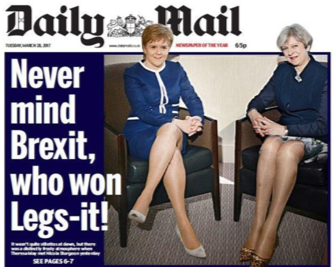
At the same time, traditional media sources continue represent women leaders in demeaning, diminishing and stereotyped ways – by coincidence, as I start to write this blog with BBC Radio 4’s flagship Today news programme on in the background, the (male) presenter describes the (female) prime minister’s Brexit negotiating tactics as ‘showing a bit of leg’. The (male) politician being interviewed responds without raising objection.
The research

In this project, together with my colleague Hannah Yelin, I seek to gain understanding of l the gendered nature of popular discourses of leadership, to explore girls’ engagements with highly visible women leaders in global media texts, and to gain insight into how these relate to their own ideas, identities, experiences, and imagined futures.  I am undertaking the first phase this autumn, with the support of the GEA. This involves conducting a series of group interview/workshops in schools across England with girls aged 14-15. Participants will discuss ideas about leadership, and then go on to create digital social media collages in dedicated closed groups. These collages will form a visual archive for later comparison in wider European settings.
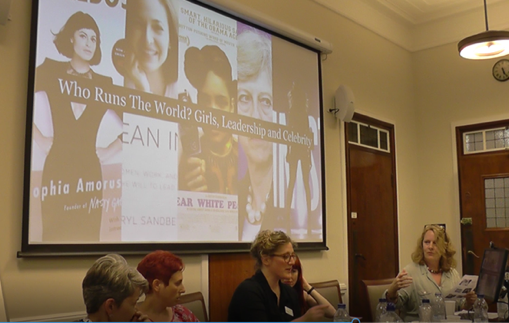
We launched the project with an event this summer: Who Runs the World? Girls, Celebrity and Leadership, where we had brilliant papers from Heather Mendick,  Janet Batsleer & Grainne McMahon, and Anita Biressi followed by a lively roundtable. As well as sharing some initial findings on the GEA site, we will be holding a public engagement event in 2018 exploring some of the implications. To find out more about the project contact Michele Paule.
#MeToo

When I was 13, I took a train to Birmingham with a friend. The train conductor came to inspect our tickets, before handing them back he lifted up our t-shirts and stamped our belly buttons. He returned to the driver’s cabin, laughing.

This and many other memories of bodily intrusions have been on my mind this week as the words ‘me too’ reverberated across social media.

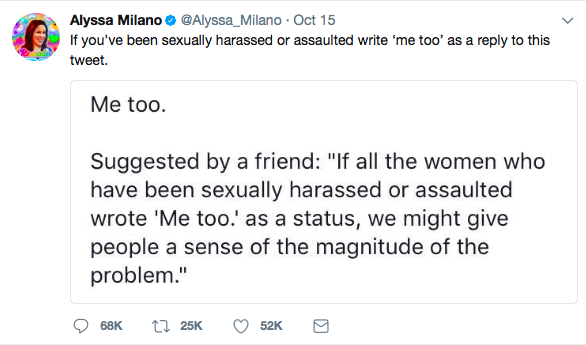
In response to growing reports of Harvey Weinstein’s sexual predation, actress Alyssa Milano tweeted, “Suggested by a friend: If all the women who have been sexually harassed or assaulted wrote ‘Me too’ as a status, we might give people a sense of the magnitude of the problem.” Since Sunday friends, family, colleagues and acquaintances (mostly women and non-binary people) have been sharing their stories of being groped, grabbed, leered at, cornered, flashed, stalked, violated, raped.

Me too. These words have a history.

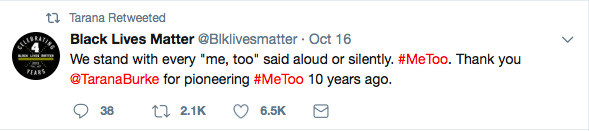
In 2006 Tarana Burke founded the ‘me too’ movement to aid survivors, particularly young women of colour, in communities where sexual assault services were under-resourced or non-existent. In a statement about ‘me too’ Burke told Ebony Magazine, “it was a catchphrase to be used from survivor to survivor to let folks know that they were not alone and that a movement for radical healing was happening and possible.”

In the aftermath of renewed discussions about sexual assault in Hollywood, the words have picked up pace as a feminist hashtag. #MeToo has sparked conversations and connections, opened up wounds, been left unspoken but nevertheless felt and incited anger and frustration.

A growing body of literature documents how feminist hashtags can provide ‘comforting solidarities and connections between strangers’, as well as entry points to wider feminist communities (Keller, Mendes and Ringrose 2016, p. 12; Williams 2015). However, they can also draw upon, and rearticulate, long-standing inequalities within feminist activism (Khoja-Moolji 2015). For example, the initial credit given to Milano rather than Burke for #MeToo perpetuated the diminishment of black women’s experiences and work within feminism (Hill 2017).

Like others (see here, here, here), I questioned what the hashtag was doing and who it was for. I wondered why the onus was on women to reveal their pain and worried about friends who had shared raw experiences. At times it felt blasé to me – ‘of course we’ve all been sexually harassed and/or assaulted, who is this news to?!’ At others I felt angry as close male friends fumbled their attempts to acknowledge the problem – ‘How do you still not get it?!’

Before I had the words to describe how sexism shaped my world, I had many ‘me too’ moments with girl friends. Conversations that, as Sara Ahmed notes, can act as a ‘drip, drip’ and eventually a flood as you connect your experience with the experience of others (Ahmed 2017, p. 30). I have epic friendships built on this ‘releasing of the pressure valve’ (Ahmed 2017, p. 30). Most notably my best friend Tari with whom a friendship began 13 years ago over shared experiences of ‘coming out’: for her as a mixed race woman, for me as a lesbian.

Of course, ‘women may have common situations and experiences, but they are not, in anyway way, the same’ (Braidotti 2011, p. 156).

This week Tari’s #MeToo post drew attention to the fact that the world has never really respected and understood her body as her own. Her rights to bodily autonomy have been impeded not only by the men who’ve assaulted her, but the women and men who have touched her hair without permission or shouted ‘afro!’ at her in the street.

In my #MeToo post I nodded to the fact that my most recent experiences of sexual harassment have been from men on the gay scene (Tari has also experienced this). Men who tickled my crotch as they walked past me or squeezed my boob, acts that both intimidated and made me feel unwelcome in a space that was supposed to be safe.

The phrase ‘Me Too’ works as a refrain, to draw on Deleuze and Guattari’s (1987) concept, a scoring over of the world’s repetitions, that marks and expresses territories (Youngblood Jackson 2016). Its recurrence weaves together communities of solidarity and simultaneously maps the persistence over time of the sexual violence that elicits it. Each utterance is different from the other, branching off and connecting territories; what we call ‘patriarchy’, ‘misogyny’, ‘heteronormativity’, ‘racism’ or ‘white privilege’. These deeply entrenched territories are marked out by repeating forces of domination and control.

Me Too. These two little words channel the enduring felt force of subjugating systems, the ways they minimize and diminish us. Yet, they also exceed these systems. Me Too.

With each repetition, the ‘refrain becomes more and more mobile, going somewhere – destination unknown’ (Youngblood Jackson 2016, p. 20). Bertelson and Murphie (2010, p.145) remind us that refrains are ‘not just closures but openings to possible change’. With this in mind, I want to end by considering how the intensified situation of a feminist hashtag might be put to work in schools. How might we harness the energy of #MeToo in a way that enables young people to safely and creatively challenge gender inequalities and oppressive gender norms?

——————–

Gender Equality Leadership in Schools (GELS)

Hosted by the Gender and Education Association, GELS helps educators and young people raise awareness of and address gender inequalities. One way in which this work is being taken up in schools is through student-led feminist clubs. Hanna Retallack, an intersectional feminist teacher and researcher, notes that these collectives provide vital space for young people to ‘discuss the issues denied to them by the curriculum’, including the ‘intersectional inequalities that lie at the root of sexual violence and harassment, as well as the structural injustices affecting them both personally and politically’ (Retallack 2016, para 7).

AGENDA: A Young People’s Guide to Making Positive Relationships Matter

Calling out sexual and gender inequalities is not without risk. Utilising the powerful potential of creative methods, such as the visual arts, poetry & theatre, can enable young people to make the personal political without revealing too much of themselves. The interactive Welsh tool-kit AGENDA is packed full of inspiring art-activisms that can help young people engage with all too frequently silenced issues. Developed by Professor Emma Renold and young people in Wales, the toolkit has equality, diversity, children’s rights and social justice at its heart.

Do you have thoughts about the pedagogical potential of hashtag feminism in educational institutions? Consider writing us a blog, we’d love to keep this discussion going.

References

Ahmed, S. 2017. Living a Feminist Life. Durham: Duke University Press.

Bertelson, L. and Murphie, A. 2010. An ethics of everyday infinities and powers: Felix Guattari on Affect and the Refrain. In: Gregg, M. and Seigworth, G. (eds). 2010. The Affect Theory Reader. Durham: Duke University Press.

Braidotti, R. 2011. Nomadic Subjects: Embodiment and Sexual Difference in Contemporary Feminist Theory. New Yor: Columbia University Press.

Deleuze, G. and Guattari, F. 1987. A Thousand Plateaus: Capitalism and Schizophrenia. London: Bloomsbury Academic.

Keller, J., Mendes, K., and Ringrose, J. 2016. Speaking ‘unspeakable things’: documenting digital feminist responses to rape culture. Journal of Gender Studies [Online]. Available at: http://dx.doi.org/10.1080/09589236.2016.1211511 [Accessed 20 August 2016].

Khoja-Moolji, S. 2015. Becoming an “Intimate Publics”: Exploring the Affective Intensities of Hashtag Feminism. Feminist Media Studies 15(2), pp. 347 – 350.

Williams, S. 2015. Digital Defense: Black feminists resist violence with hashtag activism. Feminist Media Studies 15(2), pp. 341 – 344.

Youngblood Jackson, A. 2016. Potentializing a Deleuzian Refrain. Departures in Critical Qualitative Research 5(4), pp. 20 – 23.

The GEA Fund 2017/18: APPLICATIONS OPEN

We are excited to announce that the GEA Fund is entering its second year in 2017/18.  The Fund aims to support our membership to develop networks and undertake small research projects.

The focus of the 2017/18 Fund is to support pilot work (transcription, travel costs, workshops to bring potential collaborators together) that can feed into the development of a larger research bid.

To find out more and apply please visit our funding page


C2C: Creating Peaceful Dialogue Through GEA 2016 & 17

This post is part of our new Countdown to Conference (C2C) series. We would love to feature a brief blog post from you too! Visit our main Countdown to Conference page for details!

C2C: Creating Peaceful Dialogue Through GEA 2016 & 17
by Yaron Schwartz

Although I just got my degree a year and a half ago, I’ve been involved in teaching gender classes for boys for 14 years. In the last 4 years I have written and coordinated gender programs for both religious and secular primary, middle, and high schools in Israel. This also includes social programs which work on elements like healthy sexuality as well as self defense. I will be speaking about one of these special programs at the 2017 conference.

For me, GEA 2017 is an opportunity to share how a dream can become a reality. In this sense, this conference is a direct continuation of GEA 2016. Back then, I came to the conference with a friend of mine. We both live in Jerusalem, we both just got our Ph.D’s, we both have an interest in gender and education and we share many other similarities.

But, we are different our genders. She is a woman and I’m a man. And there is another important difference between us. I am Israeli, representing the Jewish community, and she is an Arab. Her name is Dr. Dianna Da’abul and she represents the Palestinian community.

Yet another thing we shared is a common dream, to try and use our skills and deep belief in gender and education to generate a dialogue between our communities, the Jewish one and the Palestinian one. Every person who reads the daily newspapers knows that today there is almost no dialogue between Israeli and Palestinians citizens, especially not between Israeli and Palestinian educators, and especially not in Jerusalem, which is the heart of the misunderstanding between the two sides.

We started sharing this dream two years ago, and when we heard about the GEA 2016 interim conference, which took place in Sweden, we decided to come, listen and learn about what exists outside of our own area of conflict.
We wrote a brochure in which we explained our plan for peace through gender and education dialogue, and we invited researchers to participate in any way they would like in our program. We gave the brochure to many wonderful researchers we met at GEA 2016, but we didn’t get the feeling that people were too impressed by our ideas. Still, it was a good opportunity for us to declare out loud that we believe in peace, and that it can achieved.

Later, as we sat in on all of the conference lectures and listened to many interesting stories about including minorities in the processes of educating to gender equality, we were very surprised by what we learned. It was a “bad” surprise, but it gave us a fulcrum for our own work. We discovered that many European countries find it very hard to navigate the tension between gender equality and religious traditions. One central story mentioned was about Yasri Khan, the Swedish member of parliament who had to leave the parliament after refusing, based on his religious convictions, to shake hands with a woman reporter who interviewed him. The decision whether this is “good” or “bad” differs between countries and societies, but in our area of the Middle East, you can’t even dream or say something critical about religious tradition. One needs to do everything that he does with the understanding that the people with whom you work will always have some kind of religious path which must be taken into account. And if you are working with school students, as a teacher – you can’t ignore it, or deny it, nor can you say that gender equality cannot coexist alongside religious tradition (In fact, I am writing this paper while sitting in a conference in Israel listening to an ultra-Orthodox woman explaining what it mean to be an ultra-Orthodox feminist …)

So, for me, the GEA 2016 conference gave us the energy, the information and the basic understanding that if we want to create a dialogue between Israeli and Palestinian educators and students we need to base its fundamentals on coexistence between “gender equality” and “religious tradition”. We don’t have the luxury of separating them, and in fact, we have a tool that we can use to begin speaking with one another. This year, I return to GEA 2017, without my friend, Dr Diana Da’aboul, but with the full story of our J-A-G-E-C Project (Jewish Arab gender and education collaboration project), in which we eventually created an opportunity for Jewish educators to work together with 70 male and female Palestinian educators,  in which the basic shared assumption was the need to consider the importance of religious tradition in the context of gender education.

Anyone who is interested in knowing more about our peace program is very welcome to hear my lecture, which will be the last one of this conference ?.


C2C: Raising a Generation of Hope

This post is part of our new Countdown to Conference (C2C) series. We would love to feature a brief blog post from you too! Visit our main Countdown to Conference page for details!

C2C: Raising a Generation of Hope:
Showcasing sisterhood among adolescent girls of color that transcends borders
by Nina Nagib

I am excited to join the GEA community and honored that I get to attend conference during my first year as a Ph.D. student! As a former school counselor, I have always been passionate about working with girls, especially adolescent girls of color regarding worth and identity, including all the internal factors that affect them, both in the US and in the Global South. A few years ago, I watched a documentary that changed my life. Girl Rising chronicles the lives of nine girls from nine different countries and their respective barriers to global education. Watching reporters and activists interviewing the girls in their villages made me think, “I want to be her.” So, I planned to visit Malawi that summer, through a connection at my church, and run a girls’ empowerment program (co-facilitated with their leaders), Rise Malawi: Raising a Generation of Hope (RAGOH), a nonprofit initiative in the rural village of Madisi. While planning for the trip, I took my middle school students to Philadelphia to see Girl Rising. As I was educating them about the human rights issues that many of their global peers face, I saw something click within each of them. I witnessed girls known for getting into fights or skipping class, begin to take ownership of their education and choices. Not only did they begin to see how much they were taking for granted in their lives, but they also became aware of how much their actions, or lack thereof, impacted others. The girls attending the anger management groups at the beginning of the school year were now initiating fundraising projects for their disadvantaged peers! My experience in Malawi was life-changing. Hearing firsthand how child marriage, HIV, poverty, and cultural norms directly impact lives, I knew I would not return the same. I wanted to devote my life to fostering education and raising hope for girls everywhere, from urban communities in the U.S. to the most remote villages across the world. Hence, RAGOH was born. On May 31, 2014, RAGOH became a fiscal sponsorship project of Germantown Life Enrichment Center (GLEC), a 501(c)(3) public charity, which led me to my current situation.

I wanted to devote my life to fostering education and raising hope for girls everywhere, from urban communities in the U.S. to the most remote villages across the world.

The more I learned about girls’ barriers to education in the Global South, the more I began to speculate how centering the experiences and voices of our girls could transform them and their environments. For instance, creating partnerships between my girls in Philly and Malawi could be transformative for both of them. How do we develop a sense of protection in our girls that can act as preventative measures? How do we center the voices of girls of color into our work with them? How do we develop a critical consciousness within them, through which they and the society would see them as the solution, rather than either the recipients of programs or delinquents (both of which are equally dehumanizing, in my opinion)? How do we equip and train educators and schools to develop these factors in our girls? How do we empower and equip them to see the power in their own voices? Pursuing my PhD in Education with a concentration in Counselor Education, my research focuses on restructuring RAGOH as a school-based sex trafficking prevention program for girls of color, grounded in Critical Race Feminism with the development of critical consciousness in our girls.

Adolescent girls of color who have experienced trauma face unique challenges globally in their pursuit of education. As minimal attention is paid to the modern-day slavery crisis of human trafficking and a host of other injustices that girls face globally, I am honored to join GEA in my first year as a Doctoral student. I decided to come from Philadelphia because I knew I wanted to be a part of the global community of scholars committed to fighting these injustices in different ways. I am most excited about learning from every scholar there and building connections, which, undoubtedly, will transform my future research.

I want to focus my career and center my research on answering the questions I have listed above! My poster at the conference will display RAGOH’s core of centering everything we do regarding creating spaces for the existence of the voices of this marginalized group. RAGOH equips teen girls to raise their voices as leaders, advocates girls’ access to education in the Global South, and develops a critical consciousness to view and impact their community and the world. I hope you’ll take the opportunity to stop by my poster, “Raising a Generation of Hope: Showcasing a sisterhood among adolescent girls of color that transcends borders” to see and hear their words for yourself!

In closing, I have never been to London before and plan to stay through June 28th. Any tips or advice on places to stay, visit, or experience would be greatly appreciated!

Looking forward to meeting you all and joining this community of scholarly activities soon!

If you are attending conference, let us know on Twitter using the hashtag: #GEAconf2017

Introducing the new GEA Social Media Intern: Kate Marston

Hello! I’m Kate, the new Social Media Intern for the Gender and Education Association (GEA). As a Cardiff University PhD student concerned with the intersection of young people’s digital practices and relationship cultures, I am delighted to be contributing to GEA’s work eradicating sexism and gender inequality in and through education. Over the next few months I will be tweeting, posting, blogging and sharing content that affirms GEA’s key aims of promoting feminist scholarship and informing policy and practice relating to gender and education.

Prior to commencing my PhD, I worked in the voluntary sector on a range of projects that challenged homophobia and transphobia in schools. The organisations I worked for relied on a strategic web and social media presence to reach educators, policy makers and young people in order to enhance the visibility of their work. Here I learnt the discipline of maintaining an up-to-date social media presence along with creative strategies for engaging people, but as a PhD student I have enjoyed the freedom my PhD twitter account affords me to engage with feminist, anti-racist and trans activism online. I have valued GEA’s commitment to spotlighting intersectional feminist perspectives on gender and education from academics, activists and practitioners alike and I am eager to continue this work.

As a PhD student, twitter has also been invaluable for building academic networks, tracking Calls for Papers, keeping abreast of relevant literature and supporting academic events and conferences. Having attended a variety of GEA coordinated conferences and seminars I am familiar with the dynamism of these events and the value of actively engaging with conference hashtags and handles. Social media has enhanced my experience as a conference attendee through enabling me to connect with speakers, follow the development of research projects and continue discussions online. As GEA Social Media Intern I hope to facilitate similar connections in the build up to, during and beyond events and conferences. So if you’re attending our upcoming Gender and Education Conference 2017 let us know by tweeting #GEAconf2017!

A key aim over the next few months is ensuring we signal boost the work of PhD students and early career researchers. We are hosting a dedicated free day of workshops for Early Career Researchers ahead of #GEAconf2017, as well as inviting blog contributions for our website. You can write about a publication you’ve read or one you’ve written, a film you’ve seen or one you’ve made, an event you’ve been to or one you’re hosting. Whatever it is you are working on at the moment, if it is related to gender, education and feminism we’d love to hear from you.

Overall, I am excited to learn more about the amazing work of GEA members and look forward to meeting some of you at #GEAconf2017!


Imagining the Body in France & the Francophone World – CfP

We are delighted to support our members and events they host that may be of relevance to our readers; today we bring you details of a fantastic conference to be held at The University of Birmingham.
We are delighted to announce the release of a call for papers for ‘Imagining the Body in France & the Francophone World’, a bilingual conference to be held at the University of Birmingham, 19-20th January 2018, with the generous support of the IMLR and SFS.  Through this cross-cultural and interdisciplinary conference, we hope to facilitate dialogue and debate about the body and its representation in French and Francophone culture and society.
 If you are interested in submitting a proposal, abstracts of 300 words in either French or English should be sent to us at imaginingthebody@gmail.com.
Please do visit our twitter page, facebook event and/or blog for full details and a call for papers, and if you know of any PG(R)s or academics interested in representations of the body in French and Francophone culture and society, please do pass this information on! We hope to hear from you very soon,
with warm wishes from the organisational team (Antonia Wimbush, Maria Tomlinson, Polly Galis).
@imaginingbody
imaginingthebody.wordpress.com

Healthy Sexual Development Symposium

GEA recently contributed to funding a vital sex and relationships education symposium in Bristol – we are delighted to announce that The University of Westminster is hosting a further event on the 30th June.

Using the framework of the Fifteen Domains of Healthy Sexual Development* , this event aims to support practitioners and teachers involved in SRE and young people’s sexual health at all key stages, as well as to enable dialogue and collaboration between academics and practitioners. The event is suitable for any practitioner, teacher or academic with an interest in this area.

* Developed by Professor Alan McKee and colleagues at Queensland University of Technology, and adapted by the RSE Hub*

Guest speakers include Dr Ester McGeeney, a Youth Researcher and Practitioner who will be exploring pleasure in sex education and ensuring young people’s healthy sexual development and Jo Taylor, Associate Head at Chestnut Grove Academy, London – winner of Accord Inclusivity Award 2016 who be discussing how to tackle pornography and sexualisation in schools

The event looks set to be a fantastic and informative space.

For more details, download the flyer here;

Healthy Sexual Development Symposium flyer


Science and Gender Policy Reproduces Privilege

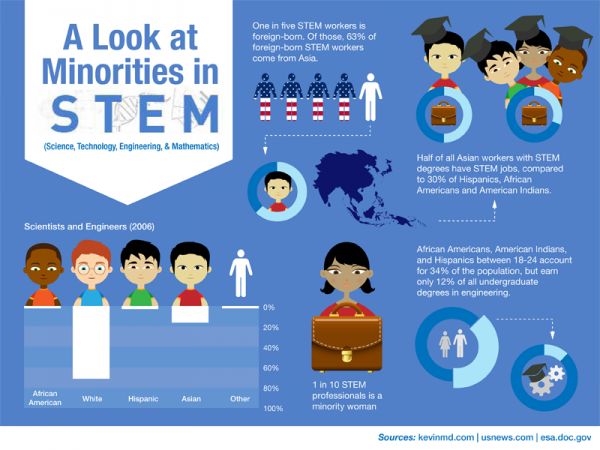
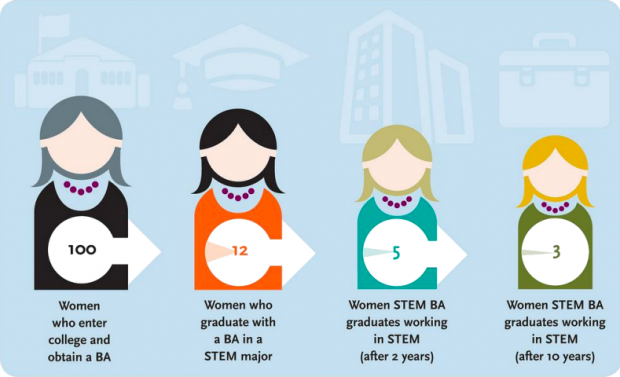
It has become global-policy commonsense that we need more people working in Science, Technology, Engineering and Mathematics (STEM) and that we must increase the proportion who are female, and that these goals are linked. As a 2014 UK policy report on Women in Scientific Careers stated, a ‘compelling reason to tackle’ the gender gap ‘is that the UK economy needs more STEM workers and we cannot meet the demand without increasing the numbers of women in STEM’. The report does not ask which women are able to progress along ‘the pipeline’ from school science to post-16 STEM qualifications and careers. Typically, it makes only passing reference to ‘moral arguments’ for equality, focusing on the business case that increasing women’s STEM participation will boost the economy and create better working environments. In this blog we argue that pursuing economically-driven policies to increase the number of women in STEM without considering gender in intersection with race and class risks reproducing privilege.


An intersectional approach to gender and STEM

Kimberlé Crenshaw coined the term intersectionality in the 1980s to capture ‘the need to think and talk about race through a lens that looks at gender, or think and talk about feminism through a lens that looks at race’. It’s since been developed to incorporate relationships between disability,  gender, race, sexuality and social class. There is evidence of intersectionality’s importance for STEM recruitment, as statistical research shows that race, class and nation impact women’s relationships with STEM. For example, studies show that US-born women studying science and engineering see STEM careers as less compatible with their values than international-born women on these courses and STEM stereotypes impact more on European-American than on African-American women. Indeed, minority ethnic and working-class women are more likely to drop out of computing courses for economic reasons than because of stereotypes of technology as masculine.

This suggests that gender and STEM policies reflect the experiences of white middle-class women. Speaking on the ‘urgency of intersectionality’, Crenshaw argues that overall improvements for women do not ‘trickle down’ to marginalised women: ‘Without frames that allow us to see how social problems impact all the members of a targeted group, many will fall through the cracks of our movements’. It is difficult to change how we see the world, which experiences we notice and which are ignored. Doing so takes more than statistical data. It takes powerful stories. We offer one below to show intersectionality in action and that gender inequality does not trickle down.

Gabriella’s choice at a crossroads of gender, race, nation and class

Gabriella is studying the high-status Natural Science Programme in upper-secondary school in Sweden, a country with an international reputation for gender equality but persistent gender gaps in STEM participation. Although academically unsuccessful, getting a mix of Cs, Ds and Es, she is planning to become a forester which includes taking a Masters in Biology. Given her lack of conventional success, how does Gabriella maintain an identification with science?

Gabriella has unstyled short hair, wears tracksuit bottoms and sweaters, sometimes the same ones for a week, and uses no make-up. In refusing the demand that young women pay careful attention to their appearance, Gabriella strongly rejects femininity and so aligns with masculinity. We also see this alignment in her interests. She gives her hobbies as reading ‘fantasy mainly’ and playing computer games. Gabriella displays a knowledge of specialist genres of games (including retro and ‘indy games’) which marks her out as geeky. Although women are increasingly identifying as geeks, this identity remain associated with masculinity.  Gabriella also breaks with dominant gender norms by distancing herself from from feminine-coded science professions. She favours forestry as it makes it less ‘likely that I’ll be stuck in a lab somewhere, as that’s what biologists usually end up doing’. She rejects the diligence and attention to detail that are typically attributed to women in science, dismissing STEM areas that are ‘so finicky and lots of sitting still’.

Gabriella’s career choice is a way of realising her passion for the outdoors. As she explains: ‘in a lab, I would be far too bored and feel boxed in’. We can see this as another way of Gabriella aligning with masculinity since work indoors is socially coded as for women and work outdoors for men. However, it is also part of her Swedish identity. Exercising one’s rights to experience and appreciate nature is key to Swedish national identity. This is enunciated in ‘friluftsliv’, the Scandinavian back-to-nature movement with its roots in the eighteenth century. This identity is attached to whiteness. As Tobias Hübinette and Catrin Lundström argue, ‘being white constitutes the central core and the master signifier of Swedishness, and thus of being Swedish’.  White men are shown more positively in relation to nature than women and immigrants with the latter portrayed as in need of training to relate appropriately to the natural world.

Gabriella’s middle-class position also plays a role in her science aspirations. Research connects science choices to ‘science capital’, that is ‘scientific forms of cultural capital (scientific literacy; science dispositions, symbolic forms of knowledge about the transferability of science qualifications), …  [and] of social capital (e.g., parental scientific knowledge; talking to others about science)’. Gabriella has strong science capital within her immediate and her extended family. Her sister and father work with technology, her cousin recently graduated from forestry and two family friends are foresters. Despite this, Gabriella presents forestry as an individual choice. To develop science policy that can support women in less privileged positions than Gabriella, we need to see her choice as social.

Final thoughts

Dominant policy frames stop at the fact of Gabriella’s gender, seeing her progression to a science university course as an economic (and moral) success. The deeper analysis of her identity above points to the significance of her non-normative gender performance and of social class, race and nation in her choice to pursue science. This suggests we need to ask which women can aspire to science careers and how other women (and men) are positioned in relation to science through their success. Gabriella’s rejection of conventional femininity supports her science identification and vice versa, but it reaffirms rather than challenges the dominant gendering of science as masculine. In forestry, Gabriella has found a STEM field where her participation is enabled by her intersecting gender expression, Swedishness, whiteness and middle-classness. But, where does that leave less-privileged women? And, how can we make gender and STEM policies that work with the messiness of intersectionality? As Crenshaw says, these are urgent questions.


This article is written by Heather Mendick, Maria Berge and Anna Danielsson. It is based on their article ‘A critique of the STEM Pipeline: young people’s identities in Sweden and science education policy’, published in the British Journal of Educational Studies. It draws on the project ‘Power, Knowledge and Identity in Science and Technology Classrooms’ funded by the Swedish Research Council.