Critically Exploring Co-production : A special issue of Qualitative Research Journal
The Gender and Education Association have been asked to share this call for papers for an exciting special issue of Qualitative Research Journal on co-production. Guest edited by Harriet Rowley, Kate Pahl, Gabrielle Ivinson and James Duggan, this special issue invites contributions that question whether university structures can accommodate research that is genuinely co-produced, highlight tensions in on-the ground co-productive practices, describe the often circuitous ways alliances emerge, and speculate about the limits and possibilities of co-production.
This special issue invites people who are involved in co-production as practitioners as well as more academic pieces to contribute ideas. The editors envisage shorter pieces together with dialogues as well as asking discussants to reflect on some of the pieces. Experimentation with form is welcome. Initial abstracts are invited as part of this process.
Contributions may cover the following areas:
· Critical enquires into the role of the university in co-produced research projects
· Co-production; research method or socio-political practice
· Ethnography and co-production
· Critical pedagogy and co-production
· Arts practice and co-production
· Creativity and co-productive practice.
· Failure and co-production
· Ethical dilemmas and co-production
Submissions and deadlines
1. 500 word abstracts due 1st November 2020 – these can be sent to k.pahl@mmu.ac.uk .
2. Full papers of 3,000 to 7,000 words due 10 January 2021.
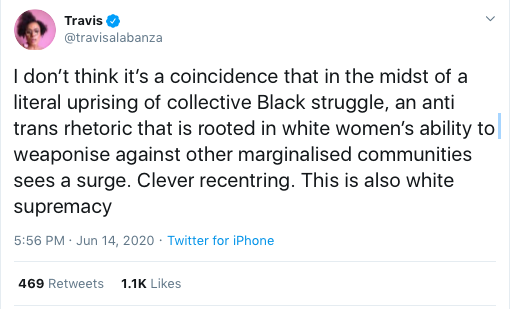
In the UK, the prominence of a number of anti-trans feminist voices in social and mainstream media has led American journalist Katelyn Burns to term anti-trans ideology as ‘the de facto face of feminism in the UK’ – but this belies a history of feminist and trans entanglements and alliances as well as the continued and resilient support of women for trans people to self-identify their gender. In June, the GEA Executive were amongst tens of thousands of individuals and organisations who wrote to the UK Prime Minister urging the government not to rollback trans rights or disregard the results of the Gender Recognition Act (GRA) consultation. For now, this show of support appears to have prompted the government to affirm that they will not restrict healthcare for young transgender people. Much more needs to be done however to safeguard and build upon existing protections for trans and non-binary people to ensure they can live their lives free of oppression, restriction and violence.
While the drive to uncover histories of anti-trans feminism offer
valuable insights, scholars and activists have also sought to acknowledge the
fruitful connections that exist between different struggles for gender justice
(Halberstam 2017). Trans and women’s liberation have always been intimately
linked by their struggle to escape patriarchal norms. The term gender (as now
commonly understood) was developed by feminists from work by psychologists on
trans and intersex subjects. Ultimately, women’s and trans liberation are both
concerned with equity of rights and life opportunities, freedom from hegemonic
gender and sexuality discourses and questions of power. Yet, the women-led
social movements that arose during the 1970s have been persistently painted as
inherently hostile to trans experiences, despite many trans and feminist
scholars having challenged this characterisation.
Withers’ work highlights that the grand narratives ‘invoked
within the paywalls of academic feminist theory or the rabid annals of twitter’
rarely do justice to the rich ‘conceptual and lived resources’ produced within
the WLM which contributed to contemporary transfeminist discourse. Drawing on
archival materials, they illustrate how the emergence of ‘women’s culture’ and
women-only spaces was part of the ‘trans-formation of sex’ allowing for
intensified experimentation where the ‘female sex was bent into new, irreversible
shapes’. Women-only networks facilitated practices such as learning ‘how to fix
PA systems, repair faulty car engines, explore the contours of a drum kit, or
mend the plumbing’ which expanded the material politics of the female body and
what it could do, be and become. Significantly, these spaces and networks were
not marked by the same categorical differentiations between cis and trans women
that shape contemporary feminist debates. Withers draws attention to
testimonial and archival evidence that illustrates the presence of trans
activists within the WLM noting, for example, that the keyboardist for the Northern Women’s Liberation Rock Band was a trans woman.
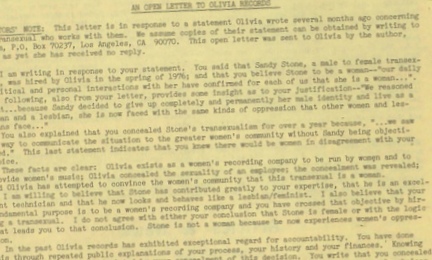
In a special issue on Trans/Feminisms, Stryker and Bettcher (2016) along with Cristan Williams (2016) and Emma Heaney (2016) map the involvement of trans activists in US-based lesbian feminist autonomous organisations in the early ‘70s. They explore, for example, the contributions of the lesbian trans folksinger Beth Elliot, Angela Douglas (the founder of the Transexual Action Organisation) and the trans inclusive politics of the radical feminist lesbian separatist music collective, Olivia Records. In an interview for Vice magazine, former Olivia Records engineer and pioneering trans studies academic Sandy Stone tells her story of living among lesbian separatists in the ‘70s. She details how revelatory it felt to discover ‘that you could be a woman without stereotyping anything, without encountering traditional cis female culture at all’ and travel through a ‘rhizome’ of ‘lesbian safe houses’ from ‘coast to coast and never encounter someone presenting as male, like a wonderful parallel subculture—or superculture.’
When trans exclusionary feminists such as Janice Raymond began threatening and harassing Olivia Records, Stone details that she initially ‘felt really protected by the women of the Collective’. However, the unrelenting nature of the attacks and the risk of boycott action led Stone to leave. Following on from Olivia Records, Stone went on to earn her doctorate with supervision from Donna Haraway and in a faculty comprised of legendary feminist academics such as Angela Davis, Gloria Anzaldua and Teresa De Lauretis. Stone proceeded to publish one of the founding essays in transgender studies, The Empire Strikes Back: A (post)transsexual manifesto.
A place for trans lives in all feminisms
These
collective and inclusive herstories question the current common understanding
that particular strands of feminism are necessarily trans exclusionary. Furthering
the view that there is no inherent need for tension between lesbian feminism
and trans-inclusion, and calling for a revival of (a trans-inclusive) lesbian
feminism, Sara Ahmed (2017, p. 227) notes: ‘I would suggest that transfeminism
today most recalls the militant spirit of lesbian feminism in part because of
the insistence that crafting a life is political work’. Ahmed’s assertion that
transfeminist texts ‘assemble a politics from what they name’ (ibid), showcases
one of the many commonalities between lesbian and trans feminisms. Both lesbians
and trans people have been rendered menacing and monstrous killjoy
figures within and outside of feminist spaces (see Mitchell and McKinney 2019;
Stryker 1994).
Similarly, and contrary to the popular belief that radical feminism and anti-trans feminism are somehow synonymous (not least due to the infamy of the moniker ‘TERF’), radical feminism does not necessitate hostility towards trans people. Catherine McKinnon and Andrea Dworkin, two of the most prominent and celebrated radfems, were both supportive of trans inclusion. In 2015 McKinnon stated “I always thought I don’t care how someone becomes a woman or a man; it does not matter to me. It’s just part of their specificity, their uniqueness like, everyone else’s. Anyone who identifies as a woman, wants to be a woman, is going around being a woman, as far as I’m concerned, is a woman.”
Intersectionality and the category of
‘woman’
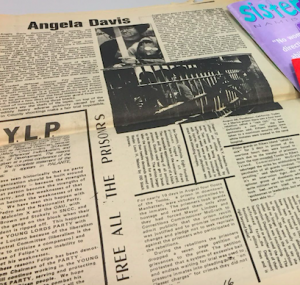
In the aforementioned TSQ special issue, Stryker and Bettcher (2016) also credit the intersectional feminist analyses promulgated by US feminists of color in the 1970s and 1980s with laying the foundation for transfeminist theories and practices. They observe that by raising the question of ‘whether “woman” itself was a sufficient analytical category capable of accounting for the various forms of oppression that women can experience in a sexist society’, Black feminists ‘called for an account of multiple “differences” of embodied personhood along many different but interrelated axes’ (Stryker and Bettcher 2016, p. 8).[1] Transfeminist scholars and activists have not only drawn from the work of Black feminists but also contributed their own intersectional analyses to the fight against racism, state violence and other oppressions (Bettcher 2007). Angela Davis recently credited trans and non-binary communities with contributing to abolitionist feminism by demonstrating that it is possible to imagine more socially just worlds that challenge ‘that which is totally accepted as normal’.
Article on Angela Davis in Women’s LibeRATion magazine (1970)
Black feminist and trans scholars have also explored the historical imbrication and interplay between Blackness and transness (Riley Snorton 2017; Bey 2017; Sharpe 2016). Marquis Bey (2018, p. 165) illustrates that the ‘subjective nexus of Black and woman, for example, irrespective of an identified trans gender, also experiences the surveillance and invasion of their bodies going through airport security (e.g hair searches), expulsion from bathrooms, housing discrimination and historical invalidation of their womanhood’. Scholars including Lola Olufemi (2020) and Alison Phipps (2020) have noted the ‘whiteness’ of the UK anti-trans feminist movement. Phipps further suggesting the paucity of British intersectional analysis, relative to the US work noted above, as a contributing factor to the prominence of ‘gender critical’ views in the UK. Dr. Gail Lewis observes how Black women’s work in Britain was denied credibility and respect by white feminists as they entered the Academy and formed women’s studies networks and reading lists.
Continuing to learn from one another
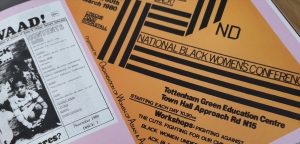
OWAAD poster (1980)
Given the marginalisation of Black British feminist thought within the Academy, it is important to re-visit and learn from the Black and working class women-centred social movements, such as Wages for Housework and the Black Women’s Movement, that thrived alongside the predominantly White and middle class WLM in 1970s Britain. Significantly, these movements did not share the same unease with trans subjectivity as expressed by minority factions of the WLM. Lewis, who was a co-founder of the Organisation for Women of African and Asian Descent (OWAAD) and member of the Brixton Black Women’s Group, highlights that the Black Women’s Movement always questioned limited articulations of gender and notes her surprise at those who have been so troubled by trans* politics. The Black Women’s Movement and Wages for Housework were characterised by coalitional working between contingently autonomous groups, activating ‘an organizational tactic to mobilize across and beyond existing racial, gender, sexual, and class configurations while recognizing the irreducible differences’ (Capper and Austin 2018, p. 449). Wages for Housework, for example, was an international movement comprised of autonomous groups such as Black Women for Wages for Housework, Wages Due Lesbians (now Queer Strike) and the English Collective of Prostitutes.
Transfeminist scholars and activists have turned to the organisational tactics and theoretical interventions of these Black and working class women-centred social movements for inspiration. Dr. Nat Raha, for example, observes how the Wages Due Lesbians campaign provided important insights into queer social reproduction by challenging the heteronormativity within Marxist feminist conceptualisations of unwaged domestic labour. Unlike the lesbian separatist movements referenced earlier, the largely Canadian / UK-based Wages Due campaign did not advance lesbianism as necessarily liberatory in itself. Instead, they noted how economic power continued to shape and limit women’s sexual choices (Caper and Austin 2018, p. 449). Raha draws on the work of Wages Due in order to advance a radical transfeminism and highlight the limits of trans liberalism. Rather than focusing on securing a particular ‘packet of entitlements’ and rights for trans people, a radical transfeminist agenda explores possibilities for common struggle across the intersecting issues of precarious working conditions, transmisogyny and sexism, white supremacy, ableism and sex work. Raha looks to contemporay and historical queer and trans-focused mutual aid support as a strategy for survival and world-building.
Conclusion
We are undoubtably living through a moment where trans lives are subject to unwarranted scrutiny and conjecture; where the historical imagining of trans as threat has reemerged and rejuvenated. That this image is often promoted by a small section of women from within the feminist movement remains disappointing. However, in the prevailing social and traditional media narrative it is easy to overlook the uplifting herstory of trans-feminist alliances which have been integral to the women’s liberation movement and which continue to inform and enrich our understandings; it is easy to overlook the collective struggles endured and the support and solidarity enjoyed. Scholars and activists demonstrate that it is in feminisms’ recognition of difference and shared experience that it is at its most sophisticated and demanding. At its best feminism is a movement that understands its role as a collective liberator of the margnalised and resists being reduced to a parochial border guard preoccupied with reserving womanhood for a privileged few.
Bio
Claire Thurlow is a PhD candidate in the School
of Law and Politics at Cardiff University. Her current research looks at
contemporary feminist reactions to trans identities in the UK. Her wider research
interests concern the intersections and divergences of feminism, queerness and
LGBTQ. She is a white cis-gender queer whose pronouns are she/her.
Kate Marston
is a PhD candidate in the School of Social Sciences at Cardiff University. Her
research draws on feminist posthuman and new materialist theories to explore
young people’s digital sexual cultures through creative, visual and arts-based
methods. She is a white middle-class genderqueer lesbian
whose pronouns are she/they.
References
Ahmed, S. 2017. Living a Feminist Life.
Durham & London: Duke University Press.
Bettcher, T. 2007. Evil deceivers and
make-believers: Transphobic violence and the politics of illusion Hypatia: A Journal of Feminist
Philosophy, 22 (3), pp. 43–65.
Bey, M. 2018. “Other Ways to Be: Trans.” Women and
Language 41(1), pp. 165 – 167.
Bey, M. 2017. “The
Trans*-Ness of Blackness, the Blackness of Trans*-Ness.” TSQ:
Transgender Studies Quarterly 4(2), pp. 275 – 295.
Capper, B. and Austin, A. 2018. “Wages for
housework means wages against heterosexuality”: On the Archives of Black Women
for Wages for Housework and Wages Due Lesbians. GLQ: A Journal of Lesbian and Gay Studies 24(4), pp. 445 – 466.
Halberstam,
J. 2017. Trans: A Quick and Quirky
Account of Gender Variability. Berkeley: University of California Press.
Heaney, E.
2016. Women-Identified Women: Trans Women in 1970s Lesbian Feminist Organising TSQ: Transgender Studies Quarterly 3(1-2),
pp. 137 – 145.
Lugones, M.
2016. The Coloniality of Gender in Harcourt, W. (Eds) The Palgrave Handbook of Gender and Development: Critical Engagements
in Feminist Theory and Practice London: Palgrave Macmillan
Mitchell, A. and McKinney, C. 2019. Inside Killjoy’s Kastle: Dykey Ghosts,
Feminist Monsters, and Other Lesbian Hauntings. Vancouver: UBC Press.
Olufemi, L. 2020. Feminism Interrupted:
Disrupting power. London: Pluto Press
Phipps, A. 2020a. Me, Not You: The trouble
with mainstream feminism. Manchester: Manchester University Press.
Raymond, J.
1979. The transsexual empire: The making of the she-male. Boston: Beacon
Press.
Riley Snorton,
C. 2017. Black on Both Sides: A Racial
History of Trans Identity. Minneapolis: University of Minnesota Press.
Sharpe, C.
2016. In the Wake: On Blackness and Being.
Durham: Duke University Press.
Stryker, S. 2004. Transgender Studies: Queer
Theory’s Evil Twin. GLQ: A Journal of
Lesbian and Gay Studies 10(2), pp. 212-215.
Stryker,
S. and Bettcher, T. 2016. Introduction: Trans/Feminisms TSQ: Transgender Studies Quarterly 3(1-2), pp. 5 – 14.
Williams,
C. 2016. Radical Inclusion: Recounting the Trans Inclusive History of Radical
Feminism TSQ: Transgender Studies Quarterly
3(1-2), pp. 254 – 258.
“I had my first child when I was 13 and dropped out of school. Since I had to fend for my baby, I decided to wash clothes for a living and this is how I got pregnant again. The man I was washing clothes for promised to take me back to school if I had an affair with him.” Says Ruth•, a fifteen-year-old Standard eight leaver.
Ruth’s story is one among many horrific tales of young mothers who reside in the informal settlements of Nairobi. Education is a basic right for all in Kenya, however, it is not enjoyed by most teenage mothers who drop out of school despite the existence of the National School Health Policy and the School Re-Entry Policy and Guidelines that provide for these girls to enjoy their right to education. Implementation and monitoring of the school re-entry policy, the national school health policy, among others is important in curbing the rising rate of teenage pregnancies. According to the Kenya Demographic and Health Survey of 2014 (Kenya National Bureau of Statistics, 2015), one in every five girls between 15-19 years has begun childbearing or already has a child and approximately 13,000 teenage girls drop out of school every year due to pregnancy. A study by the Population Council highlighted that 70% of out of school girls from Homabay County report pregnancy as the main cause of their schooling status. Numerous factors such as the disharmony between the provisions of the national school health policy and the re-entry policy among others have been linked to this unfortunate state that deprives girls of their childhood and prevent them from exercising their right to education thus compromising their future wellbeing and that of the communities they live in. Furthermore, teenage pregnancy aggravates their vulnerability to poverty, exclusion, and exploitation.
Why teenage mothers need to be in school
‘Kuteguka sio kuvunjika guu’ goes a Swahili saying. Life even after a teenage pregnancy continues and every girl has the right to re-pursue education as far as she can go. Existing evidence points out numerous benefits that accrue to girls and women when they attain an education. According to a 2013 UNESCO study, if all women in poor countries had a secondary school education, child mortality would be reduced by half. Moreover, 60 percent fewer girls under age 17 would get pregnant in sub-Saharan Africa, South and West Asia if they had a secondary school education.
In Kenya, despite the existence of policies that support the re-entry of young mothers back to school, their plight remains dire. The National School Health Policy and the School Re-Entry Policy and Guidelines stipulate the laid – out procedures to be followed if a girl falls pregnant and/or drops out of school. However, implementation has not fully been effected owing to several challenges and barriers, such as lack of awareness of these policies by those meant to enforce them; negative attitudes and perceptions of communities, parents and school personnel against teen mothers; and failure by some school heads to divulge policy provisions for the fear that this might promote early sexual activities in schools.
So what are we doing about this as a society? Nelson Mandela once said that ‘There can be no keener revelation of a society’s soul than how it treats its children’. ‘If given a chance to go back to school, I will be happy – I want to become a nurse’, says Ruth. For her and other young mothers who are yearning for a second chance at rewriting their narratives, they need the support of all the stakeholders within the education sector.
A holistic multi-sectoral approach is key to promoting access to education among teenage mothers. The Ministry of Education and other line ministries including the Ministry of Health among others should enforce relevant policies. More so, parents, schools, communities and Non-Governmental Organizations, at large need to come together in their collective responsibility to ensure that all children go to school. Communities and parents ought to support school heads and teachers in their implementation of government policies and encourage dialogue to address the prevention of unintended pregnancies as well as changing the negative perceptions associated with school re-entry.
Sensitization of communities on the provisions of the policies as well as regular guidance and counseling of parents on how to nurture and care for their adolescent children will go a long way in creating a supportive environment.
The discussions around teen pregnancy need to expand from the girl child to include boys as they too are complicit (in situations where it was consensual). It is alarming that even where fellow students are reported to be the fathers to the children born by their schoolmates, in most cases, only the pregnant girls bear the backlash from the school and community. All learners need to have equal access to education opportunities.
Furthermore, development partners and other education stakeholders need to design Interventions and programs that are holistic and responsive to the needs of teenagers and young mothers. Mentorship, guidance and counseling and creating safe spaces in schools for boys and girls to talk about the challenges they face with their sexuality and offering the appropriate knowledge will enable them to make informed decisions.
Ruth deserves a second chance and so do the young mothers in our society- to re-write their narratives, get a good education, break the cycle of poverty and ensure that they secure a bright future for themselves and their children.
•Ruth is a pseudonym
About the author
Catherine Asego is a researcher and project coordinator of the Regional Education Learning Initiative (RELI) that promotes learning and collaboration among 70 organizations in East Africa. She also supports the development of policy and communication tools that partner institutions under the Urban Education Project use in their engagement with the various policymakers in each of the countries.
Catherine is an alumni of the Mandela Washington Fellowship for Young African Leaders (YALI) program, an initiative of the former US President Barack Obama to invest in the next generation of African leaders.
Professor Ringrose won the Distinguished Contributions to Gender Equity in Education Research Award, AERA announced on the 22nd July. Established in 2006, the award recognises individuals within AERA for distinguished research, professional practice, and activities that advance public understanding of gender and/or sexuality at any level in the education community.
Professor Ringrose said: “I am thrilled to be the recipient of this
award. My research uses intersectional feminism to challenge inequity and
to promote positivity, diversity and inclusion in representations and
understandings of women and girls. I have been inspired by researching how
young people trouble gender categories, challenge power inequities and are
creating more inclusive worlds through their own digital feminist and gender
activisms.”
“This year’s award
winners exemplify commitment to the study and practice of education,” said AERA
Executive Director Felice J. Levine. “We are proud to honour their outstanding
scholarship and service to the education research field.”
Professor Ringrose has been the co-chair for GEA for the past five years, supporting the association’s work to raise awareness about gender equity in educational research, policy and practice internationally. The GEA Executive Committee are delighted to see Professor Ringrose’s work on gender equity recognised by AERA, the largest interdisciplinary research association devoted to the scientific study of education and learning in the United States of America.
A virtual awards celebration will take place on 12 September, where the recipients will be honoured for their work.
Following the lead of our colleagues at the Feminist Studies Association, The GEA Executive sent a letter to the UK Prime Minister last week urging the government not to restrict either healthcare for young transgender people or transgender people’s access to free, public facilities. As feminist scholars and activists who work in centres for the study of women and gender, GEA is intimately familiar with the sustained assault against the rights of trans and non-binary people that was unleashed by the Gender Recognition Act (GRA) consultation. Despite 70% of responses to the GRA consultation welcoming the proposals, the government looks set to disregard this show of support in a move that is profoundly anti-democratic.
Along with the majority of respondents to the consultation, GEA actively supports trans and non-binary rights because we believe that all women and non-binary people should be supported to live their lives free of oppression, restriction and violence. We are deeply concerned by Liz Truss MP’s recent comments which appear to reflect a lack of understanding regarding the proposed reforms and the unrelated issue of medical pathways for trans young people. We urge the government to revisit the wealth of evidence that supports the proposed reforms to the GRA and reconsider their position.
In this blog our social media intern, Kate Marston, discusses the GRA debate and de-centring the focus on a small but influential faction of British feminism.
The toxic GRA debate
The consultation period on the GRA was very difficult for trans communities. What should have been a discussion regarding the removal of expensive, bureaucratic and dehumanising barriers to trans people obtaining a gender recognition certificate, became an extended and drawn out assault on trans lives and dignity as though their very right to exist was up for debate. Groups opposing the GRA were given high-profile platforms to scaremonger and spread misinformation about the proposed reforms, often employing hateful and cruel rhetoric. Negative attention in the press appeared to reinforce the harassment of trans and non-binary people in the street as transphobic hate crimes surged by 81% in 2018 – 2019.
As someone who has worked with LGBTQ+ youth for the past eight years, the lack of empathy and understanding along with the outright cruelty shown towards trans and non-binary young people was deeply disturbing. I saw young people I had worked with attacked in the national press simply for standing up for their right to access the changing rooms that aligned with their gender identity, in line with existing equalities policies. Efforts to paint transfeminine people as sexual predators bore striking resemblance to the moral panic of 1980’s homophobia against gay men.
Anti-trans protesters who self-identified as ‘feminists’ were given space to frame the debate as women versus trans people. Meanwhile, feminists who support trans rights were not only ignored by the media but subject to online and offline harassment from so-called ‘gender-critical feminists’ infuriated by their supportive stance.
Writer and comedian Shon Faye observes that ‘the purpose of the debate isn’t to move the conversation on at all […] It’s to have the same debate again and again and again, almost as if that’s a strategy in and of itself, to keep us debating and to keep a question mark over every aspect of trans lives and rights.’ With this in mind, how do we de-centre the focus on anti-trans voices and build towards more trans positive futures? In a follow-up blog post, I begin to address this question by engaging with some of the fraught yet rich herstories of trans/feminist entanglements that tell a story of powers growing together.
Relationships and sexuality education
(RSE) begins long before children start school.
As soon as children enter the social world they will be encountering complex and often contradictory messages about sex, gender, relationships and sexuality that shape their day-to-day lives and imagined futures. However, while schools have the potential to create safe and empowering environments that can respond to children and young people’s own learning and experience on a range of RSE issues, they have “struggled over a long period of time to bridge the gap between official sexuality education and diverse young people’s lived experiences” (Kathleen Quinlivan 2018).
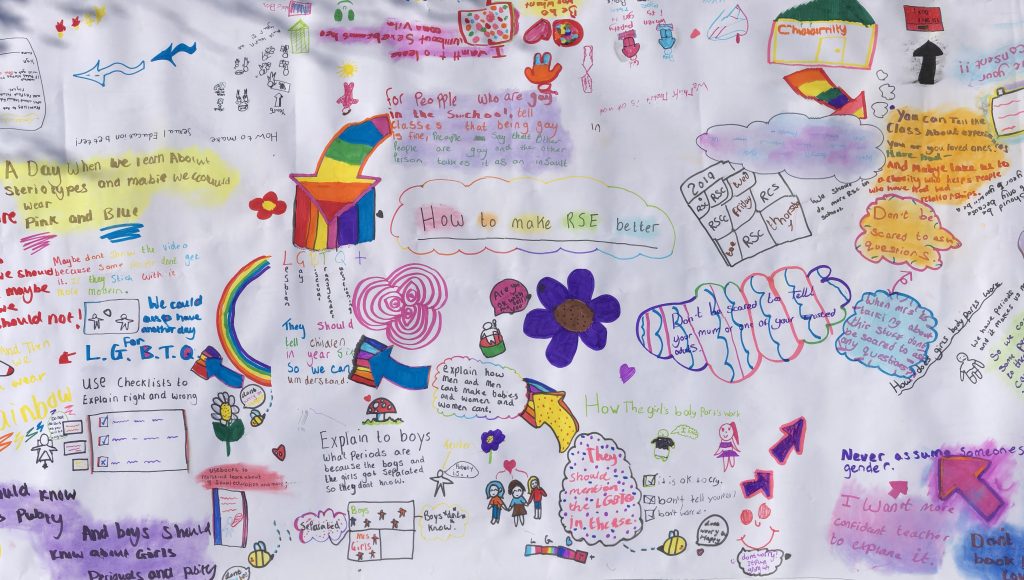
How to make RSE better
RSE in Wales is changing
Contemporary
RSE research/ers encourage us to think again how sexualities and relationships
are ‘taught, learned, witnessed, affectively charged, embodied, enacted, muted,
and resisted by students and educators’ (Sara McClelland and Michelle Fine 2017, p. 212). Yet, inventive ideas for
doing RSE in schools differently are too often disconnected from the political
ecology of local, regional and/or national contexts, making it difficult for a
new praxis to take root and flourish.
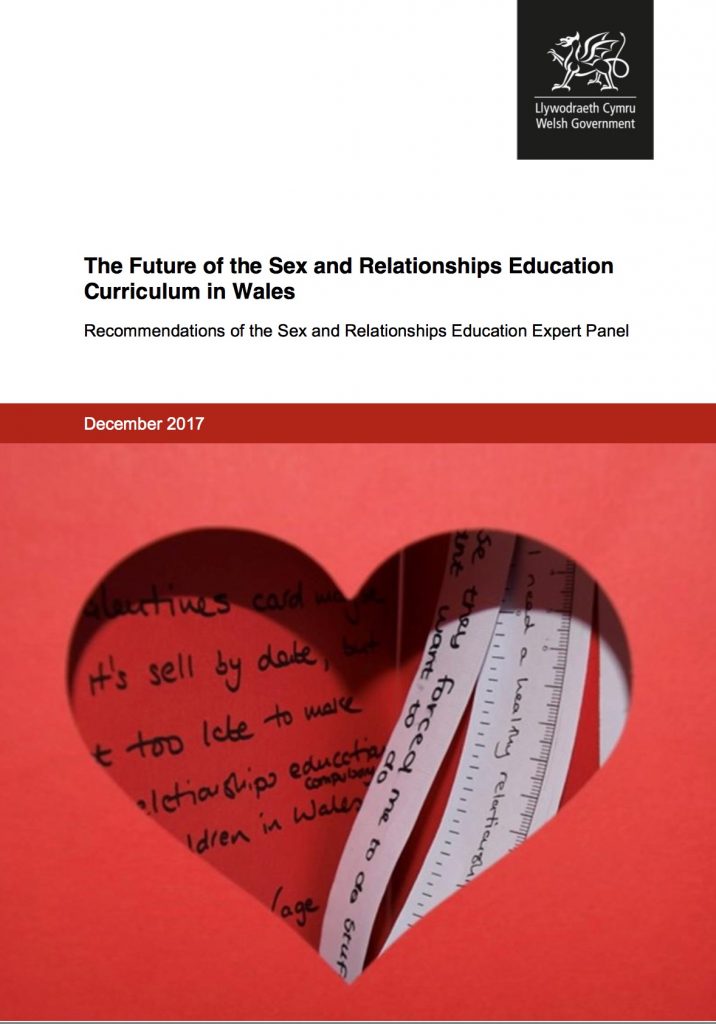
Over the last five years, EJ has had the rare privilege to build upon some incredible international scholarship and practice in RSE and has made some headway in shaping the new statutory Relationships and Sexuality Education in Wales, as an academic, activist, and Welsh Government advisor. In March 2017, EJ was invited by the Minister for Education to chair a panel of experts examining the current and future status and development of the Sex and Relationships Education curriculum in Wales. Only a short briefing was expected (Renold and McGeeney 2017a), but we produced a much longer 160 page report (Renold and McGeeney 2017b). This process laid the foundations for a radical re-routing of RSE in Wales. From 2020 this year RSE is now underpinned by the principles of rights, equity, creativity, inclusivity, empowerment, protection and co-production, and covers the core themes of relationships; sex, gender and sexuality; bodies and body image, sexual health and well-being; violence, safety and support; and rights and equity (Welsh Government 2020). However, while the expert panel’s recommendations have been slow to materialise, the stops and starts of how RSE is unfolding has opened up opportunities for EJ and Ester to develop their own professional learning programme (PLP) for teachers.
Transforming RSE: 8 guiding principlesThe Future of the Sex and Relationships Education Curriculum in Wales
Making professional learning matter
In
2018 EJ and Ester were invited to design and deliver a series of Relationships
and Sexuality Education (RSE) professional learning workshops to support
in-service teachers to prepare for the new RSE statutory curriculum and
guidance in Wales. Building upon the critical, creative and participatory
methods developed in the AGENDA toolkit (www.agendaonline.co.uk) the programme
invites teachers to participate in a range of pedagogic activities that they
can then build on creatively and experiment with, first in the workshops
themselves, then back in their own school, and then again in further workshops.
Presently, the programme has directly engaged with 27 teachers, across 23
primary, secondary and special schools.
What is a creative audit?
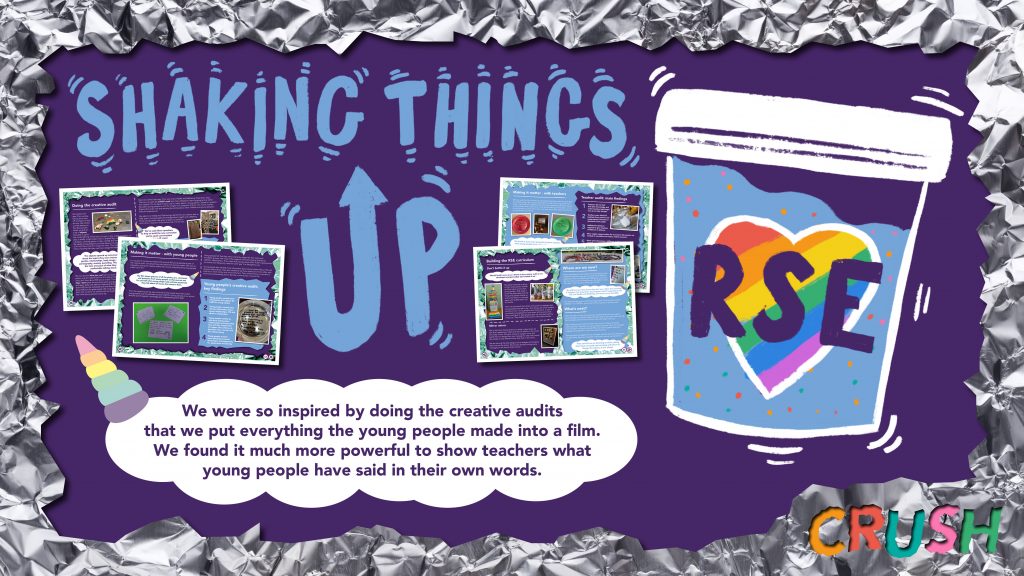
Informed by the AGENDA stARTer activities, which many GEA members may be familiar with from the annual GEA conferences in 2018 and 2019, the creative audit is a tool that enables teachers to begin co-producing the RSE curriculum with children and young people. We have used the term ‘audit’ intentionally. We have flipped the neoliberal measuring practices of a school’s ‘audit culture’ by connecting to its Latin roots; an audit can open up the ‘listening’ process (aural) to a process of perception (‘au’ – to perceive). In doing so, it scaffolds accountability on the journey of coming to know differently through ‘creativity’ – that is, as a way of imagining and doing RSE differently.
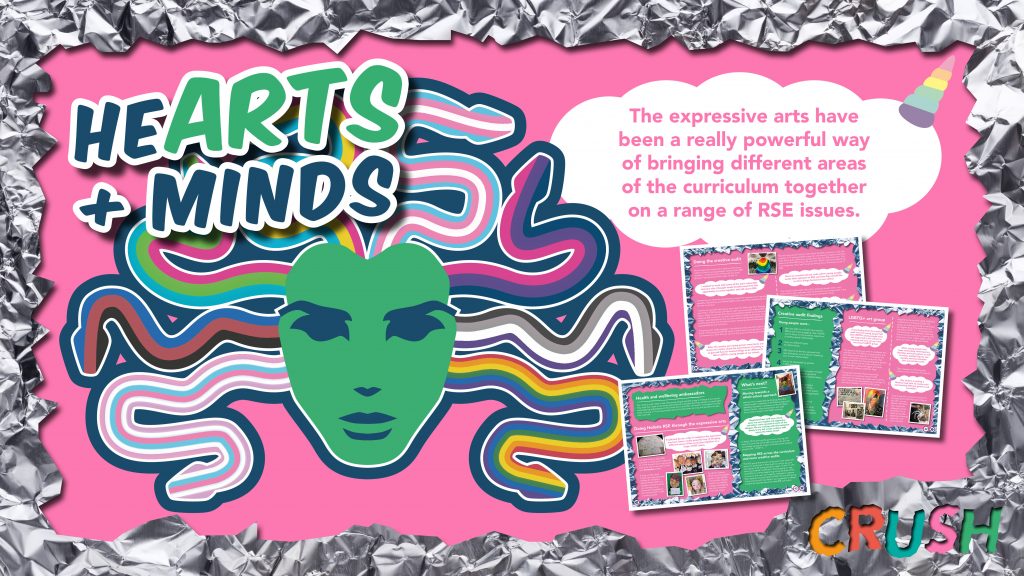
To share the praxis and potential of our new RSE professional learning programme, this spring, we created and published ‘CRUSH: Transforming Relationships and Sexuality Education’ (Renold, McGeeney and Ashton 2020). Hosted on the AGENDA online website, this free to download bi-lingual (Welsh-English) 90 page booklet shares a range of new resources that have been developed for the programme. It includes the research CRUSH-cards and a concept glossary, as well as a series of five illustrated school case studies which show how teachers are starting to reimagine what RSE can be and become with and for children and young people.
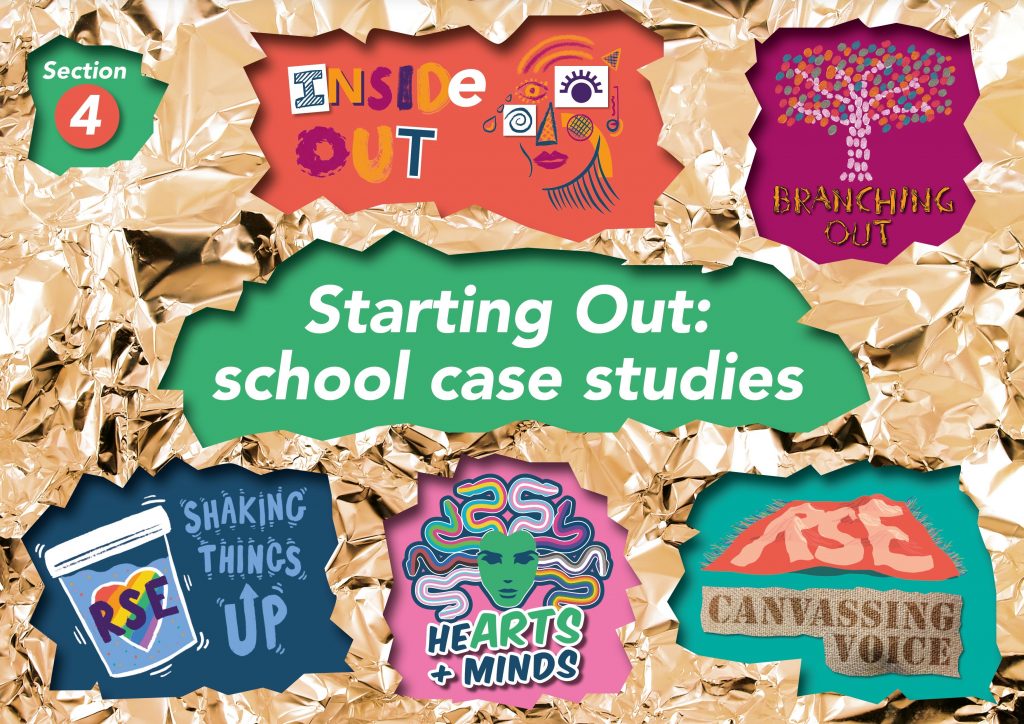
STARTING OUT: SCHOOL CASE STUDIES
Why
CRUSH?
At
the heart of the resource, is the sharing the different ways in which creative
pedagogy can enable a wide range of feelings, expression and discussion to
surface so that ideas can take-off and new connections can be made. It often
involves learning to unlearn what we think we know and making space to be
curious about what matters, to whom and how. However, it isn’t a matter of
anything goes. The pedagogy that informs our PLP is critical as well as
creative. It keeps a check on power relations and social norms and works to
understand and transform how these power relations, norms and inequalities play
out in harmful and violence ways. So it’s an ethical and political praxis that
harnesses the multiple meanings of CRUSH to get at this complexity: CRUSH as
feeling, as force, and as mash-up, or fold.
Crush as FEELING attunes to the diversity,
unpredictability and intensity of emotions the ebb and flow throughout all RSE
learning and experience.
Crush as FORCE is about developing an
affirmative praxis for addressing injustice, inequity and violence, and working
with the forces that make change and empowerment possible
Crush as FOLD is about recognising the messiness of experience, and the potential of RSE as a trans-disciplinary field, to explore how categories and concepts (like identity, consent, body image etc) entangle and fold into one another.
Make
some noise
One
of the early 14th century definitions of crush comes from the Old
French, croissir, which means to crack or brake and make some noise! CRUSH is a
resource that not only cracks open a new unfolding RSE, but turns up the volume
on youth voice through an empirical attunement of ‘what matters’ to young
people on RSE issues. It also unashamedly speaks out about the need for professional
learning and critical inquiry as RSE both expands and becomes statutory. Like
AGENDA, it’s a resource that will always be evolving by responding and becoming
responsible with all that we are learning from pupils, parents, teachers and
communities. So stay tuned for more CRUSH-stories about how RSE is transforming
in Wales. It’s been a bumpy ride, but we continue to CRUSH and teachers are
beginning to re-imagine what RSE can become. We leave the final word to one of
the teacher’s from the PLP who reflects upon her RSE journey:
“Something that I’ve noticed … is that
I’m seeing RSE everywhere! and I’ve learnt that the kids are gonna love it, and
it absolutely needs to happen, week in, week out, not just in a block pull down
week. It needs to be in history, it needs to be in science, it needs to be in
geography. It needs to be everywhere! and I think that is what I need to figure
out! … I took the creative audit findings to the staff and it was SO useful
…. to convey to teachers, they don’t
need to think of it as RSE, they need to think of it as everything else. And
yeah they (teachers) are overwhelmed with changes and uncertainty, but I do
think they’re open to a new way forward now. RSE is just around us all the time
and it really needs to be … it needs to
be … we need to be secure in that before
we do anything else”
On 25th
May 2020, George Floyd was murdered by a white Minneapolis
police officer who kneeled on his neck for a total of nearly nine minutes. The
video of Floyd’s death, bravely captured by 17-year-old Darnella Frazier, went
viral causing collective outrage and sparking a new wave of #BlackLivesMatter
protests around the world.
In this blog,
we collate the links and resources that the Gender and Education Association
have been sharing on our social media feeds in order to signpost to some of the
issues the #BlackLivesMatter movement highlights and signal boost some key
voices.
Black Lives
Matter is an international civil rights movement campaigning against violence
and systemic racism towards black people. Following the acquittal of George
Zimmerman for the fatal shooting of 17-year-old Trayvon Martin in 2013, #BlackLivesMatter
was co-founded as an online campaign by Alicia Garza, Patrisse Khan-Cullors and Opal Tometi. In 2014, the first street demonstrations took place in Ferguson after
the fatal shooting of 18-year-old Michael Brown by a police officer. Following
this, BLM has organised thousands of protests and demonstrations speaking out
against police brutality and police killings of Black people.
Many have also questioned why black women and girls remain an afterthought in mobilized outrage against police violence, noting that the fatal police shooting of Breonna Taylor in March 2020 did not receive widespread attention until after Floyd’s death. To date, there have been no arrests for Breonna Taylor’s death and only one of the police officers involved has been fired. The need to call attention to black women’s experiences of police violence necessitated the creation of the #SayHerName campaign in 2015. Following the death of Sandra Bland in police custody, the African American Policy Forum released the #SayHerName report to draw attention to the forms of police brutality disproportionately experienced by women of colour.
Campaigners have also highlighted the
intersection of disability and race in police brutality cases noting the disproportionate impact of state violence
on Black people with disabilities. Given the number of police killings of
people in mental health crisis, campaigners have called for a re-direction of
funds from police budgets towards unarmed mental health response teams.
The recent
protests have intensified demands to defund the police and consider different
modes of public safety. For decades, abolitionist feminists such as Angela Davis and Alice Walker have been
calling on us to re-imagine what justice can look like and highlighted the harm caused by the prison industrial complex. Movements to defund the police illustrate the limits of reforming
institutions that are rooted in the history of slavery and colonialism.
Last year’s #GEAconf2019 featured keynote addresses from Professor Kalwant Bhopal and Professor Heidi Safia Mirzawhose work addresses issues of racism, sexism and white privilege in higher education. You can see further information about the #GEAconf2019 keynotes and panelshere.
Calls to remove
Colston’s statue had been made for decades, and
so too have calls to revise the national curriculum. In 1999, The
MacPherson Report recommended that a more culturally
diverse curriculum was key to challenging racism. More than twenty years later,
The Windrush
Lessons Learned Review highlighted yet again the need for
migration and colonial history to be taught on the curriculum.
Natasha Richards and Gemma Connell are current PhD students who are both interested in how performance can be utilised as an effective tool for exploring issues of consent. Natasha works more specifically with young people and theatre, providing relationships and sex education through workshops and performance, while Gemma uses dance and spoken word in working with survivors of gender violence, stroke survivors and those with disabilities and mental health conditions.
After meeting at the CHASE Feminist Network Annual Conference in 2019, they realised that they were exploring similar topics through their respective practices in theatre and dance. They decided to team up to deliver a one-day workshop exploring the so-called “blurred lines” of consent through participatory exercises including theatre, dance and spoken word. The workshop aimed to open discussion around every day issues of consent, including “banter” and potentially problematic parental guidance, and how these could lead to wider issues of sexual harassment, sexual violence and victim blaming.
GEA invited Natasha
and Gemma to share a little bit about the experience…
Let’s start this post
with a disclaimer: we don’t need to advocate for talking about consent on a
platform like this, as we’d be preaching to the converted. However, we would
like to advocate for discussing the issues of consent using creative and
participatory exercises, as we feel it opens up the opportunity for new
perspectives and deeper understanding of the topic of consent.
We wanted to pilot
our theories with a small group of other artists and academics, so that we
could gain feedback and to see how our ideas worked in practice in a smaller
(and safer) environment. It is always risky to trial new ideas, even more so
with sensitive topics, and so we were very grateful for those that joined us in
our first pilot workshop, held at The University of Essex in February 2020.
We began with a series of introductory tasks, asking participants to think about what consent means for them in situations presented to them by us, the facilitators. For example, a statement was read out and each individual had to consider how far they agreed with the statement, one statement being – “It is ok to read your partner’s text messages.” These tasks led onto honest discussion, where participants could hear from others,as well as present their own opinions. As facilitators, we encouraged participants to consider in detail not just what their opinion was, but why they held that opinion.
Natasha ran a theatre
workshop, whereby the participants were introduced to a character, Stacey. They
were presented with a monologue from Stacey, which detailed an incident of
sexual harassment at school. They were given the opportunity to ask Stacey
questions and to give Stacey some advice. After the workshop, one of the
participants commented that “the Hot Seat theatre activity in which we were
introduced to Stacey was very effective, and introduced numerous considerations
affecting consent within a school environment, including peer pressure, banter
culture and teacher involvement.”
After the monologue
and hotseat, the participants were invited to create freeze frames based on
three different characters: Stacey, the perpetrator and the bystander. Creating
the images, and then being an audience member to the images of others, gave the
participants a platform to explore the different roles and emotions within
instances of sexual harassment.
After lunch, Gemma introduced her own practice, beginning with a short extract of her own dance and spoken word performance, Lies My Parents Told Me. This performance explores ill-conceived advice that parents may pass onto their children, opening up a discussion about lies and how they relate to issues of consent. What is a ‘good lie’? When do such lies cause harm?
The main task for the participants in this section of the workshop was to remix the wording of the current laws on consent in England and Wales (click here for more info on legal definitions of consent in the UK) and to generate simple choreography to accompany spoken word versions of these remixes. The remix exercise was welcoming to people unsure of dance and/or spoken word. The participants noted that they found themselves analysing the law on consent without being told to analyse it; reinforcing the notion that playing around with something can help to unlock different interpretations without that being the main focus or intention.
The workshop was a
huge success, with one participant stating:
“It was compelling to
explore the topic through the embodied experience of playing characters and
experimenting with movement. I gained a new perspective on how the arts can
allow exploration of the ‘grey space’ of consent. I also was inspired by how
vital conversations about consent can be had with young people in creative ways
that facilitate their self-expression.”
Using theatre, dance
and spoken word techniques, we have discovered that discussions of consent can
change through the creation process. Whilst generating dialogue and movement
based on the topic, participants question their motives and those of others, in
ways that they haven’t experienced before.
Going forward, the
aim is to run the one-day workshop in different contexts and evaluate the
participants’ responses. An idea is to encourage universities to run the
workshop in freshers week. We want to challenge the way people think about
consent in society; not just consent to sexual acts, but where does consent
affect the everyday lives of all of us – adults and children alike?
The pilot workshop
was generously funded by the CHASE Feminist Network Small Projects Fund.
It is with great sadness and regret that we have to announce the cancellation of GEA 2020 in Calgary due to COVID 19 measures in Canada.
Here is a message from organiser Professor Michael Keller:
Dear GEA-GC3 2020 Contributors,
It is with great regret that I am writing to tell you that the University of Calgary has had to cancel the GEA 2020 Conference event in Calgary in June. Due to the unfolding and expanding conditions related to COVID 19 (Corona Virus) nationally and internationally, we are unable to host GEA 2020 at The University of Calgary.
Registration for this event will be reimbursed in due course. An official announcement will appear on GEA and University of Calgary GC3 2020 websites in short order.
Thank you for understanding
Michael Kehler,
GEA Organizing Committee
We want to take this opportunity to thank the GEA Conference Organising Committee for all their hard work on the conference. They had put together a stellar programme of speakers, workshops and panels, and it is very sad that their work will not come to fruition as planned during June 2020.
We wish all of our GEA members safety and wellness during this difficult time.
This post is
part of the Countdown to Conference (C2C) series. We would love to feature a
brief blog post from you too! Visit our main Countdown to Conference page
for details! For more information about #GEAconf202 visit
the conference website.
…….
GEA is delighted to launch the programme for the upcoming Gender and Education Association International Conference on Gender Complexity, Collaboration, Connectedness.
Hosted by the Werklund School of Education at the University of Calgary, Canada, this year’s conference will reflect on the pillar of gender as a central identifier in education. The primary goal of the conference is to provoke conversations attentive to the complexity of gender in the current socio-political context. It will address collaboration both in the purest sense in which gender is a collaborative process through which we are authored and co-authored as well as in the broader sense that feminists and critical educators engage in collaborative research and activism to disrupt normative ideologies. Finally, it will speak to the connectedness possible when theory meets practice.
To address this
year’s theme the conference is hosting a diverse range of panels and workshops alongside
a stellar line-up of spotlight speakers including:
We look forward to welcoming national, international and local educators, teachers, administrators, policy makers, community leaders, agencies and activists with a particular focus on gender, social justice, equality and education.