On Sunday night 15th January, an alleged rape was broadcast live on the current, twelfth season of Big Brother Brazil. Meanwhile, one week later, in the UK Celebrity Big Brother House one housemate pulled down another’s trousers. Both events raise questions about gender, power and reality in contemporary society. Continue reading “Rape and Reality TV”
Notes of a London SlutWalker
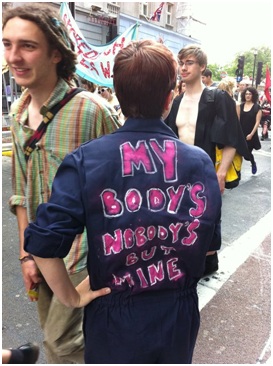
I am still on a high from the London SlutWalk, June 11, 2011. It was incredible to see all those women, girls, boys and men, queer and straight, old and young, brown and white marching together under the banner of ‘sluts’. There has been a lot written about the SlutWalks which have spread internationally in recent months, but the origins bear repeating; particularly given how the deeply misogynist, sexist remarks that propelled this political action emerged from a Canadian Police Officer at Osgoode Law school, York University, Toronto, where I did my MA and PhD in Women’s Studies! When Michael Sanguinetti a police officer from the Toronto force went on a routine visit to York University on January 24, 2011 to advise the students on personal safety, little did he know that he would unwittingly inspire a movement that has caught fire across the globe. Sanguinetti began his talk with a disclaimer “You know, I think we’re beating around the bush here” He went on to deliver the now infamous line “I’ve been told I’m not supposed to say this – however, women should avoid dressing like sluts in order not to be victimised.” Continue reading “Notes of a London SlutWalker”
“You cannot be the doctor if you are the disease”: Tackling Violence against Women and Girls in Schools in the UK
Do a quick search on the internet on violence against women and girls and school-based projects and you’ll find: specific websites; a good number of excellent, innovative packs; lesson ideas; and reports on pilot studies. However, go into most schools or young people’s projects and this work is simply not evident. Young people are lucky if they get any information on this, despite the fact that we know the huge scale of woman and girl abuse in our society. It is sad, but this issue is generally not on our list of priorities, despite the potentially enormous impact it could have by being so. Continue reading ““You cannot be the doctor if you are the disease”: Tackling Violence against Women and Girls in Schools in the UK”
Japan and the Forgiveness of Women
In the wake of Japan’s catastrophic earthquake and tsunami, the English service of China Radio International reports that among the groups sending their condolences to the Japanese people has been a group of South Korean elderly women who organized a silent demonstration to commemorate the victims of the earthquake. Continue reading “Japan and the Forgiveness of Women”
Do we need International Women’s Day?
International Women’s Day has come around again. We know this because each year at the beginning of March, you’d think that the topic of women and their rights had been newly discovered. For a few days prior to the actual day, 8th March, the media seem suddenly to be fascinated by everything about women – what has happened to them over the previous year, reflections on various gender incidents and examples of sexism etc. with article after article taking the opportunity to comment on the condition of women (whether pro- or anti-). Here in Scotland the huge increase in domestic violence reported after a bad-tempered match between Celtic and Rangers, led to heightened discussion and (I hope) awareness of the damage that certain forms of masculinity are capable of. Continue reading “Do we need International Women’s Day?”
Is feminism in the UK experiencing a double dip? Call for Action
‘Clinton is proving that feminist foreign policy is possible – and works’ so headlines an article in the Guardian in which Madeleine Bunting argues that Hilary Clinton is building her political foreign policy on a solid 1970s feminist mantra that ‘Transformation in the role of women is that last great impediment to universal progress.’ Clinton has proclaimed that ‘the rights of women and girls are now core to US foreign policy’ and Bunting draws attention to the 450 mentions of this ‘signature issue’ in the first five months of Clinton’s office. Clinton argues that ‘the empowerment, protect and protection of women and girls is vital to the long-term security of the US’. In a telling remark Bunting asks, imagine any politician saying something similar in the UK now. It is, indeed, unimaginable! Continue reading “Is feminism in the UK experiencing a double dip? Call for Action”
Are girls victims of their own sexual agency? Sexualisation, sexual violence and schooling
On the 15th October the End Violence Against Women (EVAW) organisation called upon the Coalition Government to urgently address the “alarming levels” of sexual harassment and violence against young women in schools. Their YouGov 2010 online survey of 788 16-18 year olds found that a third (29%) of young women reported unwanted sexual touching at school and witnessed routine sexual name-calling on a daily or twice-weekly basis. Over a quarter (28%) said they had seen sexual pictures on mobile phones at school twice a month or more. In the same month, Girl Guiding UK continued to fight the sexualisation of girl culture by delivering a 25,000 signature petition to Downing Street calling for the Government to introduce compulsory labelling for all airbrushed images. This concern addressed the findings from their Girls’ Attitudes Survey, in which 50% of the girls reported that they would consider having surgery to change their looks and more than half had been bullied for their appearance. Indeed, the impact of ‘sexualisation’ upon girls and young women has become the subject of high profile controversial reports and inquiries from a number of government and non-governmental bodies (Home Office 2010). Continue reading “Are girls victims of their own sexual agency? Sexualisation, sexual violence and schooling”