Dr Abimbola Abodunrin, Post-doc Researcher in Education. University of Glasgow.
Walk into many STEM faculties across the UK, and you might notice something right away: the posters/decor speak of diversity, the strategies promise inclusion, and the websites proudly showcase progress or perhaps more accurately, incremental progress. Yet, look a little closer at who is leading labs, shaping research agendas, and influencing decision-making, and a different story often emerges. As a male academic of colour researching within STEM education spaces, I often find myself asking a simple but ‘uncomfortable’ question: Are we really moving the needle? And perhaps more importantly, who is still being left behind? The experiences of women academics of colour continue to reveal a persistent gap between representational gains and promising agendas to pursue equ(al)ity. Their stories speak not just about numbers, but about belonging, voice, and power. They also echo wider concerns raised in Danny Clegg’s WonkHE blog, where he suggests that universities are often better at documenting inequalities than preventing or addressing them. These reflections challenge all of us, including men and men of colour such as myself, to think more introspectively about what it means to actively contribute to decolonising STEM and academia more broadly.

For many institutions, progress is measured through the politics of enumeration, even when agendas are well-intentioned: how many women are recruited, how many minoritised academics are appointed, how many diversity initiatives are launched. These numbers matter, of course. But numbers alone do not tell the whole story. Being the only one in the room or, worse still, being present to ‘authenticate’ spaces and projects without necessarily shaping them remains a familiar trope of experience for many women academics of colour. Alongside this is the invisible and often unremunerated labour of mentoring students seeking role models, sitting on diversity committees, and balancing expectations both at home and in the workplace that weighs on her body and career. Do I also speak of the tensions of performing particular forms of scientific legitimacy – marked by her ability to speak science, do science, and embody science in ways that mirror dominant cultural practices?

I have witnessed, and through my research, had the privilege to listen to, brilliant women academics of colour whose ideas (re)shape conversations, yet whose contributions are sometimes framed as “niche” rather than central to STEM innovation. These experiences speak to representational politics, signalling symbolic inclusion and progress without disrupting the epistemic centre. As Kalwant Bhopal’s article discusses, even equ(al)ity and diversity staff within universities often find themselves constrained; able to “talk the talk” but not always permitted to “walk the walk” when it comes to implementing equitable changes. Representation, in this sense, becomes visible but precarious; present, yet positioned at the margins of institutional power, even when occupying a leadership position.
As a male academic of colour, I am also conscious of the spaces I occupy and the privileges I may hold, even within marginalised identities. Decolonising STEM is not simply about increasing diversity; it is more about questioning whose knowledge counts, whose voices are heard, and whose experiences shape institutional change. This means listening more carefully to women academics of colour, amplifying their contributions, and reflecting on how we, as colleagues, mentors, and collaborators, can challenge systems that continue to (re)produce inequ(al)ities. It also means recognising that decolonisation is neither a metaphor, as Tuck and Yang, put it, nor a destination but an ongoing practice. Sometimes this work involves small but subversive everyday actions: citing their work, recommending them for leadership roles, or challenging assumptions about their credibility and expertise in meetings. These may seem like small steps, but they contribute to shifting cultures and redistributing voice and influence.
Encouragingly, there are growing conversations and initiatives seeking to address these issues. From mentorship networks and collaborative research communities to institutional commitments around equity and inclusion, there are signs of movement in the right direction. Yet, the question remains: are these efforts reshaping structures, or simply reshaping appearances? The stories of women academics of colour offer a powerful reminder that equitable and lasting changes require more than good intentions. It requires sustained commitment, uncomfortable conversations, and shared responsibility. As we continue to trouble the question of whether we are moving the needle, perhaps the most important step is to keep listening, keep reflecting, and keep working together toward a STEM academy where representation is not only visible but fundamentally equitable.
Dr Abimbola Abodunrin
Post-doc Researcher in Education
University of Glasgow
a.abodunrin.1@research.gla.ac.uk
https://www.linkedin.com/in/abimbola-abodunrin
Images:
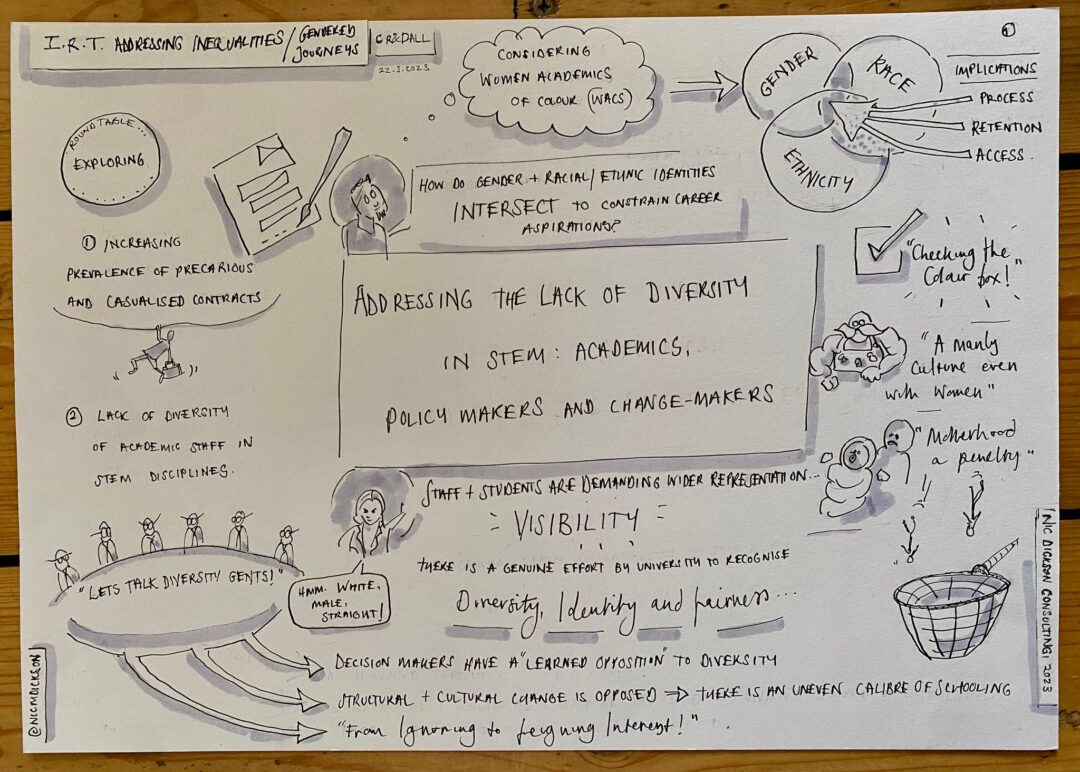
Featured image: Photo of a live sketch by Dr Nic Dickson, Visual Inquiry (2023)
Photo by Artem Podrez: https://www.pexels.com/photo/vials-with-liquids-in-holder-8533087/
Photo by nappy: https://www.pexels.com/photo/people-looking-at-laptop-3514805/
Photo by Gustavo Fring: https://www.pexels.com/photo/woman-wearing-a-white-lab-coat-looking-through-a-microscope-8770727/