Kayleigh Charlton, Jack McKinlay, Yvette Taylor
Introduction: Gathering in the Gaps
On a dark November evening, small groups of people trickled into The Boardwalk, a Glasgow based community space – some coming straight from work, others navigating city buses or walking with friends. As biscuits were passed around and mugs of tea found their way into hands, conversations began to weave together; stories of migration, memories of activism, questions about belonging, and reflections on what it means to live as LGBTQ+ in Scotland today.
‘Looking Back, Looking Forward: LGBTQ+ Equalities’, was part of the ESRC Festival of Social Science, co-organised by Kayleigh Charlton, Jack McKinlay and Yvette Taylor, and invited participants to collaboratively explore LGBTQ+ histories and futures. Through a co-created timeline and a futures wall, we aimed to collectively reflect on where we’ve been, where we are now, and where we might be going.
But as often happens in community spaces, the evening unfolded in unpredictable and meaningful ways, revealing as much about the complexities of ‘engagement’ as it did about the topic itself.
Setting the Scene: From Plans to Practice
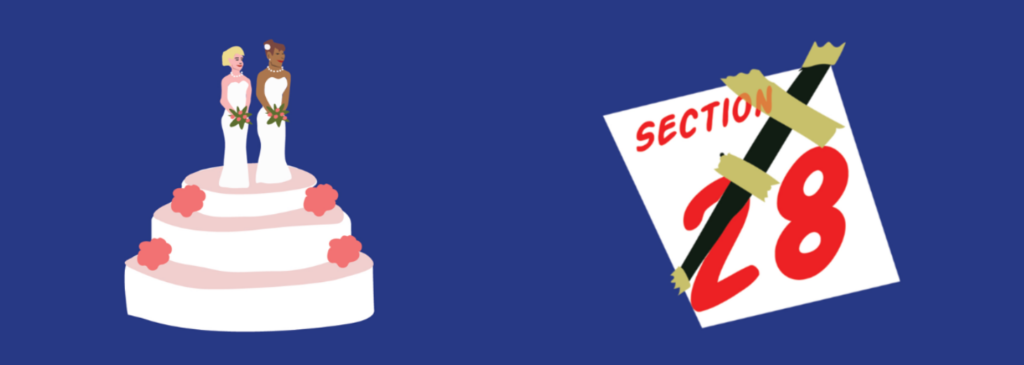
When planning this event, we envisioned a structured evening: introductions, a timeline activity, a Q&A, and a ‘futures’ wall exercise. We imagined a fruitful Q&A session, where our designated panel reflected on a number of pre-defined prompts. Following this, we imagined small, lively groups enthusiastically mapping key moments in LGBTQ+ history from the decriminalisation of homosexuality to marriage equality, from Section 28 to contemporary trans rights activism.
However, practice rarely follows plan. The event began not with a singular welcome, but with repeated ones, with people slowly finding their way in, arriving late, in waves, sometimes uncertain if they were in the right place. There were multiple ‘starts’, each time re-explaining the purpose, reshuffling chairs, and welcoming new arrivals. We reframed the event in our mind and in the room, shifting from a semi-circle with a defined panel Q&A, to something more open – recognising the expertise and lived experience in the room. This ‘disorganisation’ might look chaotic on paper, but it reflected something essential: the fluid, uneven, emergent realities of participation and engagement.
Many attendees were asylum seekers, who spoke about Scotland not as a place of history but as a place of arrival, as a new context of possibility (and challenge). A test for LGBTQ+ asylum seekers is having to ‘prove’ and document their sexuality to legitimatise their legal claims. Other attendees came from local LGBTQ+ groups or from the University of Strathclyde, bringing academic and activist perspectives together. The space became a meeting point between lived experience and research, between policy and personal story. This resulted in a richness that was beyond what we imagined.
Precarity and Proof: Asylum, Evidence, and the Uneasy Work of ‘Belonging’
It soon became clear that for some participants – particularly LGBTQ+ asylum seekers – the idea of ‘looking back’ carried very different and often painful resonances. While for many of us, LGBTQ+ history might evoke collective struggles for equality in the UK, for others it recalled histories of danger, persecution, and flight; ‘looking back’ becomes a loaded prompt in the context of ‘escape’. ‘Looking forward’ can feel painful in the context of unprocessed citizenship claims.
Conversations turned to the event itself. One participant made the bold point that despite our efforts to create an LGBTQ+ event on equalities and the room being full of diverse voices, the panel was predominately white. A few participants shared, with evident caution, that they were still in the process of seeking asylum in Scotland. For them, ‘LGBTQ+ equality’ was not a settled matter of legal progress but a precarious, daily negotiation with systems of scrutiny and disbelief. Several described the deeply invasive demand to provide evidence, witnesses, or even photographs to make their identities legible to the Home Office. In this context, ‘participating’ can feel like interrogations, where professionals ask to tell the LGBTQ+ story in a way that fits expectations.
These testimonies rightly changed the mood in the room. They disrupted any assumption that we were all starting from the same place of safety, or that LGBTQ+ equality was a shared baseline from which to build. Instead, it became painfully clear that the conditions of visibility – being seen, believed, accepted – were vastly different depending on one’s citizenship, race, and migration status.
For us, this was a moment of collective realisation. The event’s planned structure, with its familiar tools of participation and creative engagement suddenly felt inadequate. Our colourful timeline prompts (‘What was a turning point in LGBTQ+ history for you?’) did not necessarily translate meaningfully for those whose histories had been fractured by displacement, or for whom ‘turning points’ were marked not by legal milestones but by borders crossed and lives risked.
Translation and the Limits of Language
Translation, both literal and metaphorical, became a recurring theme. Some participants relied on peers to interpret, while others found themselves excluded by the speed and idiom of academic English. Certain words, like ‘queer’ or pluralised ‘equalities’ didn’t always carry equivalent or obvious meanings.
This linguistic dissonance made us more aware of how fragile accessibility can be. Despite our best intentions, the materials we had prepared – printed prompts, a shared roll of paper, pre-written event descriptions – reflected assumptions about who our participants would be: fluent English speakers, culturally familiar with UK LGBTQ+ reference points, comfortable expressing themselves publicly.
In practice, this wasn’t the whole story. Communication unfolded slowly, through gestures, pauses, and moments of collective patience. People pointed, nodded, smiled, and sometimes simply sat together in silence – and that, too, was participation.
At one point, a participant turned to us and asked gently, ‘Why are we talking about the past? I don’t have a past here’. The question is unsettling but necessary, reminding us that for many in the LGBTQ+ community the present itself is uncertain – suspended between hope and fear, visibility and vulnerability.
Co-Creating the Timeline: Whose Histories Count?
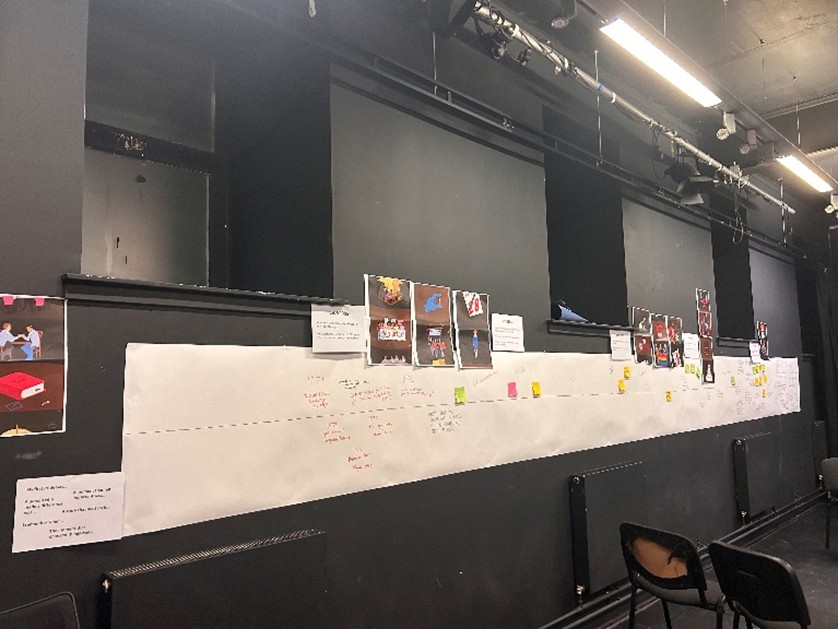
When we returned to the timeline exercise, it became less about mapping a single ‘shared history’, becoming more about acknowledging difference. The roll of paper filled with uneven fragments, some long, detailed, and dated, others brief or symbolic, resisting the neat structure of chronological order.
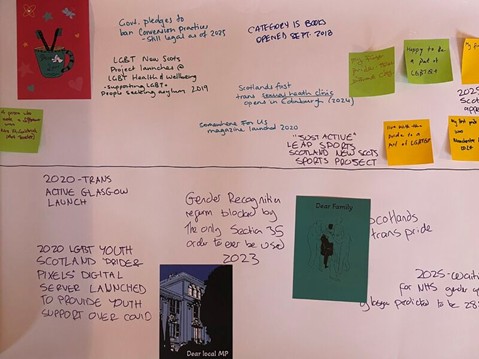
One participant wrote simply: ‘I arrived in 2022. I am still waiting’.
Another stated: ‘My life started again in Glasgow’.
Some of the timeline resembled markers of progress and visibility, including dates of people’s first Pride events, the opening of their favourite LGBTQ+ owned spaces, the rise of LGBTQ+ artists in mainstream pop, someone’s first time in drag and the date of gender-affirming surgery. The timeline, rather than functioning as a tool of collective memory, became a space to surface uneven geographies of belonging. It exposed how the language of ‘progress’, so often used in LGBTQ+ discourse, can obscure ongoing exclusions. For those whose safety depends on bureaucratic recognition of their sexuality, equality is not a destination reached but a status continuously under review.
A Conversation, Not a Lecture
After the timeline exercise, we reflected on some of what made its way onto the timeline, discussions about participants’ first Pride events, or gender-affirming surgeries followed our prompts. We reflected on near and shared events, such as the opening of a queer bookshop in Glasgow, and we reflected on individual and collective journeys across place.
Kayleigh Charlton reflected on her research on gender, sexuality, and justice, and how studying (in)justice means paying attention to everyday inequalities not just those enshrined in law.
Jack McKinlay shared insights from his work on disabled-queer student experiences in Scottish higher education, reflecting on question on who and what a student is assumed to be, and how these assumptions shape everyday experiences.
Yvette Taylor spoke about long-standing work on social inequalities and the politics of place, drawing on Working-Class Queers: Time, Place and Politics (Pluto, 2023): for some, progress may arrive conditionally, it may arrive late, or it may not arrive at all.
Taken together, these inputs did not offer a single interpretation of the timeline bur rather multiple and overlapping ways to read it. The conversation that followed was initially quieter than expected. There was a hesitancy in the room and a palpable sense that people were measuring how, and whether, to speak. For those navigating asylum systems, NHS waiting lists or insecure housing, public participation can carry risk. Speaking openly about sexuality, even in a ‘safe’ space, still has consequences.
As organisers, we learned to sit with that hesitancy, to resist the urge to fill the silences, and also to facilitate, navigate and tell our own stories. Sometimes, the most ethical thing we can do in participatory work is to allow uncertainty and to recognise that not speaking can also be a form of agency. But there is tension between respecting silence and accepting the circumstances in which participation is unsafe for some in the first place. While silence might protect or shield some participants from exposure, surveillance or harm, it might also protect us as organisers from confronting the structural limits of our attempts to create a ‘safe space’. Holding this tension asks us to think beyond the room to the conditions that shape who can speak and at what cost.
When the Public is Plural
One of the event’s unexpected lessons was about who counts as ‘the public’. The language of ‘public engagement’ or ‘knowledge exchange’ can suggest a tidy relationship between universities and communities. But in practice, our publics are plural, shifting, uneven, and often unpredictable.
Some attendees came because they saw themselves reflected in the event’s description. Others wandered in, drawn by curiosity or connection, necessity or need. The atmosphere changed as new people arrived: conversations paused and restarted, and the rhythm of the evening was continually re-negotiated.
This multiplicity challenged our assumptions as organisers. We realised again that engagement isn’t something we do ‘to’ or ‘for’ communities, rather it’s something we do with and among them. And that means letting go of control, embracing uncertainty, and being open to what emerges in the room. In doing so, we embraced conversations that we otherwise may not have had.
The Futures Wall: Hopes, Commitments, and Dreams
Toward the end of the evening, we invited participants to turn from past to future and to contribute to a ‘Futures Wall’ filled with hopes, dreams, and commitments for the next chapter of LGBTQ+ equalities in Scotland and beyond. One at a time, we went around the room and shared our hopes and dreams for the future, Yvette adding the responses to the wall as we shared.
Some messages were deeply personal, for example:
- To feel safe in my body
- To feel safe in public spaces
Others spoke to broader systemic hopes:
- Trans healthcare without waiting years
- Better representation in rural Scotland.
- Solidarity between asylum seekers and local queer communities
Nods of agreement, sounds of recognition and solidarity echoed the room as people shared. Together, these notes formed a mosaic of aspiration, or a collective imagining of what equality could mean when understood as a living, ongoing practice rather than a destination. The wall became a visual reminder that while we ‘look back’, we must also ‘look forward’ with a sense of shared responsibility and care.
Messiness as Method
If the evening felt disorganised at times – with multiple starts, repeated explanations, and shifting participation – it also felt ‘alive’. The messiness was part of the method. In the spirit of the Festival of Social Science, we weren’t there to present findings or promote a finished project. We were there to co-create knowledge in real time. The result is therefore not easy or simple to capture; it was in the shared moments and questions the evening generated.
Academic events often value order, clarity, and outcomes. Co-production itself, is, at times, described too neatly. It is clear from our reflections that not everyone participates equally. Further, our attempt to squash power hierarchies in the room does not magically eradicate power per se, it merely attempts to redistribute it and make us pay attention to it. Community engagement thrives on openness, improvisation, and care. It requires sensitivity to who is in the room – and who isn’t. It demands we notice the power dynamics of space: who speaks, who listens, who feels able to contribute. These temporary fragile spaces can practice listening as a form of equality work.
Reflections: Looking Back, Looking Forward
As we packed up the paper, pens, and half-empty cups of tea, the room felt quietly full not just of words, but of connections made, perspectives shared, and futures imagined.
The act of coming together, even briefly, reaffirmed the value of collective reflection in a time when LGBTQ+ rights globally face renewed threats. For those of us working within universities, it also calls for humility. Public engagement isn’t about broadcasting expertise – it’s about redistributing it, recognising that knowledge circulates in multiple forms: in lived experience, in conversation, in resistance, and in care.
Acknowledgements
Our thanks go to everyone who joined us, from students and researchers to community members, asylum seekers, and activists. Special thanks to the University of Strathclyde, LGBT Health and Wellbeing, and the ESRC Festival of Social Science for supporting this event. And to all who contributed to our timeline and futures wall: your words continue to inspire what comes next.