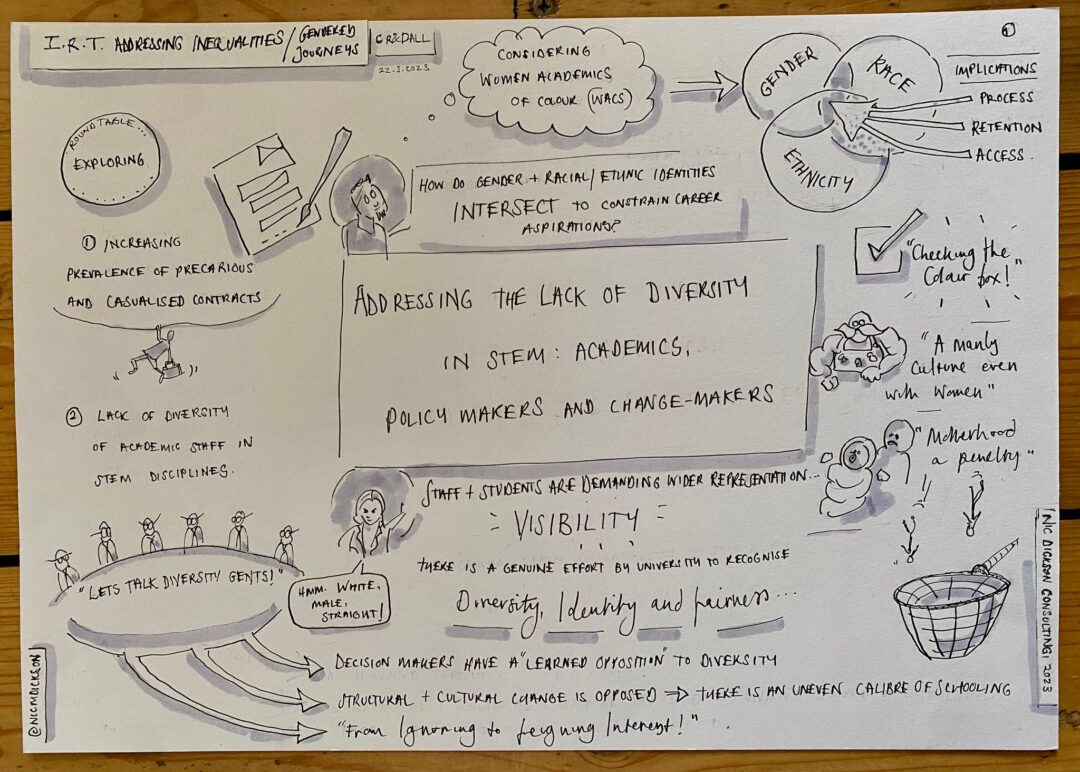
The image shows a sketch 'addressing the lack of diversity in STEM: Academics, policy makers and change makers' which was created by a colleague, Dr Nic Dickson, to visually capture discussions from a STEM roundtable

Are We Moving the Needle? Women Academics of Colour and the Politics of Representation in STEM 

Dr Abimbola Abodunrin, Post-doc Researcher in Education. University of Glasgow.

Walk into many STEM faculties across the UK, and you might notice something right away: the posters/decor speak of diversity, the strategies promise inclusion, and the websites proudly showcase progress or perhaps more accurately, incremental progress. Yet, look a little closer at who is leading labs, shaping research agendas, and influencing decision-making, and a different story often emerges. As a male academic of colour researching within STEM education spaces, I often find myself asking a simple but ‘uncomfortable’ question: Are we really moving the needle? And perhaps more importantly, who is still being left behind? The experiences of women academics of colour continue to reveal a persistent gap between representational gains and promising agendas to pursue equ(al)ity. Their stories speak not just about numbers, but about belonging, voice, and power. They also echo wider concerns raised in Danny Clegg’s WonkHE blog, where he suggests that universities are often better at documenting inequalities than preventing or addressing them. These reflections challenge all of us, including men and men of colour such as myself, to think more introspectively about what it means to actively contribute to decolonising STEM and academia more broadly. 

Vibrant test tubes filled with liquids in a modern lab setting, showcasing scientific exploration.

For many institutions, progress is measured through the politics of enumeration, even when agendas are well-intentioned: how many women are recruited, how many minoritised academics are appointed, how many diversity initiatives are launched. These numbers matter, of course. But numbers alone do not tell the whole story. Being the only one in the room or, worse still, being present to ‘authenticate’ spaces and projects without necessarily shaping them remains a familiar trope of experience for many women academics of colour. Alongside this is the invisible and often unremunerated labour of mentoring students seeking role models, sitting on diversity committees, and balancing expectations both at home and in the workplace that weighs on her body and career. Do I also speak of the tensions of performing particular forms of scientific legitimacy – marked by her ability to speak science, do science, and embody science in ways that mirror dominant cultural practices?  

A Black woman scientist in a lab coat using a microscope in a modern laboratory setting

I have witnessed, and through my research, had the privilege to listen to, brilliant women academics of colour whose ideas (re)shape conversations, yet whose contributions are sometimes framed as “niche” rather than central to STEM innovation. These experiences speak to representational politics, signalling symbolic inclusion and progress without disrupting the epistemic centre. As  Kalwant Bhopal’s article discusses, even equ(al)ity and diversity staff within universities often find themselves constrained; able to “talk the talk” but not always permitted to “walk the walk” when it comes to implementing equitable changes. Representation, in this sense, becomes visible but precarious; present, yet positioned at the margins of institutional power, even when occupying a leadership position. 

As a male academic of colour, I am also conscious of the spaces I occupy and the privileges I may hold, even within marginalised identities. Decolonising STEM is not simply about increasing diversity; it is more about questioning whose knowledge counts, whose voices are heard, and whose experiences shape institutional change. This means listening more carefully to women academics of colour, amplifying their contributions, and reflecting on how we, as colleagues, mentors, and collaborators, can challenge systems that continue to (re)produce inequ(al)ities. It also means recognising that decolonisation is neither a metaphor, as Tuck and Yang, put it, nor a destination but an ongoing practice. Sometimes this work involves small but subversive everyday actions: citing their work, recommending them for leadership roles, or challenging assumptions about their credibility and expertise in meetings. These may seem like small steps, but they contribute to shifting cultures and redistributing voice and influence. 
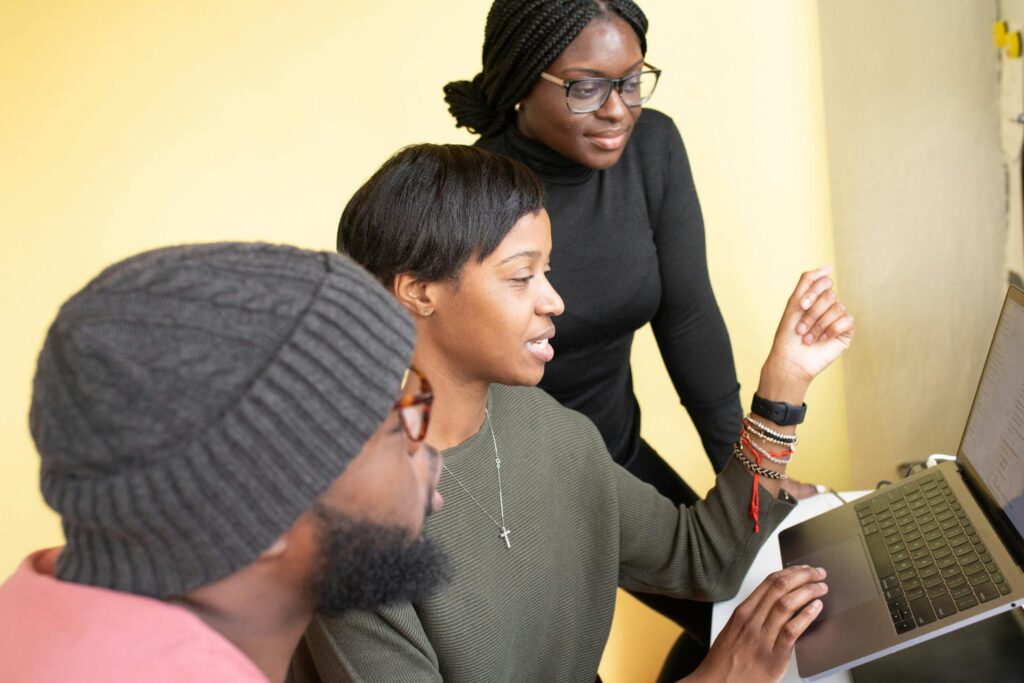
Three colleagues working together on a project, focusing on a laptop screen.

Encouragingly, there are growing conversations and initiatives seeking to address these issues. From mentorship networks and collaborative research communities to institutional commitments around equity and inclusion, there are signs of movement in the right direction. Yet, the question remains: are these efforts reshaping structures, or simply reshaping appearances? The stories of women academics of colour offer a powerful reminder that equitable and lasting changes require more than good intentions. It requires sustained commitment, uncomfortable conversations, and shared responsibility. As we continue to trouble the question of whether we are moving the needle, perhaps the most important step is to keep listening, keep reflecting, and keep working together toward a STEM academy where representation is not only visible but fundamentally equitable. 

Dr Abimbola Abodunrin 
Post-doc Researcher in Education 
University of Glasgow 
a.abodunrin.1@research.gla.ac.uk 

https://www.linkedin.com/in/abimbola-abodunrin

Images:
Featured image: Photo of a live sketch by Dr Nic Dickson, Visual  Inquiry (2023)
Photo by Artem Podrez: https://www.pexels.com/photo/vials-with-liquids-in-holder-8533087/
Photo by nappy: https://www.pexels.com/photo/people-looking-at-laptop-3514805/
Photo by Gustavo Fring: https://www.pexels.com/photo/woman-wearing-a-white-lab-coat-looking-through-a-microscope-8770727/

Three hands hold the letters EDI

When Inclusion Excludes: The Paradox of EDI in UK Higher Education  

by Chong Liu and Qiaohui Xue  

Equity, diversity, and inclusion (EDI) have become central terms in UK higher education. Universities release strategies, policies, and glossy brochures that proudly proclaim their commitment to fairness and belonging. On the surface, it looks progressive. Yet research and lived experience suggest something more complex: EDI discourse itself can sometimes reinforce exclusion rather than dismantle it. This blog is co-authored by Chong and Qiaohui. Both of us engage with UK higher education as international researchers. Chong currently serves as the EDI Lead of the Gender and Education Association, while Qiaohui is a Student Representative. Although our roles and perspectives differ, our stories intersect in showing the paradox of EDI, especially as it is experienced from international positions.  

Chong’s Story:  

One issue lies in the dominance of white-centric perspectives. Curricula shaped by Eurocentric traditions often leave out diverse knowledge systems, marginalising Black, Asian, and Minority Ethnic (BAME) students and staff. The acronym “BAME” itself, once introduced to signal inclusivity, has been criticised for producing alienation rather than belonging. Many people describe feeling reduced to a label that institutions choose, rather than a language of identity they claim for themselves.  

For me, the tension runs even deeper. The term BAME does not exist in my mother tongue. I encountered it only after coming to the UK, learning it as part of the institutional language of equity and inclusion. In that sense, I was learning a foreign word that seemed to describe me, yet I was not fully entitled to use it. The distance was not only linguistic but also emotional – I was learning how to name myself in someone else’s language, within someone else’s framework.  

I remember this tension vividly from a personal experience. While preparing an application for the Higher Education Academy, I described myself as a “BAME student” – a “fancy” word for me at the time, learnt from a university’s Inclusive Teaching course and thought I was using the right language. When a white academic staff member read my draft, she looked at me in surprise and asked, “Are you BAME?” At that moment, I said yes, but later I realised why it felt unsettling. The term seemed available for her to apply to me, but not for me to claim for myself. What stayed with me was a strong sense of being othered. A word that was supposed to include me instead created distance.  

Representation often works in similarly ambivalent ways. At one disciplinary conference, my photo appeared in a publication page alongside a middle-aged Black woman and an older white woman. The arrangement looked perfectly composed to illustrate “diversity”. Yet I could not shake the feeling that I was being positioned less for my scholarship than for my identity. We were placed together to signify inclusion, but the effect was structural, almost performative. I was visible, yet not fully recognised.  

For women of colour in particular, such dynamics are deeply familiar. In white-dominated spaces, identities are often simplified or essentialised. Even in institutions with formal EDI policies, structural practices remain that separate “marked” from “unmarked” identities. Members of dominant groups may unconsciously reinforce their own belonging, keeping boundaries intact despite intentions to erode them.  

At the same time, I hope my current role will allow me to approach EDI from a more transformative angle. As the EDI Lead at the Gender and Education Association, I want to move beyond symbolic gestures and foster genuine participation. My aspiration is to create spaces where international students and scholars can define inclusion on their own terms — where they can exercise agency, build solidarity, and reimagine what belonging means. While I am still learning how to do this in practice, I see this as a process of collective exploration, one that challenges the limits of existing EDI discourse and opens up possibilities for change.  

Moving beyond critique means asking what genuine inclusion could look like. Real inclusion is not about filling quotas, showcasing diverse faces on a webpage, or categorising people into acronyms. It is about listening to lived experiences and recognising individuals in their full complexity. It is about rethinking curricula so that knowledge is not narrowly defined by Eurocentric traditions but enriched by multiple voices. It is about shifting power, ensuring that those who have historically been silenced are not only present but also shaping the agenda.  

Qiaohui’s Story:  

The other issue is that international students often seem absent from EDI discourse. At first, I was not even sure whether EDI was meant to include students like me. In my first year in the UK, I noticed posters about EDI in university buildings. Curious, I searched for definitions and began to read related academic work. One article, ‘Feeling excluded: International students’ experience of equity, diversity and inclusion’ (Tavares, 2021), resonated strongly with me, which highlights this paradox: although universities often emphasise their commitment to EDI, international students are rarely treated as an equity-seeking group. As a PhD researcher focusing on gender and international student mobility, I was particularly sensitive to such ideas, and I started to wonder whether they could inform my own research.  

But when I raised these questions in conversations with other staff members, the responses I received were often ambiguous. Some people told me directly that EDI was not designed with international students in mind. Yet at the same time, many international students come from minority ethnic backgrounds, making it impossible to separate their experiences from the very concerns that EDI claims to address. This ambiguity pushed me to think more critically about whether international students are actually included.  

My interviews with other international students confirmed this uncertainty. Several had never heard of EDI. Others said they knew the term but felt it had little to do with them. The most visible sign of EDI, for many, was the rainbow flags displayed across campus. For some Chinese students, these flags felt novel, since in the Chinese cultural context, gender and sexuality are not always framed as diverse. The flags created a sense of curiosity, but also confusion. Students wondered what connection these symbols had with their own everyday lives.  

On the one hand, some international students see the posters of EDI in their University. On the other hand, many still encounter exclusion in daily practice, whether through racial microaggressions or moments when their voices are ignored. The gap between EDI discourse and lived experience can leave students feeling positioned outside the very spaces that claim to include them.  

These reflections also shape my current role as a Student Representative of the Gender and Education Association (GEA). For me, the goal is not simply to promote EDI as an abstract principle, but to make it real in practice. I want international students to feel not only that they are present in these conversations, but that they belong. This means creating space for their perspectives, supporting them to participate on their own terms, and ensuring they are recognised not just as symbols of diversity but as contributors to academic and social life. Only in this way can EDI move beyond words on posters and become something lived and transformative.  

Conclusion:  

Our different perspectives point to the same paradox: EDI can both include and exclude. Chong’s experiences show how label representation can create distance instead of belonging, while Qiaohui’s reflections reveal how international students often see EDI only as symbols, not as something that speaks to their daily struggles. Together, we argue that if EDI is to be transformative, it needs to move beyond posters and acronyms. Real inclusion means recognising international students as part of the conversation, shifting power, and creating spaces where people are valued for who they are and what they contribute. As universities renew their EDI strategies each year, perhaps the most radical act is not to add more words, but to listen more deeply.  

Reference:  

Tavares, V. (2021). Feeling excluded: international students experience equity, diversity and inclusion. International Journal of Inclusive Education, 28(8), 1551–1568. https://doi.org/10.1080/13603116.2021.2008536 

Image sourced from: https://phecanada.ca/professional-learning/equity-diversity-and-inclusion/understanding-edi-and-edi-intersectionality