A digital event reflection on Two-Spirit Reconciliation with the National Centre for Truth & Reconciliation
Brent Saccucci, Faculty of Education, University of Lethbridge
This Indigenous-led event was a Two-Spirit Reconciliation dialogue held in June 2020, which is Indigenous People’s History month and Pride month. The dialogue was facilitated by Candy Palmater, an oratist and writer from Eel River Bar Mi’kmaw Nation in collaboration with the National Centre for Truth and Reconciliation at the University of Manitoba. Palmater facilitated the conversation with two Two-Spirit leaders: Intergenerational Survivor and Knowledge Keeper Dr. Albert McLeod from Nisichawayasihk Cree Nation and the Metis community of Norway House in northern Manitoba, and Intergenerational Survivor Harlen Pruden who is First Nations Cree Nation/nēhiyo, whose mother is from the Beaver Lake Reservation and father from the Whitefish Lake Reservation, both located in Treaty 6 Territory (now known as northeastern “Alberta”). In Canada, June is not only Pride Month, it is Indigenous Peoples’ Month – and for me, that isn’t coincidence: Queer and trans liberation must be tethered to decolonization and Two-Spirit sovereignty. In fact, colonization brought homo/transphobia as a white Christian nationalist project that we still see pervading our schools today.
Admittedly, a lot of ground was covered in this discussion, so this reflection will focus on the panel’s themes between Indigenous Peoples and religion/spirituality in the context of Two-Spirit reconciliation. Below, I reflect on this relationship in two sections that overlap: “truth” and “reconciliation”. Truth outlines how residential schools operated a Christian imperial project enforcing Euro-Christian gender and sexual norms. This religious colonialism continues today where Two-Spirit Peoples continue to resist systemic erasure and ongoing homophobia/transphobia, notably in education and church institutions. Like Mcleod, I believe the church has not been held accountable for its role in perpetuating these harms, especially in curriculum when teaching Canada’s history (31:58).

Then, the reconciliation section will focus on how supporting Two-Spirit sovereignty and solidarity means anti-homophobia/transphobia education must adopt a decolonial approach. The section ends with the understanding Two-Spirit identity not only as “Indigenous + Queer” but as a spiritual re-orientation challenging colonial Christian binaries, fostering healing and relationality. As a settler myself, the aim of this reflection is to take seriously Pruden’s call to action: “For non-Native people, their charge is to learn our real history [truth], and then reconcile that history with today so they do not become today’s colonizer [reconciliation]” (21:57).
Residential schools were operated as a Christian-colonial projects (Truth)
The first point of critical analysis is the history (truth): The role of the church was fundamental in bringing not only colonial, but Euro–Christian norms of gender and sexuality as central teachings into the residential schools. Like many Queer and Trans folks, I was aware that gendered and sexual norms were part of colonial/British culture which influenced how the residential schools forcibly taught colonial gender and sexuality norms. But because Christian nationalism is often baked into culture as normalcy, I didn’t see the underlying (and yet central) Christianity within this colonial project. When host Palmater stated that “the very mention of sexuality, thanks to colonization, is seen as something dirty” (43:04, emphasis added), it became clear there was a religious element in this dialogue around truth. As a queer kid who grew up Catholic, the word “dirty” admittedly triggered me in a small way – it reminded me of the language a pastor used to describe gay people once in Catholic mass. This language of “dirty” comes from Christian purity culture and the idea of gender betrayal and homosexuality as a sin. After re-watching the video a second time, the messafe was becoming clearer that I had always known (and yet not explicitly named) – colonization was, and continues to be, an explicitly Christian project. Mcleod directly names that the colonizers used religiosity to justify the vilification and subjugation of Two-Spirit Peoples, explaining “we were not seen as spiritual people, we were seen as corrupt, we were seen as a work of the devil” (13:58, emphasis added). I wondered: Because Alberta has normalized white Christian nationalism – both historically and contemporarily – could I have normalized colonialism as secular, instead of an (obviously) Christian imperial project? With this lens, I rewatched the event a second time, now more attuned to Mcleod’s suggestion at the onset of the panel where he explicitly names the aim of “early contact” as directly aimed at “imposing a Euro-Christian ideal about binary gender” (10:05). And don’t we now see that imperial project still alive today in white Christian nationalism – not only in the US – but in Alberta as we face the prospect of separation from Canada?
Teaching truth must fracture the white Christian nationalist colonial project (Truth)
This truth matters to me as a teacher-educator in Alberta committed to decolonization, preparing our province’s future teachers in curricula such as our new Social Studies curriculum that states Alberta students must know the history of residential schools and their effects on Indigenous Peoples (Alberta Education, 2025). However, it’s important to note that in the new curriculum, the role of the church is barely mentioned once in describing the residential schools, and Two-Spirit Peoples are not mentioned once, keeping the white Christian nationalist image intact, void of any real responsibility for homo/transphobia or empire, while attempting to erase Two-Spirit sovereignty. We see similar erasure in the Truth and Reconciliation Commission (TRC) – another document that our new Social Studies curriculum is supposed to cover – but a document that does not name Two-Spirit Peoples at all. Speaking to this absence, Mcleod states offence the TRC didn’t acknowledge the residential schools as “a gendered structure and mechanism that still influences our communities today” (30:56). This ‘contemporary influence today’ is the modern white Christian nationalist church still at work attempting Two-Spirit erasure in our curriculum. Whether in curricula or in public discourse, Mcleod notes the church has absolved itself of responsibility, naming “we still haven’t even had these conversations about the inculcation of homophobia and transphobia against Indigenous and Two-Spirit Peoples for generations – they [the church] haven’t been held to account” (31:58). While this dialogue was in 2020, and the Pope ‘formally apologized’ to Indigenous Peoples in 2022, I would still argue the church has not been held to account when churches are only mentioned once, and Two-Spirit Peoples mentioned zero, in all of the Grade 7-9 curriculum that covers “Canadian history and human rights” (Alberta Education, 2025).
Any anti-homo/transphobia education must be decolonial education (Reconciliation)
Mcleod states urgently “we must have this dialogue with churches” noting that homo/transphobia brought by the church to Indigenous communities is still felt as ongoing colonization “through suicidality, poverty, and homelessness” (32:32). Palmeter adds that as an queer Indigenous youth raised Catholic, when she came out it was the church’s homo/transphobia that removed her from her kinship structure, further isolating her from her culture: “As a person who was raised Catholic, that was a really difficult time for me – that they saw me as a sinner, causing me to leave a religion I was raised in with all my family and extended relatives” (33:18).
Through telling the truth of the church in residential schools, we see that white Christian nationalism is the common denominator in our oppression both as 2SQT+ and Indigenous Peoples. This makes it clear that any pedagogical effort I make in resisting 2SQT+ erasure in curriculum must take a decolonial approach and be in solidarity with Two-Spirit and Indigenous Peoples.
Two-Spirit sovereignty is not only a reclamation of cultural and sexual orientation, but of spiritual re-orientation to relationality (Reconciliation)
It became clear throughout the dialogue that while some speakers also conceptualized Two-Spirit as noun ‘Indigenous + Queer/Trans’ (particularly Pruden), Two-Spirit was also understood a spiritual as a verb – one that undertakes an epistemic and ontological re-orienting outside the Cartesian mind/body dualism that pervades Christian colonial logics. Mcleod maintains that “the early colonizers saw and understood the power [of spirit] but because they were Christian, they couldn’t convert to that belief system – even though they understood its power – they would have rather destroyed it than collaborate and honour it” (1:12:32). Here, Two-Spirit sovereignty takes on a new understanding beyond just sexual liberation, but as Pruden says, “as a decolonizing and freeing of our minds, our soul, and our spirit” (52:57). This re-orientation reminded me of what Palmater rejoiced earlier in the dialogue, stating that “I love that Two-Spirit has the word spirit in it. Because so many of us LGBTQ+ people had to leave religion in order to be who we are … they can’t exist in both of those worlds” (15:04). In this way, Two-Spirit actually queers the dualistic binary of being either ‘religious/spiritual or queer’ — and instead demonstrates a new constellation of being that isn’t only an identity marker, but also an epistemic and ontological reorientation in the world that transcend Christian colonial logics and reignite spiritual ways of relating.
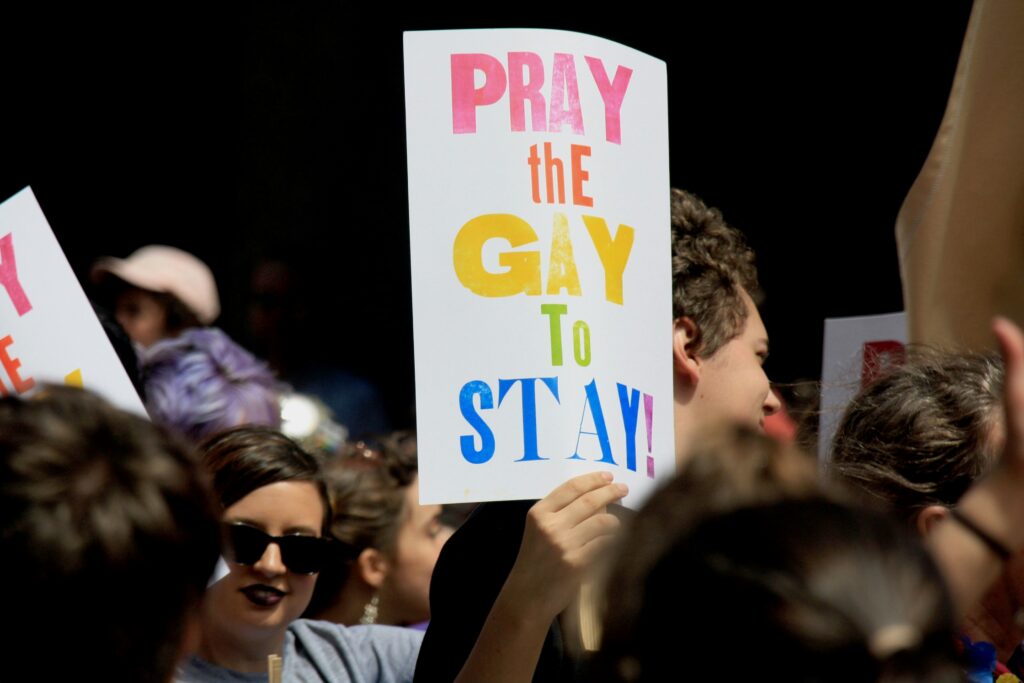
This relational way of being became clear at the end of the dialogue, where during the live Q&A a Trans Mohawk Inuk listener voiced that people in their community continue to be discriminating against them and they are lost at what to do next. Mcleod listens with deep care and replies by offering that every being is a “divine gift from Creator” and to “let spirit guide you” (1:12:10), even though that may feel hard to do. Pruden adds “I have to pray for them – because if I respond with hatred, I am no better than they are, and then colonization has won – because it has changed who I am ” (1:18:24). As a person who has confidently knocked faith down as purely harmful, I left this not only in deep reverence to the wisdom of the panelists, but also with more hope and faith than I’ve had in a long time.
References
Alberta Education. (2025). Social Studies curriculum (Grades 7–9). https://curriculum.learnalberta.ca/curriculum/en/c/sss7?s=SSS_7-9
National Centre for Truth and Reconciliation. (2020, June 23). NCTR Dialogues – Two-Spirit Reconciliation [Video]. YouTube. https://www.youtube.com/watch?v=plZZahy-37k
Images
image by Zachary Harden, 13 September 2023 New Progress Pride flag used in June 2022 by Cambrian College in Sudbury, ON: https://cambriancollege.ca/news/2022/06/cambrian-college-opens-new-pride-centre-unveils-new-pride-flag/
Photo by Ruan Richard Rodrigues on Unsplash
Photo by Nk Ni on Unsplash
Photo by Kristel Hayes on Unsplash